Tea for the First Guest
"you know I didn't think when I accidentally entered a 2000 year old wizards tower I would get fresh tea." Said the young man "well you don't exactly live to be 2000 by trying to kill the first guest you have in centuries and I'm also starving for conversation." Said the wizard pouring his own.
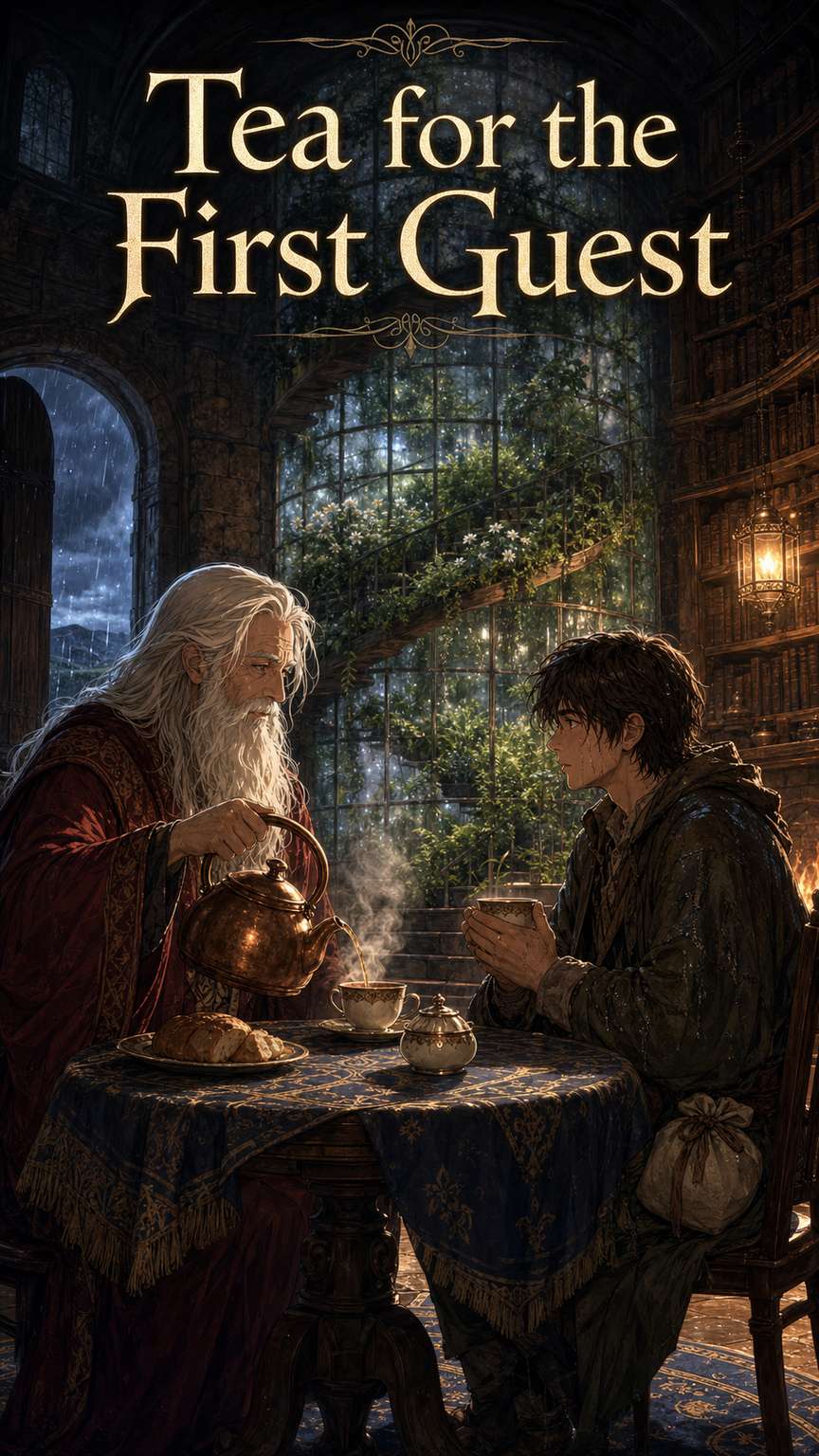
The rain found the gap between the young man’s collar and neck, ran down his spine, and made the ruined arch look like shelter.
It stood by itself beside the road, two uprights and a cracked lintel left after the wall had gone. There was scarcely room beneath it for his shoulders and pack. Still, the rain had thickened until the road was a brown stream, and the lodging house was three miles ahead if the old woman’s directions had been right. He needed a dry place to check those directions, wring out his map, and decide whether the darkening sky meant evening or merely more weather.
He ducked under the lintel.
His second step should have struck nettles on the other side. Instead his boot came down on blue tile.
The young man stopped with one foot forward. Rain beat on stone behind him. Ahead, a round room climbed farther than he could follow, ringed by narrow galleries and yellow lamps. A fire burned under a copper kettle. The air smelled of wet wool, hot dust, and something green bruised between fingers.
He turned.
There was no roadside. Behind him stood a paneled door without a handle.
He put both palms to it. The dark wood was warm. He pushed, pulled, felt along the seam, then found himself listening for bolts on the other side as if the road might have locked him in.
“If you strike it,” said a voice above him, “the panel will complain for the rest of the week. It has always preferred melodrama to damage.”
The young man backed away so quickly that his pack knocked a brass stand over. He caught it before it hit the floor, which seemed important. Across the room, a man was descending a curving stair with a pair of shears in one hand.
At first glance he looked perhaps sixty: lean, erect, his brown face scored around the eyes and mouth. At second glance there was no age that fit. His white hair hung in a braid nearly to his waist, but his hands on the rail were steady and stained green at the fingertips. His robe had been patched at one elbow with cloth that did not quite match. The shears were small, bright, and sharp.
“Sorry,” the young man said. “I was getting out of the rain.”
“An ambition I can support.”
The man reached the bottom step and stopped well beyond arm’s length. That could have been courtesy. It could also have been the preferred range for turning trespassers into smoke.
“Was that arch yours?” the young man asked.
“The arch is an arch. This is mine.” The man considered the shears, then placed them on the stair. “You did not arrive by intention?”
“I don’t make a habit of walking into rooms that can’t possibly fit where they are.”
“No. Of course not.” His attention sharpened, almost painfully. “What year is it?”
The young man told him.
The man repeated the number under his breath. Then he closed his eyes and made three tiny movements with his fingers, as though calculating on an invisible slate.
“That’s unwelcome,” he said.
The young man looked again at the handleless door. “For both of us?”
The man’s eyes opened. “I meant the arithmetic. You are not unwelcome. I have failed at the distinction already.”
Before the young man could decide what to do with that, the man lifted the fallen brass stand and set it upright. He did not use magic. He had to crouch, and one knee cracked.
“You are wet,” he said. “There is a screen by the fire, and a drying rail behind it. Leave your boots on if you prefer. I believe taking them from a guest before establishing the way out was once considered threatening. Or unlucky. I may be combining customs.”
“The way out would be useful.”
“Yes. Tea first.”
The answer came so promptly that the young man’s mouth went dry.
The man had already turned toward a doorway curtained with strings of wooden beads. “Not instead of the way out. The kettle is at the correct temperature now. The door requires attention, and I would rather not ruin both.”
He pushed through the beads. The young man counted four other doors, two stairways, and a narrow passage behind the fire screen. None showed rain. The small window above the kettle showed a sky the clear blue of noon.
Running would only mean choosing an unknown corridor. Breaking the panel had been discouraged, not proved impossible, but he had no axe. He had a penknife, two shirts, a packet of bread, and a damp letter of introduction to a man who rented beds by the week.
The beads clicked again.
The man returned carrying a shallow basket of leaves. Not dried curls from a merchant’s tin: fresh green shoots, water-bright and soft, some still joined at the stem.
“Where did those come from?” the young man asked.
“Upstairs.”
The man seemed to hear the inadequacy of this. “There is a garden under glass. I cut these after you came through.”
“You have a tea garden inside your tower.”
“Three shrubs. Garden may be boasting.”
He tipped the leaves onto a cloth, selected some, and rolled them between his palms. The simple work made his stained fingers understandable. He warmed a clay pot with water from the kettle, poured it into a basin, added the leaves, and covered them. No powder flared. No spoon stirred itself. The young man watched every movement.
“How old is this place?” he asked.
“The foundation is two thousand and twelve years old by the count you gave me. I am seven months older. There is an uncertainty of four years. Perhaps five, if the winter coronations were counted twice.”
The young man laughed once. It came out higher than he intended. “I step into a two-thousand-year-old wizard’s tower, and the first thing I’m offered is tea picked this afternoon.”
“This afternoon according to that window.” The man glanced at the impossible blue square. “Your road appears to disagree. The leaves are fresh either way.”
He set two cups on the low table near the fire. One was white porcelain thin enough to show the shadow of his thumb. The other was thick brown clay with a chip in its rim. He looked from them to the young man and exchanged their positions twice.
“Which cup is less alarming?”
“The chipped one.”
“Why?”
“It looks as if someone has survived drinking from it.”
The man’s face changed. Not amusement exactly; the remembrance of it. He placed the brown cup on the visitor’s side.
“Sit where you like,” he said.
The young man sat where he could see the handleless door and the shears. The wizard poured. Pale liquor slipped from the pot, carrying a warm smell like grass after sun. The young man wrapped both hands around his cup but did not drink.
The wizard took the chair opposite. He touched his own cup to his lower lip, swallowed, and set it down.
“No poison,” he said.
“Would poison affect you?”
“Several kinds.”
“That’s not very comforting.”
“No.” The wizard folded his hands. “I no longer remember how much comfort is expected before the first sip.”
The young man tasted the tea. It was sweet without sugar, then bitter at the back of his tongue, a bitterness clean enough to make him thirsty for the next mouthful. He had drunk leaves boiled black at coaching inns and sweepings disguised with cloves. This was another thing entirely.
The wizard watched him with an intensity that made the cup heavy.
“It’s good,” the young man said.
“In what respect?”
“It tastes green.”
“Grass tastes green.”
“Then it tastes green in a way I’d pay for.”
The wizard nodded, accepting this as usable evidence. “Do people pay for tea now?”
“Constantly.”
“Is the eastern empire still collecting the leaf duty?”
“I don’t know which empire you mean.”
“The one beyond the salt range.”
“I don’t know that range either.”
“What do you call it?”
“I might not call it anything. I mend account books. I don’t map mountains.”
The wizard leaned forward. “Account books have survived? Are they bound by signatures, seals, blood, witnesses, divine guarantors, or the merchant’s right hand? What coin is stable? Which river carries the grain fleets? Did the red fever return? Who governs the western islands? Is horse-post still limited to six hundred relays?”
The questions came without room for answers. The young man drank while they passed over him. When the wizard finally stopped, he looked startled by the silence he had made.
“The books are bound with thread,” the young man said. “Usually.”
“Thread.”
“And glue.”
The wizard waited.
“You asked about books.”
“I asked rather more than that.”
“Yes.”
The wizard sat back. His white cup remained between his hands. “How long has it been since the western islands mattered to anyone?”
“I couldn’t tell you if they matter now.”
“Then what does?”
It was not an ordinary question. It felt like a well with no visible bottom. The young man smiled because smiling had got him through examinations, quarrels with landlords, and one regrettable dinner with his elder sister’s future husband.
“Dry socks,” he said. “Affordable rooms. A road that doesn’t dissolve when it rains.”
“You make light of me.”
“Only a little.”
“Why?”
The young man looked at the narrow blue window, then at the unbroken curve of wall. “Because you say this tower is two thousand years old. Because I can’t see the road. Because you want me to answer for the condition of the entire world while holding those shears.”
The wizard glanced toward the stair. “They are for pruning.”
“I know that now.”
“I set them down.”
“I saw.”
“Yet they remain part of the difficulty.”
“A small part.”
The wizard’s gaze traveled around the room as if all its familiar objects had become evidence against him. He rose.
The young man rose too.
“I meant to replenish the pot,” the wizard said.
“Right. Please do.”
They stood on opposite sides of the table. The wizard lowered himself slowly back into his chair. The young man did the same. Water from his hair chose that moment to run into his ear.
“Am I supposed to ask why you haven’t killed me?” the young man said.
“I had hoped we might avoid making that a formal course of the meal.”
“I’m asking.”
The wizard looked at the brass stand, now upright beside the door. “Because you came by accident. Because you caught that before it struck the floor. And because, once you told me the year, I wanted your next answer more than I wanted you gone.”
“That’s not the same as wanting me safe.”
“No.”
“You are my first guest in three hundred and eighty-seven years,” the wizard said. This time he did not lean forward. “Before that, there were two soldiers who believed the tower was a siege engine. They stayed eleven minutes. I have had other intruders.”
“What’s the difference?”
“An intruder comes to take, arrest, worship, burn, or prove something. A guest may leave with nothing settled.”
The young man looked at the door. “Can a guest leave?”
“Yes.”
“Now?”
The wizard picked up the teapot. His thumb had gone white against its handle. “The first pouring should rest for forty breaths. The leaves grow harsh if they are kept hot.”
“I’m not asking about the tea.”
“I know.”
He poured the last of the first infusion into the basin instead of either cup. A waste of good tea, done with enormous care.
“There is a washroom through the second door,” he said. “If you were looking for one. Fresh cloths are in the chest.”
The young man followed his glance. The second door stood near the panel where he had entered. He understood the mistake: all his looks toward that part of the room had been translated into a household need the wizard knew how to meet.
“I was looking for the road,” he said.
“Yes.”
The wizard reached for the kettle again.
“Don’t pour another cup yet.” The politeness fell out of the young man’s voice. What remained sounded blunt and young even to him. “I need to see the way out. Not hear that there is one. I need it open before we keep talking.”
The wizard did not move.
Rain might have been falling six feet away or nowhere in the world. In the quiet, the kettle’s metal ticked as it cooled.
“If the threshold remains open,” the wizard said, “the lower lamps will dim. The drying rail will stop, and several climate balances require manual correction afterward. The tea room may become cold. None of that is dangerous. I am explaining because you may observe changes, not because the inconvenience is your responsibility.”
His words had begun to gather speed. He stopped them. Put the kettle down. Stood and stepped away from the table with his hands visible.
“Which arch?” he asked.
“The one by the road. The one I came through.”
“Describe what you saw beyond it.”
“Mud. Hawthorn hedge on the far side. A milestone leaning toward the ditch. The top was broken off.”
“Good. Stay where you are.”
The wizard faced the handleless panel. He drew one breath, then another. On the third, his fingers flexed at his sides.
Nothing flashed. The wall gave a low grinding sigh. A hairline of grey appeared around the panel and widened until rain-cold air pushed into the room. The dark wood thinned, became translucent, and was gone.
There was the ruined arch, seen from beneath its lintel. Rain streamed through the hawthorn beyond. The broken milestone leaned where it had leaned before, with the young man’s boot print filling beside it.
The young man did not approach at once.
“It opens to the same place?”
“To the arch through which you entered. I cannot redirect it while you are here, if that is what concerns you.”
“Can it shut while I’m crossing?”
“Not unless I release it. I will not.”
“Could you open it again from this side if I went through?”
The wizard took time with the answer. “Not reliably. Your arrival showed me where the alignment touched the road. Once you leave, it may be years before I can find that exact place again.”
The young man heard the last sentence and also the wizard’s effort not to lean on it.
“Stand farther back,” he said.
The wizard moved to the stair and sat on its third step. “Is this sufficient?”
“Yes.”
The young man crossed the tiles. At the threshold he held out his hand. Rain struck his knuckles, cold and ordinary. He reached farther, touched the wet inner face of the roadside stone, and withdrew. No resistance. No skin left behind.
Behind him, the drying rail gave a soft clatter and went still. One by one, the lamps on the lower gallery faded from gold to ember-red. The blue square of sky above the kettle clouded. The fire remained, but the air beyond it lost its stored warmth.
The wizard had closed his eyes. A tendon stood out in his neck. He was not watching for an escape; he was holding the way open.
The young man put one foot onto the mud outside.
The road was exactly as he had left it, except for the rain filling his tracks. Evening had advanced perhaps twenty minutes. Down the hill, a carrier’s cart labored through the mire, its canvas hood blue and its wheels striped with chalk. He knew the lodging house stood past the bridge. If he hurried, he could follow in the cart’s ruts and arrive before full dark.
He could leave.
He shifted his weight toward the road. Behind him, the last lower lamp guttered out. The wizard said nothing.
The young man stepped back onto the tile.
The wizard opened his eyes.
“The cart will reach this arch in ten minutes,” the young man said. “Maybe fifteen in this mud. I’ll go when it does. Keep the doorway open.”
“Yes.”
“And don’t ask me what matters to the whole world.”
“What may I ask?”
“Something I could know.”
The wizard nodded once. He looked toward the table, then at the threshold, as if he could not maintain both sightlines at once.
“The second infusion wants hotter water,” he said. “The kettle has cooled.”
The young man set down his pack. “Can the fire boil it without you?”
“The fire is a fire.”
“Good. Move the kettle closer.”
The wizard did. The young man brought his chair around to the doorway side of the table, where he could watch the road. After a moment the wizard moved the other chair to face him. The room grew cooler. They waited for the first thread of steam.
“Why are the cart wheels marked with white?” the wizard asked.
The young man glanced outside. “So the carrier can see if one stops turning. If the stripe doesn’t move, the axle’s binding.”
“No warding purpose?”
“None. Chalk and grease.”
“We used bells on freight axles during the Nine Banner peace. A silent wheel meant sabotage.”
“A silent wheel now means you finally fixed the bell that was keeping everyone awake.”
The wizard frowned, then gave a brief breath of laughter. He did not turn the failed comparison into a lesson.
The kettle began to murmur. He lifted it without leaving his place and poured water over the leaves. This time he offered the white cup without discussion and kept the chipped clay one for himself. The young man exchanged them.
“That one’s easier to hold,” he said.
“It leaks at the rim.”
“Only if you drink from the chip.”
They let the leaves settle.
The wizard asked how account books were repaired. The young man told him about sewing loose sections onto linen guards, scraping old glue with a blunt knife, and pressing warped covers under whatever heavy objects the customer could spare. Brick was best. A stack of other books was common and foolish.
“Because the weight is uneven?” the wizard asked.
“Because then I have two jobs.”
“Of course.”
The wizard asked what people ate on the road. Bread, mostly. Hard cheese if the weather was cool. Onions if no one expected to share a room. The young man told him about the lodging house ahead, where the roof leaked over the best bed and not the worst because the owner had arranged the buckets badly. He admitted he was hoping for work in the next town and had been pretending to his family that the position was certain.
“Is it?” the wizard asked.
“No. The binder may have hired someone else.”
The wizard started to say something large; the young man saw it arrive in the lift of his chin. But the wizard looked toward the open road, where rain blew silver through the arch, and let the sentence go.
“What will you do if he has?”
“Ask who repairs the town ledgers. Then who prints notices. Then the undertaker, because undertakers keep records and hate loose pages. After that, I sleep somewhere cheap and start again in the morning.”
“That is a considerable number of beginnings.”
“It’s one morning.”
The wizard turned his cup in both hands. His knuckles had begun to tremble from the sustained working or the cold. The young man could not tell which.
Outside, the carrier climbed another yard through the mud.
“Why did no one come for three hundred and eighty-seven years?” the young man asked.
The wizard looked up.
For once no precise answer waited ready. He opened his mouth, closed it, and rubbed a green stain on his thumb. The lamps above them held their dull red. Rain tapped on the threshold stones.
“There were wars,” he said at last. “Roads moved. Languages changed. I was occupied for some of it.”
The young man waited.
“I did not keep the arch easy to find,” the wizard added.
“Why not?”
The wizard watched the tea leaves turning below the surface. “I had reasons. Some of them may still be good. I have repeated all of them so often that I no longer know which are reasons and which are the shape of the room.”
That was not neat enough to be a confession, and the young man had no neat answer for it. He drank. The second infusion was softer than the first, almost honeyed, though no honey had gone into the pot.
For several breaths neither of them spoke.
The carrier’s horse appeared beyond the hawthorn, head low against the rain. Its harness bells gave one exhausted clank. The wizard heard it too; his hands tightened once on the white cup, then eased.
“You said you grow three shrubs upstairs,” the young man said.
“Yes.”
“And this room is getting colder because of the doorway.”
“Correct.”
“Then I’ve got time for one answer. Why don’t the cups match?”
The wizard looked at the old clay cup with its missing crescent in the young man’s hands, then down at the thin porcelain.
“That,” he said, “is not a short answer.”
The young man shifted his chair so he could see the cart round the bend.
“You’d better leave out the empires, then.”