The Tenth World Needs No Hero
The purpose of Isekai is to reform the previously shut-in heroes into people that believe in their own importance and self. It’s clear that you haven’t learned your lesson yet, because you’ve been sent to your 10th world and that goddess is getting exhausted.
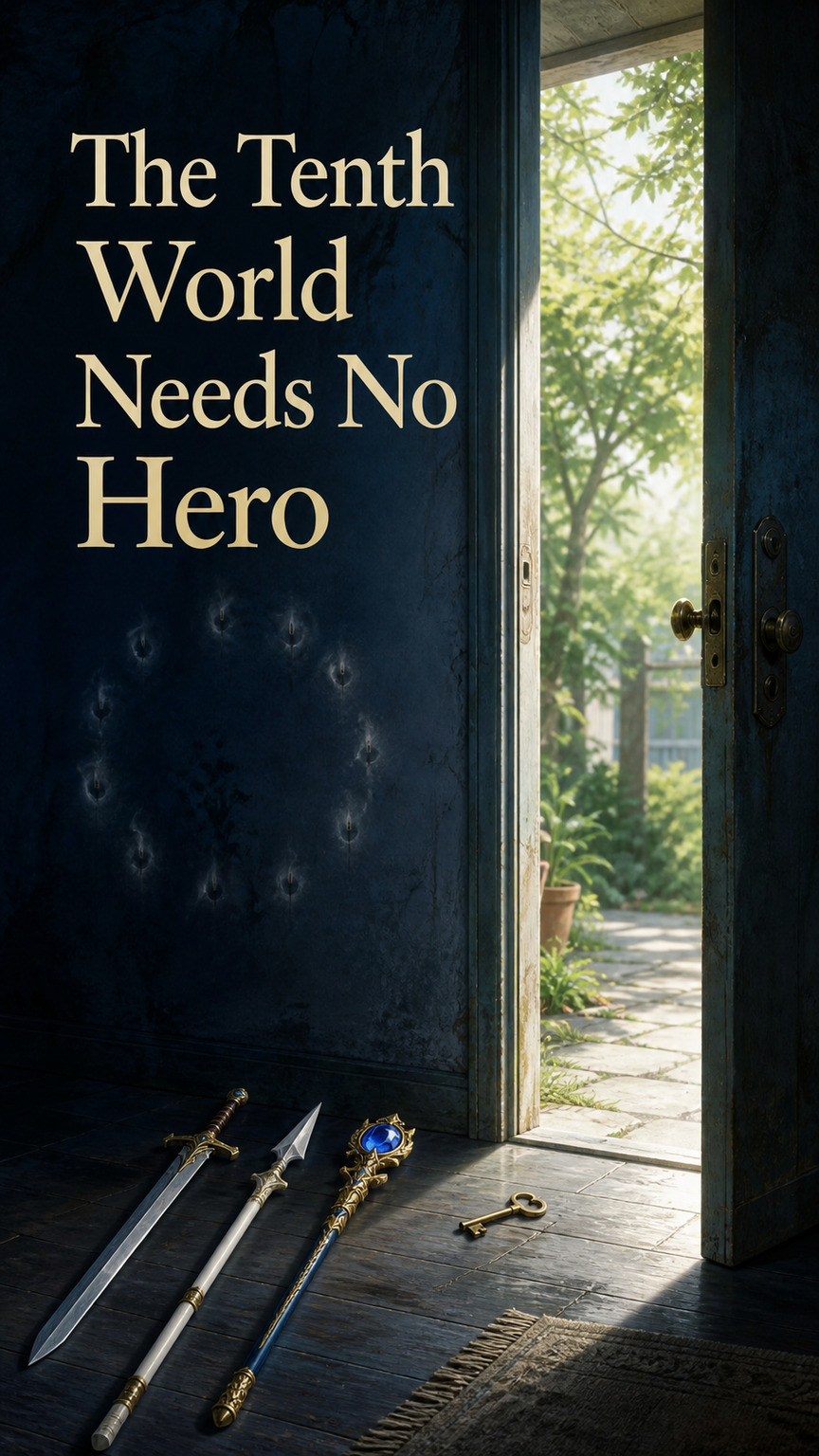
Ryo Sato came through the door sideways, because heroism had done nothing for his balance.
He struck the floor on one shoulder. His sword followed, then a white ceremonial spear, then a jeweled staff he had never learned to use. Beyond the narrowing doorway, thousands of voices were chanting his name.
“Ryo! Ryo! Ryo!”
“Zero casualties,” he reported.
Steward Eiren used both hands to pinch the shining filament that formed the door’s edge. It grew from the centers of her palms, fine as spider silk and bright as a cut in the air. Usually she closed it with a neat twist. This time her fingers shook. The chanting squeezed to a silver line, then vanished.
Eiren stepped backward, missed the only chair in the threshold room, and sat on the floor.
“Delightful,” she said. Her shawl had slipped halfway down one arm. Ink-dark stains filled the beds of her nails. “And how are you?”
Ryo pushed himself upright. “What?”
“A cunning ambush. I thought I might catch you between statistics.”
He unbuckled his ruined breastplate. Nine marks shone across his body: pale bands at his shoulder, palm, ribs, throat, temple, spine, ankle, heart, and brow. The first burned whenever he remembered the floodgate chain snapping. He had braced his shoulder beneath the falling beam while brown water climbed his legs, held until his knees ground craters into the stone, and walked away as children on the wall began a song about him.
The mark in his palm recalled a fevered well turning clear beneath his hand. The one along his ribs remembered a plain of burning grass and the seed grain he had carried through it. In both places, doors garlanded for his feast had stood open behind him. He had left before anyone served the food.
Eiren watched the marks fade. “Nine worlds. Nine victories. You collect ceremonial weapons like a hallway collects shoes, and you still cannot answer a question about yourself.”
“You said there was another pull.”
“This will be your tenth world, Ryo.” She pressed her stained fingertips to her eyes. “If nine triumphs have not taught you that you matter, I am running out of strength, ideas, and tact. The tact went first.”
He looked at the blank wall where a door might appear. Tenth mission, he thought. A pleasing round number. A completion marker.
“What needs saving?” he asked.
Eiren laughed once, without amusement. Then, because she was as trapped by the question as he was, she held out her hands.
The next doorway opened slowly.
Living filaments slid from Eiren’s palms and stitched a rectangle of darkness into the air. She had to stop twice, breathing through clenched teeth. Within the dark, Ryo saw not the destination but the reflection of another door: cheap wood, a peeling apartment number, a chain he had once kept fastened even while awake.
“Before you say yes,” Eiren said, “listen. You are alive. You have been alive through every crossing. Same body, same memory, same extremely poor habit of landing on your face.”
“Shoulder.”
“A magnificent distinction. You may refuse. This filament is nearly spent. If you cross, I can open one return during the storm’s peak, and only briefly. I cannot follow you. I cannot see the whole problem from here.”
Ryo kept looking at the reflected apartment.
Before the first door, he had stopped going outside because outside had become a sequence of demands his body treated as emergencies. At work, his chest had tightened until he could not feel his hands. He had lost the job after too many mornings spent dressed on the edge of his bed, unable to make himself touch the front-door knob. Messages accumulated. Concern became advice; advice became silence. Delivered groceries waited outside until the hall was empty.
Games had helped. Their rules held still. A failed task could be tried again without disappointing anyone who loved him. The apartment had been shelter when he needed shelter. Later, it had tightened by degrees, until safety and shame occupied the same rooms.
Then Eiren had opened a door and offered him a problem with a health bar.
The mark at his throat warmed. He remembered forcing his mouth around the warning cries of a furred hunting clan while arrows rattled on their gate. At his temple, a corridor of mirrors broke into shining fault lines and showed him the one safe path. Along his spine, impossible strength returned him to the fortress arch he had lifted while soldiers crawled from beneath it. There had been an alliance table, a ruler’s bow, a room full of the newly bereaved. He had stayed for none of them.
At his ankle: a step through shadow into a besieged gatehouse, followed by victory horns. Over his heart: a ward held all night above a refuge while snow buried the road, and a child offering him soup at dawn. At his brow: two armies halted because Ryo saw the single act that would end their war—the stolen water maps laid together on one table, the sustaining lie made visible. That crowd had still been chanting when he fell through Eiren’s door.
“The assignments made me better,” he said.
Eiren’s exhausted gaze did not leave him. “Better at what?”
“Endurance. Languages. Strategy. Saving people.”
“I asked what you wanted for breakfast yesterday. You told me which grain had the highest survival value.”
“It did.”
“The grain was blue.”
He had no defense against that except accuracy. “It was nutritious.”
Eiren flexed her trembling hands. “This pull is centered on the ending of a hero’s job. I chose it because I thought—” She stopped. “I do not know the full circumstances. That is the truth.”
An ending implied something large enough to end. Ryo imagined a concealed tyrant, a buried monster, a final form waiting beneath an innocent surface.
“I consent,” he said.
Eiren’s face tightened. Still, she opened the door.
Ryo arrived under a clear sky in a town taking its miracle apart.
The storm engine occupied the center of a stone tower open to the wind. It was a black metal column three stories high, ribbed with copper conduits. Nine conductor vanes reached from it like the spokes of a wheel. Crews in leather aprons were unbolting them one by one and lowering them toward nine squat stations built around the tower floor.
Beyond the open arches, roofs crowded down a hillside. Far past them, a purple cloudbank pressed against the horizon.
“Put that down,” someone said.
Ryo realized he had drawn his sword.
The speaker was a young engineer with cropped hair, soot on both cheeks, and a wrench braced over one shoulder. “Unless the storm has developed a throat, that will be decorative.”
He sheathed it. “Ryo Sato. I was sent to help.”
“Jori Vale. Carry that vane to station four.” Jori pointed to a curved slab of copper taller than either of them. “No powers through it. It’s inert, and we worked hard to keep it that way.”
Ryo lifted it. Four crew members let go with visible relief. He carried it across the tower floor and eased it into a cradle while Jori called measurements.
“Good,” Jori said. “Stop there.”
The words landed strangely. “I can carry the others.”
“So can the hoists. I need you clear of the conductor paths.”
Jori showed him the plan because he kept asking where the real emergency was. Long ago, every resident’s small ability to turn wind or bleed lightning from a roof had been gathered by the engine into one operator. The old plaques called that operator the Necessary One. One body could protect the whole town with wonderful efficiency, right up until the storms burned it out.
“People prefer a miracle with a face,” Jori said, tightening a clamp. “Easier to praise one person than maintain nine stations. We chose maintenance.”
For years the town had built manual channels that could divide the storm among hundreds of hands. Today they meant to cut the last central conduits before the seasonal front arrived.
There was no tyrant. No monster. No one even seemed interested in Ryo’s sword.
A siren wailed.
Crew members dropped into practiced positions. Gauges jumped along the column.
“Pressure test,” Jori shouted. “Hold your stations. Ryo, stay where you are.”
The mark at Ryo’s brow blazed. His gift had never been wrong. Every line in the room—the stress fractures in the copper, the shadow beneath the central rail, the angle of the rising gauges—pointed toward a white control circle at the engine’s base.
Necessary action.
He stepped into shadow and emerged inside the circle.
Jori shouted something sharp. Ryo did not hear it. He seized the central rails, drove cleansing warmth into one and raised a ward through the other. The tower lurched. A seam in the column opened with furnace light; he forced it shut with both hands.
The pressure dropped. The siren died.
For one perfect second, everyone stared at him.
Then the nine detached conductors snapped upright.
Mechanical letters clattered across an old brass panel.
NECESSARY ONE ACCEPTED.
The white circle closed around Ryo’s boots like cooling glass. Outside, the purple storm turned toward the town.
The engine became very interested in everything Ryo could do.
When a copper rib buckled, he held it straight. The shoulder mark burned brighter, and a second conductor lit.
When heat rolled up his arms, his fireproof skin hardened. A third conductor lit.
He saw fractures before they spread, warded sparks away from the crews, stepped through the engine’s own shadows to catch a falling brace. With each success, white light climbed higher around his legs. Each time he took a task, one of the manual stations went dark.
“Stop helping!” Jori shouted.
“I’m preventing a rupture.”
“You are teaching the engine where the power is!”
Residents had gathered in the archways below. Some recognized the old pattern faster than the crews did.
“A Necessary One,” someone breathed.
“He can hold it.”
“The hero came back.”
The words reached a hollow place in Ryo and filled it with light. His arms were burning. His feet had gone numb. He smiled anyway.
Jori saw. Their expression changed from anger to something worse: understanding without admiration.
“Every job you take disables a station,” they said. “It is not choosing you because you are destined. It is choosing you because you keep volunteering for the whole load.”
A slim doorway flickered at the edge of the circle. Eiren knelt on the other side, one palm braced on the threshold-room floor. Her other hand reached toward him, but the filaments around her fingers blinked in and out.
“Ryo,” she said. “Stop proving the problem correct.”
“If I leave and anyone dies, it’s my fault.”
“That sentence has eaten nine years of my life, and considerably more of yours.”
“Argue later,” Jori said. They shoved a diagram against the glassy boundary. Nine radial lines. Nine stations. “Your powers are distinct charges. We can bleed one into each station, and each crew can use it to break one central bond. The stations consume the charge. You lose the gifts.”
Ryo looked at his shining marks.
“Then what?”
“Then you step out before station nine cuts the core.”
“Will it work?”
“We have tested each station separately. Never all nine in a live storm.”
“So you don’t know.”
“Correct. Welcome to engineering.”
Lightning moved inside the approaching clouds. Eiren’s return door dimmed.
Ryo searched the room with his fracture-sight. There had to be a cleaner line: one cut, one ward, one decisive act that placed uncertainty on his shoulders and nowhere else.
He found a bright seam at the top of the engine.
“Ryo, no,” Eiren whispered.
He shadow-stepped upward, caught the seam, and poured his strength through it. He tried to turn the whole storm aside.
The engine took the offer.
All nine conductors flared white. The seam sealed around his hands. Station nine went black with a sound like a slammed coffin lid.
At the doorway, Eiren fell to one knee.
Ryo dropped back into the circle. He had fixed nothing. His certainty had merely become another conduit.
For three breaths, the engine held perfectly still.
Rain struck the tower in hard, scattered coins.
Eiren looked older than she had an hour ago. The door-filaments cut red grooves across her palms.
“People called me a goddess once,” she said. “Not everywhere. Not forever. Just frightened people who prayed for an exit and saw me open one.”
Ryo gripped the central rails. “This is not the moment for your biography.”
“It is the moment for my confession.” Her voice shook, but did not soften. “I learned to feel real when I was needed. Every door cost me, and I mistook the cost for evidence that I loved people properly.”
The filament pulsed between them, ragged and bright.
“Then I found you,” Eiren said. “You looked at the first crisis and stood up. I thought if I gave you enough proof—enough victories—you would carry that feeling home. When you asked again, it reassured me. Your success made my mistake look like care.”
Ryo’s hands tightened until the rails bent. “So I was a lesson.”
“In part. You were also someone I cared about. I asked each time, and you said yes. I used those facts to avoid asking what our yes was serving.”
“Tell me the correct choice now.”
Eiren closed her eyes. “No. I have made too many assignments out of your life already.”
At station nine, Jori and six crew members hauled open the dead housing. Wind threw rain through the arches. They reached bare hands into the mechanism and fed their own small currents into it: a tremor of diverted air, a blue crawling spark, a pressure change Ryo felt in his teeth.
“We do not need you to be sure,” Jori called. “We need you to stop taking away everyone else’s chance to act.”
The ninth station’s indicator stuttered amber.
Ryo looked down at the circle holding him. It promised fixed inputs and measurable outcomes. Stay here. Take every danger. Receive praise. Never answer what you wanted.
His apartment had made no such promise. It had been a refuge from pain no one else could see, until fear and shame narrowed his choices to the size of one room. The control circle was brighter. The control circle had an audience. But disappearing into it would still be disappearance.
The return doorway shrank to the width of Eiren’s shoulders.
“Ryo,” she said, barely audible. “I cannot hold it much longer.”
He did not know whether the town would survive without him.
For the first time, not knowing could not postpone the choice.
“All right,” Ryo told Jori. “Your plan.”
Jori pointed at the first station. “On my count.”
“Wait.” He swallowed. The engine thrummed approval through his bones, certain he had reconsidered. “I want to live.”
The statement sounded embarrassingly small beside the storm.
It was not small to him.
“I want a chance to find out what I like when nobody is scoring it,” he said. “Those are my reasons. Count.”
Jori did.
At one, Ryo opened the pale band on his shoulder. Years of impossible endurance rushed out of him in a white stream and struck station one. For an instant he was back beneath the broken floodgate, water climbing his chest, children singing above. Then the station’s crew caught the charge in copper arms and forced a lever down.
The first central bond broke.
Ryo’s knees began to shake.
At two, he released the cleansing warmth from his palm. He smelled fever-sour stone and remembered clear water welling between his fingers. Station two flashed gold. Its crew missed the first catch, swore, reset their clamps, and caught the second.
The engine offered the power back through the rails. Ryo let the offer pass.
At three, heat resistance peeled from his skin. The burning plain vanished from his ribs. The control rails became instantly, honestly hot, and he cried out. Station three’s crew broke their bond with a hammer because the release catch jammed.
At four, the voices of every creature he had ever understood crowded his throat—warning cries, jokes, mourning songs—then dissolved into rain. The crew at station four needed no miraculous language. They shouted ordinary instructions until everyone understood.
At five, fracture-sight left his eyes. The tower became terrifyingly opaque. No bright lines marked the safe places to stand.
“Your left hand,” Jori called. “Move it down.”
Ryo obeyed someone else’s sight. Station five engaged.
At six, strength poured from his spine. The rails sagged in his grip. Two crew members thrust a brace through the boundary and took the weight he could no longer hold alone.
At seven, shadow-step unstitched itself from his ankle. Every distance in the tower became real distance. There would be no skipping the space between danger and help, no private shortcut through darkness. Station seven groaned, hesitated, then locked.
At eight, the ward over his heart broke into sparks. Wind hit him full in the face. Rain found every burn. The engine opened a path for the storm and invited him to take the sheltering power back.
He did not.
Eight station crews held eight imperfect lines. One conductor remained white. The glass around Ryo’s boots loosened until he could lift one heel.
The final mark blazed at his brow.
His decisive instinct showed him the necessary action with the clarity of revelation: stay in the circle. Reclaim the load. Guarantee the town’s survival. Be consumed, and never again face a day in which his worth was uncertain.
Station nine flickered. Jori’s crew fought to keep their handmade current alive.
The old gift had never been wrong about how to win.
It had never been asked whether Ryo should survive the winning.
He tore the light from his brow and threw it into station nine.
Certainty went dark.
The crew caught the charge. Ryo no longer knew whether they had caught it correctly. He no longer knew the best angle for his foot, the perfect second to move, the outcome waiting beyond the next breath.
He stepped out anyway.
The tower lights failed.
The storm struck.
For one deafening moment, Ryo thought he had abandoned everyone. Then eight channels opened across the floor, messy and uneven. The ninth sputtered, died, and flared again as Jori and the others forced it by hand. Lightning divided through the stations instead of converging on one body.
The black column split along its central seam. Beneath the casing, the sacrificial core hung exposed: a fist-sized knot where all nine lines had once become one.
The return door was now too narrow for Ryo to pass through facing forward.
“Use the filament,” Ryo said.
Her fingers were inches from his. “To pull you out?”
“To cut that.”
Eiren stared at the core. “If I do, your assignment thread burns out. No powers. No eleventh door. I may not be able to reach you again.”
Fear opened under him. It had no bottom and no victory condition.
“That’s the point,” he said, and then, because it was more honest, “I am terrified. Please do it.”
Eiren moved.
The living filament lashed through the inert doorway, bright with the last strength in her bleeding palms. It looped the exposed core. Eiren pulled once.
The knot came apart.
Thunder punched cracks through the tower walls. Roof tiles spun into the streets. Every lamp on the hillside went dark. But the storm ran outward through nine ordinary channels, into hundreds of waiting hands, and no single person burned at its center.
Jori staggered against a station, laughing or coughing. “You followed the plan,” they told Ryo.
“Eventually.”
“I remain angry about the first part.”
“That seems fair.”
No one crowned him. No crowd began a chant. Crews were already checking the cracked tower and calling damage reports into the rain.
Eiren’s doorway folded inward.
Ryo wanted to stay long enough to prove the lights would return. He wanted a final count, a clean result, permission to call his choice correct.
Instead he turned sideways, took Eiren’s hand, and squeezed through.
He left before certainty.
They collapsed together on the threshold-room floor.
For a while Ryo could hear only their breathing. His arms burned. His muscles trembled with the indignity of supporting exactly one exhausted human body. The nine marks had faded to ordinary skin.
Eiren turned her palms upward. The filaments were gone. Thin burns crossed her hands where they had grown.
“I cannot open another assignment door for you,” she said.
Ryo waited for grief and found it. He also found relief, fear, resentment, affection, and a powerful desire to sleep for a week. None canceled the others.
“Thank you for bringing me back,” he said. “That does not make everything you did right.”
“I know.” Eiren’s apology arrived without defense. “I am sorry.”
“And I’m not fixed.”
“No.” She considered. “You are extremely singed.”
He laughed, which hurt. “You should rest.”
“An outrageous proposal.”
“You are not allowed to make me your project again.”
“Agreed. You are not allowed to make yourself mine.”
They slept on opposite sides of the blank room. Later—Ryo did not know how much later—Eiren found enough strength for one last one-way fold, back to the physical doorway where she had first found him. It was not an assignment and held no promise of return.
“If an ordinary road ever lets us meet again,” Eiren said, “we could try being two people.”
“What would we do?”
“I hear some people consume blue grain voluntarily.”
“Anything but that.”
It was, Ryo realized, a preference.
He stepped through.
His apartment had preserved all its unfinished problems. Dust silvered the desk. Unread messages waited on his phone. The grocery app still remembered his order. No music swelled to certify his return.
His first impulse was to answer everyone at once and promise he was better now. His second was to find some emergency large enough to delay answering at all.
Ryo ate crackers over the sink, drank two glasses of water, and slept.
When he woke, daylight lay across the floor. He opened one message from a relative who had kept writing long after questions became weather reports and small photographs from ordinary days.
Ryo typed: I’m back. I’m not okay yet. Could you help me make one appointment?
He nearly replaced it with a joke. He nearly added a list of miraculous qualifications. He sent the message as it was.
Then he wrote one item on a sheet of paper.
Visit the neighborhood garden.
It would save no one. He remembered liking the smell of wet soil after rain. That seemed sufficient.
Ryo opened the curtains. The room felt exposed, and he left them open anyway.
At his apartment door there was no silver filament, no chanting crowd, no mark to reveal the necessary action. There was only the hall, one appointment he could not make alone, and a garden he might not manage to visit today.
He put his hand on the knob without knowing what waited behind it.
Then Ryo opened the door himself.