Terms at Four
You're attending a tea party thrown by a very cute girl. Delicious tea, cake, cookies, and a pie. Then she gets a call from the Prime Minister saying the government will meet her demands if she disarms the satellite and releases the hostages.
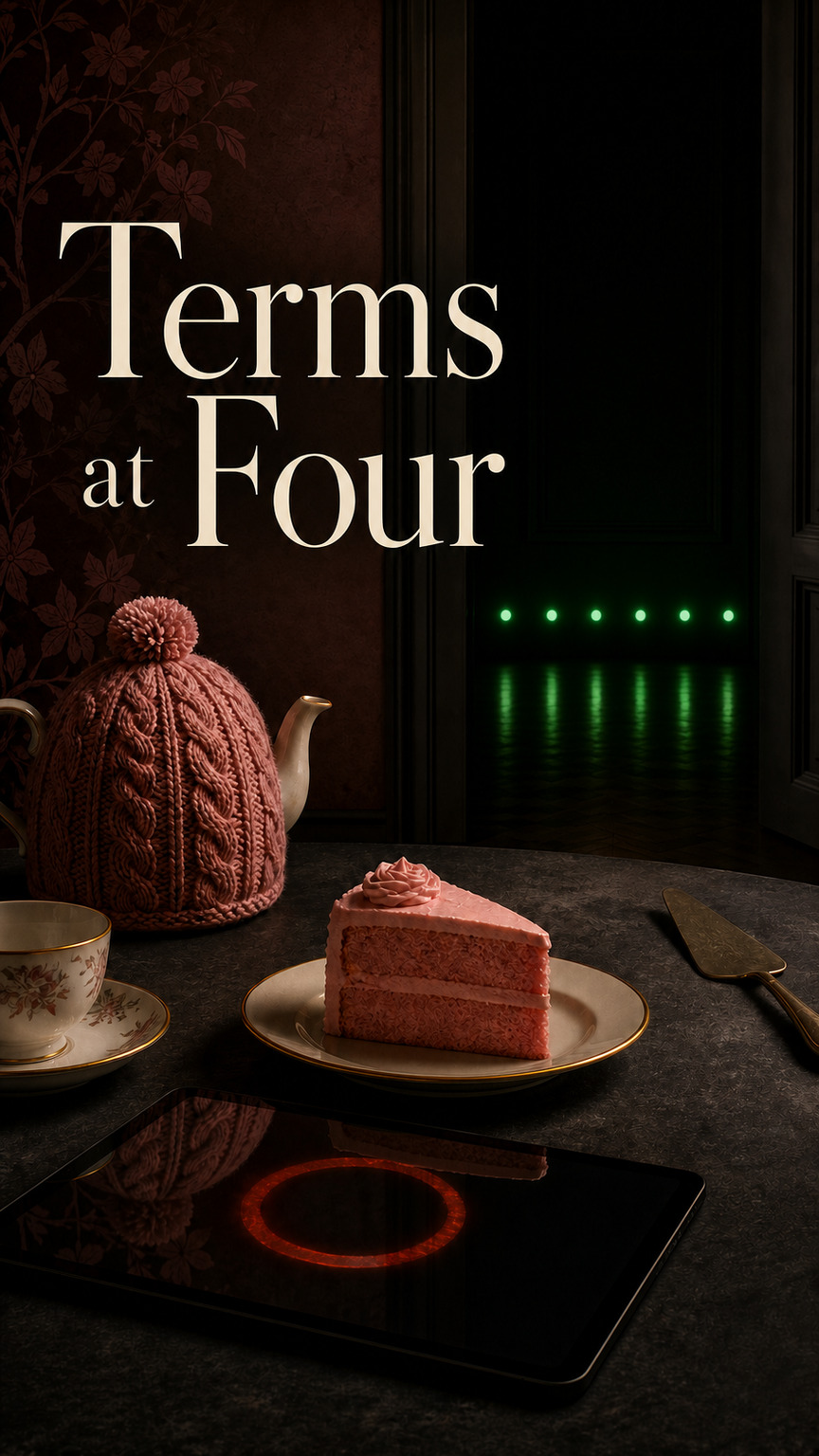
At four precisely, she opened the door with a tea towel over one shoulder and said, “You’re early.”
Your watch said four precisely too, but arguing about clocks had once consumed eleven minutes of a design review, so you stepped inside.
“I brought nothing,” you said.
“That was the instruction.” She took your coat. “Shoes may stay on. The kitchen tile is cold.”
At thirty-four, your former colleague had made herself cute with the same deliberation she once brought to fault trees: a soft green cardigan, a silver barrette shaped like two leaves, and round spectacles that kept slipping a little down her nose. Nothing about her suggested a child. She was a grown woman with a mortgage, a doctorate, and, until seven months ago, senior authority over an orbital defense platform. The effect was charming. It was also, because you knew her, a warning that she had planned the afternoon down to the teaspoons.
The table confirmed it. A white pot wore a quilted cozy. Beside it waited a smaller pot of jasmine green tea, a squat pot of smoked tea, a three-layer cake glazed pale pink, two plates of cookies, and a deep pie dish under a folded cloth. The room smelled of butter, baked apples, and warm dust from an overworked electronics rack.
“You made too much.”
“You always say that before eating enough for three.”
“I said it once.”
“At the winter calibration.” She indicated your old chair, facing the window. “Black tea first?”
That was how she had taken minutes in the control room: not tea? but black tea first?, as if the only uncertainty concerned sequence. You sat. Between the sugar bowl and a vase of small white flowers, a pane of dark glass showed a blue curve, three lines of figures, and a pulsing amber square.
You did not touch the cup she poured.
“Is that live?”
She settled opposite you. “Have a cookie.”
“Is it live?”
“Yes.”
The amber square pulsed at the old command cadence. Five seconds lit, two seconds dark. You had watched it through tests, budget hearings, and the all-night argument that ended with your resignation. The figures beside it reported an armed control lattice in orbit and a valid targeting key.
She nudged the nearer plate toward you. The cookies were little rounds, their edges browned evenly, each pressed with the back of a fork.
“Those are the salt ones,” she said. “The sugared ones are by your elbow.”
“You armed it.”
“They armed it. I retained the session.”
“That distinction won’t help anyone under it.”
For the first time she missed a serving cue. The milk jug remained in her hand after your cup was the right color.
“Six members of the security detail are in the lower training suite at the operations annex,” she said. “The locks answer to the same session. They have water, ventilation, and a toilet. No one has been injured.”
The tea touched your tongue before you understood you had picked it up. Hot, strong, exactly enough milk. You put it down.
“Show me.”
She woke a second pane. A wide room appeared under flat ceiling lights. Six adults sat or paced within its white boundary lines. Two wore jackets over formal clothes; four wore the dark uniform of state security. No restraints. One person struck the sealed door with the heel of a hand, stopped, and looked directly into the ceiling camera.
The absurdity did not soften anything. Your old colleague had baked a cake and taken six hostages. Above weather and traffic, a machine the two of you had helped design held an armed key.
“Live challenge,” you said.
She pushed the pane across the table.
You opened the verifier and chose a random phrase from its list. “Ask the person nearest the camera to repeat violet cup, nineteen, then hold up both hands.”
She pressed the intercom. Her hosting voice disappeared. “For verification: nearest the camera, repeat violet cup, nineteen. Both hands visible.”
The nearest captive stared upward. “Violet cup, nineteen.” Both hands rose. “Now let us out.”
There was no elegance in the reply, only anger and a dry throat.
“Confirmed,” you said. “Why them?”
“They came to take the maintenance crew.”
“They came under orders.”
“So did the maintenance crew.” She folded the tea towel once and laid it beside her plate. “The crew refused the final arming sequence. They were detained without counsel. The written orders were removed from the case record this morning.”
“And you thought kidnapping would clarify procedure.”
“I thought leverage might.”
On the feed, one of the uniformed captives sat down too quickly. An older person beside them knelt, listened, then looked at the camera.
“Intercom,” you said.
“We have a schedule.”
“Intercom.”
She pressed it.
“What do you need?” you asked.
The kneeling captive answered. “Their cardiac tablets. Jacket pocket, outside this room. They missed the last dose.”
You looked across the cake at your former colleague.
She had already turned to another control. “The corridor cart can bring the jacket to the transfer drawer.”
“Open the drawer before it arrives.”
“That leaves an access path.”
“For a jacket.”
“For anything that fits behind it.” Her eyes moved over three status marks. “I’m checking the outer corridor.”
“They don’t owe you patience.”
Her mouth tightened. At work, pressure had made her more grammatical, never louder. “Outer corridor clear. Transfer drawer opening.”
On the screen, a narrow panel clicked ajar near the floor. Ninety seconds later, a small service cart rolled into view outside the inner window and tipped a dark jacket forward. The kneeling captive pulled it through, found a packet, and passed over two tablets with a paper cup of water. The sick person swallowed.
“Anything else?” you asked through the intercom.
“The door,” the captive said.
You closed the channel before your former colleague could answer.
She poured herself smoked tea. Her hand was steady again. “The government delivers all five maintenance workers to independent counsel, in view of the south camera. The detention record and the original arming orders are filed with the high court. I destroy the targeting key and eject the armed lattice. Then I release the locks.”
“And if they don’t?”
“I keep control.”
“Of a weapon.”
“Of their weapon.”
You reached for a salt cookie because your stomach had mistaken dread for emptiness. It broke cleanly, scattering crumbs onto a tablecloth embroidered with strawberries.
“No,” you said. “You don’t get to hand the noun back to them. You have it.”
She watched you brush the crumbs into your palm. “You still do that.”
“What?”
“Clean the table while telling someone their system is morally indefensible.”
“It used to be your table too.”
That landed. She looked toward the amber pulse.
You had left the platform project when its defensive mandate became a drafting convenience, a phrase broad enough to cover anything the cabinet wanted after midnight. She had stayed, saying somebody had to protect the safe-mode architecture from the inside. For seven months you had wondered whether that had been courage, vanity, or simply her inability to leave a machine unfinished. Now the machine was finished. Now this.
“Give me the full telemetry,” you said.
“After cake.”
“Now.”
“You won’t think better hungry.”
She stood and lifted the cake knife. You nearly shouted at her. Then the display chimed with a government handshake request, and the knife paused above the pink glaze.
“Not yet,” she said. “That’s the liaison channel. The Prime Minister’s office has another seven minutes.”
“You scheduled the head of government between cake and pie?”
“I estimated response times.”
“Of course you did.”
She cut two narrow slices, placing yours on the plate with the painted bird because that had been yours in the control room cupboard. The cake was vanilla and lemon, its layers straight as ruled lines. You hated that it was excellent.
While she ate three careful bites, you opened the telemetry tree. She had granted you read-only access but left the branches uncollapsed. The armed lattice showed one active path. You checked the time stamps against two ground beacons and a civilian tracking clock. No loop. You challenged the orbital unit; its return arrived with the correct light-delay wobble. You searched for shadow keys and dormant targeting branches, then checked the safe-mode design you had written years ago and she had later hardened.
“You kept the dual break,” you said.
“I told you I would.”
“You told me many things in that room.”
She put down her fork. “The burn fuse destroys the key store. The lattice ejects as a cold module. Ground control can’t rebuild either before retrieval, and retrieval takes months.”
“If the ejector fires.”
“We test it every orbit.”
“You test a signal. Show me the physical interlock.”
She opened the hardware channel without argument. That was worse than confidence; it was an old concession, the kind she made only when she wanted you to notice she had prepared for your objection. The pressure seal reported intact. The ejector capacitors were charged. Two independent observers had access to the same public-safe telemetry you did.
There remained an ugly twelve-second interval in which a blackout could resemble an abort. You marked it.
“Who else can stop safe mode?” you asked.
“No one once I commit.”
“Before commit.”
“Me. Ground control can request delay but not cancel.”
“And the hostages?”
“One command opens every inner door. The recovery teams are waiting beyond the outer line.”
“Waiting under whose authority?”
“The Prime Minister’s.”
“Then the government knows where they are.”
“It has for twenty-two minutes.”
You looked at the six people on the feed. One was helping the medicated captive sit upright. Another had taken off a jacket and folded it into a cushion. They knew rescue was close enough to imagine and too far away to trust.
The encrypted phone rang at four forty-three. Its plain double trill was the same sound the old control room phones had made for cafeteria calls.
Your former colleague wiped cake crumbs from her fingertips and answered on speaker. “Good afternoon, Prime Minister.”
The voice that came through was lower than broadcasts made it, roughened by distance or fatigue. “Is your witness present?”
“I’m here,” you said.
“Have you confirmed the six?”
“Live feed and challenge confirmed. One needed medication. They have it now. They are still confined.”
A pause. Faintly, on the far end, paper moved and someone whispered too far from the microphone to make out.
“Have you confirmed control of the platform?” the Prime Minister asked.
“Yes. Armed state is real. So is the proposed safe mode, subject to execution.”
“Thank you.” Then, to your host: “The government will meet your demands if you disarm the satellite and release all six hostages.”
Your former colleague adjusted the pie cloth though it was already centered. “That repeats your message from twenty minutes ago. It does not establish sequence.”
“Release them first.”
“No.” She drew the smoked tea closer without drinking.
“Then begin disarmament.”
“The crew first reaches counsel. The filings must be accepted by the court registry.”
“You are not setting court procedure from a dining room.”
“I am naming the observable conditions.”
“And I am responsible for six people in a locked room and everyone beneath that satellite.” The Prime Minister stopped. When the voice returned, the clauses were shorter. “The crew is in transit. Counsel is waiting. The filing is queued. You will destroy the key when the vehicle crosses the outer gate. You will open the inner doors when the registry returns its receipt. The lattice ejects while my medical team takes custody.”
Your former colleague reached for her pen. “No. Custody can be staged—”
“Stop,” you said.
She did not look at you. “I am trying to prevent substitution.”
“You’re not listening. That sequence makes the hostages wait on a court server.”
The Prime Minister said, “Agreed.”
She aligned the pen with her spoon. “Then offer a dependency that can be verified.”
“Vehicle crosses the gate,” the Prime Minister said. “You commit safe mode. Your witness confirms key destruction. We open the court submission to public receipt. You release the doors. My team crosses the outer line as the lattice ejects. Counsel keeps the crew. No one is returned to detention tonight.”
“The filing includes the signed arming orders and the detention authorization.”
“It includes the complete documents your counsel identified.”
“Not summaries.”
“Complete documents.”
Your former colleague pressed her lips together. Her practiced precision was fraying in a peculiar direction: more conditions, more nouns, less ability to hear when an answer had arrived.
“And the government states on this record that it has met the demands before I open the doors,” she said.
“After the crew reaches counsel and the registry accepts the filing, I will state it.”
“The key goes first,” you said to her. “Not the people.”
She looked at you then. “If they take the crew back—”
“I know why you called me.”
“Do you?”
“You wanted someone who could prove you kept your terms.”
Her gaze dropped to the bird on your cake plate. One untouched corner of the slice remained.
“I wanted someone who would notice if they kept theirs,” she said.
It was the old division of labor, offered across porcelain: she held the line inside; you made the line visible from outside. You had once trusted it. You did not now.
“I’ll notice,” you said. “I won’t call this necessary.”
The encrypted line hissed softly.
“Prime Minister?” she asked.
“Proceed on the sequence your witness described,” came the answer. “My office will remain connected.”
At four fifty-one, she lifted the cloth from the pie. Steam brought up apples, brown sugar, and a sharp scent of citrus peel. She cut it while four screens arranged themselves among the dishes: the south gate, the court receipt, the satellite telemetry, the training suite.
“Cream?” she asked.
You stared at her.
“It is getting warm.”
“No cream.”
“You used to take cream.”
“I stopped.”
She set the jug beside her own plate. She did not ask when.
The pie crust cracked under your fork. On the gate feed, a dark vehicle rolled to a stop. Five people emerged one by one, tired adults in maintenance gray, each carrying nothing. A lawyer waited beyond a painted line with two assistants and an open case. The crew crossed. One stumbled; the others slowed until all five stood on the same side beside counsel.
“Count confirmed,” you said. “Five with counsel.”
“Government confirms transfer,” the Prime Minister said.
Your former colleague entered her command. The amber pulse changed to a red ring.
“Safe mode staged,” she said.
“That isn’t commit.” Your interruption came too loud in the small kitchen.
Her fingers hovered. “I am waiting for the registry.”
“The agreed sequence was commit at the gate.”
“The submission is moving.”
“You asked me to witness terms. Those are the terms.”
For three seconds she kept her hand above the glass. At work, that pause had meant she had found a failure path. Now the timer continued and her hand stayed still.
Then she pressed her thumb to the red ring.
“Commit accepted,” the platform reported in a mild synthetic voice.
The amber pulse vanished. A white bar advanced across the pane.
“Ground control requests hold,” the Prime Minister said.
Your former colleague’s head snapped toward the phone.
“Can they stop it?”
“No,” you said. “Not after commit.”
“Confirm that.”
“The command is irreversible. Hold is only a request to the monitor now.”
The key-store indicator changed to a permanent null. The independent monitor returned the same result.
“Key destruction confirmed,” you said.
The court screen refreshed. A receipt number appeared, followed by a file index. You opened two random pages. Signatures, dates, the arming language you remembered objecting to, and the authorization used to detain the crew. The originals carried registry seals.
“Filing accepted,” you said. “Documents present.”
The Prime Minister drew an audible breath. “The maintenance crew is with independent counsel. The complete documents are filed with the high court. The government has met your demands.”
Your former colleague did not answer immediately. Formal courtesy had left her; perhaps there was no room for it beside the twelve-second gap approaching on the telemetry.
“Release,” you said.
She pressed the lock control.
On the training-suite feed, all six inner-door indicators went green. The door slid aside. For half a second no one moved. Then the captive who had demanded release stepped into the corridor with both empty hands raised. The others followed: two, three, the person who had needed medication supported at one elbow, five, six. A medical team crossed the outer line carrying bags and a folding chair.
“Keep the wide view,” you said.
Your former colleague switched cameras before the nearest official could request it. The freed captives did not thank her. One shouted toward the ceiling; the words blurred under the alarm from the open doors. Another waved the medical team toward the sick person. All six passed the painted outer line. Two medics took the unsteady captive into the chair, checked a wrist monitor, and began talking to them. Four security officers counted aloud and counted again.
“Six released and with the medical team,” you said.
“Confirmed,” the Prime Minister said.
The satellite pane went black.
Your former colleague gripped the edge of the table. “That is early.”
You counted. One, two, three. The pie cooled between you. At six seconds, a ground beacon reported no key response. At nine, a second did the same. Eleven seconds, and still nothing from the orbital unit but a blank field.
She said your old project shorthand, barely more than breath. “Abort shadow?”
“Could be.” You watched the physical channel, not her. “Wait.”
At twelve seconds, telemetry returned. The key store still showed its permanent null. The pressure seal opened. A new object appeared on civilian tracking, separating slowly from the platform.
The armed lattice had ejected.
You checked the independent observers. Both matched. No targeting path remained; no ground command could restore one. Its armed mode was gone.
“Key remains destroyed,” you said. “Lattice separate and inert. Disarmament confirmed.”
“My office confirms,” the Prime Minister said. “The call is ending now.”
The line clicked dead.
For a while the only voices came through the hostage feed: a medic asking where it hurt, someone demanding a phone, an officer saying all six were present. Your former colleague missed her chair on the first attempt, caught its back, and sat.
At five twelve, vehicles turned into the narrow street below. No immunity had been discussed. She watched their blue-white lights pass across the ceiling, then put the cozy back over the tea.
“It won’t stay hot,” you said.
“No.” Her eyes remained on the window. “Would you give a statement?”
“A factual one.”
“Yes.”
“I’ll say you confined them to force an agreement.”
She nodded once. This time she did not correct your wording.
Heavy steps entered the building. She moved the cake knife away from the edge of the table and placed both hands flat beside her plate, visible from the doorway. The green cardigan, the leaf barrette, the carefully poured tea: none of it made her harmless.
Someone struck the door and ordered it opened.
Your former colleague looked at your half-finished pie. “You can take that with you.”
“I’m staying.”
She rose to answer the door. On the four small screens, the crew remained with counsel, the court receipt remained valid, the satellite remained disarmed, and all six former hostages stood beyond the outer line.