The Attendance Ledger
A school teacher moonlights as a handler for magical girls, looking after their wellbeing in battle and the classroom, even protecting the girls' secret identities without alerting them.
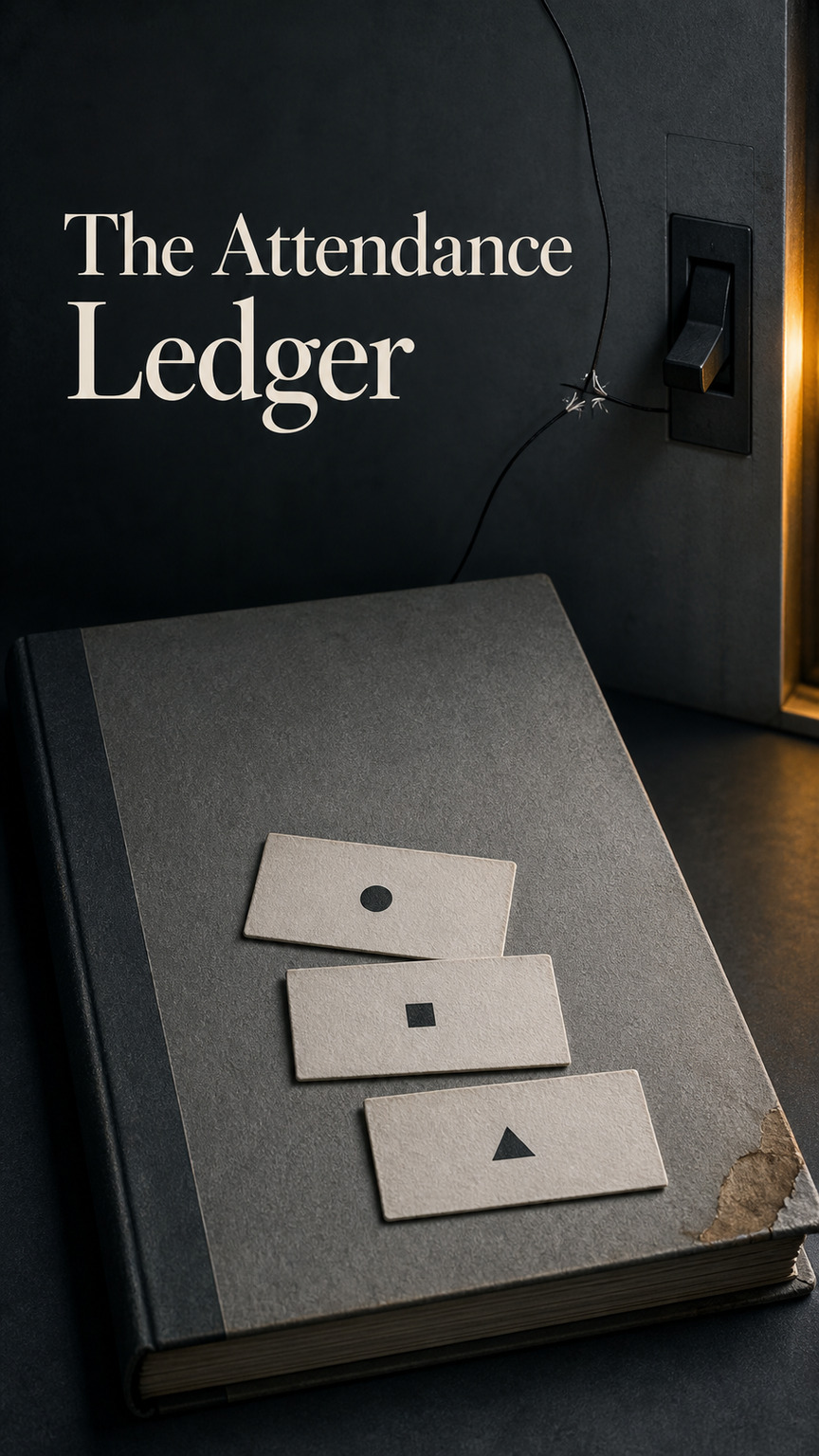
By the third name on the paper attendance ledger, Gideon Tolland knew exactly how much sleep three of his students had not had.
Northbridge Secondary’s network had chosen community-showcase day to display a spinning circle instead of the online register, so Gideon was using the paper backup. The ledger was a grey administrative object with coffee feathered along one corner. It possessed no insight. Gideon supplied the dangerous part himself.
“Drita Ademi?”
“Present.”
Drita held her left wrist close to her body. The cuff of her uniform jumper covered most of the bruise, but not the careful way she turned each page with her right hand. Her fingertips were pale with cold.
“Bryn Ahn?”
“Here.”
Bryn had already drawn two routes out of the problem on the lab sheet, although the problem concerned mineral samples and neither route was required. Her pencil trembled once, stopped under the pressure of her thumb, then continued.
“Cassia Dominguez?”
“Physically.”
The class laughed. Cassia offered them a thin grin and lowered her face over her folded arms.
Gideon marked all three present. At one seventeen that morning, in the voice-scrambled privacy of an encrypted radio relay, Kiteglass had reported a bad wrist and loss of body heat. Pulsewire had said that lights still had halos after two difficult severances. Mothlight had joked twice as fast as usual, which had been the clearest report of all.
Night Clerk had recommended a recovery day. The three girls had chosen school.
Mr. Tolland, who had no legitimate way to connect those reports to these students, had prepared accordingly.
“Before anyone asks,” he told the class, “the revision token on the board is for everyone. One deadline, moved once, no justification required. Lab roles rotate every twelve minutes. The snack box is not charity; it is protection against the paperwork generated by fainting.”
That earned a better laugh. He passed the box along the benches. Cassia took two oat bars without looking up. Drita accepted one after seeing three other students do it. Bryn chose the role nearest the door.
Kindness was easiest to disguise as policy.
Gideon had not meant to learn their secret. Six months earlier, three voice-scrambled strangers had asked for practical help over an emergency-radio frequency: routes, weather, first-aid supplies, someone to notice when brave became reckless. They had named him Night Clerk as a joke, and the name had stuck.
Then he had seen three transformed figures disappear into an alley and Drita, Bryn, and Cassia emerge moments later. After that came matching absences, matching injuries, Drita’s angle-cutting hand signal, Bryn’s insistence on two exits, Cassia’s habit of making a joke before admitting fear. No single clue had proved anything. Together, they left almost no room for him to be wrong.
He had kept that knowledge to himself. Their anonymity was not a puzzle he had earned the right to solve.
“Feet on the floor,” he said. “Before we begin, five things you can see, four you can feel, three you can hear. Yes, this is educational. I have declared it so.”
The room settled by degrees. Cassia’s shoulders lowered. Gideon reached the next line of his ledger.
From the ventilation grate above Drita came a papery whisper.
“Kiteglass?”
Drita’s head began to turn.
Gideon let the ledger fall.
It struck the floor flat, loud as a slammed door. Pages slewed beneath his desk. Twenty-eight students looked at him instead of at Drita.
“A compelling demonstration,” he said, crouching, “of gravity’s refusal to respect staff authority.”
In the shadow behind the grate, something black and thin withdrew. Not wire. Not a shadow. A living filament, wetly quick, vanishing after it had enjoyed a clear view of the page.
The Rollcaller had survived the night.
Gideon gathered the papers without hurrying. “Change of method. Mark yourselves present on the silent check-in slips. Apparently I am no longer qualified to hold a book.”
The class bent to the slips. Drita did not look at the grate again.
At the time, switching the register felt like protection. Gideon would later understand that the Rollcaller had watched him protect exactly one reaction.
At lunch, Gideon locked himself in the equipment room behind the lab and plugged an ordinary headset into an ordinary phone. The voice scrambler made him sound like a courteous cupboard.
“Something in the school ventilation tried my alias during attendance,” Kiteglass said. “Right after a civilian name. Same whisper as last night.”
“Assume the Rollcaller survived,” Night Clerk said. “Could it see the register?”
“From that grate? Yes.”
Silence held on the relay. Their health and location channels showed only what each girl had chosen to share: three rough status lights, no names, no map points.
“How many people reacted?” Night Clerk asked.
“I nearly did. Then a book hit the floor and everyone looked that way.”
“Nearly,” Kiteglass repeated, annoyed with herself. Gideon let her account stand without adding anything she had not told him.
“The creature engineered surprise. That is information about its method, not a failure on your part.”
Pulsewire’s scrambled voice cut in. “It needs correlation. The ledger gives it possible civilians, reactions narrow them, cameras prove them.”
“Agreed. My recommendation is evacuation and cancellation. Available alternatives: separate departures, remaining in public view, or a contained trap using the building map. You decide whether you engage at all.”
“Three of us leaving together would be a confession with backpacks,” Kiteglass said. “And we built that presentation.”
“For six weeks,” Pulsewire added.
Mothlight had said nothing.
Gideon resisted the urge to fill the quiet with instructions. “Mothlight, do you want options, quiet, or a grounding count?”
“Count. Then options.”
He counted five slow breaths. He could hear her match him by the faint hiss of the microphone. No one hurried her.
“I’m scared,” Mothlight said at last. “That is not the same as voting no.”
“Understood.”
“I vote we stay,” she said. “I also vote we don’t improvise in front of a guardian livestream, because I do have standards.”
Kiteglass proposed drawing the Rollcaller toward the empty rehearsal corridor during showcase setup, away from the auditorium audience. Pulsewire requested the building’s camera positions and traced two exits on the map Gideon sent: the public auditorium doors and a service corridor with no camera sightline. Three taps on the relay would be the hard abort signal. No debate afterward.
“If the network is compromised?” Pulsewire asked.
“Disconnect.”
“And if you order a transformation?”
“Night Clerk never orders a transformation,” Gideon said. It was the first rule they had made together. “If you hear one, the channel is compromised.”
“Good,” Pulsewire said. “Because you are useful, but you are not in charge of our bodies.”
The sentence pricked because it was true and because he had lately behaved as though noticing everything entitled him to arrange everything. He looked at the school map, at the three status lights, at every variable he wanted to close his hand around.
“Send me your final route,” he said. “I’ll give you camera coverage and evacuation timing. The plan remains yours.”
By midafternoon, the auditorium smelled of dust, hot projector plastic, and the citrus cleaner used whenever guardians were expected.
Gideon rotated presentation jobs across the whole class. Anyone could hand their speaking section to a partner. Anyone could use the revision token. Drita kept her speaking part but let someone else carry the display board. Bryn checked both exits before connecting the class laptop. Cassia stood in the wing, named five things she could see under her breath, and walked onstage when she was ready.
Their rehearsal was good. Not good considering the night they had endured. Simply good.
On the second run, Drita lost her place when the display board shifted. Gideon did not rescue her sentence. He reminded the entire class that a pause counted as speaking, then waited. Drita reset the board with her right hand and finished the explanation herself. Bryn quietly moved the laptop charger so it would not cross either exit. Cassia shortened one joke, drank half a bottle of water, and asked to repeat her closing section.
Those choices cost the schedule eight minutes. Gideon spent them without hesitation. A showcase timetable was an invented emergency; cold hands, sensory strain, and a student asking for another try were real. Because the roles rotated, no one could call the accommodations special treatment. Because the girls kept their own speaking choices, their project remained theirs.
Gideon checked the boring safety features while they reset: the heavy acoustic fire partition recessed beside the stage, the breaker panel near the service door, the blind corridor beyond it. Above the auditorium laptop, the stream camera’s green indicator glowed beside a guardian-view counter reading zero.
At that moment, Bryn came from the laptop, Cassia came from the wing, and all three girls leaned over the same cue sheet. A hair-thin filament beneath the camera housing pivoted to follow them. The Rollcaller had pursued a trio the night before and had one strong civilian candidate in Drita. Her two showcase partners were only a guess, but a narrow, observable one. The ledger supplied spellings, not truth. By using the public-address system, the Rollcaller could test the guess.
The public-address speakers clicked.
An administrator’s voice said, “Drita Ademi, Bryn Ahn, and Cassia Dominguez, report to the main office immediately.”
All three girls went still.
The guess had earned the Rollcaller a shared reaction.
“Continue setup,” Gideon said, pleasantly. “The office knows the traditional method of contacting staff.”
He called from the wall phone. The actual office had issued no summons.
“An audio test entered the wrong channel,” he told the class. “A thrilling preview of the competence adults will display this evening.”
The room loosened. Students returned to cables and cue cards. The three girls did not leave together.
Yet when Gideon returned to his desk, the relevant ledger page was gone. Along the baseboard, an ink-dark filament slipped beneath the auditorium’s A/V rack. His protection had told the predator what it needed to know: those three names mattered to him.
The camera counter changed from zero to one.
Then to six.
The livestream had begun forty minutes early.
The projection screen flashed white. Three civilian names appeared across it in block letters: DRITA ADEMI. BRYN AHN. CASSIA DOMINGUEZ.
Beneath them jittered blurred images from the previous night—three bright, human shapes caught at bad angles by an ordinary street camera the Rollcaller had threaded with its own living filaments. The refraction veil had smeared faces and voices in the recording, as it was meant to do. It could not hide a visible transformation, and it could not stop someone patient from placing two sets of evidence side by side.
Question marks blinked between Drita Ademi and Kiteglass, Bryn Ahn and Pulsewire, Cassia Dominguez and Mothlight.
The class stared. The view counter climbed.
Black filaments spilled from the A/V rack, thin as drawn ink and moving with the intent of fingers. They threaded the camera mount, the speaker cable, the door hardware. The Rollcaller had not enchanted the equipment. It had put living pieces of itself inside the machinery and was operating it.
From every speaker came Night Clerk’s copied voice.
“Kiteglass. Pulsewire. Mothlight. Transform now.”
Gideon’s heart lurched.
The three girls did not move.
Six months of insisting that consent be procedural, not sentimental, had just done what surveillance could not. Night Clerk never gave that order.
“Everyone away from the screen,” Mr. Tolland said. “Leave bags. Service corridor, two lines.”
The class knew his evacuation voice. Chairs scraped. A filament snapped across the main doors and cinched them shut. Another reached for the camera, carrying the Rollcaller’s living attention toward the growing audience beyond it.
Three taps struck Gideon’s earpiece.
“The wiring is one route,” Pulsewire said through the relay. Pain roughened the scrambled words. “Our channel is the second. It bridged both. I need full blackout.”
His screen still held three weak telemetry lights: cold, tremor, strain. Cut the breaker, and the school network, cameras, and relay would all die together. He would lose their reports. Their positions. His illusion that enough data could make their choices safe.
The copied voice crooned from the speakers, “Transform now.”
Gideon could have used their civilian names on the relay. Three precise warnings. Three betrayals.
Instead he pressed the transmit switch. “Facts once. The network is the exposure path. Cutting it ends the stream and cameras, and it also cuts this relay. The local power can be killed, giving you darkness but no telemetry or handler contact. Engagement remains your choice.”
A breath.
Kiteglass said, “Dark.”
Pulsewire said, “Dark.”
Mothlight said, “Very, very dark.”
Gideon pulled the local breaker. A hijacked A/V rack was still electrical equipment. School procedure gave the adult nearest the panel one sensible action.
The view counter vanished at twenty-three.
The speakers died. The relay died. Every telemetry light went out.
For one terrible instant, caring felt exactly like abandonment.
The main doors were visibly bound. Mr. Tolland opened the designated service exit, as the evacuation plan required. Gideon chose to trust the difference.
Emergency strips painted the corridor floor a weak amber. Gideon moved the class through the blind turn by touch and voice.
“Hand on the wall. Keep moving. If you can complain, save it for the incident form.”
They obeyed. One student held the service door. Another guided a classmate whose glasses had fallen. Ordinary competence moved down the line without waiting for Gideon to distribute it. His duty was here, with the whole class, even while every frightened instinct tried to turn him toward the three status lights that no longer existed.
Behind him came the sound of tearing cloth, though no cloth in the auditorium was large enough to make it. A cold, angled gleam crossed the narrow window in the acoustic partition.
He did not see who stayed behind. He did not see hands close on focus tokens, or living power pass through those nonliving shapes and become transformed light. By the time he dragged the partition from its recess, three refracted figures moved beyond the glass, their features blurred even to his knowing eyes.
The Rollcaller hurled filaments at the evacuation opening.
A translucent plane struck them aside. It appeared at a steep angle, flashed, and settled across the service route like braced glass. Behind it, Kiteglass held one arm tight against her ribs. The barrier shivered each time the creature hit. She could have chased the sheet-thin body retreating toward the A/V rack. Instead she planted her feet at the door.
“Route first,” Gideon heard her say.
With students still passing through, fire procedure required the acoustic partition between them and the auditorium.
He pulled the heavy partition. Something caught its lower track. A filament whipped through the gap and wrapped the handle. Gideon hauled back. Pain streaked from his shoulder to his elbow, bright enough to turn the corridor white at the edges.
On the auditorium side, a sharp blue flicker ran along the speaker cable. It ended with a crack. Someone gasped. The lights stayed off, but Gideon heard a body strike the stage steps and then get up again.
“One bridge cut,” Pulsewire said. Her voice sounded far too loud in the dead room. “Two active.”
The Rollcaller answered in Cassia’s civilian voice.
“I can’t. I can’t. I can’t.”
It spoke from the stage, the ceiling, the dead speakers, each imitation slightly out of time. One refracted figure stopped moving.
Gideon could see only fragments through the narrow glass: a pale hand lifted, a shimmer gone ragged, filaments turning toward the stillness. He had no relay and no right to break the darkness they had requested. He held the partition and listened.
The real voice said, “One breath.”
The angled barrier widened. The blue flicker paused.
No one told her to hurry.
Gideon took one breath too, though his shoulder shook. Beyond the glass, the still figure inhaled. Exhaled.
Then Mothlight filled the rehearsal corridor with liars.
That was all Gideon could make of it at first. Shadows ran where no bodies could fit. Light folded against the walls and came away as half a dozen figures shaped like Kiteglass, a scatter shaped like Pulsewire, Mothlight after Mothlight lifting bright hands. Displaced voices called the three aliases from opposite ends of the room.
The Rollcaller lunged at recognition. Filaments ripped out of the camera, speakers, and cable channels to seize every apparent identity at once.
For a moment the A/V rack stood exposed.
Something behind it peeled upward: a narrow living body, ink-dark and sheet-thin, its many extended pieces pulled taut toward false targets. A translucent plane appeared above it. Another below. Two more folded inward, not striking but enclosing.
The pressure against Gideon’s partition doubled. The filament around the handle tightened. His injured arm began to fail.
“External lines and relay,” Pulsewire said somewhere beyond his sight. “All remaining connections. Consent to cut?”
“Yes,” came one voice.
“Yes,” came another, after one deliberate breath.
Blue-white light snapped through every black strand.
The filament on Gideon’s handle went slack.
He dragged the partition closed with his good arm. The latch caught. On the other side came a sound like a ream of wet paper dropped from a height, then silence.
Gideon stayed against the partition, shoulder burning, while the last student cleared the corridor. Through the window he saw only a clear angular cage, a dark shape folded small inside it, and three blurred figures supporting one another.
He did not know how they had changed their plan in the dark. He did not know whether Pulsewire could still hear properly, whether Kiteglass’s wrist had worsened, whether Mothlight’s remaining glow meant strength or the last of it.
He knew the exit was clear because Kiteglass had guarded it.
He knew the connections were dead because Pulsewire had asked before cutting them.
He knew the decoys had worked because Mothlight had taken the breath she needed, then chosen to act.
For the rest, he waited for whatever they decided to tell him.
At the outdoor muster point, the story available to ordinary witnesses was strange but small.
The power had failed. A corrupted showcase file had displayed three students’ names beside fuzzy costume footage. The guardian stream had ended before anything clearer appeared. Cameras had gone dark with the breaker. No one had seen a transformation. Most of the class had been looking at Gideon or the service corridor when the lights died.
By the time explanations passed from student to student, the likeliest theory was an ugly promotional stunt interrupted by bad wiring. In a city where magic belonged to old stories and cheap effects, that answer was easier to believe than three exhausted classmates turning into the impossible.
Drita, Bryn, and Cassia emerged from separate gaps in the milling students in civilian clothes. Gideon did not see where they came from. Drita’s hands were still cold. Bryn flinched at a whistle from across the yard. Cassia ate the second oat bar in four bites.
He accepted all three back without asking questions Mr. Tolland could not know to ask.
The stolen page meant he had to rebuild attendance. He passed silent check-in slips down the rows at muster, and each student marked their own presence. Drita, Bryn, and Cassia made three honest marks. Gideon entered them without alteration.
That evening, after food, warmth, an ordinary check of his strained shoulder, and several hours in which the world remained blessedly unremarkable, Night Clerk reopened the reset relay.
Three status lights appeared by choice.
“Containment?” he asked.
“Stable,” Kiteglass said. “I held it while Pulsewire checked the cuts. Then we closed the body in an unplugged metal equipment case. We’ll decide what to do with it when we are not exhausted.”
“That is a strong argument for rest. Available support: food delivery, medical checks, deadline help, route coverage, or no contact.”
“Not a schedule?” Mothlight asked.
Gideon looked at the recovery plan he had already drafted and turned it face down.
“Not unless requested.”
They chose food, injury checks, and two mission-free nights. Kiteglass volunteered that she had abandoned pursuit because her wrist could hold a stationary shield or a chase, not both. Pulsewire reported that the final severance had been possible only after the decoys drew the living core out of the rack. Mothlight said she had needed one honest breath before she could make twenty dishonest versions of them.
They offered those facts. Gideon received them. He did not ask for more.
“New protocol,” Pulsewire said. “When we request darkness, you give facts once and disconnect.”
“Even if I dislike it?”
“Especially then.”
“Agreed.”
The next morning, Mr. Tolland did not call the register aloud. Silent self-check-in slips waited on every lab bench.
“Permanent?” Drita asked.
“Trial policy,” Gideon said. “It reduces the number of opportunities for me to drop important documents.”
Cassia smiled. Bryn checked the door, then bent over her slip. None of them looked at Mr. Tolland as though they heard Night Clerk’s scrambled voice. None looked at Night Clerk, through the relay, as though they knew he had recognized their civilian ones.
Their boundary held.
Gideon opened the replacement ledger. It was still only paper, incapable of knowing what its marks meant. Beside Drita Ademi, Bryn Ahn, and Cassia Dominguez, he recorded three simple presences.
Not pieces he had successfully controlled.
Students who had chosen, fought, returned, and answered for themselves.