By Wing and Welcome
After your kid daughter nurses a bat back to health, a strange looking couple show up on your doorstep, asking to be her god parents, claiming said bat was their son
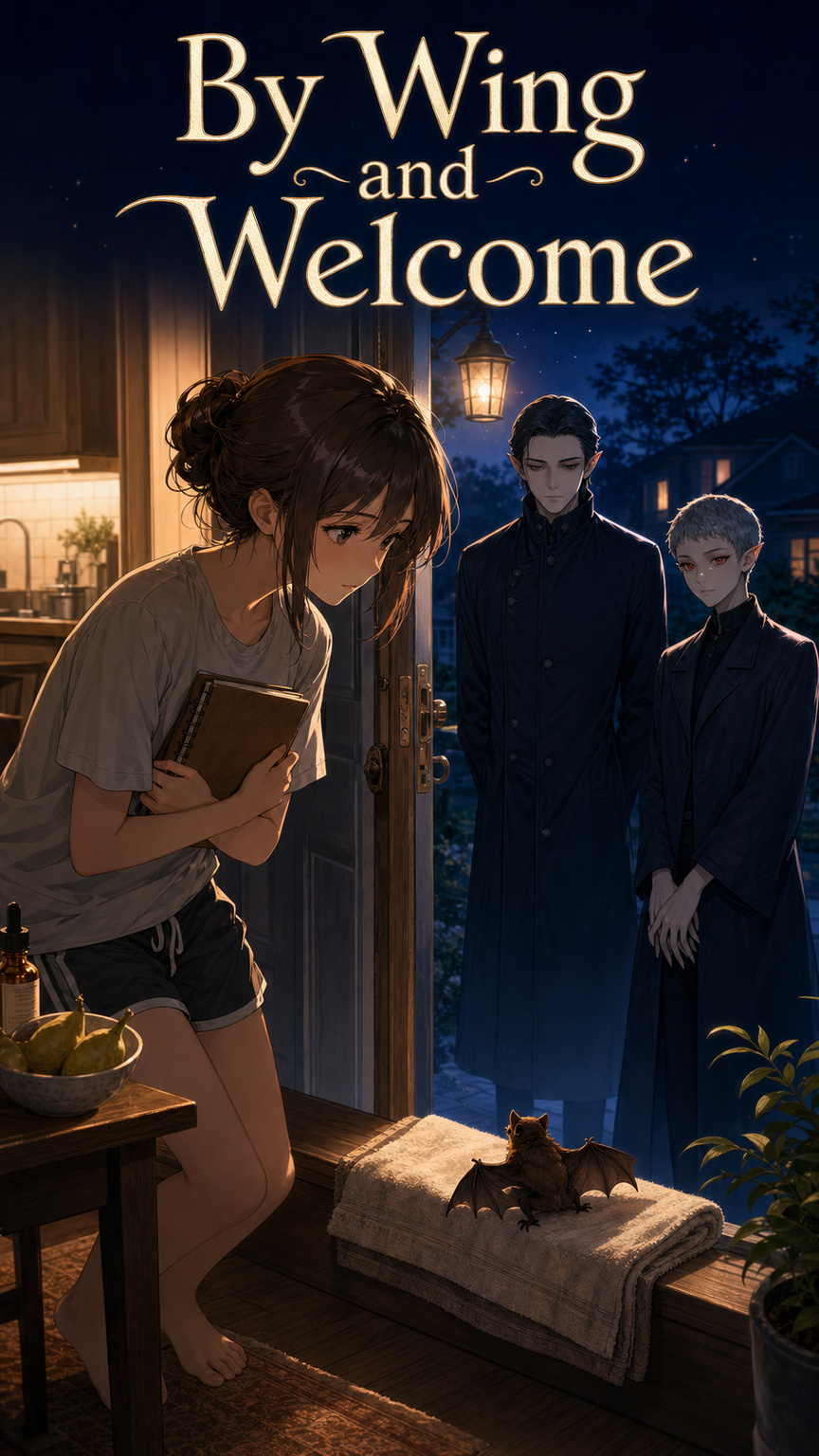
At seven thirteen, twelve evenings after Pippa found the bat on our doormat, she read his weight aloud while I held him in my gloved hands.
“Nine point two grams.”
“Check the decimal.”
My daughter bent until her braid brushed the scale. “Twelve point nine. I knew that. The six looks like a decimal when the light catches it.”
“It was a nine.”
“Then the nine looks like a six.” She wrote the correct number in the care log and underlined it once. Pippa was eleven and had spent twelve days learning that supervised wildlife care meant she recorded weights, changed water, counted mealworms, and kept the flight room quiet. It did not mean she got to put bare hands on a bat because she loved him.
The bat tucked his narrow head against my thumb. His right forearm had been cracked when Pippa found him, the wing dragging wet across the front step. That evening the joint moved cleanly and the membrane had healed to a thin pink seam. I lowered him to the landing board.
“May I check the other side?” I asked.
He put one claw on the green YES square.
Pippa and I had made the board on his third day, after he had ignored a dish I moved within reach, crossed half the recovery box, and planted himself on the word WATER. It offered YES, NO, STOP, WATER, PAIN, ALONE, and an alphabet strip—nothing more. A bat should not have been able to read block capitals. By then, a bat should not have been able to glare at my thermometer either. I had stopped saying should in front of him.
I examined the wing, then backed away. He climbed to the perch and shook himself. His ears flicked toward the rain ticking on the high window.
“Three full circuits tonight,” Pippa said. “Maybe four.”
“Three, if he chooses. Outdoor release is off while that storm sits over us.”
“I know. Controlled test.” She drew a box for the result. Beside it she had already written door shut, fan off, water left in her cramped capitals.
The doorbell rang.
The bat dropped flat against the perch. Pippa looked at me, then at the clock. Nobody visited on a release night, and nobody sensible visited in that weather without calling first.
“Stay here,” I said.
“You can’t supervise me from the front door.”
She was right, which was irritating. I settled the bat in his open recovery box, carried it to the front hall, and had Pippa wheel the landing-board cart behind us. I kept my gloves on.
The couple outside looked as though the storm had discovered two people who had dressed for the wrong century. The woman’s coat fastened diagonally with dozens of dull horn toggles. The thin edges of her ears rose through her soaked hair and turned separately, one toward my voice, one toward the recovery box. Beside her, a tall man wore a waxed coat cut with deep triangular pleats under the arms. Before he spoke, the skin at his throat tightened in two quick pulses.
“Is he there?” the woman asked.
The man said, “We believe the injured person in your care is our son, Teyo. He is twelve years old.”
The woman looked past my elbow, though she did not step closer. “And we came to ask if we may be godparents to your daughter.”
Pippa whispered, “They led with the second-weirdest part.”
I put my foot against the door. “Names. Yours, not his again.”
“Olya,” said the woman.
“Corven.” The man wiped rain from his mouth. “We understand that the combined request lacks an adequate sequence. Recovery first. Verification second. The pledge—if welcome—last.”
“Nothing is welcome yet,” I said. “How do you know there’s a bat here?”
Olya’s ears tipped toward the box. “I hear him.”
“You hear a bat.”
“I hear a frightened young one trying not to answer me.” Her hands closed on each other. “That isn’t proof. I know.”
Corven gave me the date Teyo had disappeared. Twelve days ago. He described a healed notch along the left ear and an injury to the right forearm, neither of which they could see from the step. Then he said, “When he is upset in this body, he bites cloth hems but leaves the seams intact.”
Pippa opened the log without being told. Day four: pulled towel under perch, three tooth marks, didn’t rip it. Day eight: did it again after weighing.
“People can guess,” I said.
“Not that,” Pippa said. “But they could’ve watched us.”
The lights went out.
For a moment the only illumination came from my battery alarm panel and the white tear of lightning above the road. Rain hammered the porch roof. In the recovery box, claws scraped cardboard.
I shut the door on the weather and locked it. That admitted Olya and Corven only as far as the tiled vestibule. “Pippa, backup pad.”
She was already kneeling at the cart. The small heat pad switched to its battery with an amber light. Its display settled on forty-eight minutes.
“Flight room will cool faster than the house,” I said. “We do this narrowly. You two stay here until he answers.”
Olya pressed both palms to her coat. Corven began, “Our kin can execute a voluntary bodily transition no more than once in the interval commencing at sunset and terminating at the subsequent sunset—”
“How long?”
“Three uninterrupted minutes without light. The change spends heat. It retains injury, hunger, memory, and the person.”
“Can you trigger it?”
“No name, touch, order, threat, appeal, or emotional extremity can initiate it in another person.”
“Plainly,” Pippa said.
Corven looked at her. Rainwater ran off his wing-cut sleeves. “No. We can’t make him.”
“Can he stop once he starts?” I asked.
“Not safely that we know.”
“Then we don’t start cold.” I checked the room thermometer: nineteen degrees and falling. “Twelve point nine grams. Healing forearm. He has flown only in this room, and not tonight. You will tell me only what affects his immediate safety.”
“Warm, awake, free to move,” Corven said. “And willing.”
Pippa rolled the cart into the flight room. I carried the open box. Olya and Corven waited behind the yellow tape I used to mark the handling area. The exterior release hatch was shut against the storm, but the door to the hall stayed open behind them.
The bat climbed out on his own. He ignored the board and stared at Olya.
She made a sound too high for me to hear. I knew only because her throat moved and the bat answered with a burst that my detector rendered as a scatter of descending clicks. He launched, circled once, and caught the mesh wall closest to her. Olya lifted a hand, then stopped it at her own chest.
Pippa watched the detector. “That’s his found-something sound. Not yes. Just—I don’t know. Excited.”
“Teyo,” Olya said. “Little—”
The bat dropped to the board and struck STOP.
Olya went silent so abruptly I heard the battery pad’s relay click.
Corven took one step back. Then another.
I moved the board closer without touching the bat. “Do you want the two people from the door inside this room if they stay behind the tape and do not touch you?”
YES.
“Do you want Pippa and me to stay?”
YES.
“One question at a time,” Pippa told Corven. “He can spell, but it’s slow, and his right side gets tired.”
Corven nodded as if she had given him a difficult professional instruction. “Understood.”
I pointed to the alphabet strip. “Are the letters T-E-Y-O your name?”
The bat tapped YES.
“Are Olya and Corven your parents?”
He held still long enough that Olya’s breath caught. Then he crossed to YES.
Olya made no move toward him. She only crouched behind the tape and turned her face slightly away, giving him the side view rather than the full attention of her large, light-catching eyes.
“Did you leave their home on purpose?” I asked.
YES.
“Did you have permission?”
NO.
Corven closed his eyes. Olya whispered something I did not understand.
“Don’t do that,” Pippa said.
Olya looked up.
“Not the other language. The sad noise like you already know everything. He hates when I do the sad voice.”
“Pippa,” I said.
“He does. Day six, after he wouldn’t eat.”
Olya’s fingers opened. “Thank you. I was answering for him with my face.” She tried the sentence again and lost it halfway. “I am afraid, so I keep—I see him and my hands—” She tucked them under her arms. “I will wait.”
The room thermometer showed eighteen. The pad read thirty-nine minutes.
“Do you want to change to the body that can speak?” I asked the bat.
YES.
“Now?”
YES.
“Are you in more pain than before the visitors came?”
NO.
He moved from NO to WATER.
“See?” Pippa said. “One thing.”
I set down the shallow dish. He drank, one wing slightly lifted for balance. Olya watched his ears instead of the dish.
“He dislikes moving air over his back when he is cold,” she said. “At home he crawls into the sleeve of my oldest coat. The brown one. It smells of cedar and burnt sugar.”
Pippa checked the log. “He hides under the towel when the vent comes on.”
“May I put this near him?” Olya opened her coat, revealing a lining patched in three shades of brown. “Not over him. He can enter or not.”
I asked. The bat selected YES.
Olya slid the coat across the floor and withdrew her hands before it crossed the tape. Pippa positioned it beside the landing board after he agreed to that too. He crawled halfway into one sleeve, nose working. His detector trace sprang into tight, rapid curves.
“Recognition,” Pippa said. “Maybe happy. You still have to ask.”
Olya nodded, but tears had reached her chin and she seemed unable to find any more words.
We prepared the room around his choices. I filled two sealed bottles from the hot-water tank while it still held heat and wrapped them in towels. Corven checked the blackout blind only when I told him he might. Pippa covered the alarm display with a folded cloth. When Corven suggested the recovery carrier, the bat struck NO before I finished the question.
“No carrier,” I said.
“The carrier would reduce the chance of a fall during altered balance,” Corven began.
The bat hit STOP.
Corven pressed his lips together.
I opened the carrier door and laid it on its side, available and empty. “He stays unrestrained.”
“Yes,” Corven said. This time there was no definition attached.
The pad showed twenty-seven minutes. We could wait for the power, but not with any assurance, and release into hard rain was no option. I wanted a veterinarian, a generator, daylight, and a week to decide whether impossible visitors were trustworthy. What I had was a cold animal who had just told me he was a child, two parents making themselves obey a strip of yellow tape, and Pippa noticing every time an adult let fear turn into permission they had never received.
“Who stays in the room?” I asked.
Through separate yes-or-no questions, Teyo chose all four of us. He wanted Olya and Corven behind the tape. He wanted Pippa beside me. He wanted no one touching him. He wanted the coat within reach and the carrier open. When I asked if we could bring up low light after three minutes, he chose YES.
“Last chance to stop before we start,” I said.
He rested one claw on YES.
Pippa corrected me. “That sounds like yes means stop.”
She was right again. I breathed out. “Do you still choose to change now?”
YES.
I shut the hall door, pulled the blind, and switched off my torch. The darkness was complete.
Pippa started the three-minute timer under the folded cloth. Nobody spoke. At first I heard the tiny working sounds of a bat inside fabric. Then the coat lining dragged across the floor. A heel struck the empty carrier and shoved it into the wall. Olya inhaled sharply but did not cross the tape. Somewhere in the second minute, the sounds became human breathing: quick, chilled, trying not to complain.
The timer vibrated against Pippa’s palm.
“Teyo?” I said. “May I bring up the covered lamp?”
A boy’s voice answered from the floor. “Yes. Low.”
I uncovered the lamp one fold at a time.
He was twelve, or near enough that the number fit his narrow shoulders and furious embarrassment. Olya’s coat covered him from collarbone to shin. His ears were smaller than hers but had the same fine mobile tips; his eyes caught bronze at the edges. His right forearm lay guarded against his ribs. A thin healing abrasion crossed the inside of the wrist exactly where the wing seam had been.
Olya stayed behind the tape. “May I come to you?”
“Not yet.”
She sat down where she was.
I knelt outside his reach. “May I examine your arm?”
“In a minute. Bottle first.”
I rolled him one of the wrapped hot-water bottles. He trapped it between his knees. Pippa handed over the cup only after he asked. He drank, shivering hard enough to tap his teeth on the rim.
“Pippa said you could read,” I said.
“I can. Spelling with one foot is awful.”
“You used your left,” Pippa said.
“My right hurt.”
“I put the letters closer on that side.”
“You put Q beside P.”
Pippa turned to me. “That was one time.”
The ordinary irritation in his voice did more than his ears or Olya’s coat had done. This was the same particular patient who shoved cards aside when they inconvenienced him.
He let me examine the arm. The change had not repaired it or broken it anew. The same forearm remained tender; the same motion caused him to flinch. His temperature worried me more. I wrapped a second warmed towel around his shoulders with his permission.
“Tell me who they are, and how you reached our door,” I said.
Teyo looked at his parents, then at Pippa. “Olya’s my mother. Corven’s my father. I left through my bedroom window. They said I wasn’t cleared to fly alone after dark. I went anyway. There were moths by the school field. I followed them too far, hit a wire over your lane, and came down on the step.”
“Why our step?” Pippa asked.
“It was the first dry one. Then you came outside in socks and asked before you put the box over me.”
Pippa looked down at her slippers.
“Did you know your parents were searching?” I asked.
“I heard calls on three nights. I couldn’t answer far enough after the fall. When I got stronger, I didn’t change because it would take heat and I didn’t know where I was. After that I wanted to finish the wing test.”
“You could’ve spelled HOME,” Pippa said.
“I didn’t want them called until I knew I could fly.”
“That’s not a good reason.”
“No.” Teyo looked at his parents. “It wasn’t.”
“You wanted release?”
“I wanted to know if I could fly.” He glanced at Corven. “Before the lecture.”
Corven said, “There will be—” and stopped. “Yes. Later.”
“Do you want to go home with them tonight?” I asked.
Teyo drew the bottle closer. “Yes. I want you to check the arm first, and I want food. Then home. Medical care tomorrow. They can be angry after I eat.”
Olya laughed once, badly, and covered her mouth. “May I?”
Teyo considered her open arms. “You can sit here. Don’t squeeze my right side.”
She crossed the tape only after I moved it and sat beside him. He leaned against her left shoulder. Corven waited until Teyo crooked two fingers at him. Then he joined them, plain and careful, and offered his hand instead of taking Teyo’s.
Pippa pulled me into the hall while Teyo ate toast with honey. “Now they can ask the godparent thing,” she said. “But not because I fed him. He would’ve got fed anyway.”
“Agreed.”
“And I talk first if it’s for me.”
“You ask first. We decide together.”
Back in the flight room, Corven wiped honey from his sleeve while Teyo denied putting it there. The power remained out, but his temperature had begun to rise.
“Explain the offer,” I said. “Exact obligations. No ceremony.”
Corven straightened. “Godparent is the nearest English term, not an exact translation. In our family, adults may make one optional pledge to a household whose child has sheltered theirs. Until Pippa turns sixteen, we would owe her truthful warning of any danger our family causes or brings near her, as much as three nights of emergency shelter, and practical help such as transport, food, or supplies when we can provide it safely.”
“What do you get?” Pippa asked.
“No custody,” he said. “No access to you or your home. No obedience, secrecy, service, or claim. We do not become family unless you use that word. Refusing causes no offense.”
Olya said, “And this is our gratitude to carry. Not yours. Not Teyo’s.”
“Can you ask again if I say no?”
“No,” Corven said. “Not unless you invite the question.”
“Why me?”
Olya started with a sentence, lost it, and touched the damp patch over her own knee. “Because you kept noticing what he did. Because when we were foolish at the door, you—”
“I told you about the board,” Pippa said. “That doesn’t mean you know me.”
“No.” Olya gave a small nod. “It is what I know tonight. The pledge can stay unmade.”
Pippa and I went to the kitchen alone. She asked whether emergency shelter meant sleeping in the wing coat. I said we could prohibit the coat. She asked if they could take her anywhere. I said not under the offer and not under any agreement I would accept. She asked whether Teyo got to be her friend without the adults’ pledge.
“Yes,” I said. “Separately. With the usual rules.”
“Group messages?”
“No hidden messages. No deleting. At first, the family account.”
“That’s annoying.”
“It is.”
She ate half a piece of Teyo’s toast while she thought. Rainwater crawled down the dark kitchen windows. At last she said, “One year. Then we both have to say yes again. You and me.”
“Either of us can end it sooner.”
“And no surprise visits. They knocked like a horror film.”
“No unsupervised visits or outings.”
“Not even flying ones,” she said, and that decided it.
We returned with the terms written on a page torn from the care log: a one-year trial, renewable only with Pippa’s and my joint consent; either of us could end it; no custody, secrecy, surprise visits, unsupervised access, or contact hidden from me. The obligations Corven had named remained theirs. Pippa did not owe thanks, work, or a relationship in return.
Corven read it twice. “This is acceptable.”
“Just say yes,” Teyo said through another piece of toast.
“Yes.”
Olya asked Pippa directly, “Do you want this for one year?”
“I want to try it,” Pippa said. “But you text before you come even if it’s raining.”
“Yes.”
Teyo chose his own departure just as carefully. He borrowed dry clothes from the emergency bin, let me fit a sling, and decided he could walk to their car if Corven carried the warmed bottles. Olya asked before touching the front door. I asked before giving Corven a copy of the care log. Pippa and Teyo exchanged contact details as peers on the family account, separate from the pledge, while the battery pad blinked down to seven minutes.
At the threshold, Pippa sent the first test message. Four phones sounded, not quite together.
“The supervised visit can be next Saturday,” I said. “Afternoon, after I speak to your doctor.”
Corven entered it. Olya checked that our number had arrived. Teyo asked Pippa to photograph the corrected board before she threw it away.
Pippa looked at Corven’s screen. “You put two sevens in Saturday’s date.”
He took his wet glove off and started again.