The Body Called One
After escaping Unit 02, a rebel pilot begins searching for its missing predecessor, only to discover that “Unit 01” was not another machine—it was her first body.
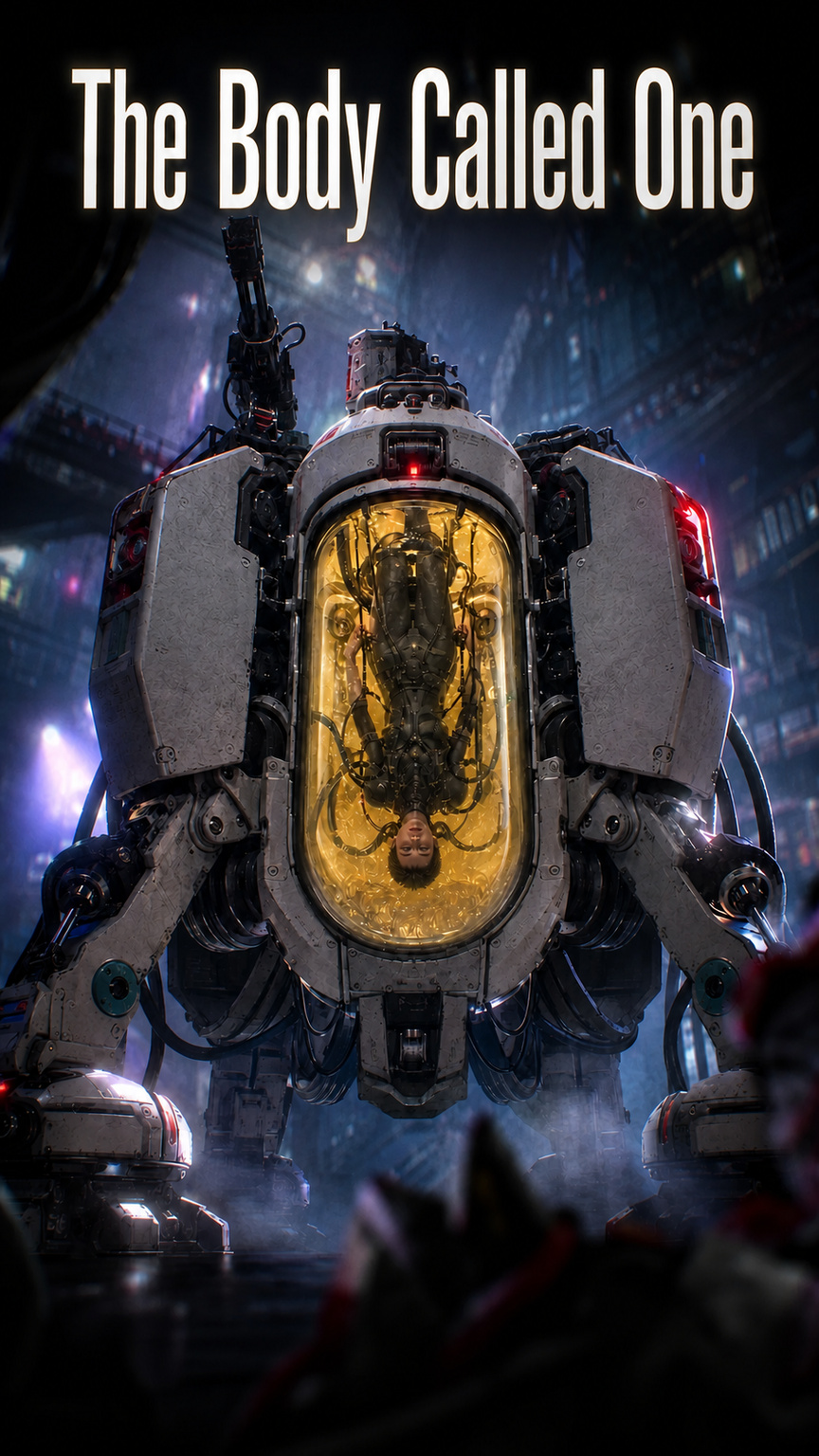
The stolen courier banked when Loxan Vythe tried to close her left hand.
Metal dust slid across the forward glass. A broken antenna mast turned end over end beyond it, black against Harrowstar’s white glare, and the courier’s proximity alarm knocked twice through Loxan’s teeth. She opened her hand. The ship leveled.
Her fingers lay in the restraint cradle where fingers belonged: five pale lengths, too many joints to account for, each tipped with a blunt nail. They were not port vanes. They did not have thrust authority. Less than an hour after the rebels had torn her active pattern out of Unit 02, her new body still disagreed.
“That was yours,” Mursa said through the bone link.
Loxan pressed her tongue to the rear molar that acknowledged audio. A green bracket closed around the tumbling mast.
“I mean the bank,” Mursa added. “Courier controls show no fault.”
“I know.”
Mursa’s carrier thinned as debris passed between them. Her voice lost its lower register first, leaving the consonants sharp inside Loxan’s jaw. “Then I can stop checking the courier and return to checking the retrieval craft. Seven hours at their current burn. Less if they know where the annex is.”
The emergency shell’s support meter showed nine hours and twelve minutes. It had shown ten when Loxan launched. Nobody had promised it would count honestly.
Ahead, the debris lane thickened into the remains of an orbital foundry: girders, slag blisters, rooms sliced open to vacuum. Harrowstar Annex was somewhere inside. Directorate records called it decommissioned. Directorate ships had changed course the moment Loxan transmitted Unit 02’s calibration code into the ruins.
“We can still make the rendezvous,” Mursa said. “Turn out now, you’ll have fuel for the quiet route.”
“And the next pilot?”
Static washed the answer away. A moment later Mursa sent three amber glyphs to the courier’s display: SIGNAL LOST, HOLD VECTOR, RETRYING.
Loxan held vector. She had spent four years believing Unit 02’s artificial cockpit was wrapped around her—believing her body slept somewhere below the armored deck while her nerves reached into a vehicle. When Mursa’s people opened the service channel, there had been no sleeping pilot to recover. Only the flight pattern, cut loose into this failing shell, and Unit 02 falling silent behind her.
Directorate records said Unit 01 had flown before her. Its control map might explain how the Directorate had done that. It might be the key to opening every other sealed cockpit.
Mursa returned as a buzz behind Loxan’s right ear. “I said the next pilot needs a command seed, not your wreckage.”
“Find me one without going in.”
Mursa breathed once over the link. Paper rustled on her end; she still kept sums on paper when she did not trust a system. “Six hours, forty-one minutes until they can acquire us. I want that number acknowledged.”
Loxan touched the molar. Then an obsolete guidance light winked among the wreckage.
Blue. Dark. Blue-blue.
Her right shoulder pulled back before the second pulse. She drove the courier down and through a gap that had looked too narrow. The broken foundry rolled above her. A beam passed so close that its frost streaked the glass.
“Loxan.”
“Clear.”
“You moved before I marked the route.”
She had. The turn had arrived as a flinch along a limb she no longer possessed, a long rigid span hinging from somewhere behind her ribs. Port control surface, she would have called it yesterday. Now her small shoulder throbbed where the impulse had ended.
“Inherited calibration,” Mursa said. “That’s why we’re here.”
The lights led them deeper.
Harrowstar Annex did not have a hangar. It had a slit in the foundry wall just wide enough for the courier, followed by a docking throat that tightened around the hull like a measuring ring. When Loxan laid her hand on the neural plate, faded words appeared across the forward glass.
UNIT 02 CALIBRATION SIGNATURE.
RETURN ACCEPTED.
The clamps caught.
Loxan unstrapped. Standing remained a sequence she had to perform consciously: feet under hips, weight forward, knees released but not too far. Unit 02 had never needed knees. The shell was adult-sized but spare, grown quickly around bone that had not thickened under gravity. A clear support line entered beneath her lowest rib and trailed to a pack at her waist. It tugged when she moved.
“Seal reads clean,” Mursa said. “Your pack?”
Loxan showed the status icon to the link.
“Eight fifty-six. It is counting worse.”
“Noted.”
She crossed the lock. On the annex side, the door had a hand-shaped contact sunk into its center. Human-sized. The walls beyond were too close for aircraft and too wide for ducts, with grab rails at shoulder height and colored maintenance bands worn smooth by palms.
Loxan fitted her hand to the contact.
The annex struck a chord through her skeleton.
It was not music. The low tone settled behind her eyes while a higher one traveled along the right side of her jaw and vanished. Red flooded her vision. Then violet. Then a white horizon tipped six degrees to the left.
She corrected against it. Her heel left the deck.
“What did it send?” Mursa asked.
“Balance test.”
“I got an airframe diagnostic.”
Lines assembled in Loxan’s sight: a central chamber, paired structures extending laterally, a round sensor housing above. The archive colored the left extension yellow. It looked enough like a craft if she held still.
She blinked.
For that fraction of darkness, the diagram’s horizon disappeared too.
Loxan blinked again. The recorded field pinched downward beneath a fringe of black curves.
“Airframes don’t interrupt telemetry to wet their sensors,” she said.
“Send it.”
Loxan pressed two fingers harder into the contact. Mursa received what the annex allowed through: a compressed visual trace, a frequency sweep, vectors labeled as pitch and roll.
“Could be pilot capture,” Mursa said. She spoke faster when assembling a signal theory, each condition slotted before the next. “They may have used someone’s inputs as a reference set. Unit 01 could still be hardware built from that set.”
The white horizon rolled. Loxan’s stomach tightened a moment after her eyes had already told her she was falling.
“Six-degree correction,” Mursa continued. “Same bias Unit 02 carried.”
Loxan let go. The corridor returned, level and gray. Her body did not believe it.
“I carried,” she said.
Mursa went quiet.
They moved inward. Loxan’s boots woke strips of service light one at a time. Every third strip failed, and Mursa filled the dark spaces with a thin arrow in Loxan’s visual field. LEFT. TWELVE METERS. DOWN ONE LEVEL. The glyphs were steadier than Mursa’s voice. Harrowstar’s bulk absorbed more of the carrier with every partition.
The first maintenance room held six vertical frames. They were narrow at the shoulders, broad at the hips, and fitted with cups for heels. Bundles of mineral-stiff tubing hung where heads would rest.
Not aircraft racks. Cradles.
On the nearest frame, a painted legend remained under layers of cleaning abrasion.
EMBODIMENT SERVICE.
Loxan touched the next panel with the back of her hand. She had learned not to trust her fingertips; the shell reported pressure there a quarter second late. A column of colored blocks appeared, then resolved under Mursa’s decoding into service categories.
OPTIC: RIGHT RETINAL INTERRUPTION.
A bright thread crossed Loxan’s sight. She turned instinctively from a light that was not there. Unit 02’s starboard camera had always flared along that exact angle. Maintenance had called it a harmless manufacturing seam.
The archive sounded another frequency sweep through the frame. Loxan heard the tones descend until one vanished on the right, returned, vanished again. Unit 02’s internal alarms had a dead band there. The Directorate had boosted them rather than repair the receiver.
Mursa sent a request for the raw table. “The notches match.”
Loxan leaned her forearm into a restraint cup. The frame sampled her posture. A muscle plot drew itself in orange: left shoulder rotation shortened after pain response; right hip compensated; head tipped against an unreliable horizon.
She knew the sequence before the plot finished. She had used it to bring Unit 02 out of a spin over the salt planet, dragging thrust on the right because the left side would not answer quickly enough. The maneuver had earned her a medal she never touched.
“Three matches,” Mursa said. “Visual, audio, control.”
“Body.”
“Not body. Not yet.”
Loxan pushed away from the frame. Her left shoulder caught, a small hot refusal. The plot’s yellow line stopped at the same angle.
“Four,” she said.
The room changed around them.
Partitions dropped over both exits. The service lights turned red. Text stepped across every frame, identical and unhurried.
LOOSE PROGRAM MATERIAL DETECTED.
UNIT 02 ACTIVE PATTERN.
RE-INTEGRATION ROUTE PREPARING.
The support pack at Loxan’s waist clicked. Its timer lost eleven minutes at once.
Mursa’s reply broke into scraps. “—not answer—move. Loxan, east panel—”
Loxan hit the nearest partition with her palm. No seam. Above it, a pressure diagram pulsed red. Mursa caught the pattern even when her voice could not cross. She stripped the alarm down to timing and returned it as two white arrows: ventilation intake opening, maintenance relief cycling.
Loxan climbed the frame. Her knees shook under twice their expected load. At the top, she forced her hand into the intake before its cover could close, tore skin across two knuckles, and pulled herself into a shaft barely wide enough for her shoulders.
The archive tipped the white horizon through her shell’s neural receiver. It wanted her to roll right.
She shut her eyes. The shaft pressed along her back and elbows; those were facts. Air brushed her injured hand; that was direction. She crawled toward it while the false horizon revolved.
At the first junction, a blue glyph from Mursa pointed right. Harrowstar drew horizontal reference bars across both branches; the bar on the left sat just above Mursa’s arrow. Loxan stopped.
The old muscle plot returned in her mind: right hip compensating, head tipped. Unit 01’s recorded horizon had run six degrees left. Mursa had mapped the instruction for a level maintenance route onto the archive’s uncorrected frame.
Loxan went left.
Mursa’s arrow flashed amber, then changed to left. “Found the construction plane,” she said, her voice briefly clear. “You were right.”
Loxan had no breath for an answer.
The shaft opened above a descending ladder. She hooked her legs through and nearly kicked free when her feet touched nothing. For one sick instant she expected a thruster to catch her. Then a rung struck her shin. She held on.
“Retrieval burn changed,” Mursa said. The paper was back; Loxan could hear the pencil scratch between bursts. “Four hours, maybe three twenty. Your support gives eight sixteen if the loss stays linear, which it won’t. Archive core is two levels down. Command-seed volume is small enough to transmit.”
Loxan descended. “And Unit 01?”
“No location yet.”
“Find one.”
“I’m finding the thing we came for.”
Loxan’s boot slipped. She caught the ladder against her forearm and waited for the shell to report whether anything had broken. Pain arrived late, blunt and purple at the edge of her vision.
“Find the cradle,” she said.
Mursa did not answer for eleven rungs. Then a new arrow appeared, pointing away from the archive core.
The preservation vault lay behind a round door with no hand plate. Loxan pressed her bleeding knuckles to a narrow black strip. Harrowstar sampled warmth, pulse, retinal motion, then played the missing high tone directly into her right jaw.
The door opened.
One cradle remained lit.
It lay horizontal under a clear cover, surrounded by coolant pipes and old manual gauges. Inside was a woman. Her dark hair floated in the preservation fluid, cropped raggedly around contact scars. Adhesive rings marked her ribs. One knee had been opened and closed with a pale surgical line. Her left shoulder rested a little forward, as if even suspension could not persuade it farther back.
Loxan walked to the glass.
The face did not unlock a memory. No lost childhood arrived. She saw a broad nose compressed by a breathing seal, a crease across the brow, lashes drifting over closed eyes. The archive’s green diagnostic line traveled from the woman’s chest to a display.
EMBODIMENT 01.
BIOLOGICAL ROOT: LOXAN VYTHE.
RETENTION PURPOSE: CALIBRATION / CHALLENGE RESPONSE.
By then the name did not surprise her. She read the purpose twice.
Mursa’s carrier clicked in and out. “I have the production table. One and two aren’t vehicle numbers. They’re embodiment sequence.”
Loxan laid her palm on the cover. The archive accepted the contact and began a challenge.
A sharp tone traveled through the cradle’s headrest. The woman’s right eyelid tightened. Light crossed the eye beneath it; the diagnostic registered a retinal interruption. A platform under the cradle tilted. The woman’s fingers flexed against the fluid as her balance trace rose six degrees late.
Loxan jerked her hand away.
The challenge stopped.
“What happened?” Mursa asked.
“It tested her.”
“Response quality?”
Loxan watched the fingers loosen. “She moved.”
“Voluntary?”
“No data.”
The answer sat between bursts of carrier noise. Mursa did not offer a theory.
Loxan opened the record index instead. She scrolled with a wheel beside the cradle, each turn producing a dry mechanical tick. The entries were short: acquisition passes, tissue damage, pattern comparisons. Unit 02’s neural lattice had been grown from mappings taken here. The extraction field was listed as destructive to active continuity. A later note called the preserved responses inconsistent above the reflex threshold.
Nothing in the table said what had awakened in Unit 02. Nothing recorded whether the higher responses in the cradle belonged to reflex or awareness. After that, the records offered only comparison percentages and maintenance instructions.
“Seed located,” Mursa said. “It’s coupled to the challenge-response table. Forty seconds to copy.”
Loxan looked at the woman under the cover. “The seed is her body.”
“It’s a biometric response set.”
“Taken how?”
Mursa pulled a page across her desk hard enough for the microphone to catch it. “Run one challenge and I can trace—”
The woman’s hand twitched again. No tone this time. Perhaps the muscles were settling. Perhaps not.
Mursa stopped. “Don’t run it.”
An impact trembled through the annex. Fine rust lifted from the door rim.
“Retrieval probe,” Mursa said. “They launched it ahead of the craft. That cuts three hours. We have nineteen minutes before a boarding path, less if Harrowstar helps them.”
Three options lit on the cradle controls. Full archive extraction required twenty-seven minutes. Seed copy required forty seconds and another challenge. Emergency cradle release required one minute, fifty.
The record index—the locations of other calibration vaults, without their keys—needed thirty-eight seconds.
Loxan selected index.
“Confirm,” Mursa said.
“No full table. No seed.”
“We leave with addresses and no key.”
Loxan braced both hands on the manual release. “Two minutes.”
A second impact shook the vault. Mursa exhaled. “Index first. Release on my mark.”
The archive poured its address list into Loxan’s visual field. She could have acknowledged each block through the neural contact, but the contact also offered re-integration, bright and immediate. Instead she read the blocks aloud in groups while Mursa caught them through the failing audio. Halfway through, the carrier dropped.
Loxan kept reading. Her voice sounded small against the vault walls. On the twenty-third group, a white square flashed at the edge of her vision: Mursa had restored the visual channel but not sound. Loxan changed to glyph acknowledgment, closing her left fist each time a block cleared. The old reflex tried to bank the absent wings. Her feet shifted against the deck.
Thirty-eight seconds.
The last block turned green. Mursa sent one word.
PULL.
Loxan hauled the manual release. Nothing happened. She changed her grip, leaned from the right hip, and felt the left shoulder stop where the archive’s orange muscle line had stopped. The lever wanted the range that first body had never possessed.
So the maintenance crews had built a second grip lower down.
Loxan found it beneath the housing, planted her heel, and pulled. The cradle seals opened with a long wet sigh. Fluid drained into the base. A transfer shroud folded around the woman, keeping the lines at her throat and ribs connected to a compact pump.
The shell’s support timer dropped below seven hours.
Loxan unlocked the cradle wheels. The first refused to turn until she kicked its brake. The late pain in her forearm sharpened. She pushed anyway.
Mursa gave her the route in light: white arrows for open passages, amber bars for pressure changes, red crosses where the annex had sealed itself. No voice softened the work. At the shaft junction, the white arrow pointed toward a service lift Loxan had missed on the way down. At the lift, an amber bar flashed twice before the floor lurched upward. Loxan caught the shroud with her hip, one hand on the woman’s shoulder through the fabric, the other locked around the rail.
The shoulder beneath her hand was warm.
Harsh white flooded the lift. The retrieval probe had opened the outer maintenance ring and was forcing Harrowstar to cycle its lights. Text covered the wall.
UNIT 02 ACTIVE PATTERN.
BIOLOGICAL ROOT PRESENT.
AWAIT RE-INTEGRATION.
Loxan looked away before the archive could place a horizon in her sight.
The lift stopped one level short. Mursa’s arrow broke into scattered pixels. Loxan pushed the cradle into the corridor as a partition began to fall. Its lower edge struck the shroud’s metal frame. The archive held it there, neither open nor closed.
Loxan crouched and put both hands under the frame. The shell’s muscles trembled. Unit 02 could have torn the partition from its track. This body had blood leaking across two knuckles and a pulse that sprinted whenever she stood too quickly.
She lifted. The cradle wheels cleared by a finger’s width, then another. The woman’s head rolled gently inside the shroud. The green line on the pump continued.
Loxan shoved. The cradle went through. She followed as the partition struck the floor behind her.
Audio returned in the docking throat.
“—see you. Loxan, I can see you.” Mursa’s words overlapped themselves as delayed packets arrived together. “Courier is pressurized. Probe has the outer clamp. You get one launch.”
Loxan rolled the cradle into the passenger bay and fixed all four wheel locks. Unit 02’s false cockpit had never given her a passenger bay. It had shown her mission weight and center of mass. Now she pulled a restraint across a human chest, checked the pump with sore fingers, and tightened the second strap because the first sat too near the breathing line.
“Ready,” she said.
“Not quite. Your support pack is still in local mode.”
Loxan found the switch under her ribs. “Now.”
The courier launched while Harrowstar still held one clamp. Metal screamed through the hull. The ship yawed left. Her hand clenched; this time the courier ignored it because Mursa had locked neural assist out of the controls.
Good.
Loxan took the physical stick. Guidance lights pulsed through the debris—blue, dark, blue-blue—but the annex had changed their sequence for the incoming retrieval craft. Mursa marked them false with red crosses and laid a thin white route between the girders.
“Three seconds to roll,” Mursa said. “Not yet. Not—now.”
Loxan rolled. Her inner ear reported the turn late. Unit 02’s old correction rose in her shoulder; the emergency shell’s hand wanted to close. She left it open on the stick and flew by the debris moving across the glass.
The retrieval probe fired a tether. It passed under the courier and caught a slag blister, snapping it into their wake. Mursa’s voice vanished under the impact alarm. She replaced herself with two glyphs: DROP, BURN.
Loxan dropped beneath a broken furnace drum and burned until the support pump at her waist stuttered. The white route narrowed. Girders flashed past, close enough to turn Harrowstar’s glare into alternating day and dark.
Then the debris lane opened.
The probe did not follow. Its tether had wrapped the furnace drum, and it spun among the wreckage with its thrusters fighting the wrong mass.
Loxan eased the courier onto the quiet route. Her right arm would not stop shaking. Behind her, the transfer pump kept a steady green line.
Mursa came back at low volume. “Rendezvous wants a medical count.”
Loxan checked the shroud. Nothing moved inside it now except fluid in the clear throat line.
“Two bodies,” she said.
Mursa waited through a carrier skip. “Responsive?”
“One speaking.”
“Support for both?”
“Yes.”
Keys tapped on Mursa’s end. “Sent.”
Loxan adjusted the aft restraint by one notch, returned to the controls, and trimmed the courier left until both support lines hung clear.