The Bride Who Came Back
Each winter, the frozen kingdom sends one bride south to keep the fire kingdom from invading. This year, the woman they sent returns alone—while the southern capital burns behind her
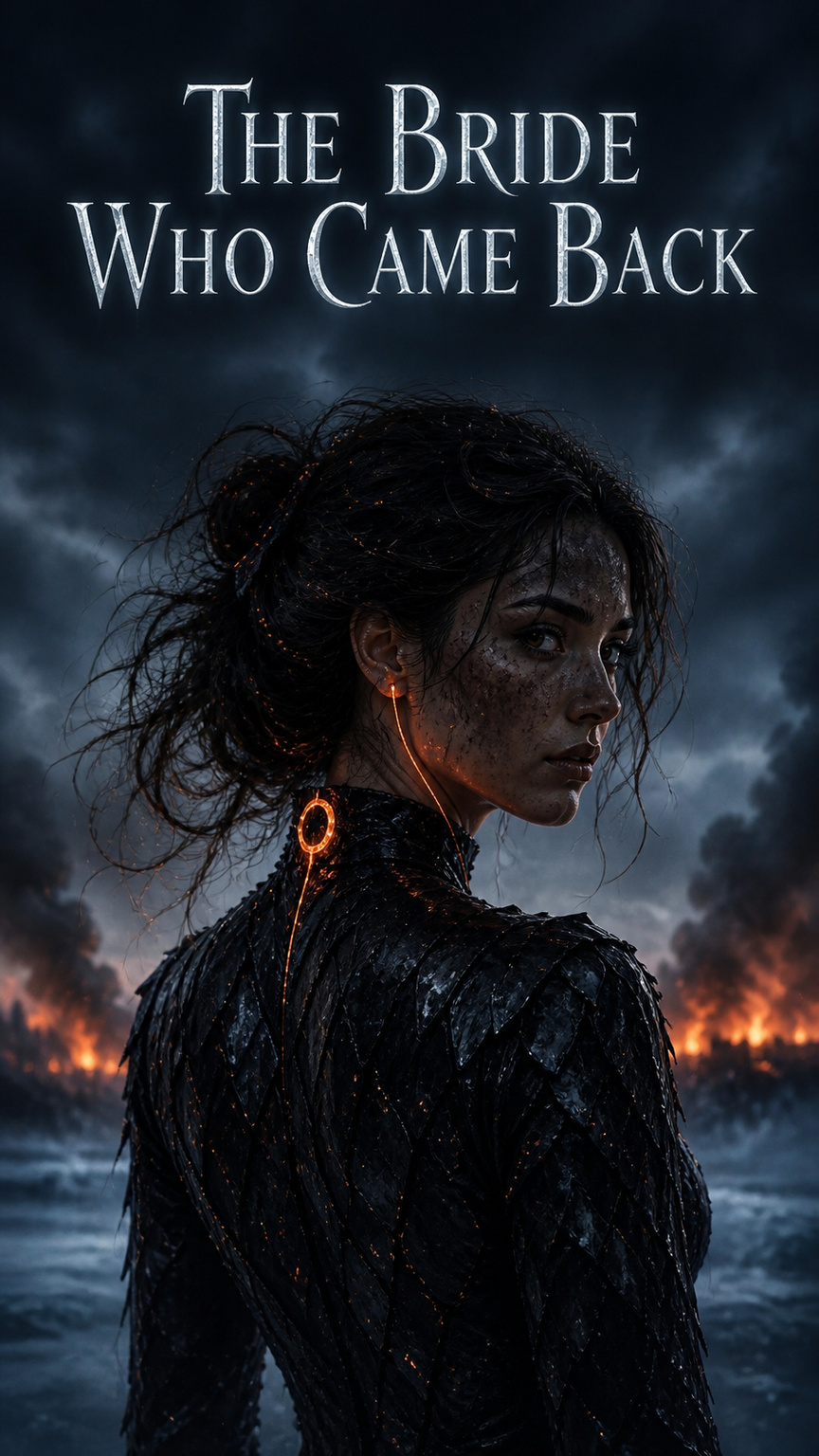
Ylva knew her sister by the way she lost every seventh step.
The figure on the causeway was still too far away for a face, no more than a black stroke moving north across the lake. Behind her, beyond the southern mouth of the pass, Cyrak burned. Smoke climbed over the mountains in a wall, turning the afternoon dark, and every gust showed a red seam at its roots.
But six steps came evenly. The seventh dragged.
“It’s Marzena,” Ylva said.
No one on the watchtower answered. Below them, the gate horns had already sounded three times: stranger approaching, southern fire, bar all doors. Soldiers heaved the last oak crosspiece into place. Frost sifted from its iron brackets.
Queen Tirza stood at the parapet with one gloved hand around the stone lip. “We cannot know that yet.”
“She broke her left ankle on the fish stairs when she was twelve. She still cheats that foot when she’s tired.”
“Many people limp.”
“Not at seven.”
Ylva counted again. Six, drag. Six, drag. The woman’s dress was the black of wet coal, though no cloth should have shone at that distance. Orange points ran over it and went dark. Her head was bare. Wind worried loose strands from the knot of her hair.
At first snow, twenty-three days ago, Marzena had gone south in a hood of white fox and a gown made from Iskal’s winter glass. She had walked between two files of Orravan soldiers without looking back. One bride each winter, and the fire kingdom kept its army below the pass. That was the treaty. In school, Ylva had been made to copy it until the words felt as natural as weather: one bride, one winter, one border at peace.
Brides did not return. They lived in the warm courts of Cyrak, Iskal was told, honored and secluded by southern custom. When Ylva had asked why none came north even to be buried, her tutor had struck a line through the question and made her copy the treaty again.
The figure stumbled. One hand struck the ice. A circle of water opened beneath her palm.
Ylva ran for the stair.
“Stop.” Tirza’s voice carried the clean edge it had in council. “Until we know what she carries, the gate remains barred.”
Ylva turned. Her mother’s face had gone pale except where the southern light laid copper along one cheek.
“She carries your daughter.”
“She may be followed.”
Ylva pointed into the pass. Nothing moved there but smoke.
“Smoke can hide an army,” Tirza said.
“Then keep the gate shut. I’m going out.”
She did not wait to hear whether this was forbidden. At twenty-four, Ylva had outgrown the fear that her mother could stop her feet. She had not outgrown the wish that Tirza would try for the right reasons.
In the lower guardroom she took a coil of lake rope, an ice hook, a wool cloak, and the short iron knife used to cut frozen harness. The captain at the postern looked past her toward the stair, hoping for a different order.
“Tie the rope to me,” Ylva said.
“Her Majesty said the gate stays shut.”
“This is not the gate.”
“Princess—”
“If I fall through, pull.”
That, at least, was an instruction he understood.
The postern opened just wide enough to put her outside. Cold took the wet from Ylva’s eyes and stiffened it on her lashes. The causeway was not a bridge but a winter road laid across the narrowest part of the lake, black ice thick enough for wagons and polished by a hundred years of bride processions. Today it groaned under one woman.
Ylva went quickly until she felt the rope tighten at her waist. Then she shortened her steps. Marzena had stopped on the southern half of the causeway, bent forward with her hands on her knees. Steam came off her shoulders.
“Marza.” The childhood shortening slipped out before Ylva could stop it.
Marzena lifted her head.
The south had changed her in less than a month. Soot filled the hollows beside her nose and lay in the fine cracks of her lips. One eyebrow had burned away at the end. The black gown fitted her too closely, not sewn but hardened around her ribs in overlapping scales. Hair-thin cords ran from its collar into the skin below her ears. Other cords trailed from the skirt, drawing bright scratches across the ice.
Her eyes were the same. Grey, irritated, and at that moment fixed on the cloak under Ylva’s arm.
“Don’t,” Marzena said.
The word ended in a cough. She held up a hand when Ylva moved closer.
“The wool will catch.”
“You’re freezing.”
“I’m not.”
Around her boots, meltwater widened by a finger’s breadth.
Ylva stopped an arm’s length away. She had imagined this welcome in the time it took to descend the tower: an embrace, Marzena’s face against her shoulder, some proof that twenty-three days could be undone by holding tightly enough. Instead there was heat between them and a dress that made a faint ticking sound as it cooled.
Ylva bent two fingers into her palm, the sign they had used under the supper table to mean Mother is watching.
Marzena looked toward the parapet. Tirza was a small white shape above the closed gate. Then Marzena made the answering sign with the wrong hand.
It meant save me the last pear.
“You’ve forgotten,” Ylva said, and almost laughed.
“No.” Marzena’s mouth shifted. “You always did.”
The laugh came out of Ylva anyway, one ugly breath in the freezing air. It hurt more than crying would have.
From the gate Tirza called, “State your name and purpose.”
Marzena closed her eyes.
Ylva shouted back, “You know her name.”
“The gate requires an answer.”
“The gate is wood.”
“Ylva,” Marzena said. “Later.”
Her voice had the old shape of command, but not the strength. She took two steps north. On the second, a cord at her hem caught in a shallow crack. The gown pulled hard against her neck.
Ylva reached for it. Marzena slapped her hand away.
“Hot.”
“I had gathered that.”
“No. Hot enough to open your fingers.”
Ylva packed snow around the cord until its orange veins dimmed, scored it with the harness knife, and struck the cut with the handle. The glass snapped. Its loose end whipped across the ice and hissed into a puddle.
Marzena drew a full breath for the first time.
“How many?” Ylva asked.
“Four more behind. One at the collar.”
“And if we leave them?”
“The road goes into the lake.”
Practical answers. Marzena had always given them when the other kind cost too much.
Ylva moved behind her and began on the next cord. “Did you burn Cyrak?”
Marzena’s shoulders tightened. “Yes.”
The knife skidded. Ylva caught it before it spun away.
“That isn’t the whole answer.”
“It is the part you asked for.”
Marzena started walking again.
They went north a few steps at a time. Ylva cooled and cut each trailing cord while the rope dragged after her over the ice. At the gate, people were gathering despite the horns: soldiers along the wall, servants in the arrow slits, the bridal glassmakers in their silver masks. No one cheered. Cyrak’s fire painted all their faces alike.
When the third cord broke, something slipped from inside Marzena’s sleeve. She tried to catch it, missed, and swore.
Ylva picked it up. It was a strip of copper as long as her hand, blackened at one end and punched with rows of tiny marks. The seal of Iskal appeared at the start of every row. At the end of every row but the newest, a square had been driven through the metal.
“What is this?”
Marzena kept her eyes on the ice. “Their tally.”
“Of what?”
“Us.”
The wind pushed smoke over the sun. For a moment the whole lake went blue-black, and the marks in the copper seemed to multiply.
“How many are alive?” Ylva asked.
“The newest one.”
Ylva looked up. “You.”
Marzena nodded.
From the parapet, Tirza called, “What has she given you?”
Ylva could not make her voice work. Marzena answered instead.
“The marriage record.”
“We have the marriage record.”
“You have the arrivals.” Marzena coughed into her wrist. “This is the rest.”
The queen’s white figure did not move.
Ylva closed her hand around the copper. “Tell me.”
Marzena looked south. Fire showed in brief pieces when the smoke moved: a roofline, a tower, a running brightness that might have been a whole street.
“The gown is a bridle for their heat channels,” she said. “They fix the cords into the Crown Hearth. A living body inside Iskal glass keeps the winter fire from running wild. When the next bride arrives, they renew the binding.”
“Renew.”
“They take everything left in the old one.”
Ylva understood the punched squares. She wished she did not.
“The letters,” she said. Each bride sent three: safe arrival, gratitude for southern hospitality, assurances of health. Marzena’s first had praised oranges, although she hated them. Her second had used Ylva’s full title. There had been no third.
“Written with three readers behind me.”
At the gate, Tirza said, “You signed them.”
Marzena turned so quickly that the cords at her neck flashed. “I hate oranges.” The effort broke her voice.
Wind swallowed whatever Tirza said next.
Ylva put the copper inside her coat. “How did you get free?”
“I pulled the hearth hook out.”
“And the fire?”
“Went back through everything joined to it. Palace furnaces first. Then the bathhouses. The kiln street.”
Ylva saw, unwillingly, rooms she had never visited filling with flame. “You knew?”
“I knew it would go back.”
“How far?”
“No.” Marzena’s answer came sharp, before Ylva had finished. “They never told me how far. They told me enough to keep me still.”
“Did you warn anyone?”
“The women in the dressing room. The kitchen stairs. People on the east road when I ran.”
“Did they get out?”
Marzena stared at her.
“I don’t know, Ylva.”
The fourth cord took two blows from the knife handle. The fifth had worn a groove of water behind it; Ylva scored it twice before it snapped and sank, spitting, into the lake.
There it was: no innocent account waiting under the damaged one. Marzena had learned what her freedom would cost and had torn loose anyway. Ylva wanted to ask whether children had been in kiln street, whether the fire had reached the river quarter, whether Orravan soldiers were marching north because they had nothing left to guard. She wanted numbers that would make love simple.
The ice gave a deep, splitting knock.
Water ran across Ylva’s boot. They had reached the old pressure ridge at the center of the causeway. Heat pooled around Marzena’s feet, filling white cracks and turning them transparent.
“Move,” Ylva said.
“The collar first.”
Ylva went behind her. The final cord was thicker than the rest and vanished beneath the high collar, then emerged between Marzena’s shoulder blades as a glass loop bright enough to throw red through the skin around it. Ylva swallowed.
“I can’t get the knife under without cutting you.”
“Then go back.”
“Very useful.”
“I mean it.” Marzena’s breath snagged. “The loop spills all at once. Take the tally and go.”
Ylva crouched to pack snow against the collar. It vanished into steam.
“Was I next?” she asked.
Marzena said nothing.
“My measurements were taken again yesterday. Mother said it was caution.”
“Your name was first on the list they sent with me.”
The truth landed with less surprise than shame. Ylva had known. Somewhere underneath her outrage, underneath every hour she had spent at the watchtower, she had known why the glassmakers kept coming to her room.
“Is that why you came back?”
“Get off the ice.”
“Is it?”
Marzena rounded on her. The collar flared, and she flinched but did not turn away. “You were next. I wanted my own bed. I did not want to die in a room called Second Warmth. Choose whichever reason makes you move.”
“I took your bed.”
For one astonished second, Marzena looked offended. “Already?”
“You had six rooms in Cyrak.”
“I had one room with no latch.”
“You can have it back.”
“I don’t want your pity-sheets.”
The laugh hurt Marzena. It folded her at the waist, coughing, one hand pressed uselessly to her ribs. Ylva caught her forearm. This time Marzena did not pull away.
“You crossed the pass to insult my bedding,” Ylva said. “You don’t get to send me back now.”
“I crossed the pass because south had nothing that was mine.”
It was the closest Marzena had come to asking. Ylva tightened her grip.
Behind them, wood boomed. The postern had opened.
Queen Tirza came onto the causeway alone.
She had left her white mantle behind. A second rope circled her waist, its far end looped around the postern hinge; she had tied it herself rather than let a guard follow. Her boots were thin court leather. On the first slick patch, her arms flew out and one hard, ordinary curse crossed the lake.
Marzena made a sound that might have become another laugh in a kinder hour.
“Go back,” she called.
Tirza kept coming.
“Your Majesty,” Ylva said, because titles returned when intimacy hurt. “The ice is failing.”
“I can see that.” Tirza’s breath came fast. “If the cord is removed, what happens?”
“Heat,” Marzena said.
“How much?”
“They neglected my instruction.”
Tirza reached them. Up close, she looked older than she had on the tower. Meltwater darkened both knees of her gown where she had fallen.
“Where may I hold you?” she asked.
Marzena glanced at her, startled. “Left arm. Not the cloth.”
Tirza took her arm above Ylva’s hand. Marzena stood between them, rigid as the glass around her.
“I knew the treaty forbade return,” Tirza said.
Marzena looked toward the gate.
“I did not know it killed you.”
“You didn’t ask.”
“No.”
The lake shifted under their feet. Tirza’s grip slipped and closed again.
Ylva heard herself shout, “Why not?”
For once, her mother had no council answer ready. Her mouth opened, closed. She looked past them at the southern road as if an answer might still be coming up it.
“Because then I might have had to say no.”
No one forgave her. The wind went on dragging smoke north.
Ylva pushed the knife under the collar loop. Marzena jerked.
“Wait,” Tirza said.
“There isn’t time.”
“I was not speaking to you.” Tirza shifted her hand, not tighter but steadier. “Marzena. Now?”
Marzena shut her eyes. After a moment, she nodded.
Ylva cut.
The loop sprang apart with a noise like a plate breaking. White heat struck the ice. Water leapt around their boots, and the causeway dropped half a hand beneath them. Tirza went down. Marzena fell against her. Ylva’s rope snapped taut and threw her backward, but she kept hold of the knife.
For several breaths the severed cord burned beneath the water, orange, red, then a dull cherry glow. It did not reach for them. It did not follow. It spent what remained and went black.
Tirza struggled to one knee with Marzena’s weight across her shoulder.
“Was the fire an accident?” she asked.
“No,” Marzena said.
“Are you asking me to pardon you?”
“No.”
“What are you asking?”
Marzena’s answer was so quiet Ylva nearly missed it. “Open the gate.”
Tirza looked at the black water spreading over the road, at Ylva, and then at the daughter she had sent south. She raised her free hand.
The crosspieces began to move.
They reached the gate as the last one lifted. Soldiers stood back from Marzena’s smoking dress. No one knew whether to bow. Tirza stepped across the threshold first, then turned and waited.
Marzena stopped outside.
“Am I under arrest?” she asked.
The queen opened her mouth. Ylva watched her reach for law, condition, title—any clean thing that might stand between them.
“No,” Tirza said.
“Then what am I?”
Tirza had no answer. Instead she stepped aside, leaving the whole width of the doorway clear.
After a moment, Marzena crossed it.
Inside the guardroom, the healers peeled the dead glass from the gown with bowls of snow and blunt iron. They worked behind a screen, and Marzena refused sleeping draught until every cord lay cooling in a bucket. The captain brought news in scraps: no southern troops at the pass, no messenger, no way to see beyond the smoke. By morning, any of those things might change.
Tirza listened, then pointed to the copper tally in Ylva’s hand. “Lock that in my private chest.”
Marzena’s head came up.
The queen stopped. “No. Keep it.”
Ylva put it back inside her coat.
“And the procession?” the captain asked. Everyone in the room knew he meant Ylva’s.
Tirza looked at Marzena, wrapped now in three grey blankets, her face slack with exhaustion.
“No bride leaves Iskal,” she said. “Not tonight. Not at dawn.”
It was not a plan for the army Orrava might send. It was not justice for whoever had failed to outrun the fire. It was one door held shut.
They took Marzena to the room that had once been hers. Ylva had, in fact, moved into it on the ninth day after the procession, though she had kept Marzena’s cracked blue cup on the sill and her collection of bent hairpins in the drawer. She began to apologize for this. Marzena was asleep before Ylva reached the apology.
Tirza stayed at the threshold, wet and soot-marked from holding her daughter. Without the white mantle she seemed uncertain where to put her hands.
Ylva sat on the edge of the bed. “Are you coming in?”
“If she permits it.”
Marzena did not open her eyes. “Shut the door,” she whispered. “You’re letting the cold in.”
Tirza obeyed. Then she sat on the floor beside the bed, boots still wet, while Marzena slept before any of them could ask her for another thing.