Nine Lives of Excuses
you inherit a magic cat that gives advice about life when you complain to it. However, one day it snaps, giving you a long frustrated lecture about how much of a waste you are and that you are the source of your own problems
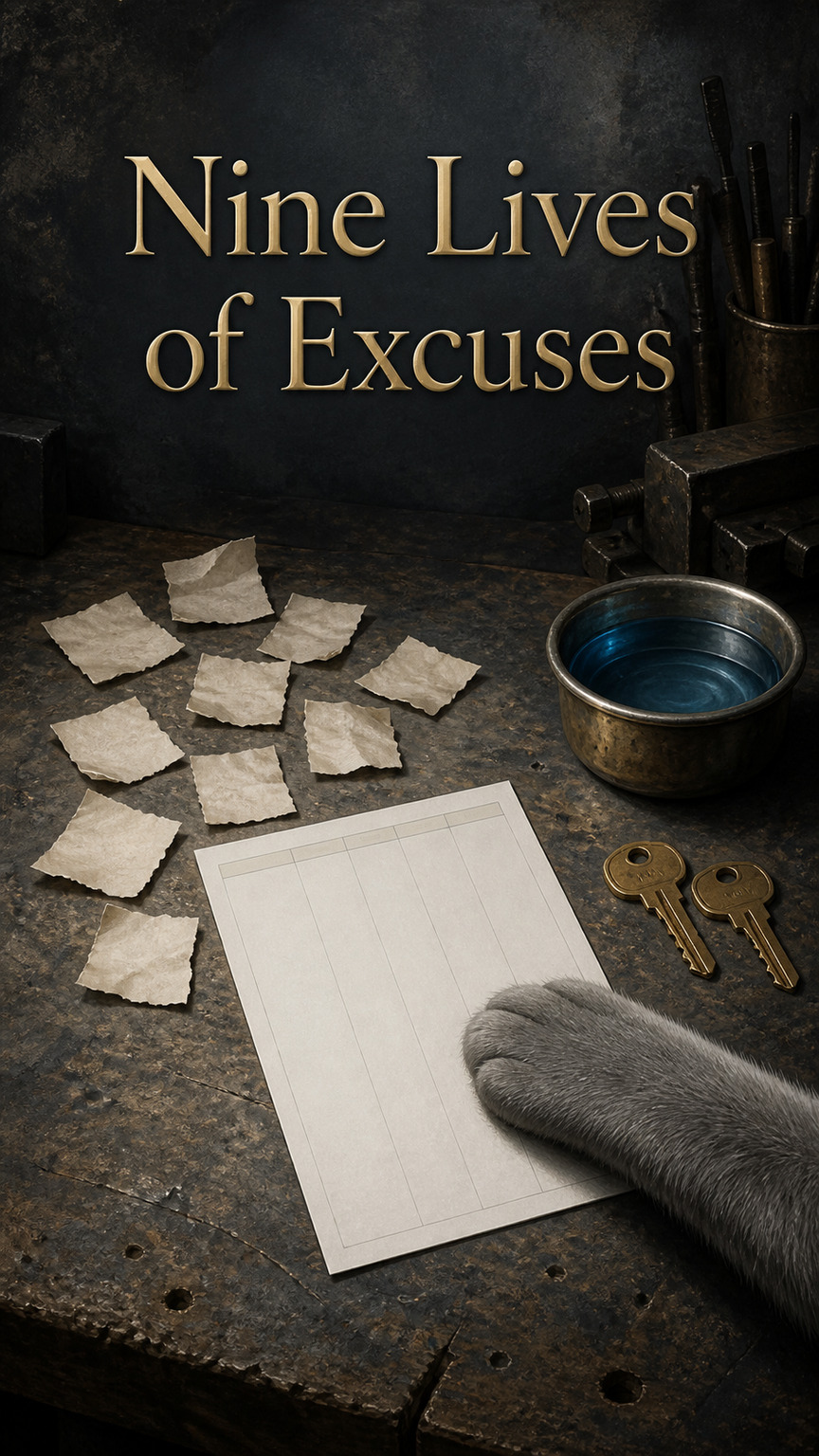
At 8:13 on Tuesday morning, Mizzle was sitting on the signature page of my personal guarantee.
This was not sabotage. Mizzle sat on anything that was both rectangular and important, a preference that had survived all ten months since I inherited her. The guarantee had only become important at midnight, when I moved it from beneath a cookbook to the kitchen table. Before that it had been paperwork, which was a different category entirely.
I drank my coffee and discovered it was cold.
“Mizzle, this is disgusting.”
She opened one green eye. “You poured today’s coffee onto yesterday’s and then forgot it beside the sink. Make fresh coffee.”
Her eye closed.
That was how her advice worked. A sincere complaint, spoken directly to her, bought one reply. It could be six words or six minutes; the length belonged to Mizzle. Questions got silence. Praise got silence. Fake grievances got the kind of silence that included slow washing between the toes. In the first weeks after she came to me, I had treated the rule like a coin-operated wisdom machine. I complained about sleep, work, whether to buy cheap shelving, and the woman downstairs who practiced scales at seven in the evening. Mizzle advised blackout curtains, sending invoices on time, wall anchors, and growing up.
Mostly, she was useful.
My phone buzzed beneath the sugar bowl.
My sister’s message read: FOUR O’CLOCK. If you’re in, bring the signed guarantee. If you’re out, tell me by noon so I can ask for the back unit. After four they keep the whole $8,400. I won’t chase you again.
The message made it sound as if the decision had been sitting around waiting for me. It had, technically, but not in that accusatory way. There had been the first lease packet, and then revised numbers, and then the contractor’s estimate, which altered the numbers enough that anyone sensible would have paused. My sister’s answer to the estimate had arrived nineteen days earlier. A person could hardly be blamed for wanting the dust to settle around a life-changing decision.
Mizzle shifted. The corner of the guarantee appeared beneath her flank, already creased.
“She’s cornered me,” I said. “Mizzle, I can’t believe my own sister would put me under this kind of pressure.”
Mizzle stood.
She was a small gray cat, round through the ribs, with one white paw and a dark stripe down her nose that gave her face the look of a document someone had tried to amend. Her tail expanded to twice its ordinary width. She stepped off the guarantee, leaving four warm dents in the paper, and looked up at me.
“Your sister did not corner you this morning,” she said. “You drew the corner, furnished it, lost the key in a bowl, and complained the room was poorly designed.
“You have been waiting to say this happened to you. I have watched you prepare. Six weeks ago you brought home those keys and slid them across the floor for me because you were happy. You said the front room could hold six tables, the ovens would go along the east wall, and your sister’s morning buns would pay the rent before the lunch trade even began. You called her at eleven forty-eight at night. You told her you had found the place. You told her not to be afraid of the deposit because there were two of you.
“Then there were two of you when she paid eight thousand four hundred dollars, but only one of you when the landlord asked for signatures.
“I know the order. I slept on the first packet for three days. Each time you lifted me off, you stared at the last page, took a photograph of it, and put it back under the green cookbook. You complained that legal language was meant to trick people. I told you to mark what you did not understand and call the tenant adviser. You marked two paragraphs. You did not call. When your sister found the adviser, you complained that the appointment was too early. It was at ten thirty.
“The contractor’s estimate was higher. That was a real problem. Your sister came here with the cinnamon rolls you left uncovered until they hardened, and the two of you cut the plan. She removed the second oven. You kept the painted sign. She asked you to choose between six tables and a longer counter. You said you needed to see both versions. She sent both versions. You opened neither for five days.
“On the sixth day you complained to me that spreadsheets make your eyes swim. I told you to read one line at a time. You spent forty minutes choosing a color for the bakery calendar instead.
“This is what you do. First a thing must be done. Then any person who names the thing becomes your new problem. The client who did not pay you was greedy until you found the invoice in your drafts. The landlord was neglectful while the pipe dripped under the sink, although you had not sent the photograph. The emergency plumber cost too much after you waited until the cabinet floor swelled and the door would not close. Yesterday I yowled through your call because my water dish was empty. You complained that I always need something at the worst time. You asked me what would make me stop. Water made me stop.
“You collect advice so that the choosing will belong to someone else. If the advice works, you were clever to ask. If it fails, you were misled. If you never follow it, you remain a person who might have succeeded under better circumstances. You have asked me whether to sign this guarantee four times without complaining, because you know questions do not compel me. Then you complain about your sister, hoping I will answer the question you are too proud to ask and too frightened to answer.
“You are not cornered. You are the source of the pressure in this room. Your sister’s messages became sharper because you ignored the soft ones. The deadline became dangerous because you used the safe days imagining how trapped you would feel on the last one. Her money is at risk because you asked her to risk it and then treated your name as the only expensive part.
“And yes, you are a waste. You waste food, work, sleep, favors, money, and every answer you drag out of me. You waste your sister’s competence by turning it into rescue. You waste your own talent by keeping it theoretical, where nobody can reject it. You have spent ten months making me hear the same complaint wearing different trousers, while I depend on you to remember water and food and the box in the laundry cupboard. I cannot leave. I cannot tell you in words that my dish is empty unless you first make my need about your inconvenience. Then you ask why I sound impatient.
“Perhaps you do not want the bakery. Perhaps you only wanted to be the person who was brave enough to propose one. I do not know. You have hidden so thoroughly behind delay that even you may no longer know. But do not stand over a paper you requested and tell me your sister built this morning. If four o’clock costs her more, it will be because you used the safe days without answering and made everyone ask again.”
Her mouth closed. The refrigerator hummed. Somewhere in the building, a pipe knocked twice.
I realized I was gripping the handle of my mug hard enough to ache.
“That was vicious,” I said.
Mizzle’s whiskers angled forward, but a statement was not a complaint. She said nothing.
“The pipe was rotten before I ever moved in, Mizzle. I hate how you turn every bad thing into evidence against me.”
“The pipe was rotten,” she said. “The soaked cabinet was seven days of you not sending one photograph. I used the examples I have. You selected the one with a rotten pipe and ignored the draft invoice, my empty dish, your sister’s six messages, and the paper under my body.”
“The invoice got paid.”
Silence. Another statement.
“It’s unfair that you get to decide when something counts as a real complaint.”
Mizzle sat down. “I do not decide. You do. That is why your voice changes when you mean it.”
I hated that answer partly because I could hear the change she meant. I tried, “Mizzle, the weather is persecuting me,” in a tone of theatrical despair.
She began washing her white paw.
“Should I sign?”
The paw passed over one ear.
“You just spent all that time telling me I caused this, and now you won’t even tell me how to fix it.”
“Correct,” she said. “I will not choose whether you bind yourself to a business.”
“Then what was the point of any of that?”
Question. Silence.
I picked up the guarantee. The last page asked for my signature beneath a paragraph stating that I understood what I was undertaking. My sister had placed a yellow tab beside the line. The tab said SIGN, not because she thought I could not identify a signature line but because she had once watched me return an unsigned tax form.
“You act like signing is the honest answer,” I said. “But I can’t stand the idea of being there at five every morning, smelling fryer oil in my hair, smiling at people who say a five-dollar pastry is too expensive. I don’t want to spend the next five years pretending the rush is exciting. I don’t want it anymore, and that makes this whole thing impossible.”
Mizzle stopped washing.
“Then tell her,” she said. “Leave out the five years and the fryer oil if you need to. Tell her you do not want it.”
“You don’t know what my sister can afford. You don’t know why I stopped wanting it. You don’t know whether I’ll regret it.”
“No. I know what I saw and what you told me. I know you wanted the shop when you found it. I know you stopped opening the plans. I know your sister paid because you promised. I do not know her accounts. I do not know whether the shop will succeed. I do not know what you will want next year. I know she does not know what you want today.”
“So tell me what to do.”
Mizzle looked at me for a long moment, then jumped down. I had given her an order, not a complaint. She walked to the bedroom, pushed her head through the door I had left almost closed, and disappeared.
I flattened the signature page over the rest of the packet. My pen was in the key bowl beneath three dead batteries, a grocery receipt, and the brass ring holding the temporary shop keys.
Ninety minutes passed. I read the guarantee twice, opened the bakery projections, and answered no messages.
Signing would have solved the immediate problem. It would prove Mizzle wrong about me wasting advice. It would prove my sister right to trust me. It would turn the morning into an ugly but useful shove, the kind successful people later thanked someone for.
I wrote the first stroke of my name.
Then I saw what I was doing: letting an angry cat choose, only in reverse.
At 10:26, I tore the signed corner off rather than pretending the mark had been accidental. I printed a new page. At 10:41, I put the guarantee, the two shop keys, and the contractor’s revised plan into my canvas bag. I did not send my sister a message saying we needed to talk. I had sent three of those already.
The shop was a forty-minute walk if I cut through the park. I left at 10:47.
Outside, the morning had the chilly brightness of a day that resented coats. Delivery trucks occupied half the curb. At every crossing, I composed explanations in which the estimate had changed, the lease was aggressive, retail was unstable, and my sister had moved too quickly. Every sentence was true enough to be useful. None included the fact that nineteen days ago, while we stood in the empty shop with blue tape marking the counter, I had imagined arriving before dawn and felt not fear but absence. Nothing. No warm leap at the room becoming ours. Only the wish to go home.
I had known then. I had let her order the electrical drawings twelve days ago.
The brass keys knocked against my water bottle all the way there.
My sister was kneeling inside the front window when I arrived. She had a tape measure stretched from the wall to a strip of blue tape on the floor. In the bare room, every sound returned thinner. The previous tenant’s sign brackets remained above the window, and flour-colored dust from the ceiling repairs lay in the corners.
She looked at the canvas bag. “Did you sign it?”
“The guarantee puts a lot of exposure on both of us. With the revised build-out, there are concerns that I don’t think we’ve fully—”
“Yes or no?”
Her hand stayed flat on the metal tape.
“No,” I said. “I’m not signing. I’m not opening the bakery with you.”
The tape snapped into its case. My sister stood.
“How long?”
“It wasn’t one moment.”
She waited.
The room offered no hum to fill the space, no refrigerator or pipe. Even the traffic outside seemed sealed behind the glass.
“Nineteen days,” I said. “The morning we taped the counter. I knew enough then to tell you.”
“Twelve days ago, I paid twelve hundred and eighty dollars for the electrical drawings.”
“I thought it might come back.”
“Did it?”
“No.”
She walked past me and locked the front door, though nobody had tried it. “The holding loss is eighteen hundred if we withdraw before four. After four, it is eighty-four hundred. The back unit was available at eight this morning. It may still be available. It has no front window and no customer seating. I can do wholesale and pickups there.”
“You could still do that.”
“I could have done it three weeks ago.”
“I know.”
“No, you know now. Three weeks ago, you let me keep spending.”
There was no useful answer. I took the keys from the bag and set them on the sill. She picked them up immediately and put them in her coat pocket.
“I’m sorry,” I said.
“All right.”
I had prepared answers for anger and for forgiveness. She gave me neither.
She took out her phone and called the rental office. Her voice changed, not softened exactly, but narrowed to dates and square footage. She gave the shop number, asked whether the back unit could still be transferred under the existing application, and listened without looking at me. Once, she closed her eyes. Then she asked for the transfer form before three and said she would return it within half an hour.
When she ended the call, she opened the contractor’s plan on the windowsill and drew a line through the front counter.
“They’ll transfer sixty-six hundred of the deposit,” she said. “They keep eighteen hundred. The smaller unit needs different drawings. The twelve-eighty is gone. Your half of those two losses is fifteen-forty.”
“I can pay you Friday.”
“Have you looked at your account?”
I had not.
“Then don’t give me another date. Check it. Send me a schedule you can keep.”
“Okay.”
She folded the plan along a line that had not been meant as a fold. “The release will come to your email. Sign it by three. Not four. I’m not using the last hour.”
I wanted to ask if she needed help measuring the smaller room, if I should revise the logo, if we could have dinner after this. All three would have let me feel useful before she had asked anything of me. She had already turned back to her phone.
“Do you want me to stay?” I asked.
“No.”
That answer did not require interpretation.
At home, Mizzle had pulled one of my socks from the laundry basket and was asleep with her chin on the heel. She opened her eyes when I came in, but she did not get up.
The release arrived at 1:36. I read all four pages. At 1:51, I signed. At 1:53, the portal marked the withdrawal received. My sister replied with two words: Got it.
My bank balance was $2,318.44. Rent and the phone bill would take $1,706. I transferred four hundred dollars to my sister and wrote: First payment toward $1,540. I can send $380 on each of the next three Fridays if the overdue design invoice clears this week; if it doesn’t, I will message Thursday with the revised dates.
The typing box showed that she was answering, stopped, then started again.
Her reply was: I’ll hold you to Thursday.
Mizzle came into the kitchen and sat beside her water dish. There was water in it, but a crescent of kibble dust floated along one edge. I emptied it, scrubbed it with the rough side of the sponge, and filled it to the blue line on the bowl. She drank for long enough that the refrigerator motor switched off around us.
While Mizzle drank, I sorted the lecture without asking her help. Rotten pipe: not mine. Seven days without sending the photograph: mine. Higher estimate: not mine. Nineteen days without telling my sister: mine. Her risk: hers. My promise that persuaded her: mine. Waste did not belong in either column, so I left it out.
Mizzle finished drinking and looked up at me.
I did not complain to her.
In the bedroom, my laptop still held the half-finished menu layouts for the client whose invoice had been late because I had sent it late. Three options were due the previous Friday. I opened the email I had been avoiding, attached the one complete layout, and wrote that the other two would arrive by ten the next morning. Then I checked the calendar before I sent it.
At 2:17, I set a forty-five-minute timer and began the second layout. Mizzle jumped onto the desk, stepped across the keyboard, and settled on my right forearm.
“You’re in the way,” I said.
Not a complaint. Not quite.
She stayed there. I moved the mouse with my left hand and kept working.