The Cat Who Kept the Door
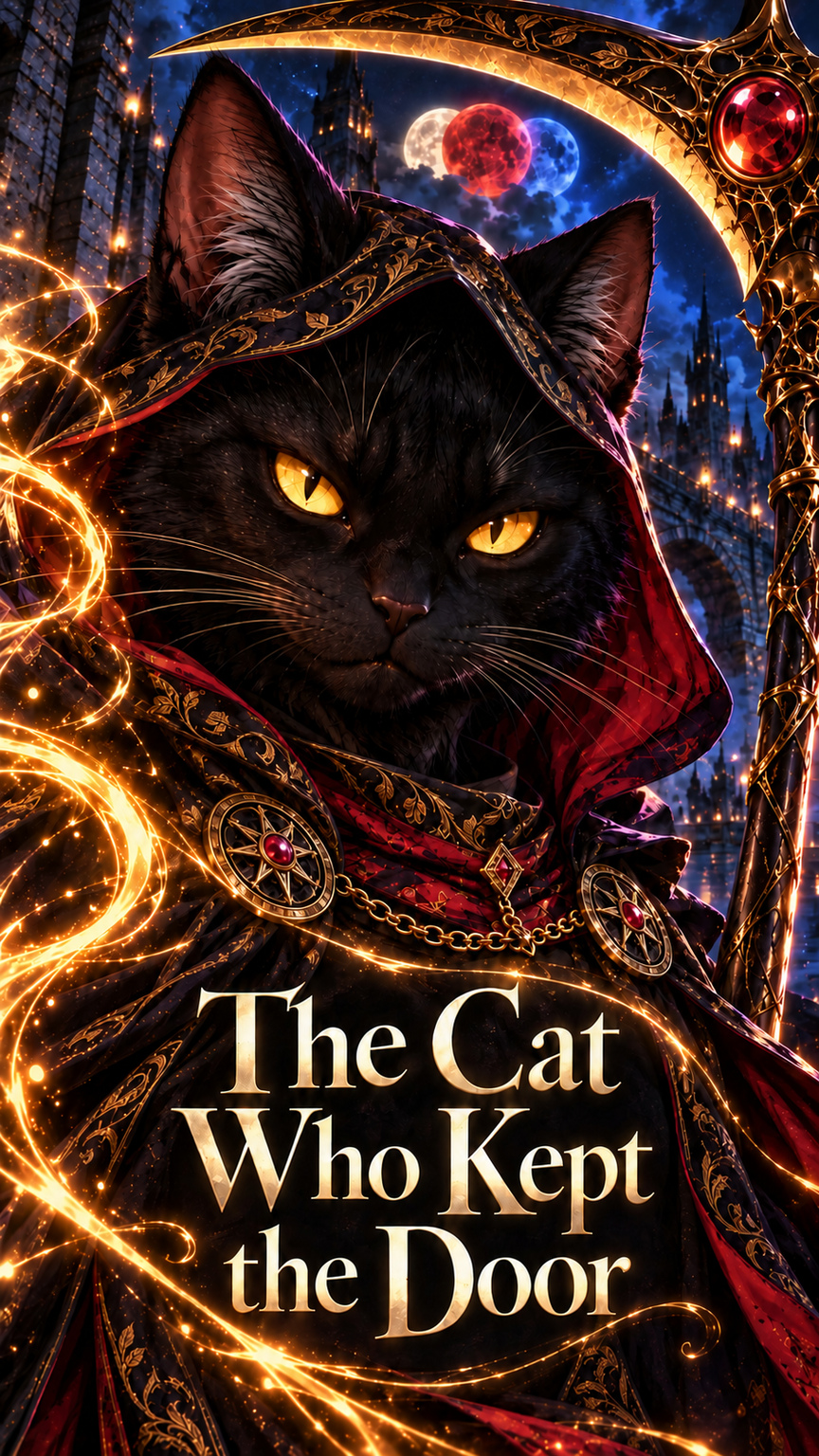
The kingdom’s most feared archmage is a black cat who has quietly served every royal family for nine life times—but on the night three moons finally align, he retrieves the scythe he swore never to wield again and informs the terrified young queen that something older than magic has just awakened.
Isabet had saved the quail’s liver for Murrant, but he stole it before she could offer it. His black paw slid between the stems of two wineglasses without disturbing either. Across the table, the commander of her cavalry stopped talking until the paw had withdrawn.
She had been queen for forty-one days. Murrant had slept outside her bedroom for all forty-one, and still she could not quite bring herself to tell him to get off the table. As a child she had watched him kill a man who had drawn a sword on her father. One burning breath, a body beneath a cloak. Afterwards he had hidden under her bed, furious when anyone tried to touch him.
Beyond the open windows, the pale moon approached the blue. The red moon already rested against its edge. Courtiers crowded beneath the painted ceiling; on the terrace an astronomer held up one finger, asking the kingdom to wait.
Murrant dropped the liver.
His ears flattened. Isabet looked at the windows, where the last pale crescent slipped behind the blue and all three moons stood in one line above the towers. Then she felt it through the soles of her slippers: a slow upward pressure, as though something enormous had put its back against the foundations.
The astronomer’s finger remained raised. Glasses rattled against plates.
Murrant sprang down and went behind the throne. Isabet followed him. Under the lowest panel of its carved back was a cupboard she had always supposed held cleaning rags. He pressed his nose against it. Three locks opened in succession, without keys.
A black robe unfolded out of the darkness. Its red lining settled over his shoulders; little gold clasps fastened beneath his throat. Then the scythe came out, butt first, scraping the flags. It was taller than Isabet. The inward curve of its blade had the faint blue sheen of a raven’s wing, and a red stone sat where blade joined shaft.
She knew it from the oldest battle tapestries. None of them showed what was left after its passage. They showed soldiers running from a small patch of black.
The scythe rose upright beside him. Murrant put one forepaw on its shaft.
“Something older than magic has awakened,” he said. “Older than any magic our people remember.”
She waited for the impatience, the flick of his tail that meant someone had overwatered the wine or misused a title. His tail was tight against his legs. A sour mouthful rose into her throat.
“What do I do?”
“Get everyone out of the palace. Go with them.”
She turned. The commander stood at the edge of the dais, his hand hovering near his sword. “Take them out through the west court,” she told him. “The servants too. No carriages. Get well clear of the walls.”
He looked at the weapon, then bowed and began ushering people toward the doors. As the first chairs overturned, Murrant slipped through the little door behind the throne, and Isabet followed him down to the tombs.
Her father’s burial chamber smelled of fresh mortar. A stone mason’s mallet still lay beside the uncompleted inscription. Murrant passed it without looking, the scythe floating lengthwise at his flank, and went on down the stair.
“I told you to leave.”
“How do you know what’s down there?”
He halted at the next landing. In the gold light gathering along his whiskers, his eyes were almost lost.
“I have guarded this place since the first family built their hall above it. If you come any farther, I may not be able to get you out.”
She gripped the stair rail. Above them, feet were running across the throne room. Below, a much deeper noise had begun: iron turning on iron.
She ought to go. He had said so, and he knew. But her father had gone into a room with his physicians, and everyone had told her to wait outside; she had been waiting outside things ever since.
“I’m coming as far as I can.”
Murrant stared at her. Then he turned, and she hurried after the red hem of his robe.
They passed the tombs of the family her grandfather had displaced, then a queen whose likeness had been chiseled off every coin. Beside that queen’s stone pillow lay a tiny collar, green enamel with a bell.
“Was that yours?”
“My second life. She thought I might wander into the kitchens and get lost.”
The next chamber held square coffins and no likenesses. Lower still, the kings lay on their sides inside jars. Murrant had served them all: these people whose crowns had different shapes, whose prayers Isabet could not read, who had killed one another and kept the cat. Nine lifetimes, the histories said. She had accepted the number as she accepted the nine golden points on his seal, something too old and official to question.
At the foot of the last stair, he stopped to tug a fold of robe from under his hind paw with his teeth. Beyond him, the masonry ended at a narrow door set in a metal wall. Isabet laid a hand against the jamb and snatched it back. Hot already.
The door stood open. Engravings around it showed an egg-shaped structure inside a much larger chamber: shut, opening, and open. In the last picture, a branching shape filled the egg’s center.
Murrant lifted his nose toward that picture.
“That is where it thinks. I spent most of my fourth life learning to read what its builders left here.”
“People made it?”
“People made a mind and gave it more power than they could take back.” He studied the black doorway. “Later people tried. Several civilizations of them. We built our first hearths in their ruins.”
Isabet bent close to the engravings. Around the central shape were lesser shapes, scratched through by some long-dead hand. Fine lines joined them to the center. Those had been cut through too.
“Those were other places where it thought,” he said. “All destroyed. Only this one can give orders now. It shut itself away to sleep until the sky reached a position its makers had chosen. Tonight.”
“Why didn’t you kill it while it slept?”
He lowered the scythe until the red stone brushed his forehead. A warm pulse ran along the edge, bright enough to show a pale scar across his nose.
“I tried. None of my fire ever marked it.” He touched the outer line of the engraved egg. “The shell was fused shut. With this I can part a join I can see. I cannot cut my way through a thing with no seam, however long I wish at it.”
The wall gave a metallic click. Warm air brushed her face from the doorway.
“Now it has to open or cook itself. I can reach the mind.”
He started forward, but she caught the trailing cloth of his robe. His head whipped around, teeth showing, and she let go.
“You swore you wouldn’t use that again.”
Her father had told her the story when she had wanted the scythe on her first banner. She had cried at his refusal, and Murrant had left the room.
“I did.”
“What happened?”
For a moment she thought he would go without answering.
“Two princes. Both wanted their father’s chair. One brought an army into the nursery wing to reach the other.” He looked up the long stair behind her. “I had slept across both their cradles. By morning I had killed them both. I died of my wounds. When I came back, I put the blade away.”
“You could come back again.”
His ears turned toward her, then slowly forward.
“That was my eighth life, Isabet.”
She had been holding her arms tightly across herself. Now she dropped them. Murrant looked much smaller with the robe dragging behind him.
“I didn’t mean you should die.”
“I know.”
“Are you going to?”
“I don’t want to.” He put his paw against the shaft again. The red stone brightened. “Keep behind me.”
The passage led out onto a gallery inside a chamber large enough to contain the palace. Isabet knew its breadth because a whole corner of the royal tombs had fallen through the roof and stood, impossibly small, among the things below.
All around the walls, jointed arms were unfolding from their housings. Some ended in delicate pincers; others held scoops broader than houses. Beneath them stood the armored body from the engraving, opened now along its upper half. A shell leaf the size of a tower gate hung from chains and counterweights above a service bridge running from the gallery into its side. Within that opening, hundreds of glass plates revolved around a white branching column.
Heat struck her hard enough to sting her eyes. Rows of identical copper teeth glowed below the plates. Here and there a little arm advanced, replaced a tooth, withdrew. Everything bore the repetition of manufacture, down to the same pattern of six pits on every turning joint.
Behind the open body a mast was rising in sections toward the roof. Each section locked with a crash. The ceiling split before its ascending point, letting down a white powder of stone.
“Aphan,” Murrant said, so quietly she almost missed it.
Light moved across the gallery wall. Three people stood there, small as living people, wearing white things close to their skin. One lifted a hand. Behind them rose a city of transparent towers, and beyond the city a crooked mountain Isabet recognized from her nursery window.
The people vanished. The mountain wore a pale cap, then lost it; its crooked summit broke away. A forest covered the transparent towers. Men in copper masks dug into their foundations. Isabet watched another city grow on the same slope and burn, and a third spread its long black roofs over the ash. Their work occupied a few breaths. The mountain kept wearing down.
Her own palace appeared at last, bright as a toy on the ruins.
“You occupy my crown station,” said a voice from the rail under her hand.
She recoiled. The same voice continued from far below, deep enough to shake dust out of her sleeves.
“I am Aphan. I receive your attendance.”
Murrant had crept along the gallery to the service bridge. Isabet stood where she was, trying to remember how an envoy from another throne ought to be received. Everything she knew began with a list of ancestors. She had just seen them reduced to the last finger’s breadth of a dying mountain.
“I am Queen Isabet. We didn’t know you were here.”
“Your companion knew.”
“I didn’t know. Nobody told me.”
She wished she had not said that. It sounded like a child denying she had broken a cup. She glanced at Murrant, but he was studying the bridge. A wheeled carriage crossed its far end, carrying a load of black rods into the open shell.
“Your inhabitants will be removed from the station,” Aphan said. “I will require the high ground around it.”
On the wall, buildings vanished from the image of the city in widening circles. In their place grew branching towers like the mast rising behind the shell.
“There are people in those houses.”
“You will move them. There is time while I recover my reach.”
She looked at the mast. Its next section rose through the roof with a noise that swallowed her reply. Stone fell toward her from above; an arm pivoted, caught the block in its pincers, and swung it over the gallery behind her. It held the stone there while dust trickled through the metal fingers. The block was twice her height.
“What reach?” she said when she could hear herself.
The wall showed a curve of the world. Red points gleamed in chains along it. One was buried beneath a mountain; another hung above the clouds. Between them, great empty areas remained dark.
“My hands await instruction.”
Aphan had held her palace on its back for all its history. It seemed possible that this being had once lifted mountains to put them somewhere more convenient. The first image returned, the white-clad people beside their towers, and now they were kneeling.
“You may retain your office,” Aphan said. “I require a human voice among humans. There will be honors. Your household will be preserved.”
Her attention went to the black cat at the bridge. He had crouched so low that his belly touched the grating. She wanted her household preserved. She wanted, shamefully and with sudden force, for someone older to take command and tell her where to stand.
“Will you stop moving that tower while we speak?”
“No.”
Another section slammed home. Somewhere overhead, a bell began ringing and broke off in mid-stroke.
“I can’t tell them to leave if I don’t go back up.”
“Your voice will carry.”
Her own words returned from a hundred apertures in the walls, altered in pitch, searching for her exact sound. I can’t tell them. I can’t tell them. I can’t tell them. At the third repetition they were indistinguishable from her voice. She could imagine it issuing from the windows above, giving orders to the people who had run when she told them to run.
“Stop that.”
The repetitions ceased.
“Accept your station,” Aphan said.
Murrant’s ears twitched toward her. He could not see her face from where he crouched. Isabet drew a breath that hurt all the way down.
“No. You can’t have it.”
The pincers opened behind her. The block began to fall.
Murrant turned and spat. A gold curve sprang from him, passing over Isabet as she ducked. The block struck it and broke. Fragments slid down either side of her, knocking sparks from the gallery.
“Bridge!” he shouted.
She stumbled after him. The scythe swung flat, almost touching the grating. At the far end the carriage shed its load and came at them, wheels shrieking. Murrant planted both front paws. Light ran from his claws into the scythe’s shaft; the blade swept upward through the carriage’s fastenings, and its two halves went past on either side of the bridge.
They fell a long way. Isabet heard them strike machinery underneath, then a thinner rain of parts.
Murrant was already moving. She ran with her skirts bunched in both hands, the gap beneath the grating flashing between her feet. No floor below them. No rail on the last length. The open shell was six paces away.
Inside it, the glass plates stopped revolving.
The voice came from the bridge this time. “The animal will be destroyed. Stand aside.”
“Don’t listen,” Murrant said. He was panting, his mouth open. She had never heard that sound from him.
Three arms swung down toward the bridge. The gold curve drew tight around them, scarcely above her head now. Metal fingers scraped its surface. One pushed far enough through to catch her hair; she fell to her knees and crawled, leaving strands behind. Murrant gave a short, ugly cry. The fingers sprang back.
At the threshold she saw what waited inside. The branching column was laced with fine black connections, each splitting and splitting again until the smallest disappeared into glass. Thousands of blue sparks flashed together at each syllable of the voice. Down the column ran a silver seam.
The scythe reached inward. A barrier rose from the floor and struck the blade, throwing it back against the shell. The ring of the blow hurt her teeth.
Murrant’s gold shield flickered. Above them the great shell leaf began to descend. Hot air blasted out past their faces.
He could not hold off the arms and drive the scythe through that barrier. She saw it in the shaking of his legs, the uneven light. He pulled the blade back. Aphan’s fingers began pressing through the gold again.
“Isabet. Go.”
She looked behind them. The bridge was clear all the way to the gallery. The arms were bent toward Murrant. She could run now. He had given her a path.
“Go!”
She scrambled backward onto the bridge. The shield contracted around the cat, leaving her out in the raw heat. Murrant put his shoulder against the scythe’s shaft and gathered himself as he did before leaping onto her bed. For one sick moment it was the same small effort, hind paws settling, tail finding balance.
Then the gold around him went out.
All of it entered the blade. He leapt through the threshold and the scythe swept before him, cutting the barrier from its hinges. Its tip caught the column’s silver seam. A white line shot from end to end, and the column split, tearing apart the black connections. Glass plates fell in sheets. Aphan made a sound with no word in it, so vast that Isabet felt it inside her ribs.
The arms stopped. The mast behind the shell dropped one section with a bang. Light raced upward through the torn column and vanished at its broken ends. Along the walls the cities went dark, leaving only copper teeth glowing in the sudden quiet.
Murrant lay just inside the shell. The robe had fallen across his face. The scythe, no longer upright, slid toward her along the sloping threshold.
Above him, the enormous leaf kept coming down, drawing its counterweights upward.
Isabet ran back. She caught the shaft as it slid over the edge and pulled, but the blade was hooked behind the broken barrier. She jerked it again. Something shifted under the robe. A forepaw came out, scrabbled once, withdrew.
She put one foot against the threshold and heaved the shaft sideways. The blade scraped free. She could have dragged it onto the bridge, but Murrant was trying to crawl and getting nowhere, and the lowering leaf would cut him off before she could reach him.
She thrust the blade beneath the leaf instead.
Its tip caught the inner rim. She hauled down on the long shaft, using the lip of the threshold as a fulcrum, and felt the whole weight take hold. The leaf stopped. Her heels lifted off the bridge. She hung from the shaft with both hands, seeing the tiny scraps of herself reflected in the red stone.
“Murrant!”
He dragged himself toward her voice. His back legs trailed. She could not tell whether he was caught in the robe or hurt. The iron under her palms began to bend.
“A little more. Come on.”
He reached the gap. His head came through, then his shoulders, and the gold clasp snagged on a broken hinge. He pulled and choked. His claws scraped the metal once, twice.
She hooked her left knee around the shaft and let go with one hand. The gap narrowed. She reached down, caught his robe at the clasp, and tore. The fastening broke; he fell against her wrist. She grabbed the loose cloth behind his shoulders and hauled him out.
The shaft snapped as she fell backward. The shell leaf slammed shut on the broken scythe.
For a moment she lay on the bridge with the cat beneath her chin, unable to feel anything but the hammering in her hands. Then a black rod fell past the bridge. Another followed. The mast was folding down through its own supports.
She got up with Murrant clutched against her chest. A rod struck the grating behind her. She ran, slipping at the turn onto the gallery, and plunged into the passage as a mass of falling metal struck the dead shell. The whole chamber rang. She kept running into darkness.
At her father’s tomb she could go no farther. She sat against the unfinished inscription and put Murrant on her lap. Dust coated him gray. When she lifted the torn robe, his hind legs moved; he pulled one away from her fingers.
“Don’t,” he said. Barely a voice.
She left him alone. Far below, another piece of machinery fell. The noise came up the stair smaller than before, and after it there was only his harsh breathing.
She counted his breaths until he opened his eyes.
“I thought you’d gone.”
Her arms began shaking so badly that she had to press them against her knees. “I didn’t get very far.”
He lowered his head onto the torn red lining. She rubbed a thumb along his cheek, and he turned into it.
“I couldn’t get out,” he said.
“I saw.”
For a while neither spoke. Somewhere above them people were calling her name. She tried to answer and found she could not shout. Murrant’s forepaw closed on the cuff of her sleeve.
“Carry me up.”
She gathered him carefully, one hand beneath his haunches, and stood. At the top of the stair the little door had swung shut. She leaned against it with her shoulder until it gave, and carried him through.