The Count Was 131,072
The museum's new wing commemorates the ancient Battle of the Bay: one queen, alone, against an invasion the plaques round to "countless." You have read every caption. The count was 131,072. She never carried a sword. And the audio guide keeps mispronouncing your name.
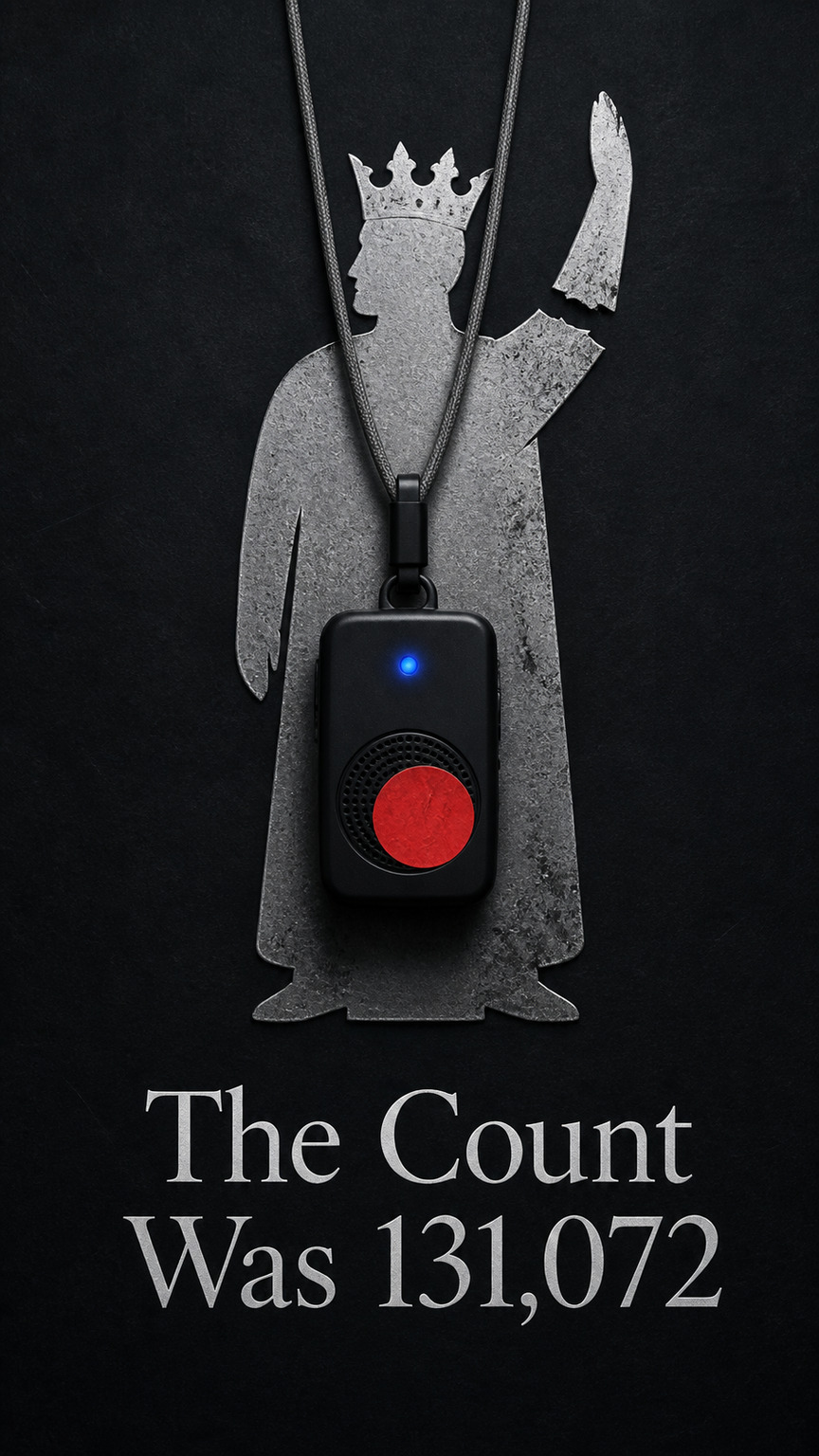
The guide mispronounced your name before you had passed the first caption.
“In this wing, visitors will encounter the last living witness to the Battle of the Bay: Sol-steece Evening Bell, the warrior queen who stood alone against a countless host.”
You stopped beneath the entry arch. The borrowed guide hung from your neck on a gray cord, warm already where it touched your collarbone. A blue access light blinked beside the volume pad. Someone had spent care on the voice: low, patient, unhurried by disaster. It gave countless half a breath of reverence.
The curator watched you over a tablet. “Too loud?”
“Wrong.”
“The volume?”
“My name.”
Behind the curator, an attendant carried a crate of guides toward the charging wall. Another knelt at the threshold, testing the clearance strip with a wheeled gauge. The wing was due to open in forty-three minutes. You had read every caption once in proofs and twice on the walls. The walls had changed between readings.
“I flagged the pronunciation,” the curator said. “The master package is already distributed to two hundred units, including the tactile-control batch, and some units retain a local cache if the network—”
“Solstice.” You said it without slowing the middle. “Evening Bell.”
The curator entered something on the tablet. “May I record that?”
“You just heard it.”
“For the engineers.”
The guide at your chest began again because you had remained inside the entry beacon. “Sol-steece Evening Bell—”
You pressed stop.
The first wall showed the bay as a dark curve under a field of descending marks. None of the marks was a recovered frame; the label below the display said so in small type. They were an artist’s reconstruction, simplified until the eight wedges looked like rain. At the center, a silver silhouette floated upright, skirts streaming, one arm raised. From a distance the light along that arm made a blade.
Centuries after the bay, your body had outlasted everyone else the museum might have put before a recorder. It had not outlasted illustration.
The large caption read: ONE QUEEN. ONE BAY. COUNTLESS ENEMIES.
The count had been 131,072.
You had not arrived at it by adding bodies after the sky went quiet. At first emergence the frames had arranged themselves in eight equal wedges, 16,384 to a wedge, mass and position entering royal hearing with the clean pressure of fingers laid against glass. The coordination pulses made the power-of-two structure plainer still. Before the mesh learned to lie to your crown, the number had been exact.
The curator followed your gaze. “The opening panel uses the received civic wording.”
“It uses a false quantity.”
“An imprecise one.”
“A count exists.”
“In your testimony and in two much later numerical traditions. The surviving contemporary civil records give evacuation totals, force withdrawal, atmospheric effects. They don’t independently preserve the host count.”
The attendant with the crate returned. “West charging rail is dropping every sixth unit.”
“Take the sixths out of circulation,” the curator said. “Use the east rail for returns.”
“Then we’re short thirty-one.”
“Twenty-eight. Three are staff.”
The attendant looked at you, then at the silhouette on the wall. “Do staff need guides?”
“Today they do.”
The attendant went away counting under their breath.
You touched the number field on the curator’s tablet before remembering it was not yours. They did not pull it back.
“Put 131,072 on the wall.”
“As whose claim?”
“Mine.”
“That is possible.” The curator’s relief irritated you more than refusal would have. “But not as an unqualified institutional fact. You are the best-positioned witness and also the combatant, sovereign, and subject of the wing. We need provenance visible at the point of claim, in language a child can follow, with an alternate format ready before—”
“Twelve donors.”
The curator stopped.
“They are not on this wall. The evacuation is six rooms away. The sword is in the next gallery.”
“The donors have a dedicated station.”
“After the triumph floor.”
“Because that room can hold the quieter audio without cross-bleed.”
“They are quiet because you put them there.”
The curator lowered the tablet. “Their final works were instrumental. They were not present as combatants, and the evidence is especially sensitive because visitors repeatedly infer that their persons were trapped in the crown. The station has to state what we know without reproducing that harm.”
“Move the sword.”
“It is commemorative. The label says you never carried it.”
“Move it.”
The curator looked past you. On the other side of the arch, two installers were leveling a temporary stanchion. One lifted a hand: five minutes. The curator answered with three fingers.
“Let’s walk the read,” they said.
The tactical floor responded to your steps. Light opened under the glass: two breakwaters, the sea shelf, four points along the eastern ridge. Eight pale streams descended toward them. A visitor standing on the central marker would see the streams turn aside from the inhabited land and gather over the evacuated bay.
At your feet, a circle of unlit glass bore the words THE QUEEN STOOD HERE.
“I did not.”
“It’s interpretive.”
“Then interpret me elsewhere.”
The curator pinched the bridge of their nose, once. “That is the witness position for the opening ceremony.”
“I did not stand here during the battle, and I will not stand here today.”
An access technician rolled a narrow chair onto the floor. “Can I borrow the center for a turn-radius check?”
“Yes,” the curator said.
“Please,” you said, and stepped aside.
The chair crossed the queen’s marker. The descending lights flared. Eight wedges became hundreds of neat white figures, all roughly human in proportion, vanes opening from their backs. Clean models. None had ever been recovered. The mesh divided them into schools of sixty-four and sent them along the routes that the floor now traced as if the routes had always belonged to you.
They had not. You had constrained them.
The technician turned the chair at the northern breakwater, clipped a projection sensor with one wheel, and wrote something on a strip of tape. “Need another four centimeters here.”
“Take them from the model base,” the curator said.
“That puts the rail off the printed shoreline.”
“Then the shoreline moves.”
Ordinary authority, exercised without thunder. You remembered that you had once been good at it.
The curator waited until the technician had rolled away. “The floor makes the withdrawal visible. Every route begins beyond the evacuation boundary. No civilians under the battle.”
“Good.”
“That was not easy to secure. The first proposal put figures on the ridge for scale.”
“Then keep it. Add the count.”
“And if your count is wrong?”
The absent crown answered by not answering. No ring of chimes turned above your head. Nothing sounded mass against your nerves; nothing put the wing, its staff, its crates and wiring and hollow model frames into a second geometry made of tone. Thirteen permanent silences had no direction. You carried them anyway.
“The initial count was 131,072,” you said. “After the mesh produced false pulses, royal hearing could be deceived. Say that too.”
The curator’s thumb hovered over the tablet. “You would qualify your own figure?”
“I just did.”
“And the later reductions?”
“Some I can certify. Some I can bound. None gives you their motives.”
The guide woke again as you crossed another beacon. “With her enchanted sword, Sol-steece—”
You pulled the cord over your head and held the unit out.
The curator did not take it. “That track refers to the sword as a later civic gift.”
“Not before the next sentence.”
“The transcript has a semicolon.”
“It has a sword in my hand.”
The access technician, now measuring the turn at the southern breakwater, said, “It does sound like she used it.”
“Thank you,” the curator said, with no gratitude in it.
“Do you still need the center?”
“Two minutes.”
The technician rolled on.
The sword lay ahead in a long case, polished to a brightness no battlefield object would have kept. It had been made generations afterward, donated by a civic society whose seal appeared three times in the label. The first line said THE SWORD OF THE BAY. The fourth said you had never borne it.
“Visitors read cases before fourth lines,” you said.
“Some do.”
“You know they do.”
“I know objects hold attention. That is why the loan committee wanted it at the center.”
“And you?”
The curator looked at the case, not at you. “I wanted an object people could gather around without mistaking any crown fragment for a relic. There is no surviving crown material. There is no frame debris. We have reproductions, contested diagrams, damaged archives, and a sword that admits it came later.”
“After four lines.”
“After four lines.”
Before either of you could continue, the doors at the far end opened and a staff member backed into the wing, arms spread.
“No, not yet. Group entrance is the lower hall. Lower hall.”
Children flowed around both elbows. Their adult followed with the expression of someone who had obeyed a sign and been betrayed by architecture.
“We were told the quiet entry opened early,” the adult said.
“It does,” the curator said. “In thirty-four minutes.”
“The message said nine.”
“May I see it?”
Guides were already coming out of a canvas bag. Some showed blue access lights; some amber. The children put them on, tapped whatever lit up, and scattered no farther than the staff could safely catch them.
“Please stay on this side of the silver rail,” the staff member called. “No flash. You can take photographs after the access check. Please don’t sit on the floor projection.”
Three guides began speaking at different points in the track.
“Sol-steece Evening Bell—”
“Solstice Eve-ning Bell—”
“—stood alone against a countless—”
“Does countless mean it kept making more?” one child asked.
“It means they didn’t know,” said another.
“It means too many to count.”
“She had a sword.”
“That sword?”
“Don’t touch the glass.”
The curator closed their eyes for one second. When they opened them, the overqualification was gone.
“Let them continue,” they told the staff member. “Keep the east threshold closed. Log every device number.”
The adult held out the message. “It really does say nine.”
“Yes. That is ours. You may stay.”
One child had reached the central marker. The floor placed the silver queen around her body, then cast a bright line along her raised arm. She planted her feet and swung an invisible weapon at the descending streams. Two others copied her.
“Can we take the picture now?” the adult asked.
“No flash,” the staff member said. “And please wait until the chair test is clear.”
“Did she fight all of them by herself?” a child asked.
The guide answered first. “Alone, the warrior queen held the bay—”
“There were no other combatants in the battlespace,” the curator said. “The bay had been evacuated. Conventional forces had withdrawn.”
The child pointed at the silver arm. “So the sword was magic?”
The staff member said, “The sword was made later.”
“But it’s in the picture.”
“It is light,” you said.
The children turned. The adult looked from you to the wall silhouette, then back, searching your clothes for a crown that was not there.
“Are you acting her?” one child asked.
“No.”
The curator said, “This is Solstice Evening Bell.”
The child with the raised arm lowered it. Someone’s guide continued serenely: “Sol-steece—”
“It says it wrong,” said a child near the sword.
“Yes,” you said.
“Can I get a photo?” the adult asked, then winced. “Sorry. With you, I mean. Only if that’s allowed.”
“Not on the mark.”
The curator’s tablet chimed twice. “Photographs are your decision. We need the center clear in ninety seconds.”
You stood beside the northern breakwater instead. The adult took one picture. A child crossed in front at the wrong moment; the adult asked for another. Behind you, an amber-lit guide called the enemies limitless. A blue one called them innumerable. Nobody asked permission of the devices.
“How did you count them?” the child beside you asked.
“Royal hearing.”
“Like ears?”
“No.”
The child waited. You could have stopped there. The curator did not rescue you.
“My crown sensed mass, position, and their coordination pulses,” you said. “At emergence, eight equal wedges. The total was 131,072.”
“Exactly?”
“Then, yes.”
“The whole time?”
“No. They learned to send false pulses.”
“So maybe you missed some.”
“Later, perhaps.”
Another child called from the floor, “But she got them all.”
The first child was looking at your bare forehead. “Where’s the crown?”
“Gone.”
“In the battle?”
“All thirteen tones.”
“Can we hear them in the audio?”
“No.”
The curator looked down at the tablet. You could see the note forming there before they typed it: visitors would expect reconstructed crown sounds. You said, “Do not invent them.”
“I wasn’t going to.”
“You were considering it.”
“For access to the concept of absence.”
“No.”
“No,” the curator said, and deleted the note.
The group moved toward the donors’ station in fragments. Some followed the wall text. Some followed the sword. One child kept the guide pressed to both ears and walked past you without looking up. At the twelve dark circles, the staff member began correcting the same inference in different words.
“No, there weren’t twelve queens inside it.”
“No, those are not pieces of the crown.”
“The displays represent donated works.”
“Please don’t step over the low rail.”
The curator listened through three repetitions.
“I can change the opening,” they said quietly.
“Change the wing.”
“Not in thirty minutes. The sword case requires the loan officer, two handlers, a condition check, and a new mount. The wall panel needs fabrication. The audio fleet needs units returned and awake. I can change how the evidence is layered today.”
You waited.
“Legend remains labeled as legend. Your account enters beside it, dated, attributed, and limited. ‘Alone’ becomes ‘sole combatant’ wherever we can patch text without corrupting alternate formats. The evacuation record moves forward in the guide sequence. The donor station gets a sightline from the tactical floor. The sword track is disabled now, and the case gets a temporary cover until relocation.”
“The count?”
“Spoken by you, with how you knew and where that knowledge became uncertain.”
“Not your summary.”
“Your recording. My label will say what kind of record it is.”
“And the name?”
“We reload every returned unit. We cannot catch every local cache before opening without taking the accessible fleet below capacity.”
The child at the donor station asked whether the twelve people had volunteered. The staff member answered yes, then began to add something about their souls. The curator crossed the floor before the sentence could turn into theology.
“Final works,” they told the child. “Not stored people. We’ll show you the source note.”
Plain at last.
You did not tell the curator what the new plaque should say. Plaques had a way of borrowing certainty from stone, even when the stone was composite and mounted with removable clips. You knew the twelve donors had knowingly given their final works. You remembered each living person. You did not possess their last thoughts, their private reasons, or their view of the sky when they transformed. Memory did not promote you into them.
“Record first,” you said.
The service room smelled of warm plastic and dust caught in filters. Guides covered two worktables in rows, cords looped beside them. Each returned unit received a red sticker, a cable, and an instruction from an engineer who spoke without once looking up.
“Blue batch here. Amber waits. If it shows green, don’t wake it.”
“Why?” an attendant asked.
“Because green lies.”
“About the load?”
“About finishing.”
The curator set a recorder on a crate. “We need short segments. They may be inserted at separate stops.”
“No stitching sentences.”
“We will cut only between complete responses. State your name for calibration.”
You did.
From a guide on the table: “Sol-steece Evening Bell.”
The engineer slapped a red sticker over its speaker. “That one’s amber pretending to be blue.”
“Again,” the curator said.
You stated your name again.
“Slower, please.”
“No.”
The curator moved the recorder closer. “Then once more at your pace.”
You did.
“Now the sword,” the curator said.
“I never carried a sword. The object in the gallery was made generations after the battle.”
A cable slipped loose at the next table. Three guides announced three different percentages at once.
“Retake?” the curator asked.
“No. Separate segment.”
You began the donors next. “The crown held twelve nonliving final works—”
A crate arrived before you could finish. The attendant carrying it said, “Nineteen returns, four won’t release guest mode, one smells hot.”
“Hot one on stone,” the engineer said. “Not the table.”
The curator paused the recorder.
“Do not pause for me,” you said.
“We need a clean segment.”
“You need a record of a wing opening.”
“We need visitors to hear you over their own devices.”
That was true. You disliked it without argument.
On the next take you said, “The crown held twelve nonliving final works, one freely given by each of twelve adult donors. It did not hold the donors. I alone entered the battlespace as a combatant. All thirteen crown tones were permanently expended.”
For the count, you said, “At emergence, royal hearing registered 131,072 nonliving adaptive-mesh frames. They were organized in eight wedges of 16,384. I can certify that initial count.”
The curator did not ask you to make it grander.
You recorded the reductions in pieces. The first full chord broke 32,768 and exposed its pattern. Repeating it yielded fewer than one hundred. Edict planes held between tones could destroy only what crossed them. Three burnt tones, and the routes you forced through them, brought the count to 49,152 near the tropopause. Six more tones, an autumn storm, constrained routes, and landing geometry left 8,192 in eight columns. The last three orbiting tones destroyed four columns and forced four together: 4,096 frames, synchronized around the rupture.
At “autumn storm,” a staff member opened the door and asked, “Is weather caption copy cleared?”
“No,” the curator said.
“Do I leave the cloud loop running?”
You said, “Yes.”
The curator said, “Yes, but remove the claim that she summoned it.”
“That means export.”
“Then export.”
The door shut.
You began the final segment. “I closed a circuit through my living body, the twelve residue trails, and the forced lattice. I crushed the central resonator. The inverse release disabled the remaining 4,096 frames and sealed the rupture.”
The recorder caught your breathing after. Royal hearing had ended before that release. You had acted without the sense that once made 131,072 exact. In memory, the last number was less a field of separate masses than a pressure arranged to hold open a wound in the sky. Reports, later models, the absence of a bridgehead, the sealed rupture: those supported the zero. You would not pretend you had listened to every frame go dark.
“Add the limit,” you said.
The curator restarted.
“By then royal hearing was gone. I certify what I chose and what the release did through the lattice. I cannot certify each frame’s action. I cannot tell you who built them, why they came, or whether every later pulse was true.”
“Could you say what the donors wanted?” the curator asked.
“No.”
“Even collectively?”
“No.”
The curator nodded once. “Keep both.”
They recorded the evacuation separately, because it came from civil records stronger than your view. You confirmed only that the bay below you had been empty of civilians as the host descended, and that conventional forces had withdrawn. You did not endorse the ceremony. You did not pose on the glass circle. When asked for a final sentence inviting visitors to decide what the battle meant, you said, “The record ends there.”
The curator stopped the machine. “It does.”
Opening was delayed eleven minutes. The sword case disappeared under a gray fitted cover that made it less interesting and therefore more conspicuous. An attendant taped a temporary line at the tactical floor: SILVER FIGURE IS SYMBOLIC. NO SWORD WAS USED IN THE BATTLE. Another attached a source card to the “countless” panel without hiding the old words. It named the phrase as a later civic tradition and directed visitors to your attributed account. Nobody called the card final.
The updated guides went out first and ran out first. Old units still circulated. One voice said your name correctly; another met it in the room with the wrong long vowel. Visitors looked up, or did not. A child dragged an adult back toward the donor station. Two people took photographs of the covered sword. The school group left with one guide missing, and an attendant found it under the northern breakwater projection after the next group entered.
You stood outside the queen’s marker while the curator checked device numbers at the service door.
“Twenty-three old packages still out,” they said. “Four may not return today.”
“They will return eventually.”
“Usually.” The curator handed an attendant another red sticker. “The sword move is scheduled after close. Evacuation records tomorrow, if you’re willing.”
“Donor sources first.”
“They are harder.”
“Yes.”
From the wing, a returned guide began, “Sol-steece Evening Bell—”
The curator held out a hand. The attendant dropped the speaking unit into it, and the curator pressed the red sticker across its speaker.
“Donor sources first,” they said.