The Door in the Ivy
The queen has retaken her capital, but she cannot bring herself to enter the palace. Resting against the ivy-covered wall where she escaped as a child, she hears the same servant’s door creak open—and the familiar voice of the woman she thought she had left to die.
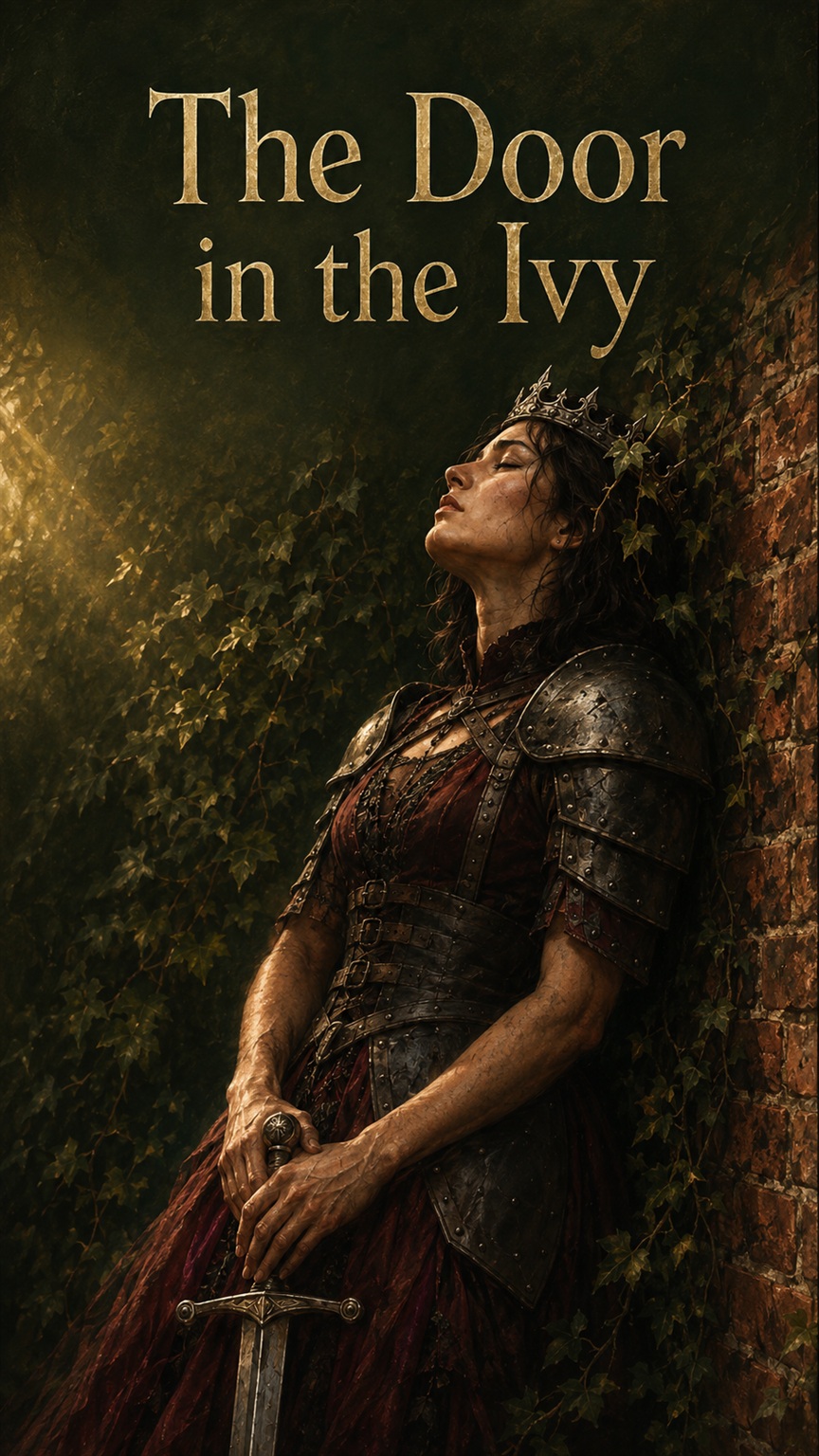
A point of Clarimond’s crown caught in the ivy when she leaned her head back. She left it caught. The brick held the afternoon’s warmth, and she could stand against it without anyone seeing how much of her weight it bore.
At the front of the palace, her officers were waiting. She had reached the lowest step, heard someone call for the doors to be opened, and discovered that she could go no farther. She had told her captain she needed a moment. Then she had walked around the building, past the rose beds, until the marble gave way to old brick and the path narrowed between the wall and a hedge.
The capital was hers. She had heard its governor surrender it. Her own soldiers held the gates; the palace guard had laid down their weapons; bells were sounding from streets she had last seen seventeen years ago. She had imagined those bells so often that she ought to have known how they would sound. Too loud, it turned out. All of them together, and no room between the blows.
Here the hedge muffled them. She set her sword’s point in a gap between the paving stones and closed both hands over the pommel. Dust had settled in the dark red folds below her armor. There was a tear at her knee she could not remember making.
The little door stood three paces to her left. Someone had painted it green. As a child she had known it brown, with the wood worn pale around the latch.
She had not meant to come here.
The hinge scraped. It always began low and rose to a squeal just before the door cleared the stone.
“Clarimond?”
She turned too quickly. The ivy pulled at her crown, and for a moment she could see nothing but leaves.
“Oh, wait. You’re caught.”
That was the voice. Its impatience was the same, the impatience of someone undoing a knot she had been told about too late. A woman came out of the doorway and reached up, then stopped with her hand in the air.
She had gray hair above her ears. Her cheeks were heavier, her mouth smaller than Clarimond remembered. She wore a blue dress and a brown shawl, and one foot was set at an angle to the other. The raised hand trembled.
Clarimond let go of the sword with one hand and tore the crown free. A sprig of ivy came with it. She pushed her hand through the circlet and let it hang over her wrist.
“Belda?”
The woman’s face crumpled. Clarimond had never seen that happen to a face while it was smiling.
“Yes,” Belda said. “Yes, it’s me.”
Clarimond took a step and the sword skidded. Belda caught her elbow; Clarimond caught the sleeve of Belda’s dress. They stood bent toward each other, held apart by steel and the blade slanting between their feet.
The sleeve was warm. There were little burrs of wool at the cuff. Clarimond rubbed one beneath her thumb until Belda put her other hand over hers.
“I didn’t know whether they’d let me see you. I came as soon as they said the fighting was over. The cook knew me. Not the old cook, her girl. She was in the kitchens when I was here.” Belda was speaking quickly, watching Clarimond’s face. “One of your men said you’d gone round the side. I thought of this bit of wall. I thought you might.”
“You were here.”
“Today? Only since the bells.”
“All this time.”
“In the city, yes. Mostly.”
Clarimond was still holding the sleeve. Belda looked at it, and at her, and began to cry in earnest.
“You’ve grown so tall.”
It was such a foolish thing to say that Clarimond made a sound almost like a laugh. She was twenty-six. Of course she had grown. But Belda had once marked her height against the nursery doorframe with the blunt end of a needle, a secret mark because the steward disliked scratches, and now she was measuring her with her eyes.
“I thought you were dead,” Clarimond said.
“I thought you might be, too.”
The sword was dragging at Clarimond’s hand. She eased it away from their feet and leaned it against the brick. When she turned back, Belda was drawing a handkerchief from her sleeve. It was yellow, edged in an ambitious, uneven lace.
Belda wiped her face, then offered it. Clarimond had not known she needed it until she pressed it beneath her eyes. For some time neither of them spoke.
Beyond the hedge a man called for another man. A cart rattled over loose stones. Belda went to the door and pulled it onto its hook so it would stay open. She favored her left leg, putting a hand to the jamb as she came back.
“Your leg,” Clarimond said.
“It mended. Badly, but it mended.”
“Under the cupboard. You couldn’t get it out.”
She saw the cupboard before she finished saying it: its white dishes broken across the passage, Belda on the floor with one leg trapped beneath it. The men on the other stair. Someone striking at a lock. She had been nine, small enough to squeeze past the fallen door of the cupboard when Belda pushed her toward the way out.
“Two of the kitchen men found me,” Belda said. “After the soldiers had gone upstairs. They lifted it enough. I don’t remember much of that. They took me to the scullery first, then to my sister’s in a washing cart.” She drew the shawl tighter under her arms. “It sounds funny now, a washing cart. It wasn’t funny at the time. Every stone in the road.”
“I could have fetched someone.”
“I kept listening for someone.”
Clarimond looked along the path toward the lane. It had been empty when she ran into it. At its foot, her father’s groom had pulled her through a gate into a stable yard. She remembered fighting him because he put his hand over her mouth. By dawn they were on a fishing boat, and for weeks afterward the people around her had been people who could answer nothing about the palace.
“I told them where you were,” she said. “When we were away. I told everyone.”
Belda nodded. Her gaze had dropped to the handkerchief twisting in Clarimond’s hands.
“I didn’t dare let people know I’d worked in the nursery. They were still taking people away. My sister said I must keep quiet, and I did. When I could walk again, I went to work with her.”
“But later. When you heard—”
“When they first said in the market that you were alive and raising an army, last autumn, I wrote. Twice. I sent one letter with a grain merchant, and one through the men collecting money for your army.”
“I never had them.”
“No. Well. There was a war on.” Belda tried to smile. “I put things in them you’d remember. I thought they might need proof.”
“What things?”
“That you hated the blue shoes because they pinched, and hid them in the cold stove. Your mother had half the household looking.”
Clarimond pressed the handkerchief hard against her nose. She had forgotten the shoes. Both of them had been found when the fire was laid the next morning, one scorched black along the side. Her mother had tried to look stern while Belda explained.
“She laughed,” Clarimond said.
“She did. It made the steward very cross.”
Her mother’s face was suddenly there, as Clarimond had seen it, before anyone had told her about the hurried burial in the palace garden. She had to shut her eyes to keep it. Belda stayed beside her, breathing noisily through a blocked nose.
When Clarimond opened her eyes, Belda was smiling at her feet.
“I expect those fit better.”
“No,” Clarimond said. “These pinch too.”
Belda laughed, surprised by it, and Clarimond laughed with her. It hurt the dry skin of her lips. She wanted Belda to keep looking at her that way, wanted to do something else that would produce the same delighted disbelief. She slipped the crown off her wrist and tugged the ivy out of it.
“This isn’t comfortable either.”
“I did wonder.” Belda leaned closer to look. “Is that the little crown your mother wore?”
“My aunt’s. She kept it with her when she fled. She had it altered for me.”
“Ah. I never knew your aunt well.”
There were whole portions of Clarimond’s life Belda would not know. The realization came pleasantly at first. She could tell her about the house abroad and the old mare she had been given, the people who had taken her in, even the things she had done badly. There would be time.
Belda touched the uneven lace on the handkerchief.
“You can keep that, if you like. My daughter made it when she was learning. I’ve got a drawer full.”
“Your daughter?”
“My husband’s girl. She was seven when we married. Twenty-one now. She does much better work these days; she’d be mortified if she knew which one I’d brought.” Belda held up a corner with a badly joined loop, plainly pleased. “She wanted to come with me, but I said I ought to come first. I didn’t know how you’d be.”
“You married.”
“Fourteen years ago. He repairs clocks. You wouldn’t have known him. He’s always lived in the north of the city.”
Fourteen years. Clarimond had been twelve, living beneath another name, sleeping with her shoes on when it rained because rain reminded her of footsteps in the gravel. Belda had been getting married. There had been a dress and people in a room; perhaps she had laughed like this. Clarimond could not quite put them together, the Belda at her wedding and the one who had lain under the cupboard throughout all those years.
“Is he kind to you?”
“Yes,” Belda said, and then, with a small amused frown, “Of course he is. I wouldn’t have had him otherwise.”
“I should like to meet him.”
“He’d like that. He’ll say he wouldn’t know what to say to a queen, but he will. You’ll hear about his clocks.”
Clarimond looked past Belda into the service passage. The walls had been whitewashed. A pail stood beneath a tap that had not been there before.
“We can find rooms for all of you. Somewhere with a separate entrance, if he’d prefer that for his work. You could have the rooms above the south garden. Do you remember? The ones with the painted birds.”
Belda lowered the corner of the handkerchief.
“They’re lovely rooms.”
“You could choose others. I don’t know what’s been done to them.” Clarimond spoke more quickly. “There’s no need to decide today. You could come whenever you’re ready. I’d like you near me.”
“Oh, love.”
Clarimond knew before Belda said anything else. She straightened.
“I’d only be finding the stairs difficult,” Belda said. “And we’ve got our house. We’ve only just got it the way we like.”
“On the ground floor, then. There must be—”
“I don’t want to live here again.”
Belda said it louder than she had said anything. She glanced down the path, then back at Clarimond.
“I came to see you. I didn’t think you’d ask me that.”
Heat spread from the rim of Clarimond’s collar to her face. The offer was a good one. She had meant it kindly. Belda would never have to worry about money or growing old. But she had been arranging a clockmaker’s workshop in a room she had not entered since she was nine, and she did not even know his name.
“Forgive me. Of course you must do as you wish.”
Belda’s hand moved toward her and stopped. “Don’t sound like that.”
“Like what?”
“As though I’ve come about a position and you won’t be taking me on.”
Clarimond opened her mouth, then looked away. There was dirt beneath the hook that held the door. Even that little hook was familiar. Belda had shown her how to lift the door slightly so it would catch.
“You were always here,” she said. “In the mornings.”
“I know.”
“When I saw you, I thought—”
She stopped. Belda rubbed at a wet patch on her cheek with the heel of her hand. Clarimond gave the handkerchief back.
They stood quietly until Belda said, “I’d like you near me too. I don’t know how we do that now. But I do.”
The bells had stopped. In their absence Clarimond heard sparrows moving in the hedge, a rustle followed by an indignant scuffle. It was a sound she had heard often outside the nursery windows. She had been allowed to put crumbs on the sill provided she swept them away before lessons.
“You called me,” she said.
Belda waited.
“When I was running. You told me to run, and then you called me back.”
For a long time Belda looked at her. Her mouth was slightly open.
“I heard you,” Clarimond said. “I always heard you. I pretended sometimes that I hadn’t, but I did.”
She had meant to turn. At first she had meant to, and then the lane had been there and the turn at the bottom, and she had wanted to be around it where they could not see her. Where no one could catch her. She could remember wanting it more than she could remember loving anyone.
“I kept going.”
Belda pressed the handkerchief flat between her palms. She looked toward the passage and away again.
“I’d hoped you didn’t hear that.”
“Did you think I would come back?”
“For that moment, I did.”
Clarimond had to breathe through her mouth. There it was, said aloud by the person she had abandoned, and she had no account of herself to offer. She had carried a sword across a battlefield that morning. At nine she had run because she was afraid, and all the years between could not make that a different act.
“I thought they were coming down the stairs,” Belda said. “I couldn’t move. I didn’t want to be there on my own.” She folded the handkerchief, missed the edge, and tried again. “I’d just told you to go. I knew you’d only get caught with me if you stayed. But I called anyway.”
The woman beside Clarimond was younger than her aunt. Even now, she was younger. That afternoon she had been thirty-four. Clarimond had never reckoned it before; Belda had simply been grown, as tall and certain as the doors.
“You were frightened.”
“Yes.” Belda’s voice had gone thin. “Very.”
Clarimond put her crown on the paving beside the sword. When she stood, she reached for Belda’s hand. The first fingers she found were stiff around the folded cloth; she waited until they loosened.
“I’m sorry I left you there.”
“I’m sorry I called.”
They held hands. Clarimond could feel the pulse in her own fingers, or in Belda’s; she could not tell. Belda kept her eyes on their hands. After a while she drew a breath that caught, and Clarimond moved closer, wanting to put her arms around her, unsure whether Belda could bear it.
“May I?” she asked, lifting her free hand.
Belda pulled her in before she could finish the movement. A metal edge pressed into Clarimond’s ribs. Belda’s cheek rested against the leather at Clarimond’s shoulder; they shifted, and Clarimond bent her head until it rested above Belda’s ear. The gray hair was soft and smelled faintly of smoke from a cooking fire.
Belda was crying again. Clarimond held her while her own face grew wet. Once Belda drew back to breathe, then came close again, and Clarimond was grateful beyond speech for that second, deliberate return.
When they finally let go, the light had moved lower on the bricks. Clarimond’s captain appeared at the bend in the path and halted. She raised a hand to show she had seen him, and he withdrew.
“They’re waiting for you,” Belda said.
“They can wait a little.”
“There’s something I wanted to ask.” Belda was winding the handkerchief around one finger. “In those years away. Was it all dreadful?”
Clarimond began with the safe house, how well guarded it had been, but Belda made a small impatient movement.
“I mean, were you ever happy? You don’t have to tell me you were. I just want to know.”
She thought of the things people asked about exile: who had sheltered her, who had paid, when she had begun preparing to return. She had answers for all of those.
“I learned to swim,” she said at last. “There was a millpond. My aunt disapproved of it.”
Belda looked up.
“The miller’s daughters taught me. My aunt wouldn’t let me take a good shift into the pond, so I cut holes in one.”
“You didn’t.”
“I wasn’t allowed back for a week. I hid the scissors, as though that helped.” Clarimond remembered the cold water taking her breath, the miller’s elder daughter holding her beneath the arms and growing exasperated because she would not kick. “I was quite happy there. In the summers. I got better at swimming, and we’d take bread and cheese and stay until we were hungry again.”
Belda listened as she described the pond: the shallows clouded with mud, the rope hung from a willow, the green smell of their shifts drying on the bank. She had not spoken about it for years. Midway through explaining how the youngest girl refused to enter the water unless everyone turned away, she remembered her name and was startled into saying it would be good to write to her.
“Do,” Belda said. “She’ll be wondering about you.”
“She will.”
Clarimond smiled, and Belda touched the side of her face with the backs of her fingers.
“There you are,” she said softly.
Clarimond leaned into the touch. Then she stooped for the sword and crown. Her knee resisted; she had to turn a little to reach them. Belda watched without trying to help.
“When I come to your house,” Clarimond said, “will you tell me about your wedding?”
“If you want to hear it.”
“I do. What you wore. Whether you were nervous.”
“Terribly. I’d had a tooth out the day before. All I could think about was whether my face looked swollen.” Belda laughed under her breath. “There’s a likeness my husband had done a few years later. You can see what he looked like before he lost his hair.”
“I’d like that.”
Belda stayed while Clarimond settled the crown among the loosened pins in her dark hair. They kissed each other’s cheeks, missing slightly on the second side, and held hands once more before Belda turned down the path toward the gate.
Clarimond watched until she passed the captain. Belda said something to him, gesturing back, and he bowed with a gravity that made her look flustered. Then she was beyond the hedge.
The service passage smelled of damp stone. Clarimond stood outside it with the sword at her side. From farther along it came the clatter of someone setting down a pail.
She lifted the hem of her red skirt over the sill and went in.