
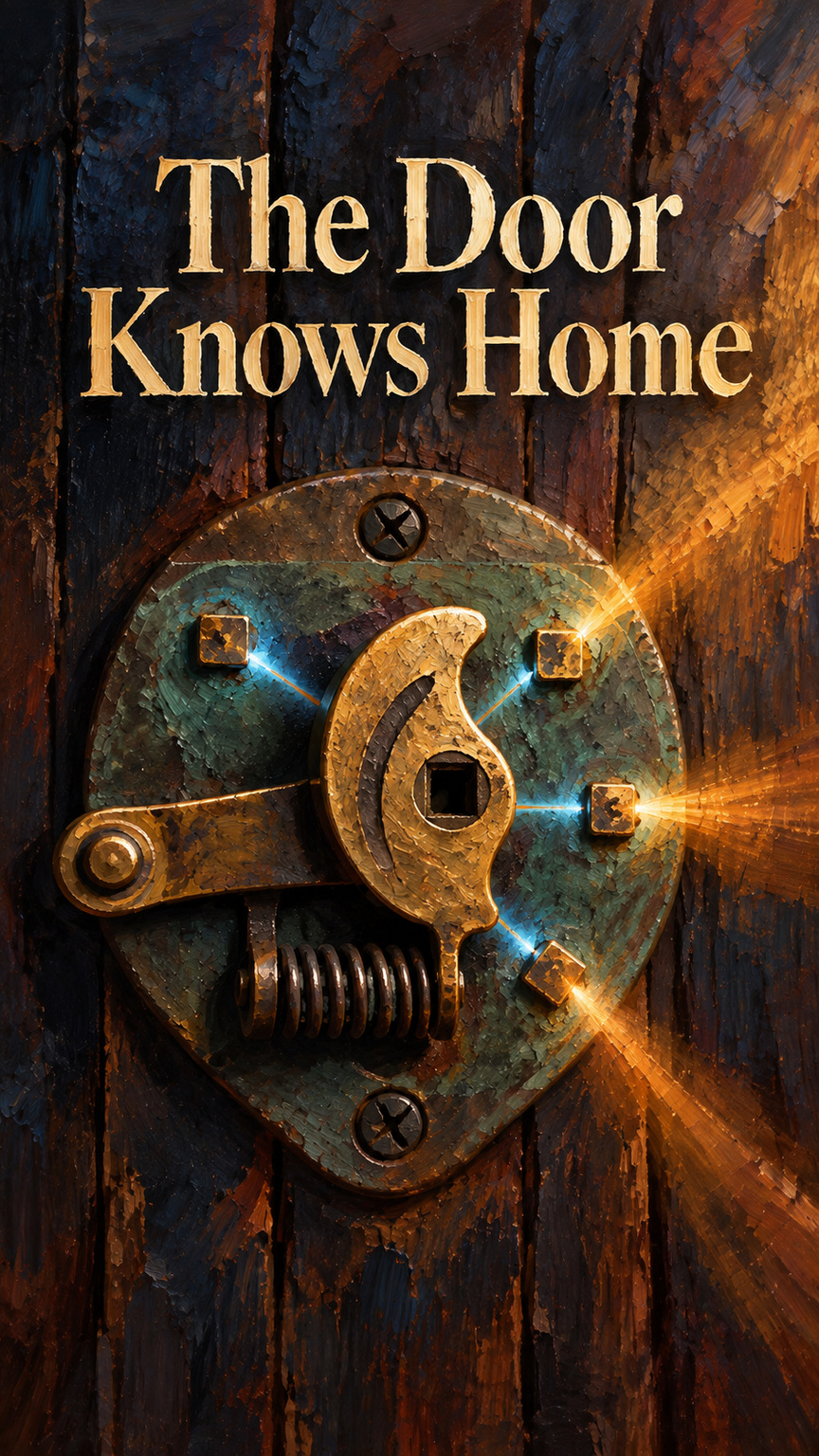
The door arrived with two people pushing it and neither of them steering.
Its temporary oak frame shuddered over the workshop threshold. One caster caught in the brass strip and the brother put his shoulder into the stile while the eldest sister, who had introduced herself only as the executor, kept saying, “Watch the veneer. It has to be collected at five.” The other two siblings carried a document box and a flat box against their chests. A loose lever on the door trembled with every jolt but did not return to level.
The apprentice caught the frame before it struck the key-cutting bench.
“Brake the back wheels. Both of them, please.”
“The appraiser’s driver won’t wait,” the executor said. “And the house completes tomorrow. We need a working certificate, an inventory category, and a decision about whether this goes with the property.”
“First I need it not to roll over my foot.”
The brother found the second brake with his boot. “Load’s high on this side. Whoever mounted it put the brace too near the hinge.”
He was right. The old black door, narrow and tall, had been bolted into the test frame with its iron hold-open brace folded along the wrong edge. The brass furniture had gone soft-colored where hands had polished it and green where they had not. Around the keyhole, a ring of scratches showed the impatience of years. This would be the apprentice’s first repair entered under their own bench number. If it passed the master’s later inspection, they could begin certifying traveling fittings without a second signature. If it failed in front of an estate appraiser, the number would still be theirs.
“Your mother was the last regular user?” they asked.
“The owner,” said the executor. “She opened it. It went to the pantry at the house. We all know where it goes.”
“Did anyone else cross with it?”
“We didn’t need to,” the middle sister said. Her phone vibrated inside her coat. She pressed it silent, then shifted the box to her other hip. “She brought things through. We carried them on from there.”
The youngest set down a flat box marked PRINTS. “Lever stopped coming back.”
That much, at least, was not disputed.
The apprentice laid clean baize beneath the rim case and backed out its screws. The case came free with a tacky pull. Inside, the return spring lay snapped at the eye. Brass filings had gathered beneath the floating fence, and the square spindle could be rocked far enough to show daylight between its collar and bearing.
The home cam was the only part not ruined by ordinary use. It sat behind the fence like a small, eccentric moon, its edge scored by a deep circular track and dozens of fainter rubs. A witness pin passed through the case above it. When a living hand set a route, the cam should find the fence, draw the pin flush, and release the traveling bolt for its full throw. When nothing living asked to cross, it was only an oddly balanced piece of brass.
“Can you replace the wheel?” the executor asked. “That groove looks damaged.”
“If I replace the cam, I replace the evidence that tells me how the fault developed.” The apprentice turned it under the lamp. “The spring failed. The burr here could keep the fence from seating. This play in the spindle lets the lever steal movement from the bolt. I can correct those without cutting away the wear.”
“Will it open to the house?”
“If those are the faults, it should open wherever it was already capable of opening.”
The executor looked at the wall clock. “You have two hours and fourteen minutes.”
The brother had already unfolded the hold-open brace. “Pin’s bent.”
“Not bent. Installed backward.” The apprentice passed him a screwdriver. “Turn the foot, not the arm. If the arm twists, it won’t carry the door.”
For the next forty minutes, the workshop narrowed to metal. The apprentice fitted and tensioned a new spring, taking care that its first coil cleared the old wear track. They stoned the burr from the floating fence until a fingernail no longer caught. A phosphor-bronze shim closed the spindle play without binding it. They cleaned the filings with a hog-bristle brush, not solvent, and left the polished hollows where fingers and mechanisms had spent years touching the same places.
The siblings sorted boxes behind them in bursts of paper and tape.
“Kitchen lot is a quarter share only after valuation,” the executor said.
“That crate isn’t kitchen,” the brother answered. “Engine spares. They were in the scullery because the shed roof leaked.”
“Then take the spares out before I seal it.”
The middle sister’s phone vibrated again. “I said I’d check. Top freezer drawer, behind the peas. No, the other peas.” She listened while peeling an old label from a box. “Put the pan on the cold ring. I’ll be there before six.”
The youngest said nothing. They separated a stack of framed prints from the executor’s papers and slid sheets of tissue between the corners.
Once the case was closed, the apprentice mounted a deadwood turning jig on the lever. The weighted artificial hand pulled the brass down. The latch cleared, the deadbolt traveled eleven millimetres, and the return spring lifted the lever cleanly. Beyond the opening remained the workshop wall, close enough for the door’s edge to nearly brush it.
“It hasn’t gone anywhere,” the executor said.
“It won’t with the jig. That was only the motion.” The apprentice removed it. “It needs someone alive on the handle. So we test one person at a time. Bare hand on the brass. Don’t name a destination. Don’t tell each other what to remember. Turn only when you mean to walk through, and keep the door on the brace until you’ve come back.”
They weighed a canvas-bound brass block, stamped it with the work order number, and put it beside the frame. Each user would carry it across, set it beyond the sill, and bring it back. The apprentice knew from its construction what the home cam could not possibly measure. There was no element in the case for affection, deservingness, or legal title.
“Why bare?” the brother asked.
“Because this fitting samples at the furniture. If leather is between skin and brass, I can’t tell a blocked contact from a bad route.”
The executor pulled off one packing glove and kept the other on. “I’ll go first. The survey folder. We need it for the appraiser.”
She hooked the test weight in her covered left hand and took the lever in her bare right. The apprentice watched the witness pin rather than her face. The pin sank until its round top lay flush with the case. The bolt completed its throw. A bright, square band appeared through the inspection slot where the cam met the fence.
The executor opened the door.
The workshop wall vanished from the frame. In its place stood a narrow pantry lined with pale shelves. Half the shelves were empty; rectangles of unfaded paint showed where tins and jars had been. Afternoon light came from a kitchen beyond. A roll of survey flags leaned in the corner beside a crate stencilled for removal.
“The house,” the executor said, already stepping across. “Hold that brace.”
The brother put his boot on its foot. She crossed, set down the test weight, opened a cupboard beneath the lowest shelf, and returned with the weight in one hand and a blue folder tucked under her arm. Only when both her feet were back on the workshop boards did the brother lift his boot. The door closed. The bolt withdrew, and the witness pin rose the width of a thumbnail: reset.
The executor wrote FOUND across one line of her contents schedule. “There. Certify it.”
“That certifies one set.” The apprentice measured the bolt throw with a leaf gauge. Eleven millimetres. “The next user needs the same result.”
The brother wiped his palm on his trousers and took the test weight. “I need the long socket. Sixteen millimetre.”
He grasped the lever as if it were a grab rail on a wet deck, pulled it down, and shoved before the apprentice could tell him to use steady pressure.
The pin struck flush. The bolt threw fully.
When the door swung open, cold white light fell across the baize. A cramped cabin tilted very slightly beyond the frame, though the workshop floor did not. Tools hung in webbing above a built-in bunk. Through a small round window, the next boat in the yard stood on steel props, its hull streaked green to the waterline.
The brother looked at it for a long second, then reached for the hold-open brace himself. He glanced at the apprentice. “Yard blocks are sound. She sits light with the tanks empty, that’s all.”
“That is not the house,” the executor said.
“No.” He stepped into the cabin, set the weight under the bunk, shouldered past an oilskin, and called back, “Socket rail’s shifted. Did anyone move a red case when we cleared Mum’s shed?”
“Nothing red was on my list,” the executor said.
“Useful.” A drawer slammed. He returned with the weight looped over one wrist, a long socket in one hand, and a rag in the other. “Don’t close yet. My heel.”
The apprentice held the door until his boot cleared the sill, then let it shut. Again the pin rose on reset. Again the gauge read eleven millimetres. The contact band was square, with no bright edge to suggest a false seating.
“So the repair hasn’t held,” the executor said.
The apprentice turned the leaf gauge so she could read it, then recorded both measurements. “Eleven. Same as yours.”
“To a boat on blocks,” the middle sister said.
“Hardstanding,” her brother said. “Still on shore power, with the yard crane booked. She goes back in after the hull plates.”
“I didn’t ask for the maintenance plan.”
“You said it was on blocks.”
Her phone rang this time. She answered with a clipped “What now?” and turned away. “Then move the recycling bag. I can’t get through the kitchen doorway if you leave it there. Yes, now. Put it by the table. The pan is already off.”
The apprentice looked up from the gauge. “Was the doorway blocked?”
“A bag and a grocery trolley. Probably.” She closed her eyes briefly. “Clear now.”
“Try with the glove first.”
She still wore thin driving gloves. With her fingers covered, she pressed the lever down. The ordinary latch moved, but the traveling bolt stopped after three millimetres. The witness pin did not stir.
“No contact,” the apprentice said. “Take it off.”
The bare-hand attempt began with a faint scrape behind the case. The cam moved, stopped, then found the fence. Pin flush. Full throw.
The apartment kitchen beyond was bright with under-cabinet lamps. A grocery trolley stood folded beside a small table, safely clear of the threshold. The middle sister lifted the test weight. Someone out of sight asked, “Are you coming home now?”
“After the collection.” The middle sister crossed without looking back at the workshop and set the weight beside the table. “Lunch card’s in the front pocket of my bag. Not that bag. School bag.” A cupboard opened. “I’m taking the address labels.”
She returned with the weight hanging from one hand, a roll of labels over her wrist, and a freezer pack wrapped in a tea towel. “This goes in the food box before it warms.” She stepped clear, shut the door herself, and put the pack into the carton at once.
Eleven millimetres. Flush pin. Square contact.
The youngest had been standing beside the flat box, peeling dried adhesive from one thumb. When the apprentice turned toward them, the executor said, “Think of the pantry. The blue tiles, the flour bin, the back step. You remember the back step.”
“No prompting,” said the apprentice.
“It went to the house for me. It’ll go there for them.”
The youngest put a hand on the lever. The executor laid two fingers over their knuckles. Inside the case, the cam began to chatter. The witness pin bobbed without sinking, and the bolt pawl clicked against its stop.
The apprentice lifted the executor’s hand and the youngest’s from the brass. “Competing contact. It can’t establish a primary user.”
“I was only steadying them,” the executor said.
The youngest rubbed the pale marks the executor’s fingers had left. “The prints need glassine.”
“There’s tissue in the box,” said the executor.
“Not for ink.” The youngest glanced at the three siblings, then at the lever. “I’ve got some.”
The executor opened her mouth.
“One instruction,” the apprentice said. “When you are ready to cross, take the lever alone and keep even pressure until the pin finishes moving.”
The youngest picked up the test weight and waited through the click of the cooling kettle on the back bench. Then they closed a bare hand around the brass and pressed.
No chatter this time. The witness pin sank in one unbroken motion. The bolt reached eleven millimetres.
Warm light filled the frame. The receiving threshold was scarred wood, speckled with old ink. Beyond it, beneath rafters, stood a narrow bed screened from racks of drying paper by a canvas curtain. A hotplate and two washed cups occupied a bench beside a utility sink. Down a short flight of open stairs, the dark print shop showed rows of type cases and a press under its cover.
The youngest crossed and put down the weight. They did not offer an account of the place. They went to a flat drawer, took out a handful of translucent sheets, checked their size against a metal rule, and came back with the weight before the executor could get a question out.
The pin, throw, and contact band all matched the other tests.
“Four addresses,” the executor said. She had stopped looking at the clock. “That is not a successful repair.”
The apprentice held out the test log with its four rows of readings. “Every one of those seated square. If I thought one was bad, I wouldn’t put my number on it.”
“It’s supposed to know the house.”
The brother put the socket into his coat. “Mum’s door did.”
“Every time,” said the middle sister.
“Then we make it do that every time,” the executor said. She caught the brother by the sleeve and brought him back to the lever. “Say it. The pantry. Blue tiles. Flour bin.”
“I know the room.”
“Then open there.”
He put his hand on the brass. The executor kept hold of his sleeve, not the lever. The cam hunted audibly. Pin halfway. Bolt at six millimetres. When she reached to add her hand, the apprentice blocked her with the gauge.
“Don’t force the pawl. You’ll raise another burr.”
The brother took his hand off the brass and yanked his arm. “Let go of my sleeve.”
She let go. The apprentice opened the case again.
This time they brushed a thin film of marking blue over the cam edge and asked each sibling for one neutral turn without opening the door. Bare hand. No help. Intent to cross, stopped at the hold-open brace. Between turns, closing pressure reset the cam. Last, the brother agreed to one more turn while the executor recited the pantry beside him with her hands in her pockets. He stopped that one at the brace too.
Four fresh arcs cut through the blue at four angles. Each ended in a square patch where the fence had seated. The executor’s arc ran along one shoulder of the deep old groove. The recited turn left a wavering trail between two positions and an edge smear where the cam had never met flat.
The apprentice set the case under the magnifier. The old groove looked less like a notch there and more like what it was: thousands of passes over the same route. Its bottom was dark with age; its shoulders had been polished by repetition. It recorded how often the mother had used one position. Nothing in the inert brass could retain the user who had made it.
“These four end square.” The apprentice touched each arc with a scriber in the order the turns had been made, then the wavering trail. “That one’s on an edge. That’s what a slip looks like. The deep one is wear. Years of one hand going the same way.”
The executor examined the magnified track without touching it. “Can you certify the door as functional without naming where it goes?”
“Yes. With operating restrictions.”
The brother bent to the magnifier beside her. “That first one’s yours. Right up against Mum’s.”
The executor pulled the blue folder from under her arm and found a contents form. “The sale of the house continues. The door comes off the fixtures schedule and goes on the estate chattels list as removable personal property, working condition subject to certificate. Net proceeds remain divided in four equal shares.”
“It was always four shares,” the middle sister said, sticking labels on the boxes in the order she had already arranged them. “The lamp is still disputed.”
“The lamp is not holding up completion.”
“It’s holding up my hall.”
The brother tested the brace foot. “If the driver takes the frame at five, move the boxes through now. Saves four deliveries.”
The executor checked the clock, the collection list, and the fee column. “One route at a time. Each person signs for what crosses.”
The apprentice fitted the case cover and stood beside the witness pin while the executor took her documents and silver through to the pantry. Before she returned for the second load, the apprentice pointed to the first box, left squarely inside the receiving threshold. She moved it clear while the route was still braced open, crossed back, and reset the door. On her next turn the pin sank flush. The apprentice added CLEAR RECEIVING THRESHOLD to the certificate.
The brother carried the tool crate into the barge cabin, complaining that its marked weight was wrong, and returned before the door closed. The middle sister took kitchen goods into her apartment while directing someone beyond the frame to make space beside the table, then came back before the brace was released. The youngest moved the flat print box to the loft in two loads, glassine between every inked sheet, and came back each time before releasing the brace. At every closure the route vanished, the workshop wall returned, and the witness pin rose. There was no handle waiting at the distant side once the door had reset, no way back except to be in the workshop and set it again.
The apprentice wrote the restrictions in material terms: one primary living user; bare contact at the brass; stable intention to cross; receiving threshold clear and safe; brace held until return; closure resets route; no remote return. They attached measurements for four sound sets and noted every observed block, then signed their bench number at the bottom.
At four fifty-one, a van reversed into the lane. The siblings were still disputing whether the lamp belonged with silver or furnishings. The executor took the certificate, checked the equal-share notation twice, and went to meet the driver. The brother folded the brace correctly. The middle sister pocketed the remaining labels. The youngest swept a curl of dried adhesive from the bench and missed the bin.
When they had cleared the frame, the apprentice pressed the ordinary transport pin through the hinge plate. It seated with a small, workmanlike click. The repaired spring drew the lever level and held it there while the door was wheeled away.