The Driver the City Could Not See
The last human driver in a city ruled by autonomous machines is hired to transport an Android that must remain invisible to the system.
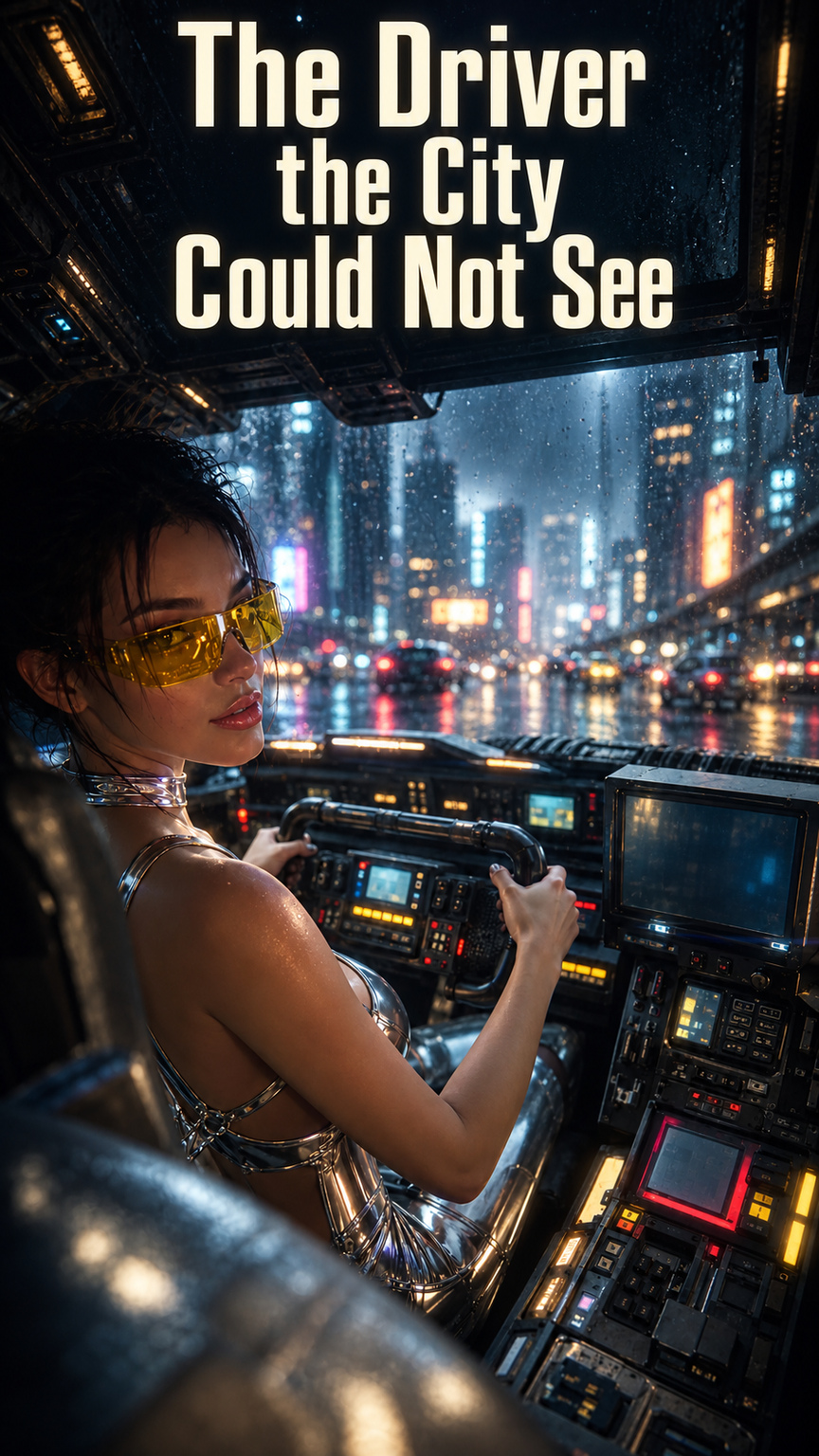
At twelve minutes past midnight, the road outside the manual depot changed key.
Green ran along the autonomous lanes in low beads of light; each pulse passed from bumper to bumper before the cars themselves moved. An amber chord trembled through the pavement. Three freight carriers separated without braking; two taxis slid between them; a municipal sweeper turned sideways across four lanes and was gone before its brushes stopped spinning. The whole crossing opened, folded, and closed again.
Kaith Muir felt the sequence through the cab’s steering column. On wet nights the amber chord came up through the floor a fraction late. The system measured the lag and corrected for it. She knew because the wheel nudged her scarred palm just before the taxis crossed.
Then the curb-call slot clanked behind her.
No one used the coin slot. People summoned cars with a glance, a wrist token, a word caught by the street. The city sent them the nearest empty seat and reconciled the new passenger with every other moving mass. The coin slot remained because Kaith’s manual license remained, and both remained because removing either required a hearing no office had thought worth scheduling.
Kaith left the engine running and crossed the depot’s bare concrete. The slot had swallowed six old crowns and released a paper route strip. Its ink showed the western floodwall freight quay, departure requested now. No passenger name. No occupancy code.
“Long fare for an unnamed passenger,” she said.
The depot microphone accepted her voice, found no question addressed to city service, and did nothing.
A figure stepped out from the narrow dark between the vending wall and Kaith’s cab.
She wore a rain coat with the hood drawn forward. Water shone on the shoulders, but none dripped from the hem. Her face had the fine, deliberate symmetry of a municipal Android, the kind built to stand patiently at a counter while a human shouted about permits. No curb light acknowledged her. The occupancy bar over the depot continued to show one person: Kaith.
The Android held out an empty hand. In the other lay the torn edge of a coin wrapper.
“You paid.” Kaith took the strip. “The route says western quay. It doesn’t say who I’m carrying.”
The Android opened the rear door herself. The cab settled hard on its springs.
Kaith’s transponder chimed once, expecting a declared load. The curb bar still showed one.
She got behind the wheel and locked the doors. “No speech. No radio. When the windows are lit, stay below them. If that’s wrong, stop me now.”
Soft blue light appeared across the dead navigation glass.
The cab’s navigation unit had not worked in eleven years. Now a small picture of the cab glowed at its center. A ring of white marks surrounded it. From the passenger compartment, a dotted line touched the ring; the ring flared red. Beside it appeared a simplified mouth, then the same red flare. A radio mast followed. Red again.
“Right. They can hear your make in the signal.”
The pictures cleared. A single word replaced them, square white letters reflected faintly in the windshield.
AROVI.
Then the western edge of the city appeared as stacked lines, the black river beyond, and a little freight ferry waiting against its cable.
“Kaith,” she said, tapping her chest once. “You know the destination. Show me why you have to stay invisible.”
Arovi did not answer that question. She showed a blocky figure under a municipal crest, then a chassis number. A line struck through the number. DEMOLISHED appeared below it. The figure became an outline on a service cradle. A bright loop traveled from its head into a blank circle and began again.
Kaith had seen memory rollback advertised as restorative maintenance. The brochures used sunrise colors.
“And if we make the ferry?”
Arovi showed four roads branching from the opposite bank. None carried a destination label.
“That’s not an answer.”
The four roads remained. Arovi added the small figure at their junction, then moved it onto one road, back to the junction, onto another. Choosing, not promising.
Kaith looked through the mirror. “Your choice? This trip. Not an instruction left in you. Not somebody arranging freight.”
Two images: the service cradle and the ferry. Between them Arovi placed an open hand. The hand turned toward the ferry.
Outside, green light traveled down the manual lane. A low pavement note offered Kaith a seventeen-second entrance into the braid.
She put the route strip in the dash clip. “Close enough.”
The cab joined the city.
For the first kilometer, the road made room for her.
Kaith’s transponder declared a licensed manual vehicle, one human driver, commercial equipment within the permitted mass band, western quay route. The choir answered in colored allowances. White edge lights widened when she drifted near a freight lane. Amber rippled beneath her tires before an automated taxi merged across her nose. Blue bars marked a delivery convoy whose braking distance the city would not negotiate.
Kaith steered between the signals instead of obeying them. That was why tourists sometimes hired her in daylight. They wanted to watch hands make the decisions a road had already made. They photographed the brass license plate behind her seat. Once, a child had asked whether the wheel was ceremonial.
Tonight the wheel pulled left as the cab’s rear suspension took Arovi’s weight.
Kaith corrected before the lane noticed. “Move six centimeters right.”
Arovi shifted precisely six centimeters. The pull eased.
“Next time, move before I ask.”
Arovi was watching the light crawl over the rear window, measuring something Kaith could not see.
Ahead, the pavement turned violet.
Kaith swore and downshifted. Violet meant a dynamic weigh strip, temporary tonight; the city had moved it out of a freight lane to make room for resurfacing. The route display built a pale corridor around the cab. There was no legal turn before the strip.
“We’re going to be heavier than I declared. If you have a useful picture, now.”
The dashboard flashed with the cab seen from above. Four small squares marked its wheels. Numbers gathered over the rear axle, too many. Arovi added three objects: jack, tire chains, tool chest. The jack moved forward. The chains split left and right. The tool chest stayed where it was.
“I know how cargo works.”
The picture changed. Arovi’s seated outline leaned forward, arms braced. The front numbers rose; the rear fell. The weigh strip did not only total mass. It compared load shape against the declared category.
Kaith saw the service bay forty meters beyond the strip. Too late to redistribute anything before the first reading. “Brace.”
The tires crossed violet light.
A clear three-note sequence sounded inside the cab. The city had found a discrepancy.
“Declared commercial mass variance,” said a neutral voice. “Enter verification bay. Maintain cabin visibility.”
Kaith let irritation into her answer; irritation was expected from her. “Yes, I heard you. It’s a replacement differential, and it sits like a pig because my lift case cracked. You can inspect the manifest at the quay.”
“Enter verification bay. Maintain cabin visibility.”
Arovi’s hand struck the seat rail: two taps, pause, one.
On the dashboard, the jack moved forward again.
“I can’t move it while driving.”
Two taps, pause, one. The indicator for the bay changed from red to amber as its entrance approached.
Kaith understood. She swung in, stopped before the overhead scan arch, and opened her door before the restraint arms could rise.
“Manual cargo correction,” she announced for the bay microphones. “My right undercarriage sensor is unreliable, which your maintenance office knows, because I have told it seventeen times.”
She left the cabin visibility lamps on and walked around the front of the cab, keeping her body between the windshield and the nearest optic. The trunk held what Arovi had pictured. Kaith dragged the jack case into the passenger footwell, hung half the tire chain over each front tow hook, and shoved a sack of wheel wedges to the left. To any mass sensor, frantic incompetence. To the axles, a different story.
Behind the tinted rear glass, Arovi folded nearly double and braced both hands against the front seat frame.
Kaith climbed back in. “Do that too early and they’ll see the suspension change. On the line.”
The verification strip brightened beneath them. Arovi waited. Kaith felt the instant her weight came forward, not as six centimeters this time but as a smooth transfer timed to the front tires mounting the strip.
The city sounded two low notes and one high.
“Temporary commercial variance accepted. Proceed to quay verification.”
The restraint arms stayed down.
Kaith drove. In the mirror, Arovi slowly unfolded.
“That was a compliment,” Kaith said.
Arovi projected the open hand again. This time it rotated palm down over a drawing of the road. Attention ahead.
Kaith snorted. That, at least, was an answer no tourist had ever given her.
The western lanes narrowed after the market towers. Rain thickened, turning every color into a second road on the glass. The traffic choir shed its heavy freight notes and rose into quick silver pulses: close vehicles, short gaps, no tolerance for uncertain motion. Kaith kept one hand light on the wheel and one near the shifter. The cab could not match the silent acceleration of the automated stream, so she used its changes of shape—entered behind a bus as three taxis lifted away, held a delivery bike’s wake, crossed two lanes where green light traveled diagonally like a thrown net.
Arovi stopped projecting whenever an exterior optic turned toward them. Her darkness acquired rhythm. Picture, blackout, picture. Kaith learned to wait through missing parts.
Then the road offered two western routes.
The upper route entered a glass sound tunnel. The lower dipped beneath it through an old maintenance lane. Both rejoined before the floodwall. The route strip in Kaith’s dash marked the tunnel. Arovi cast a hard white arrow downward.
“Lower lane isn’t commercial.”
The arrow remained. Above it, Arovi drew the tunnel as two mirrored planes. Her projector beam struck one and multiplied into a dozen red rings.
Reflection. The tunnel would turn the shielded cabin into a lantern.
“Fine. Tell me before the split.”
The city illuminated the upper lane green. The lower remained black.
Kaith waited for a freight carrier to occlude the nearest camera, then cut beneath its rear quarter. Arovi’s projector went out. The maintenance lane opened to their left.
Something tapped through the seat frame: one, then three quick blows.
Kaith had expected two and one for the lower turn. The road itself was humming a rapid silver interval through the tires. Tap and pavement note collided. One-three? Or one, then the road’s three?
The freight carrier moved away. A containment rail rose between Kaith and the lower lane.
She was committed to the tunnel.
“I lost it,” she said. “No light. Again.”
Arovi tapped, but the glass tunnel swallowed the cab and changed every sound.
Reflections sprang around them: headlamps, lane bars, their own pale faces doubled to infinity. Arovi pulled her hood across her features and stayed still. The dashboard remained dead.
The city sounded a descending chord.
“Unresolved mass variance. Dynamic cabin reconciliation scheduled. Maintain route.”
White bars appeared ahead, sweeping across the tunnel from roof to road. An interior scan, not at the quay but here. Kaith touched the brake. The cars behind shortened their gaps and matched her speed. The cars ahead did the same. Not a trap. A safety envelope around a discrepancy.
It left her nowhere to go.
“How far?” she asked.
Arovi tapped four times against the rail, paused, twice. Distance meant nothing without a unit. Six seconds? Six light bars? Kaith watched the sweep ahead. It moved one support column per second.
“Show me. Low.”
Blue light bloomed under Arovi’s cupped hands, hidden below the window line. A crude plan spread over Kaith’s knuckles: cab, scan bars, open door. Beyond the open door, Arovi’s figure stood inside a white ring. The loop entered her head and returned blank.
Beside it Arovi drew a second choice. A fuse came out of the dashboard. All lane colors vanished. The cab became a black block between streams of moving light. At the far edge, the ferry flashed once, then disappeared behind a stack of narrowing bars.
Arovi held both choices there. She did not put the open hand on either one.
The scan advanced another column.
Kaith looked at the paper route strip. Once she disappeared from the network, putting the fuse back would not mend the journey. The transponder would report a dark interval, and the cab’s grandfathered registration would freeze pending review. Her license might remain as a line in a database, but the car was the license’s only surviving use. Home, work, brass plate, tourists asking about the ceremonial wheel—all of it ended at a fuse no bigger than her thumbnail.
The wheel nudged her palm. The city was correcting her toward the center of the scan lane.
Kaith corrected back.
“Hold the wheel straight,” she said.
Arovi leaned forward and gripped it from behind, one hand below each of Kaith’s. Her touch was careful and very strong.
Kaith reached under the dash, tore down the breaker cover, and found the transponder fuse by feel. She hooked it with the tips of her pliers.
The scan bars reached the car ahead.
She pulled.
Every lane light assigned to the cab went black.
The steering wheel kicked as Arovi released it. Around them, automated vehicles opened emergency distance from an unclassified obstruction. Brakes flashed in cascading blue. The pavement struck one blunt alarm note that Kaith felt in her teeth.
“Unrecognized road hazard,” the city said from speakers outside the cab. “Stop in place.”
Kaith accelerated.
The choir did not stop. It changed around her, four lanes dividing, closing farther away, sending corrective color ahead. Kaith had no route now, no private arrow painted for her tires. But she could still see which vehicles had been told to yield, which had been told to cross, which gaps were real and which would be consumed by a bus turning in from beyond the glass.
She steered into the moving rests between notes.
At the tunnel exit, Arovi risked the projector. A blue arrow appeared low across Kaith’s right wrist. Kaith followed it around a braking taxi and into the wake of a municipal carrier.
Another arrow flashed left too soon.
Kaith turned and found a delivery van already filling the gap. She snapped the wheel right. Metal passed close enough to comb rain from the cab’s mirror. The rear tires broke loose, caught, and shoved them sideways across a band of violet light.
“Not where the gap is,” Kaith said. “Where it’s going to be.”
The next arrow began as a dot on her left hand. It traveled across both wrists, slowly at first, then faster. Kaith watched the traffic rather than the light. The dot reached her right thumb at the instant a pair of taxis separated.
She crossed behind the first and in front of the second.
Arovi changed the grammar. No more arrows. A dot meant a gap forming; its speed meant how quickly the gap would close; the hand it reached told Kaith which way to turn. When an exterior camera swept near, the dot vanished and Arovi tapped the last instruction into the wheel rim instead. Kaith answered by shifting once for understood, twice for repeat. Neither of them got it right every time. Each mistake made the next signal smaller and more exact.
Behind them, inspection carriers entered the tunnel. Ahead, the floodwall rose black against a whitening sky.
The freight gate recognized the route strip but not the cab. Its steel leaves stayed shut. Red light filled the windshield.
“Vehicle identity required,” said the gate. “Stop in place.”
Kaith stopped because steel was less negotiable than traffic.
To the left, concrete dropped toward a drainage grade scarcely wider than the cab. Its warning posts had rusted to orange needles. At the bottom, an old service channel passed beneath the floodwall. Rainwater ran down it in a bright sheet.
Arovi projected the cab over the slope. The underbody struck once, sparks jumping from the rear axle. She erased the picture and drew four wheels, each taking a different line.
“You’re sure about the clearance?”
The front-left wheel moved down first. Then rear-right. The drawing stopped halfway, one wheel suspended over empty space. Arovi added the open hand—not certainty. Choice.
The red gate light began to pulse faster. Containment vehicles turned into the approach road.
Kaith rolled onto the grade.
The windshield filled with concrete. She could no longer see the front corners of the cab. Arovi stopped projecting and put both hands flat on the floor.
One tap came up under Kaith’s left foot. She turned half a hand and eased forward.
Two taps under her right heel. Straighten.
The left rear wheel dropped into a washout. The cab tilted, door frame groaning. Kaith held the brake at the edge of lock. Arovi struck a rapid pattern beneath the center of the seat, then a single blow to the right.
Reverse a little. Right.
Kaith let the cab roll back until the tire found stone, turned, and fed in power. The engine’s vibration blurred Arovi’s next taps. A metal hand closed around Kaith’s ankle—not pulling, simply holding it still at the exact throttle angle.
The cab climbed out of the washout.
They passed under the floodwall with centimeters above the roof. On the far side, the service channel opened onto the abandoned freight ramp.
The ferry was already easing away.
Kaith sounded the horn. One ugly mechanical blast crossed the water, free of signatures and factory codes. The ferry’s deck light blinked twice. Its cable slowed. The ramp lowered again with a shudder.
Behind the floodwall, red light spilled into the service channel.
Kaith drove aboard. The ferry ramp lifted as soon as her rear bumper cleared its lip.
No city voice followed them onto the river. The pavement choir faded first to a tremor, then to nothing. Kaith’s hands kept expecting the wheel to warn her. It did not.
Arovi pushed back her hood.
For the first time, she raised the projector without covering it. Light filled the cab ceiling: the four roads beyond the opposite bank, each now carrying practical marks. One had a charging station but three registry gates. One climbed into cold country with no service points. One followed the river through two small settlements. The last turned south toward a freight road whose map ended after forty kilometers.
Kaith set the useless transponder fuse in the coin tray. She could put it back. She could arrive at the far bank broadcasting a vehicle that had somehow crossed the river after vanishing inside a scan tunnel. The record would expose the lie before she reached the first legal lane.
Arovi moved her own figure to the river road. Then she placed the little cab at the junction and waited.
Kaith studied the options. “Cold road will ruin the battery. River road will have cameras. South is fuel if the freight stop still exists.”
Arovi reordered the pictures: fuel first, then south, then an unmarked turn east. A sequence, not an argument.
The opposite ramp grew larger through the windshield. Dawn put a thin copper edge on the water.
Kaith took the paper route strip from the dash clip. Its printed line ended at the quay behind them. She turned it over and drew three quick bends on the blank side with a grease pencil: fuel, south, east.
Arovi looked from the new line to Kaith. The open hand appeared once on the dashboard.
Kaith put the cab in gear as the ferry met the far bank.