
Taremet had to tell the bearers twice to put her down outside the gates. They stood with the litter on their shoulders, looking at the open bronze doors as though she had mistaken which side of them was safe.
“Here. Where the stone is level.”
They lowered her so carefully that she could not blame them for the pain. She waited for it to settle before dismissing them to the guardhouse. At twenty-two she had commanded hunting parties and disputed her father's appointments; now every order had to survive a discussion of whether she needed another cushion. She sent the cushions away too. She wanted to see who approached.
A locust had caught in the fringe of her shawl. One wing was folded wrong, and a hind leg dragged. She loosened the thread with her nail. Released, it struggled a little farther into the wool.
Beyond the palace wall, a cow cried from the slaughter yard. There had been no slaughter since yesterday, but the cattle struck down before the prohibition were still there. The men had laid fodder beside them. A kitchen girl had told Taremet this while changing her sheets, then begged her not to tell the king who had spoken.
From the temple across the avenue came the uneven rise of prayers. People had begun carrying their sick there when no one died at home. Now the steps were crowded with bedding. Under the nearest torch a woman sat with her eyes shut, still moving a damp cloth over the mouth of the man beside her. A boy came down the steps with a loaf. He tried to give it to her, then stood holding it against his chest. She had not seen him.
Taremet had been allowed to rest between her bad hours. Someone else always came to turn her, to bring clean linen. Across the avenue the boy put the bread down and took the cloth. The woman kept moving her empty hand until he caught it.
Farther out, beyond anything she could see, locusts were eating the fields. Soldiers trampled them. They crawled out of the footprints and ate again. Fire had not killed them either, a messenger had told her father. He had brought a sackful as proof; even tied shut, it traveled across the floor. She had watched from her bed while her father ordered it taken away.
She had asked her father whether the reports were true. He had said the royal grain stores were open.
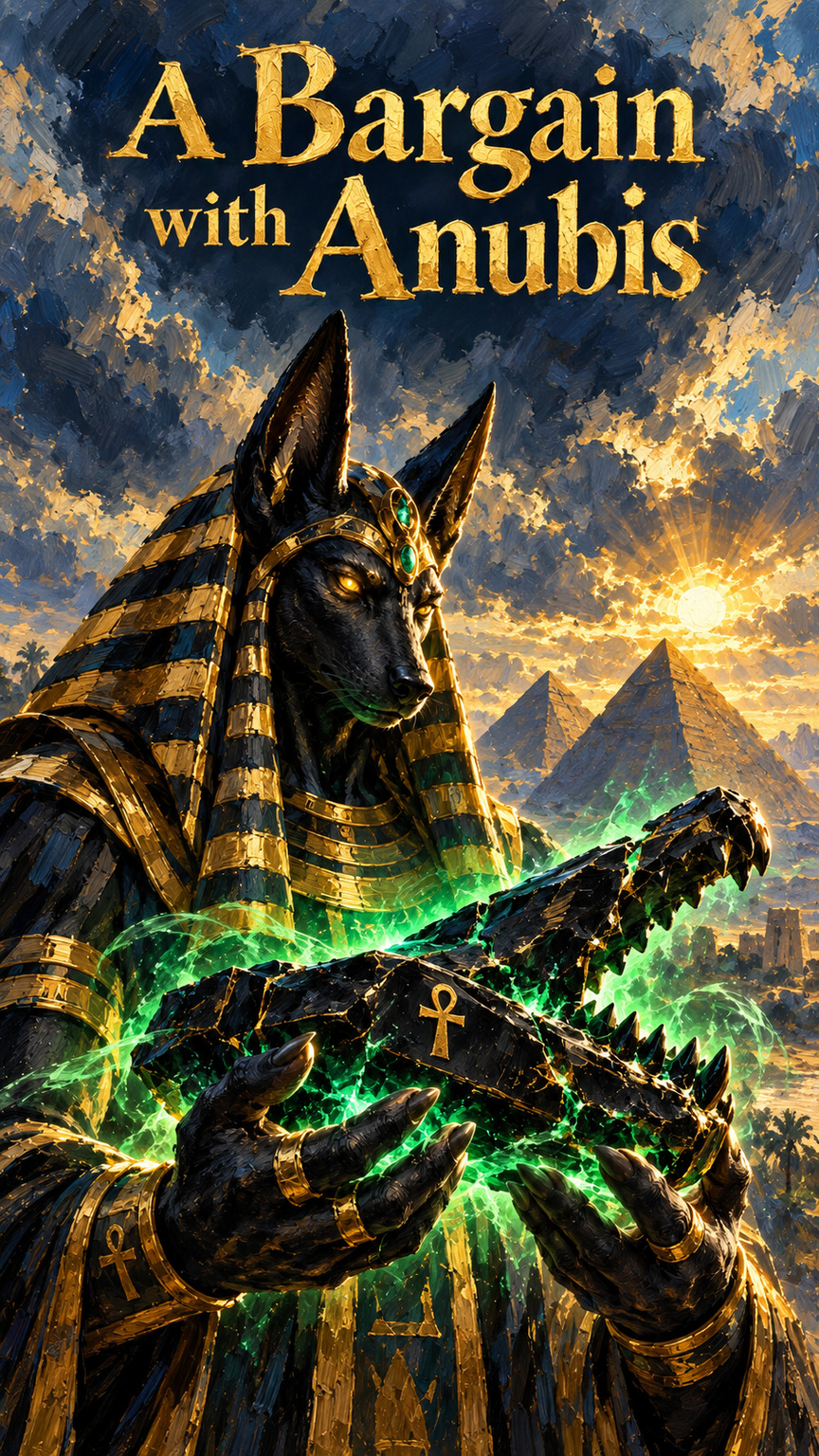
The prayers changed. Voices called the same name together, then broke apart into separate appeals. A tall figure came up the avenue, passing through the torchlight without a guard before him. Gold lay across his shoulders. His jackal ears stood erect, and his black muzzle turned toward the slaughter yard before he looked at her.
Taremet tried to sit straighter. The effort took the breath she had saved for his name.
He stopped beside the litter. Beneath his collar his chest moved. She had expected the painted stillness of the shrine; instead there was the small sound of air through his nostrils, and dust on his feet.
“Anubis,” she managed.
“You should not have been carried this far.”
She disliked him for saying it. Everyone said it. She pressed her palm against the place under her ribs where the pain sharpened and waited until she could speak without gasping.
“You're going in to find what he took.”
“Yes.”
“He won't give it back.”
Anubis looked toward the open doors. The guards had withdrawn into their house. Taremet could see one man's white skirt beyond its threshold, motionless.
“Can't you just take it from him?”
“He has threatened to break it and send the pieces away.”
“Would that end this?”
“It would leave my power bound in the pieces. I would have to find and join them before I could release Egypt.”
Since her father came back from the temple, riders had waited saddled in the courtyard below her window. She had listened to their horses shifting on the stones all afternoon while he slept in the chair beside her.
“I can get him to show it to me,” she said. “I haven't asked yet.”
That brought the god's attention back from the doors. He crouched beside her, his gold ornaments settling with a heavy, intimate noise. His face was level with hers. There were grey hairs under his jaw.
“What do you ask in return?”
She had rehearsed an offer of access, a demand for secrecy, a declaration that she was acting for Egypt. In front of him, with the cow beginning again, the declaration became impossible to say.
“I want it to stop hurting.”
He did not reach for her or promise anything.
“When I recover the relic, you will be able to die. I cannot tell you how soon.”
“And the others?”
“Those whose bodies can no longer sustain them will die. The rest will live as they lived before.”
She worked a fold of shawl between her fingers. “Could you leave just me as I am? For a while?”
“No.”
She had imagined herself resting afterward, the noises quiet, her father beside her, with no need to decide anything more that night. She had hardly let herself imagine the empty bed.
“He says the physicians need time.”
“What do the physicians say to you?”
“They ask whether I've eaten.” She swallowed. “Will it be all at once? The people who should have died?”
“Some at once.”
The locust pulled against her thumb. She took her hand away. There would be children among them. There would be people whose families had thanked her father. She could not make the return of death into an event everyone would welcome.
“He mustn't know I helped you.”
Anubis waited.
“Not afterward either. When he dies and you receive him, you mustn't tell him then.”
“You ask me to keep this from him forever.”
“Yes.”
“I cannot prevent him from discovering it himself.”
She glanced toward the guardhouse. “They only know I came out for air. He'll believe that.”
“And if he asks you?”
Taremet pulled the shawl higher. The wool scraped her chin. When she was small, her father had delighted in catching her lies: fruit juice on a sleeve, a forbidden dog under the bed. Later he had stopped searching her face. If she told him where she had ridden or whom she had met, that was where she had been. She had liked that more than the freedom.
“I won't tell him.”
She rubbed her eyes with the heel of her hand. “He'd think I didn't trust him to find something. And he's been trying. He hardly leaves me.”
Anubis waited while she pulled a loose thread from the shawl. She wound it tight around one finger, then unwound it.
“Sometimes I pretend it hurts less when he comes in.”
“Does he believe you?”
“He sits down. We can talk about something else.”
Anubis laid one hand on the litter's wooden rail. She could have set hers beside it. She wanted some sign that he approved, then resented wanting that from a stranger who would not even say whether her dying would hurt.
“Will you do it?” she asked.
“I will not reveal your part.”
“Promise me.”
“By the office in which I receive your dead, I promise.”
“What does it look like?” she asked. “He only calls it the Emerald Relic.”
“A stone jaw. Black, with green teeth. Small enough to hold in both hands. I breathe power through it to hold back death while I tend those who are passing. Until I draw that breath back through it, nothing here can finish dying.”
“So even now you're keeping us here?”
His fingers tightened on the rail. “He has trapped my power there.”
For the first time she noticed how stiffly he was crouching.
She described the garden door of her bedchamber, the reed screen inside it, the little table at her right hand. Her father sat on her left, where the chair had room. She would have the door left unlatched. Anubis must come through the garden, wait behind the screen, and put out his hand only when hers appeared around its edge.
“I may be slow,” she said.
“I will wait.”
She shut her eyes briefly. The prayer she had come to make was finished. Now she had to get back to her room.
He rose and went along the wall toward the gardens. Taremet waited until she could no longer hear his steps, then raised her hand for the bearers. They came running.
By the time they carried her into the bedchamber, Pharaoh Khaseb was awake and standing in the doorway without his sandals.
“Who ordered this?”
“I did.”
He looked past her at the bearers. She said his name, an indulgence allowed her since childhood, and he looked back.
“I wanted air.”
“Then we open a door. We don't carry you down half the palace.” He bent over the litter. “Can you stand?”
“No.”
He helped lift her. She kept her mouth against his shoulder while the attendants moved her legs onto the mattress. For a moment she could smell only his skin and the old linen of his sleeping robe. She wanted to stay there. He drew back before she was ready and tilted her face toward the lamp.
“The garden door,” she said. “Leave it open.”
An attendant pushed it inward and returned the screen to its place, shielding the bed from the doorway. Its near edge stood just beyond the outer rim of the bedside table. Then Khaseb sent everyone out. He had learned to settle her himself, and did not like other hands doing it badly.
The locust had traveled in her shawl. He found it when he took the wool away.
“Another one.” He caught it gently between finger and thumb, saw its dragging leg, and put it in an empty brass cup on the bedside table. “I'll have someone take that out.”
She watched him. “They can't even burn them in the fields.”
“I know.”
“Did you see?”
He pulled the sheet over her feet. “I was told. You need to sleep. Let them bring their complaints to me.”
“I can hear the cattle from this bed.”
He tucked the sheet under one swollen heel and she flinched. At once he loosened it and slipped a rolled towel beneath her calf.
“Here?”
“Closer to my knee.”
He moved it. “Here?”
She nodded. He cupped her heel until the tightness in her face eased, then lowered it onto the sheet.
Three nights before, he had come into the room with blood dried on his forearm and told her she was safe. He had left his crown somewhere. She had thought the physicians had found something, and cried because she would live. Only in the morning had she learned that he had gone into Anubis's temple and carried the relic from the shrine himself.
“Does your arm still hurt?” she asked.
He glanced at the healing cut. “Nothing much.”
“How did you do it?”
“A hinge on the shrine door. I didn't feel it until afterward.” He settled into the chair. “You slept nearly an hour that night without waking. I sat right here. An hour.”
She remembered pretending to be asleep the following night, while he held her wrist and counted. She had been afraid that if she moved, the pain would take her again.
He found the knucklebones on the stool beside his chair. “One throw?”
“You can.”
“It isn't much of a game by myself.”
“You like winning.”
“I like beating you. There's a difference.” He shook them, waiting for her smile. She gave him one. “There. Shall I throw for you?”
“You'll give me the bad cast.”
“You've never needed my help with that.”
It should have annoyed her. Usually he kept a tally of her worst throws for weeks, long after she had forgotten her own wins. Tonight she wanted him to keep talking. Instead she asked to see what he had brought from the temple.
His hand closed over the bones.
“Why?”
“You keep saying it's made me better. I haven't even seen it.”
“You went to the gates tonight.”
“They carried me.”
“You wanted to go. Yesterday you wouldn't look out of the window.”
She could tell him how much the journey had hurt. He was watching her so hopefully that she let it pass. He put the game away and stood, smiling now.
“Wait here.”
“Where would I go?”
“Apparently anywhere.”
He went into the dressing chamber. She heard a lid open, the scrape of something heavy. At the garden door the screen remained still. It had painted birds on it, their beaks worn away where servants gripped the frame. She stared at one of them until her father returned carrying a black linen bundle.
He laid it on the table and uncovered the jaw, setting the brass cup on a corner of the spread linen to make room.
The teeth were emerald, their points uneven. Gold filled old fractures in the black stone beneath them. Green light spilled over his fingertips and showed the deep hollows on either side of his mouth. He had looked younger by the lamp.
“Touch it,” he said.
She put her fingers against the curved underside. Cold, smooth, astonishingly ordinary. He raised it so she could feel its weight, but did not let go when her wrists sagged.
“Careful.”
He lowered it again. She kept her hand on the cloth under it.
“He's coming for it,” she said.
“Let him come.”
“You can't keep him outside.”
“I don't intend to. If he wants it whole, he can wait until you're well.”
Taremet looked at the gold seams. Her father folded the linen over the teeth, extinguishing their light.
“I know what they say in his temple,” he said. “I have stopped the slaughter. There is grain enough for now. Your physicians are still working. Three days, and already they speak as though I mean to leave things like this forever.”
“What if it takes longer?”
“Then it takes longer.”
He saw her face and knelt beside the bed, on her left by his chair.
“You were cold,” he said. “That night before I went. I could feel you getting colder while I held you.”
She remembered his hands rubbing her arms, too hard, and how she had lacked the breath to ask him to stop.
“I wasn't going to sit there again.”
He kissed the fingers of her left hand. Her right still lay on the linen beside the wrapped relic, within reach. Behind the screen, a shadow crossed the garden doorway, where the first grey of morning had begun to show.
“Father.”
“What is it?”
There was still time to send Anubis away. She could say she was tired, let her father lock the jaw away, and wait for morning. Someone would wash her. Someone would take the cup out. Her father would offer the knucklebones again.
“The fastening at my neck. It's rubbing.”
He sat on the mattress to her left and helped her upright. Her sleeping dress had a clasp at the back; he usually undid it when she was too sore to lie down. She turned into his chest, her back toward the table, and left her right hand on the cloth behind her.
He bent his face beside hers as he felt for the clasp. Her shoulder hid her right arm from him. She eased her hand around the screen's near edge, only a finger's length beyond it, and touched warm skin.
Then she brought her hand back to the bundle.
Khaseb was working at the clasp with one hand, supporting her back with the other. “Your hair's caught. Hold still.”
She tried to push the wrapped jaw across the table. It was heavier than she remembered; she had felt only what her father allowed her to feel. The linen bunched beneath it. She could not turn far enough to straighten it without pulling away from him.
The clasp tugged her hair.
“Ow.”
“I'm sorry. Nearly done.”
Her fingers slipped off the cloth and struck the cup with a small brass knock. Inside it the locust scratched.
“What are you reaching for?”
“I need to lean back. A little toward the table.”
He moved his arm lower and shifted her to the right, taking her weight on his forearm. Her elbow reached the tabletop. With her forearm resting on it, she could push the jaw toward the gap beside the screen. It moved a hand's breadth, then stopped. The cloth had caught under the cup.
Her father freed the clasp. “There. Better?”
She lifted the cup clear of the linen and set it nearer the bed. When she pushed the bundle again, Anubis's hand closed over its far end.
For a moment she was holding it with him. She could still pull it back. Her father's thumb moved over the sore place at her neck, checking the skin. She opened her hand.
The bundle vanished behind the screen. She snatched her empty hand back, lost the support of the tabletop, and tipped backward. Khaseb caught her.
“I've got you.”
She buried her face against him. He held her there, one hand cupping the back of her head.
Gold clicked beyond her shoulder. She lifted her head. Anubis was coming around the screen, and her father's gaze followed hers to the black bundle. His whole body stiffened against her.
“Put that down.”
Anubis uncovered the jaw.
Khaseb started to rise. Her weight checked him; he glanced at the pillows, then drew her close again.
“Guards!”
The door from the passage opened. Two men crowded into it and stopped at the sight of the god.
“Get it from him.”
Anubis lifted the jaw to his muzzle and drew a long breath through the emerald teeth. For a moment the green light shone through his fingers, bright enough to show the veins, and then it contracted along the gold seams and went out.
The locust fell onto its back in the cup. Its legs folded and did not open.
Taremet waited for a blow, a fall, some unmistakable change inside her. Her father was still holding her. Her dress hung loose at the throat. Beyond the garden a bird called, then called again. The cow had gone quiet.
“What have you done?” Khaseb said.
Anubis lowered the jaw. “Ended the working.”
“She was getting well.”
Her father pressed his cheek against her forehead, testing for something. She wanted to move her face to his, but her neck would not hold it up.
“Taremet. Tell him.”
She drew breath. It was no easier than before. She had thought there would be ease.
“Tell him you went out tonight.”
Anubis stood with the relic resting in both hands. He could explain. It would take so little speech to turn her father's face toward hers and change it forever.
“She couldn't even stand,” Khaseb said to him. “You came through her garden. You waited until I had my hands full of her.”
The god said nothing.
Her father rocked her once, trying to find a position in which she could breathe. “Do it again. Whatever you did at the shrine. I will return it afterward myself.”
“No.”
“Look at her.”
Anubis did. She wished he would go.
Khaseb called for the physician. One guard left; the other stayed at the door with his spear lowered. Her father rubbed her arm, and she made a small sound.
“What? Tell me.”
“Don't rub.”
He stopped at once. The place his hand had warmed cooled slowly through the linen.
He bent his head to hear what she might say next. She could see a strand of her hair caught in his beard.
“Will you kiss me?”
He kissed her forehead. She tried to reach his cheek with her mouth. He turned, holding still while she managed it.
Then he looked past her.
“You stole this from her,” he said.
She tried to find the warm hollow below his chin. He lifted her a little higher, and she was there. His beard scratched her temple. He was still holding the back of her head when the next breath did not come.