Where the Mountain Used to Be
An entire mountain village goes to sleep beneath a strange aurora and wakes millions of years later inside an archaeological excavation. The future knows them only as the mythical First Kingdom; the villagers know themselves as an unimportant trading stop with overdue taxes, mediocre beer, and no idea how to get home.
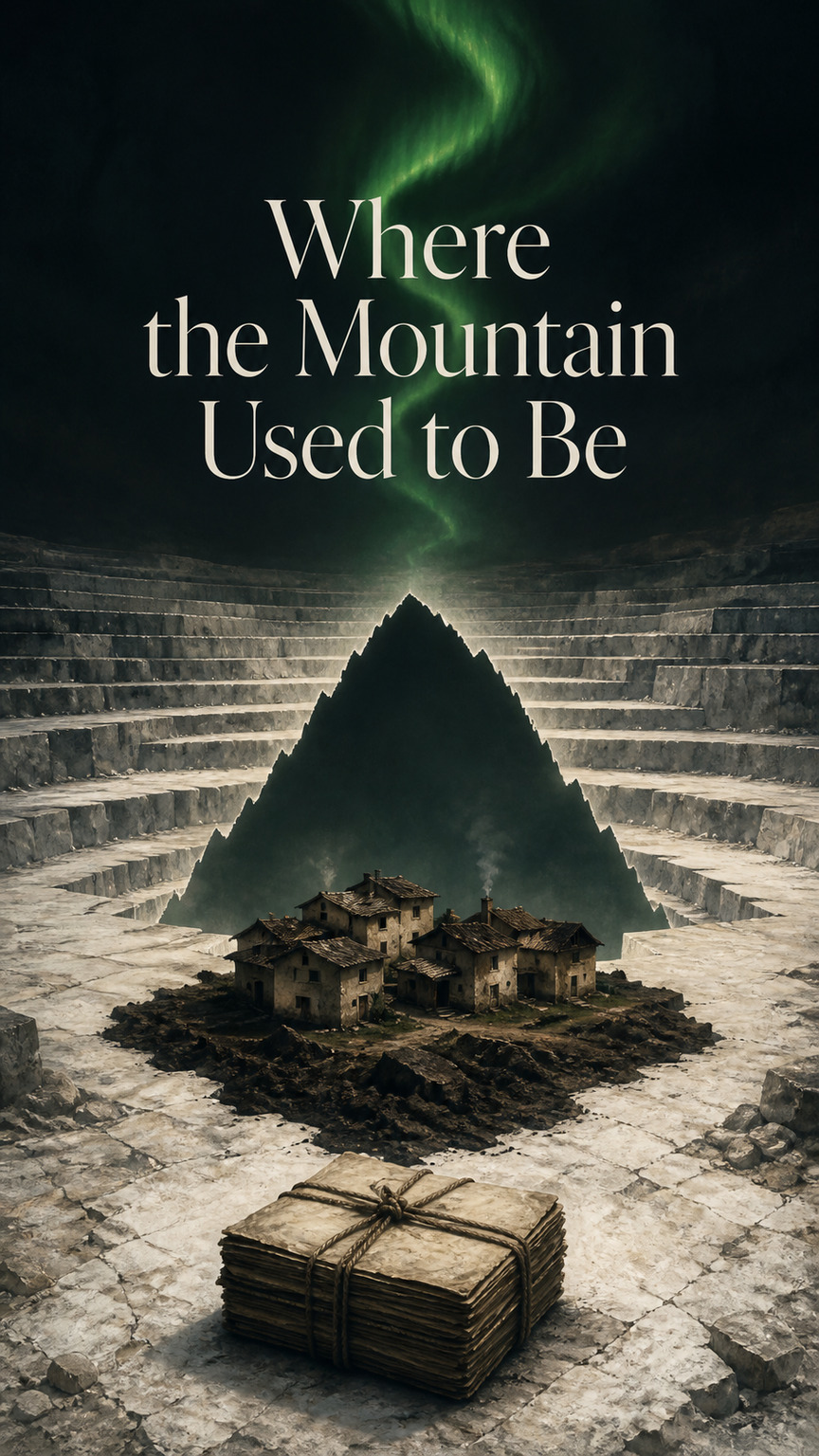
The brew-house bell was ringing, though nobody had pulled its rope.
Ormela woke beneath the table where she had fallen asleep over the tax bundle. The bell trembled on its hook. Mugs walked in small circles along the shelf, and in the cellar the casks knocked one against another like impatient customers.
Last night the aurora had lain across the mountain in green ribs. Everyone in Kettlebridge had come outside to stare until the cold drove them in. Ormela remembered putting another log under the copper, remembered deciding that one cup of her own brown ale might improve the tax figures. Then nothing.
Now white daylight came through the shutters.
She tucked the bundle inside her coat and opened the door.
The mountain was gone.
Kettlebridge remained: three crooked lanes, the bridge over the narrow runnel, the bakehouse, the byre roofs, every chimney and weathered lintel she knew. But beyond the last houses there were no fields, no pines, no upward road. The village sat on a torn shelf of stone at the bottom of a vast stepped hollow. Pale walls rose around it, ribbed with ramps and galleries. Machines stood withdrawn on the terraces, their jointed arms folded. High above, the last green thread of the aurora tightened against a blue sky and went out.
Someone screamed for a child. Goats screamed because everyone else was doing it.
Ormela climbed onto the mounting block outside the brew house. Counting roofs was useless; she needed breathing people.
“Upper lane, door to door,” she called to the baker’s two eldest. “Don’t write names. Marks only. One mark for found, a ring for hurt. Lower lane, take the potter’s boy. Belkin!”
“I see it.” The well steward was already kneeling at the public cistern, a cord running through his fingers. His usual stoop had vanished. “No, you don’t get a bucket yet. Nobody does.”
“How much?”
“Less every time you ask.”
“Useful.”
“Twenty-eight handspans. No spring coming in.” He hauled up the dripping weight and glared past her at a woman with two pails. “Drinking cups first. Then I’ll tell you where washing happens.”
Aruz pushed through the lane with her sleeves rolled, directing three people to carry an old man into the shade. “Dizziness, vomiting, bleeding, or heat in the skin comes to me. Everyone else sits down before they invent a symptom.”
At the village edge, a hen stepped past the final fence post and vanished over a drop. Ormela heard the flutter and the small, distant impact. She sent two carters to rope every broken boundary. Fires were damped. Animals came out of stalled air and into pens made from carts. Belkin marked two lined latrine trenches where the ground seemed thick enough, then moved one when the cooper pointed out it stood uphill of the cistern.
“Where’s the cemetery?” an upper-lane widow asked.
The old path ended at a clean plane of rock twenty paces beyond her house. There was no cemetery. There was no place where it had been.
Ormela opened her mouth, but the upper runner arrived waving his tally stick. Work took her before an answer did.
Ninety-six found. Then ninety-seven, after the potter’s youngest was discovered asleep inside an empty flour chest. Two broken wrists, a burned palm from a fallen lamp, six people too sick to stand. Three households kept asking when someone would count the grain and animals in the outlying sheds.
The fields had not come.
Across the gulf, figures in smooth grey clothing watched from a metal deck. None had entered the village. They had put down their equipment and backed away whenever someone approached the edge. At last one figure placed both empty hands on the rail. Another raised a flat board bearing pictures: water, a person lying down, a flame crossed through.
Ormela pointed at the water picture and held up the empty end of Belkin’s inlet pipe.
The first conversation lasted twenty minutes and produced a hose.
The hose came down from the access deck on a mechanical sling, its fittings sealed inside clear wrapping. Belkin would not connect it until the people above sent a sample first. He sniffed it, tasted one drop, waited, tasted another.
“Water,” he allowed. “Too clean.”
“Can we drink it?” Ormela asked.
“That’s what water is for. Doesn’t mean I trust a hose with no patch on it.”
By then the woman with the picture board had learned five Kettlebridge words and proved three of them wrong. She tapped her chest and said, “Sevri.” Then she pointed to a house.
“House,” Ormela said.
“Huss.”
“House.”
“House.” Sevri pointed to the whole village.
“Kettlebridge.”
Sevri repeated it carefully. Her board filled with paired marks and moving diagrams. A device at her throat offered sounds in a voice too even to trust, but Sevri stopped it whenever Ormela frowned. By noon they could manage objects, numbers, simple actions, and several kinds of no.
The man beside her was Odan, the director of the place around them. He spoke through Sevri in short pieces.
“If people stay behind ropes,” Sevri rendered, pointing first to the raw edges, “machines remain stopped. If house at east…” She paused while Odan drew a square hanging over a line. “Bad stone. We put support. No enter house unless household says.”
The owner of the east house, listening over Ormela’s shoulder, said, “He can support my kitchen from outside. Nobody opens the blue chest.”
Sevri caught outside, lost blue chest, and tried again.
Odan nodded after the fourth attempt. He sent an engineer under the shelf, where the owner could see both her and her empty hands.
Aruz permitted three future healers to set up at the lane’s end. They showed each instrument before using it. A little girl with a split lip accepted a light shone in her eyes and refused the patch afterward. Her mother accepted it for her only after Aruz smelled it, touched the adhesive to her own wrist, and made Sevri repeat that it could come off.
“Ask before touch,” Aruz told Sevri.
“I know ask.”
“Ask again when the person understands what you’re asking.”
Sevri looked at the crowd of officials gathering behind Odan. “That word will take longer.”
It took longer because the future kept bringing the wrong nouns.
First came site. Then recovery. Then Founding People, spoken by a polished official whose pale clothes seemed designed never to encounter mud. The official indicated the terraces, the machines, the village. Behind him a suspended display brightened with an image of a gold crown above a mountain.
Sevri translated in scraps. “They call this First… before kingdom. First Kingdom. You are…” She stopped. “Not rulers. Beginning-rulers? The people they say began…”
“Began what?” Ormela asked.
Odan and the official answered at the same time. Sevri closed her eyes.
The official began again. Millions of years, Sevri eventually managed. Ormela understood millions only after they built the number with pebbles, then ran out of lane. Odan showed a sequence of ridges wearing down, seas changing, cities appearing as brief sparks. This hollow was the First Kingdom Excavation. The village had not been buried inside it. Kettlebridge had returned into an empty cut on the same bedrock where Odan’s people had been digging.
There had been a warning: pressure where no pressure should be, rainwater lifting from the trench, air fleeing a shape that was not yet there. The machines had cleared forty-three heartbeats before the village arrived. Nothing had joined with stone or steel. The returned ground ended where the aurora’s boundary had ended around sleeping Kettlebridge.
The spring, road, fields, and cemetery had lain outside it.
“Way back?” Ormela asked.
Sevri did not need Odan. “No known way.” She touched her board, removed known, and said it again. “No way.”
The polished official leaned toward the recording lenses hovering behind the deck. He said something with the solemn measure of a proclamation.
“He asks,” Sevri began, “if the Keeper of Founding Record will greet the waiting public.”
Ormela had been called many things over unpaid drink, but never that. “I’m the tax reeve.”
Sevri checked the phrase twice.
“Tax?” the official said in Ormela’s language, delighted by the new word.
“Overdue tax.” Ormela pulled the bundle halfway from her coat. “Three quarters late, because the bridge washed out and because people lie about how many mules they sold.”
The lenses turned toward her as one.
She shoved the bundle back inside. “No.”
By afternoon, Kettlebridge had divided itself into meetings without anyone ordering it to.
Belkin ran water and waste from the cistern steps. “Show me the tank,” he kept telling Odan’s logistics people. “Not the cup. The tank, the pipe, and where it goes after.”
Aruz occupied the shaded wall of the bakehouse, where future healers explained examinations one person at a time. Several villagers accepted treatment. Some accepted temperature checks but not blood sampling. One man refused every device and agreed only to let Aruz listen to his lungs. A mother wanted her sleeping baby moved before she would discuss herself.
At the byres, drovers argued for the goats to leave before any furniture. The brewers argued that six full casks weighed less than thirty panicked goats and behaved better on a lift. Children wanted to know whether the floating lenses could see through shutters. Someone wanted bread. Someone else wanted the latrine moved again. The cooper tasted Ormela’s least successful ale and asked whether millions of years had improved it.
“Not yet,” Ormela said.
Odan moved between these circles, never promising past what he controlled. If a house was occupied, his team would treat it as occupied. If an object was needed for food, shelter, care, or work, it would not enter a study queue. If people crossed the access deck, media would be held behind the upper barrier. Land ownership, he kept saying, was not his decision.
The official’s preservation office disagreed about nearly everything else.
They had catalogued Kettlebridge for generations. On the terraces stood sealed trays of pottery from an outer rubbish slope, worn road tokens, animal bones, and tools lost beyond the old village boundary. Farther inside the facility were boxes lifted from the cemetery before anyone knew the cemetery belonged to people who might return.
“Our dead?” the widow asked.
Sevri took off her throat device. “Wait. I need the difference. Your dead, the place, the… right to choose. They are not one word.”
The widow waited. So did Ormela, though waiting felt like allowing a theft.
When Sevri was ready, Odan arranged for them to see the cemetery room through a closed window. The containers were opaque and unmarked except for future numbers. No bones were displayed. Odan said sampling had stopped that morning. The polished official said several cultural councils claimed descent from the First Kingdom and must be included.
“Are they our grandchildren?” the widow asked.
Sevri translated. The answer traveled through three officials and came back polished smooth: the councils maintained inheritance through foundational affiliation.
“That’s not what she asked,” Ormela said.
“No,” Sevri said. “They cannot prove family. They may have a claim to be heard. Not the same as owning.”
The widow chose two people to remain with her at the window. She did not ask to open the containers. She asked for the room to stay locked, for no ceremony, and for time to choose more representatives. Another villager whose family used a different burial slope wanted no part in that choice. Aruz said the distinction must be recorded too.
Ormela’s bundle grew warm under her coat.
It held ninety-seven names, after correction, with debts beside most of them. It did not hold the dead in the boxes. It did not hold the seed grain, the grazing rights, or the outlying sheds. It recorded one widow as owing two hens, though the hens had been payment for a roof repair and everyone on upper lane knew it. A tax list was useful because it was narrow. The future liked it because they believed it was wide.
When officials requested a household record for the emergency hearing, Ormela laid the bundle on the brew-house table but kept one hand on it.
“Headcount,” she told Sevri. “Sleeping places. Animals if transport needs it. Nothing copied without the household seeing the entry.”
The official asked whether a complete scan would protect the record.
“It would protect your copy.”
Sevri began to translate that, stopped, and chose simpler words. “She says no.”
The hearing took place in five places at once. Ormela, Belkin, Aruz, the widow’s group, and the drovers stayed in their own meetings while Sevri carried questions among them. Future advocates and site workers spoke from the deck. The polished official wanted a single authorized delegation. Kettlebridge offered him a water answer, a medical answer, a burial answer, a livestock answer, and several household answers that contradicted one another.
It was slower. It was also the first arrangement that worked.
Near sunset, a temporary adjudicator appeared on the suspended display. Sevri could not carry the legal language, so the adjudicator broke the order into pictures and short statements, each checked by Odan’s counsel and the village group concerned.
Living people, their clothing, and what they carried were outside artifact custody. Occupied houses and the goods still in them remained with their occupants while claims were examined. Images, measurements, samples, and interviews required permission. Excavated material and human remains would stay under neutral care; the cemetery containers would remain sealed, with no display, testing, family ruling, or reburial until representatives chosen by the villagers and the claiming councils had both been heard. The land beneath Kettlebridge was unresolved. So was the history.
The next day’s founding ceremony was paused. The exhibition was closed.
“Paused isn’t ended,” the widow said.
Odan heard her tone if not the words. “No,” he said through Sevri. “Locked until the next hearing.”
That was less than the widow wanted and more than the preservation office had offered at noon. The recording lenses rose beyond the rim. On the terraces, bright public displays went dark one by one.
The museum offered climate-controlled rooms. The medical service offered separate housing for observation. Both offers came with excellent diagrams and too many doors that locked from outside.
Freight Hall Nine appeared on a logistics map only because Belkin asked where the water tanks could be reached by hand.
It was a disused concourse beyond the excavation, built for cargo transfers that no longer used wheeled loads. It had working water, visible pipe runs, high ventilation, broad loading access, animal bays, floor drains, and partition tracks where households could hang walls of fabric or board. The future officials called it unsuitable for heritage reception.
“Good,” said the cooper.
No village vote followed. Households walked through moving images of the hall and made their own decisions. The drovers chose the bays nearest the outer doors. Aruz claimed a room with two exits and a washable floor, then crossed out medical on the plan until Sevri replaced it with care. Several older villagers would not leave Kettlebridge that night. The east-house owner refused until she saw the new supports under her kitchen. Four adults volunteered for alternating watches at the site, and Odan agreed they would keep access as stewards, not exhibits.
Others reserved the right to change their minds in the morning.
By full dark, lifts stood ready at the access deck. A future inventory on the first cargo pallet identified Ormela’s tax chest as ceremonial regalia and the cooper’s adze as a dynastic emblem.
The cooper sat on the pallet. “Dynasty can carry itself.”
Odan closed his eyes for one breath. Then he stripped both labels off.
Ormela brought out the bundle.
Not for the officials. She set a bench beside the lift and called households in the order of the lanes because the lane order was the only part of the list that helped. Each family saw its entry. Each could correct it, use it, or walk past.
“One loom,” Ormela said to an upper-lane household.
“Not going tonight.”
She struck it from the loading sheet.
“Two adults, three children.”
“Two children. The eldest is staying with the animals.”
The eldest, who was twelve, shouted from the goat pen that she was not. Her mother went to settle that without the tax reeve.
The brewer beside Ormela claimed four casks. His wife corrected him to three and vinegar. Belkin cut the second furniture lift when a waste tank arrived late. Aruz held back a feverish man until he could travel lying down. One household declined to have its names spoken where the future clerks could hear, so Ormela marked five anonymous places and nothing more. Sevri translated weights, destinations, and consent, stopping whenever the device at her throat grew more certain than she was.
The polished official returned once to request a certified copy of the “royal household roll.”
Ormela handed him a blank loading tally.
“Tonight,” she said, “this is what we’re writing.”
He looked to Sevri.
“Loading,” Sevri translated. “Only loading.”
Odan accepted the sheets one lift at a time. He checked that the number aboard matched the number arriving, then gave each sheet back. Property left with the people using it. Site trays stayed sealed. The cemetery room remained under three locks, with one chosen villager and one neutral steward watching the door until morning.
There were mistakes. A crate of boots went to the animal bay. Two goats reached Freight Hall Nine before their keeper and attempted the care room. The first privacy partitions proved translucent, provoking such a storm from the upper-lane households that the future crews replaced them without asking for a heritage ruling. Supper arrived as nutrient bricks until the baker showed a logistics worker flour, salt, water, and an oven.
Past midnight, Ormela rode the last passenger lift out.
She stood beside Odan at the rail while Kettlebridge dropped below them. Work lamps silvered the roofs. Beyond the little island of houses lay foundation cuts, sealed galleries, and the sheer blank walls of the excavation. No dark shoulder of mountain rose behind the chimneys. No road bent toward home, because home had become the thing inside the ropes.
Odan held out her tax bundle.
“No copy,” Sevri said beside him. Fatigue had roughened her careful speech. “He says his office has no copy. The loading numbers only.”
Ormela thumbed the cord. “The potter still owes six copper.”
Sevri considered this, decided it did not need to become history, and did not translate it.
At Freight Hall Nine, the animal bays smelled of wet straw and frightened goats. Water knocked in exposed pipes. Children slept behind mismatched opaque screens while their parents argued softly about drafts, doorways, and who had taken the good blankets. Belkin had chalked drinking times on a pillar and was adding a separate line for washing. Aruz’s held-back patient had arrived and was snoring in the care room. Near the loading doors, three households were still deciding whether to stay.
Ormela put the bundle under the bunk assigned to her, then found that someone had rescued the vinegar cask and left the better ale behind.
“Mediocre,” the cooper said after a taste.
“You’re welcome to wait a few million years for another,” Ormela told him.
He held out his cup anyway.
Predawn air moved through the high vents. Ormela poured to the chalk line Belkin had marked, stopped when he rapped the pipe with his wrench, and poured the remainder back into the jug.