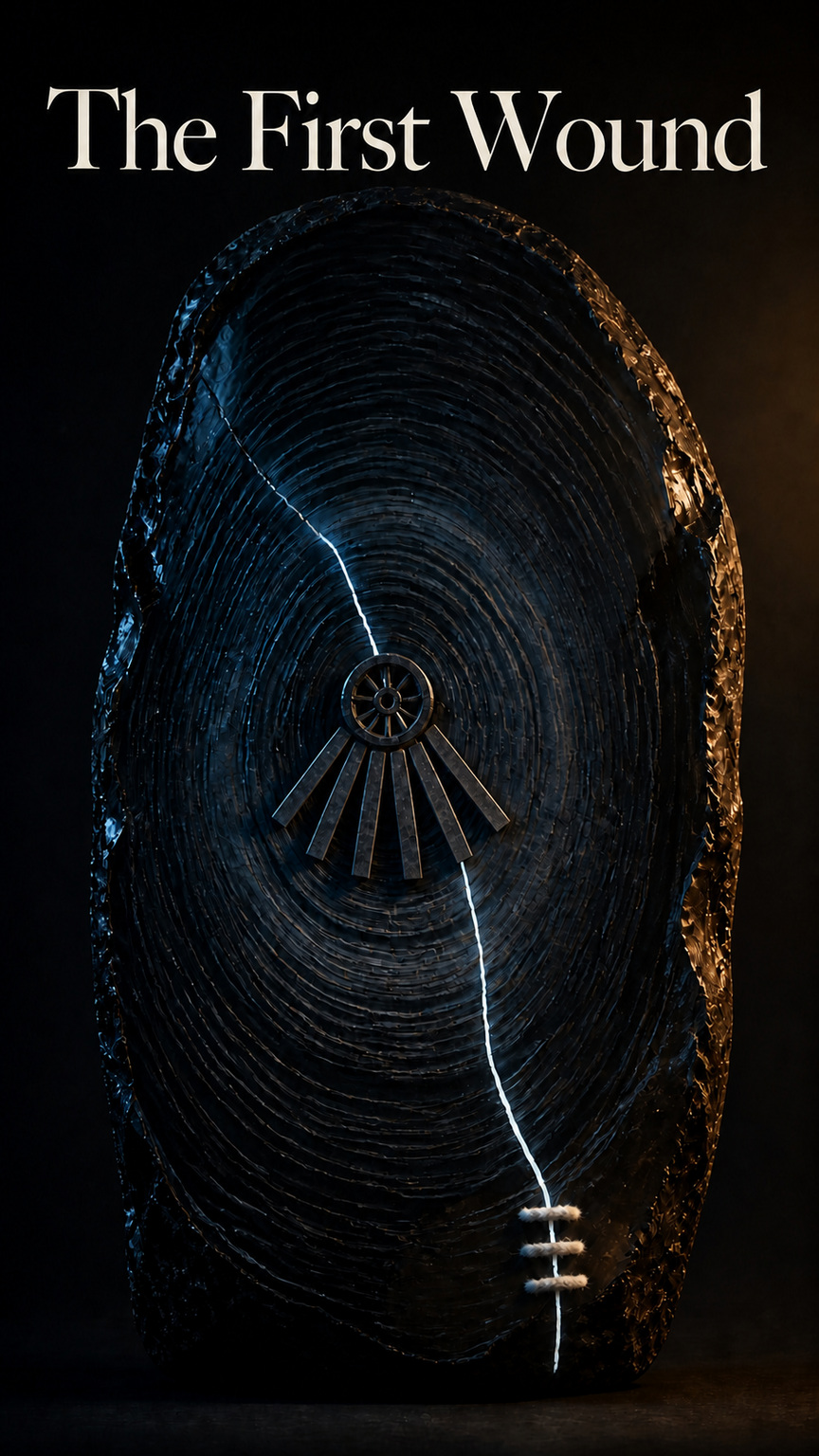
The First Wound
The therapist enters his memories and follows the trauma back his memories, only to discover its source: a battle fought 25000 years ago.
“Don’t follow the bell,” the man said. “Follow my left hand.”
His left hand lay palm-up on the low table between them. Nothing unusual marked it except a faint white line below the thumb. The recording slate beside it showed a single green point: room sound only. It could keep their spoken words. It could not enter anybody’s memory, and she had learned not to let its presence flatter people into believing otherwise.
She rested two fingers against the inside of his wrist. His pulse was quick and meticulously ignored.
“Starting point?” she asked.
“The river tram. Six days ago.”
“Your hold on the room?”
He rubbed the seam of his cuff between finger and thumb. “Wool. Three raised stitches.”
She shifted her left shoe until the braided edge of the rug pressed through its thin sole. Her own way back. “Either of us releases, I leave. You can leave without waiting for me.”
“I know.”
He answered too quickly, as he had twice already that evening. The therapy session had run late because he could describe the brass housing of a tram’s emergency lever to the width of its screws, but not what he had meant to do with it.
“Do you want me to follow from the pressure in your hand?”
His thumb moved across the old white line. “Yes.”
Her faculty needed no machine. It needed another person making a memory present, and her attention willing to meet it. She listened below his pulse, where the body sometimes kept its own sequence of doors.
The room tilted.
Cold brass filled her palm.
Then she was standing where he had stood six days ago, inside the crowded tram beneath the river.
The memory admitted only what he had admitted. A sleeve against his cheek. Wet wool. The sour-metal smell of a brake overheating. Twelve passengers in the half-car he could see, though the far end vanished behind taller bodies. He counted them without deciding to count.
Eleven. Twelve. A shoulder shifted. Eleven again.
The tram had stopped between stations. Its doors gave three warning notes although there was no platform outside, only black service stone sliding past the windows as the carriage rocked. Someone laughed uncertainly. Someone else pushed toward the driver’s compartment.
The man’s left hand closed around the emergency lever.
Not to open the doors. To hold them shut.
That purpose arrived without explanation and with the force of a command. Pressure crowded his ribs. There were people behind him. There were people coming. If the barrier did not seal before—
“Not the bell,” his present voice said through the memory. Thin, far away. “The grip.”
She let the three notes pass. Beneath them, his palm registered the lever’s shape: rounded handle, narrow neck, a shallow split in the brass. His hand knew how much force it would take to move it. It knew the final position before his eye found the painted arrows.
In the carriage, a woman caught his elbow. “Sir. Let go.”
“Clear the door,” he told her.
“There is no door open.”
“Not yet.”
His voice had gone level. He counted the visible bodies again, then the breaths between the warning notes. A transit attendant forced through the crowd, one hand raised.
“Step away from that lever.”
“How many in the forward car?” the man asked.
“Let go.”
“Its rated capacity.”
The attendant put both hands over his. For one instant, pressure enclosed his left palm: brass below, living fingers above.
The tram disappeared.
Rain hammered a sheet-metal roof. The same hand gripped a wheel crusted with red paint, and floodwater shoved against a factory gate on the other side. The man wore another coat. The white line below his thumb was not there.
“This is eighty-three years earlier,” he said from somewhere close to her ear.
Three workers splashed down a corridor toward him. He could have spun the wheel and protected the machines behind the gate. Instead, he braced it open. Water struck his knees, his hips, his chest. The last worker slipped. He released the wheel to seize the back of her jacket, and the gate slammed hard enough to bend its lower track.
An alarm rang three times.
The memory lurched before she could ask what happened next.
Now stone scraped his palm. Smoke lay along a ceiling so low that everyone moved bent-backed beneath it. A refuge door stood open while people carried clay water jars inside. There were no wires in the walls, no glass in the lamps, no fabric she recognized in the man’s rough sleeve. Yet the hand was his.
“How far?” she asked.
“Six hundred and twelve years.”
He caught the door before its counterweight could fall and held it while two more people ran through the smoke. Someone inside shouted at him to shut it. He waited anyway. The last runner crossed. He dropped the bar. A blow landed outside a moment later, hard enough to shake dust from the lintel.
Here, too, he had kept the barrier open.
The memories were not repetitions. The pressure was. The weight in his palm. The shrinking interval in which strangers became arithmetic.
She felt the rug’s braid vanish beneath her shoe.
That loss was the limit, not a metaphor. The session room had become too small to locate. The hand under hers seemed to stretch back through centuries, a continuous line with no safe estimate at its far end.
She released his wrist.
The refuge broke apart. She came back with her heel grinding against the rug and her other hand clamped around the table edge. The room’s lamplight looked flat and yellow. Her stomach climbed, then settled.
Across from her, the man still sat with his eyes closed. His fingers worked the three raised stitches on his cuff, but without rhythm, as though he had forgotten what they meant.
“Open your hand,” she said.
His left fist tightened.
“The room is here. I’m out.”
He drew one breath, then another. His fingers opened.
When he looked at her, he did not ask why she had stopped. His gaze went first to the slate, then to the distance between their hands.
She switched off its green point.
“You gave me a risk history of twelve years,” she said.
“Those were the incidents that mattered.”
“You just took me through six centuries.”
“Six hundred and twelve years.”
“That correction is not helping you.”
His attention dropped to his left palm. “No.”
She waited. In the quiet, rain ticked against the high window, softer than the rain in the factory memory and real in a way that temporarily felt unconvincing.
“How old are you?” she asked.
He pressed the thumb scar until the skin blanched. “My count has gaps. Approximately twenty-five thousand years.”
The figure did not enter the room all at once. First came the absurdity of it. Then came the remembered door under his hand, six centuries before this chair and table existed. Then came the practical fact that he had known the depth she might encounter and had let her calculate danger from twelve years.
She moved her chair back half a foot. The rug whispered under its legs.
His face changed at the sound—not surprise, exactly. Recognition of a consequence he had expected and hoped to postpone.
“I asked for the first occurrence,” he said.
“You asked me to follow you there without telling me where there was.”
“If I tell people, they stop asking what is happening to me. They ask what happened to everyone else.”
“I’m asking what happened to me five minutes ago.”
He looked toward the dark slate again. “You left.”
“Yes.”
“I didn’t stop you.”
“You didn’t tell me I might have to find my way out of twenty-five thousand years of compressed memory.”
The precision drained from his posture. Not from his words; those became more exact as the rest of him failed. “Compressed is your inference. Some periods remain detailed. Others are almost empty. I don’t control which until I’m near them.”
“That belongs in the risk.”
“Yes.”
The plain admission left them nowhere easy to go.
He took his cuff seam between thumb and finger once more. One stitch, two, three. “The tram was worse than the others. I nearly sealed the forward partition while people were moving through it. I need the source before the next time.”
“Finding a source may not change the next time.”
“I didn’t say cure.” His head came up. “I said source.”
There it was: the thing he had asked for, narrowed until it could not promise more than it was. She could refuse. She could also continue only by pretending his concealment had not changed what continuation meant.
She turned the slate facedown.
“Nothing further is recorded,” she said. “One descent. You choose what we follow. I decide whether to follow it, and I leave when I decide to leave. You come out by your own hold on this room, not by waiting for me to drag you.”
He glanced at the slate’s dark underside. “Afterward?”
“Afterward, this session ends. Any other decision waits.”
His jaw shifted. He had wanted assurance and found a boundary instead.
“My hold is still the cuff,” he said.
“Is it enough?”
He tested the stitches, taking time now. “Yes.”
“What do you want me to follow?”
He placed his left hand palm-up again. “The pressure before the scar.”
She did not touch him until he said, “I want you to follow.”
Then her fingers found his wrist.
The room fell a very long way.
For a time there were only hands.
His hand around a wooden peg while men hauled a gate against winter wind. His hand gripping a rope slick with river water. His hand beneath a stone slab while someone crawled under it. Each contact flared and vanished before she could see a face. The memories were too compressed to inhabit, stepping-stones worn down to pressure and release.
Then the left palm was young and unscarred.
It closed around a black wheel set into a wall of glassy stone.
The battle struck through the mountain.
The shock came first through his feet. Pale lines inside the walls flashed from white to blue. Dust lifted from the passage floor and hung there. Somewhere beyond the bend, something gave a thin rising cry that might have been a weapon or stone forced past endurance.
She saw only his station: a corridor cut through dark rock, the wheel, a barrier suspended above the opening, and the backs of defenders carrying the wounded toward an inner turn. Whatever armies fought outside his sight remained outside the memory.
“First break,” a voice behind him called. The commander. He never saw the speaker’s face. “Hold the wheel.”
The young man’s palm tightened. The wheel’s spokes had been wrapped in hide, but heat leaked through them. Above the opening, seven thick ribs waited inside the barrier. Once lowered, fire in the wall would fuse their teeth into the floor. No one had explained this to her. His hand knew it.
Figures appeared around the outer bend.
“Eleven moving,” he said.
He could see five clearly. The rest arrived as shadows inside dust.
A wounded survivor at the front had one arm hooked through a litter frame. “Keep it high,” she called. “Two on the frame. Don’t crowd the turn.”
Someone behind her shouted, “They’re through the lower cut.”
“Then use your legs,” she answered. “Lift on mine.”
The commander’s voice struck from behind the young man. “Second break.”
Another shock rolled underfoot. A blue fracture ran across the passage wall and stopped an arm’s length from the wheel.
“Eleven outside,” the young man said. “I need two more measures.”
“You can see five.”
“I counted movement.”
“You counted dust. Hold for the third break. Then seal.”
The survivors ran unevenly, bound by the litter between them. One stumbled and pushed the frame toward the others.
“Take it.”
“Get your hand back on.”
“I’m slowing it.”
“You’re walking.” The front survivor caught his harness and dragged him upright without stopping. “Walk faster.”
There were people behind the young man too. He did not turn to count them. The commander had given numbers earlier—hundreds in the chambers beyond the inner turn, stores, water vessels, children carried down from the upper shelters—but those facts were now only pressure without pictures. The memory could not show what his eyes had not.
The third shock began as a bright pulse in the wall.
“Seal,” said the commander.
The young man did not move.
The first survivor crossed beneath the suspended barrier. She pulled one side of the litter. Two others supported the middle. A man at the back looked over his shoulder into dust boiling around the bend.
“Now,” he yelled. It was not clear whether he meant the gate or their feet.
“Seven through,” the young man said.
“Seal.”
“Four moving.”
The wheel burned deeper into his palm.
At the bend, a figure fell. Two shadows stopped. The front survivor twisted against the weight of the litter and shouted, “Leave the pack. Both hands on him.”
“They won’t make the measure,” the commander said.
“One more.” The young man’s voice cracked on the last word. “One.”
The blue fracture reached the wheel housing.
His hand turned.
The barrier dropped.
Its seven ribs came down through the opening one after another, too fast to count and slow enough that he did. The front survivor threw herself clear on the inner side. The litter struck stone, half across. Someone dragged it by the frame. A shoe scraped beneath the descending edge and vanished inward.
Beyond it, three figures reached the gate.
Or four. Dust cut one body into two shapes. His memory supplied a shoulder where the view had been blank, took it away, supplied it again.
The last opening closed.
Light ran molten along the barrier’s teeth. The wheel kicked in his grip. Heat tore the white line into his palm.
On the other side, something struck the sealed gate.
Once.
Twice.
Then several blows overlapped.
He counted seven. He counted nine. The rhythm broke and began again beneath the rising cry from beyond the bend. The young man kept both hands on the wheel although it could no longer turn.
“Release it,” the commander said.
“How many were outside?”
“Release the wheel.”
“You saw the line. How many?”
“I saw the fracture.”
The barrier rang with three descending notes as the fused ribs cooled.
The memory snapped back to the instant before his hand turned.
“Wait,” the present man said.
Again the survivors came through the dust. Again someone fell near the bend.
“There was a voice after the third break.”
She listened from inside his hearing. Commands behind. Running feet ahead. The thin weapon-cry in the rock. Nothing else she could separate.
“I don’t hear one,” she said.
“The one at the back said something.”
The passage reset.
This time the man at the rear seemed nearer. His mouth opened. Dust covered his face.
“You moved him,” she said.
“No.”
“He was behind the litter.”
“He was beside it.”
The memory shuddered. The man stood in both places for a breath, not as two people but as two attempts to know where one person had been.
The client’s fingers closed around hers in the session room, distant but unmistakable.
“Again,” he said.
She felt what he wanted from the missing voice. Not forgiveness. A fact: warning or accusation, permission or plea. Anything definite enough to finish the calculation he had carried through every closing door since.
The wall flashed. Third break.
“I’m leaving,” she said.
“One more measure.”
The young man’s hand waited on the wheel. The survivors ran. The commander drew breath to order him.
She turned her attention downward, searching for the rug beneath her shoe. Nothing. The ancient floor bucked. She searched instead for the small ache in her ankle from moving her chair, for the cool table edge under her free hand, for rain tapping a window no one in this passage had ever seen.
“Your cuff,” she said. “Find it or don’t. I’m leaving.”
She opened her fingers.
The gate fell without her.
The session room returned in pieces: rain, lamplight, table, the bitter taste at the back of her tongue. She pulled both hands into her lap.
The man remained bent forward. His left hand gripped empty air. His right thumb scraped frantically across his cuff, missing the raised stitches, finding smooth cloth, missing again.
She did not touch him.
His breath caught. His thumb slowed. Found one stitch.
Then the second.
At the third, his empty hand opened.
He raised his head. For several seconds his eyes moved over the room without collecting it. They stopped on the facedown slate.
“How long?” he asked.
“Here? Less than a minute.”
“There were nine strikes.”
“You counted seven first.”
He closed his eyes, but he did not fall back into the memory. “Three reached the gate.”
“I couldn’t tell.”
“Four, if the shape in the dust was a person.”
“I couldn’t tell.”
His hand curled around the scar. “The commander was right about the fracture.”
She waited until he looked at her.
“That’s where it begins,” he said.
It was the first answer he had given without a measurement attached.
She turned the slate upright but did not switch it on. “Do you want the earlier room audio kept?”
He considered the little black square as if it were another barrier under his hand. “Keep the tram. Remove everything after you asked my age.”
“Done.”
“And this session ends.”
“Yes.”
He stood carefully. The movement exposed how unsteady he was; one hand went to the table, then withdrew before she could offer hers. He looked once at the dark slate before turning toward the door.
At the door, he paused with his fingers on the latch.
Outside, footsteps passed along the hall. Two people speaking, one silent, then a fourth hurrying to catch them. His lips moved once with the count.
The latch gave three soft warning notes. His knuckles whitened.
He found the three stitches at his cuff with his thumb. Then he opened the door and stood aside until the hall was empty.