The Five-Minute Warranty
Goblin's aren't terrible engineers, they can make anything work. And I mean anything. Just... not for very long.
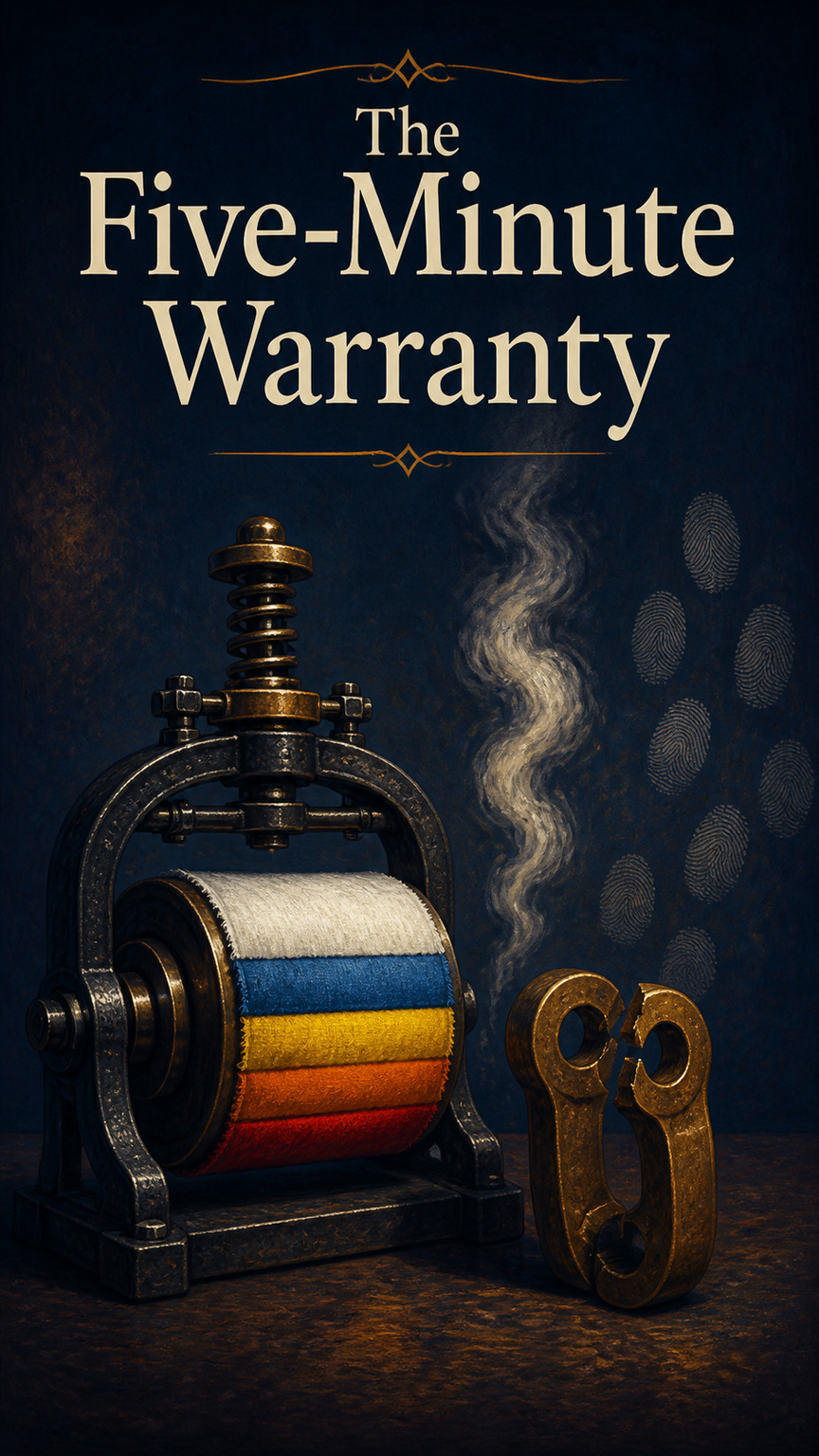
The North Rise died in three sounds.
First came the kiln-shed blast, a flat blow that struck soot from the upper landing’s rafters. Then the lift cables sang as the lower terrace jumped beneath them. Last came a crunch so deep and expensive that Kezli, standing two streets away in her workshop yard, knew a crown gear had lost more than one tooth.
In the echoes, she reconstructed the likely sequence: broken teeth punching through the inspection cover, the cable drum lurching half a turn, the ratchet brake catching with a crack. If one cage had been at the upper landing, its twin would be stranded somewhere in the smoke below.
By the time Director Nalda Vick’s runner reached the workshop, Kezli and Olbit had already packed gauges, oakcloth, and every wrench that could be carried at a trot.
When they arrived, Kezli found the failure she had heard. Two iron wedges lay on the Rise’s landing stones beside the holes they had punched through the inspection cover. The cable drum stood half a turn out of position, held fast by its ratchet brake.
Four signal flags hung from the lower station: ten people ready, ten behind them, ten more behind those, and a fourth group still coming out of the quarry sheds. Forty in all. A bruised lift attendant below worked the speaking wire with one arm. Beyond the flags, black smoke moved across the kiln yard toward the station. The stair road had vanished under a spill of rock and brick.
Two human lift mechanics knelt beside the opened gear housing. One held up half a tooth as if the rest might apologize and come back.
“The crown is finished,” he said. “Casting and cutting another takes six days. Resetting that pedestal may take ten.”
“You have minutes,” Nalda told Kezli. Her gray coat was powdered white from the blast. “I need a proper repair. Permanent.”
Kezli looked at the drive pedestal. A hairline crack ran through its masonry footing exactly where her rejected maintenance bid had warned it would. Excessive short-term work, Nalda had written across that bid. The lift office requires lasting solutions.
All around the upper landing, people were watching Kezli as though goblin pride might be hammered flat enough to fit where the gear had been. She wanted the civic contract. She wanted Nalda to regret every word of that rejection. For one hot, foolish moment, she wanted to say yes before she knew what yes would cost.
Olbit crouched beside the cable drum and put two fingers against the brake pawl. “Still holding,” he said. “That is one useful fact. Shall we collect more before making promises?”
Kezli let out the breath she had been saving for a boast.
“A permanent repair? No,” she said. Nalda’s face tightened. Kezli pointed past the wrecked teeth to the smooth iron collar left on the engine shaft, then to the clean outer rim of the cable drum. “But the boiler still turns, and the drum can still turn. They can’t mesh anymore. They might be persuaded to touch.”
Kezli checked the engine while Olbit checked the load path. They worked separately because agreement was useful only when it survived two sets of hands.
Boiler pressure held steady. The piston rods ran true. The engine-side shaft had gained a bright score but no bend. Kezli chalked a line on the flywheel and watched three slow revolutions under steam. Across the housing, Olbit measured cable lay, tested both landing brakes, and sent an empty cage two handspans down and back on the emergency windlass.
“Cables pass,” he said. “Cages pass. Brakes engage. Drum collar is sound. Pedestal offset is eleven fingers at the crown and worsening under weight.”
One of the lift mechanics proposed welding the broken teeth into place.
“The crown is brittle,” Kezli said. “The first passenger load would pull the welds out with larger pieces attached.”
The other suggested a leather belt around both rims.
Olbit stretched a cord between the misaligned shafts. It wandered to the edge before he had pulled it taut. “The belt would walk off before the first cage cleared the lower roof.”
“Then couple the drum directly,” Nalda said.
“The engine turns six times too fast,” Kezli said. “Direct drive would bring the cage up promptly. It would not stop at the landing, which is where passengers generally prefer to leave it.”
Nalda pressed her mouth shut. Below, the speaking wire clicked twice: smoke had crossed the kiln yard.
Kezli sighted along the two bare rims. Rigid teeth demanded alignment. Friction did not, if the contact could follow the offset and if something gentler than iron carried the heat. She drew two circles in the soot on the housing, then a smaller circle pinched between them.
“A contact roller,” she said. “Spring-mounted. Sleeve it in oakcloth so it grips both rims.”
“One roller will climb,” Olbit said. He drew a second small circle under hers. “Two will share the side thrust. Put them in a flexure brace so they can follow the shifted axis instead of arguing with it.”
“The piston pulse will eat the cloth.”
“Sorter flywheel. The cracked ore sorter behind the coal shed still has one.”
“Too heavy.”
“Which is why it will smooth the pulse.”
Kezli grinned despite the smoke. That was the pleasure of working with Olbit: he disagreed in completed calculations.
They measured the shaft speeds and chose roller diameters that reduced the engine’s turns to the drum’s safe rate. Olbit took two brass weights from a platform scale and sketched a ball governor to hold that rate under load. Kezli cut a strip from a standard resin-bound oakcloth leaf, clamped it to a test roller, and pressed it against the powered engine collar for ten counted seconds.
The sample emerged hot, glazed, and thinner by a measurable shaving.
They ran it again at the pressure required to lift the heaviest declared cage. Kezli marked wear against time. Olbit measured the available collar clearance.
“Five standard leaves,” he said.
Kezli stacked them around the test roller: white, blue, yellow, orange, red. Five fitted snugly. A sixth made the roller too fat to engage. She tried six thinner strips; the test heat burned through the outer pair so quickly that iron would meet iron before the fourth load arrived.
Nalda watched the red layer disappear beneath the others. “How long?”
“Under a declared load, at governed speed, five minutes from clutch engagement to bare iron,” Kezli said. “Not six. Not five and a favorable opinion. Five.”
“People say your workshop can make anything work.”
It was a local joke, usually told when someone wanted a miracle at the price of a hinge. Kezli rolled the ruined test strip between her fingers.
“We can make these parts agree,” she said. “For five minutes. If you want anything else, call someone who lies.”
The apparatus looked improbable only to anyone who could not see what each piece did.
Cart springs became the flexure that kept the rollers pressed against both offset rims. A straight length of ore rail braced the frame. The salvaged sorter flywheel went on the engine side to swallow the pistons’ hammering pulses. The scale weights spun on hinged arms above it, opening the steam throttle linkage when speed fell and closing it when speed rose. Five resin-bound oakcloth leaves wrapped the main contact roller, each dyed a different color and chalked with a wear line.
Olbit riveted a copper tab into every layer. As each leaf stripped away, its tab would strike a hanging clapper. Kezli notched a bronze shear link to part at the force expected when compliant cloth gave way to bare iron. The parting link would release the spring brace, pull the rollers clear, and trip the steam-dump latch. After that, the Rise’s own tested ratchet brake would hold the drum.
Nothing in the chain was decorative. Even the shield of dented boiler plate had one purpose: keeping curious people away from the harmless but alarming pieces.
Nalda returned with a passenger sheet while Kezli fitted the final pin.
Olbit read it and frowned. “It says ‘forty, roughly adult.’”
“There are also three children,” Nalda said.
“Then they are remarkably roughly adult. Any tools? Ore samples? Family trunks?”
“One hand bag each.”
“A hand is not a unit of mass.”
Smoke rolled above the lower terrace roof. Still, Olbit would not sign for a mystery. They weighed upper-landing volunteers with ballast, established ten marks on the cage floor, and sent instructions down the speaking wire: four balanced groups of ten, bags on laps, quarry tools left behind. The bruised attendant confirmed each group against the marks.
Kezli wrote the operating ticket on a board and read every line aloud.
“Four passenger loads. Governed speed at the painted line. Five minutes beginning at clutch engagement. White, blue, yellow, orange, red, then bare iron. Smoke expected. Clatter expected. Copper strike at every cleared leaf. Everyone behind the shield line when red appears. Terminal sequence: shear, roller withdrawal, steam dump, brake engagement. No restart after terminal shear.”
At the bottom waited signature lines for engineer, loadwright, director, and use priority.
Five minutes looked miserable in ink. Six looked almost generous. Six might look like confidence to Nalda, and permanence’s smaller, respectable cousin to the council.
Kezli’s pen hovered.
Olbit glanced at it. “Will the extra minute be made of ink?”
She scratched out the beginning of a curve before it became a six, wrote a hard-edged five, and stamped the ticket in red.
“Five,” she said.
Director Vick signed beneath her. “Five.”
The speaking wire bell rang before Nalda could fill in the use-priority line.
The council courier bent to the mouthpiece, listened, and went pale. “Order from the council. Two guards take the first empty cage down. The returning cage carries the civic strongbox. Passenger evacuation follows.”
Nalda stared toward the smoke. “The strongbox holds the quarry receipts and the reserve for wages. Without it, half the lower district may not be paid. We may not be able to rebuild this lift.”
The order was not foolish. That made it worse.
Olbit laid four square washers on the ticket, one for each passenger group. Then he set a brass nut beside them for the strongbox cycle. There was no room for the nut.
“Find another minute,” Nalda said to Kezli. Quietly, as if quiet words weighed less. “Or slow the lift and stretch the five.”
“Slower means the cloth sits under pressure longer and cooks,” Kezli said. “Faster means the landing brake takes more speed than we tested. The four passenger loads use the travel and loading time we have. Send guards and retrieve the strongbox, and ten people remain below when red clears.”
“Then tell me what to do.”
Kezli felt the invitation inside the demand. If she chose, the director could later say the goblins had forced her hand. If Kezli invented a sixth minute, everyone could pretend the machine had erased the choice.
She moved the washers and nut apart.
“I can price your choices in loads and minutes,” she said. “I cannot decide whose future counts. That line is yours.”
For one breath Nalda looked furious. Then she took the pen.
On the use-priority line, she wrote: PERSONS BEFORE PROPERTY. FOUR PASSENGER LOADS. STRONGBOX REMAINS BELOW. She signed the addition and made the council courier witness it. Then she took the speaking-wire mouthpiece herself and transmitted the order to the bruised attendant.
The four lower flags dipped in acknowledgment.
“Engage,” Nalda said.
White showed on the roller. Five minutes remained.
Kezli opened the boiler feed, watched the governor weights lift to their painted line, and pulled the clutch lever.
The roller train gripped.
For a terrible half second, every piece merely strained: engine collar against white oakcloth, cloth against rollers, rollers against the hoist rim, drum against forty lives’ worth of cable. Then the empty upper cage descended. Out of the smoke, its loaded twin began to rise.
The impossible connection worked because every part was doing exactly one possible thing.
“Speed on line,” Kezli called.
“Contact pressure true,” Olbit answered.
Nalda read the first ten names from the passenger sheet, then caught herself and called, “First load rising.”
The drum turned steadily. Resin warmed into a bitter smell. At the first chalk line the white leaf frayed, tore into smoking ribbons, and flung itself against the shield. Its copper tab struck the clapper once.
Several onlookers cried out.
“Expected transition,” Kezli said. “Blue exposed. Four minutes. Keep the landing clear.”
The first cage settled onto the upper stops. Ten soot-streaked people spilled out while the other cage reached the lower station. Nalda counted them herself. Below, the second group loaded according to the marks.
The council courier appeared at her shoulder. “The council repeats its order. The strongbox—”
“Remains below by my signed direction,” Nalda said, loudly enough for the arriving passengers to hear. “Send the cage back.”
The blue leaf darkened along Kezli’s chalk line. The governor weights held steady. Kezli reversed the drum for the empty cage’s exchange, then took up the second load. The connection changed direction without wandering off the rims. That had been Olbit’s second roller. She glanced at him; he was already watching the brace, not seeking thanks.
The clapper rang. Blue strips snapped away, and yellow appeared with three minutes remaining.
The second load climbed. Halfway up, heat widened the engine collar. The contact roller edged toward the limit mark. The flexure brace kicked hard enough to dent its wooden stop.
The crowd recoiled.
“Expected brace correction,” Olbit said.
He did not improvise. He pulled the premeasured second fulcrum pin from his belt, drove it into the waiting hole, and shifted the spring weight one notch. Contact pressure dropped. The roller recentered between its chalk lines.
“Pressure true,” he called.
Kezli kept her hand off his work. Trusting a partner was another form of accuracy.
Ten more people reached the upper landing. Twenty safe. Yellow glazed, blistered, and peeled away. Its tab hit the clapper. Orange emerged with two minutes left.
The third cage rose through resin smoke and a shower of black scale. The bruised attendant stood inside, one arm strapped to their chest, while another worker below organized the final group. The apparatus looked as though it were burning itself apart because it was, in the measured and useful way stated on the ticket.
“Governor still on line,” Kezli said.
“Drum steady,” Olbit said.
Nalda no longer watched their hands. She helped the third group off the cage, supported the attendant by the good arm, and cleared all ten behind the shield line.
Orange reached its final chalk mark. The orange tab dropped against the clapper, and red turned on the roller like a warning lamp.
“One minute,” Kezli called. “Operating trio only. Everyone else behind the shield.”
The final cage began to rise.
The lower signal flag fell. No people remained at the station. Through a gap in the smoke, Kezli saw the squat civic strongbox still chained beside the speaking-wire desk.
“Final wear mark approaching,” Olbit said.
The red leaf looked thicker than it had on the bench. For one treacherous instant, Kezli imagined it lasting another passage. Perhaps the measurements had been conservative. Perhaps she could wrap on another leaf, fetch the strongbox, save Nalda from the inquiry, and turn five good minutes into six glorious ones.
Then she saw the heat score spreading across the shaft and the flexure spring sitting at the end of its useful travel. Hope was not a measurement.
“Cut fuel,” she told the boiler tender. “Dump ready.”
The council courier gripped the edge of the shield. “The sleeve can be packed again. When they arrive, send it down once more.”
“No,” Kezli said. “After shear, the shaft is scored, the brace is spent, and the lower station will be inside the fire. The warranty includes stopping.”
The fourth cage broke through the smoke. Nalda and the lift mechanics hauled it onto the upper landing. Ten people crossed the stop line with seconds left.
Forty.
Red vanished.
Bare iron caught against iron instead of slipping compliantly. The jolt loaded the notched bronze link past its threshold. It parted with a clean metallic crack. Released springs snapped the contact rollers away. The same motion tripped the steam-dump latch, and white vapor burst above the housing. The ratchet brake dropped into the drum and caught it against the landing stops.
Sparks scattered across the boiler-plate shield. Scale pattered onto the stones. The clapper rang one last time, nearly lost beneath the hiss of vented steam.
People screamed.
Then nothing moved.
Kezli looked down the sequence on the ticket. Bare iron. Shear. Withdrawal. Dump. Brake.
“Terminal behavior as warranted,” she said, and discovered that her voice was shaking only after the words were out.
Olbit checked the brake pawl and held up his thumb. “Forty passengers. Five minutes. Zero unpriced adults.”
The upper landing laughed, a thin and astonished sound that became cheering.
A second rumble rolled up from the terrace. The roof of the lower station folded into the fire, and rock swept across it from the broken stair road. When the dust cleared, the speaking-wire desk and the strongbox were gone.
Nalda watched the place where they had been. She did not look away from the price she had signed for.
By noon, the North Rise was quiet enough to hear cooling iron tick.
Kezli and Olbit inventoried what remained: five stripped oakcloth leaves, one cleanly parted shear link, one heat-scored shaft, a flexure spring with no safe travel left, and a brake still locked around the drum. Olbit punched each completed color on the ticket as they checked it. Beneath all of it, the pedestal crack remained. The crown gear was still ruined. Their success had not repaired a single permanent fault.
It had only kept every one of those faults from mattering for five minutes.
At a makeshift desk, Nalda dictated two records. The first admitted that she had deferred the pedestal work after Kezli’s maintenance bid and recorded her decision to leave civic funds below. The second listed the emergency rig’s declared duration, four-load capacity, five warning colors, and terminal sequence. Every item had occurred within its stated bound.
“The council will hold an inquiry,” she said.
“Probably several,” Olbit said. “Committees multiply when stored near missing money.”
Nalda gave him a tired, unwilling smile. Then she paid the emergency invoice in full from the lift office’s upper reserve. On a fresh work order, she commissioned a new pedestal and crown gear, named Kezli’s workshop as paid lead, and assigned the ordinary lift mechanics as independent inspectors.
“A permanent repair,” Nalda said, offering Kezli the pen.
This time the phrase did not sound like a verdict on everything temporary.
Kezli signed.
They pinned the red-stamped warranty to the silent lift housing beside the rebuild order. All five colored boxes had been punched through, exactly as promised. Below them, in the space for witnesses, forty soot-marked fingerprints crowded one another nearly off the board.
Kezli looked past the spent leaves to the cracked pedestal they would set right next. The five-minute machine had not lasted.
Its consequence would.