The Memory Under Line Zero
A vertical neon city claims to be humanity’s first civilization. Citizens pay rent by leasing selected memories to corporations that copy, edit, and resell them. A junior memory-repossession technician is ordered to erase an evicted transit worker’s recollection of a sealed tunnel beneath the lowest train line. The memory contains physical evidence of civilizations older than the city’s official history. Preserving it would require hiding it inside the technician’s licensed memory space, placing their already-collateralized childhood at risk.
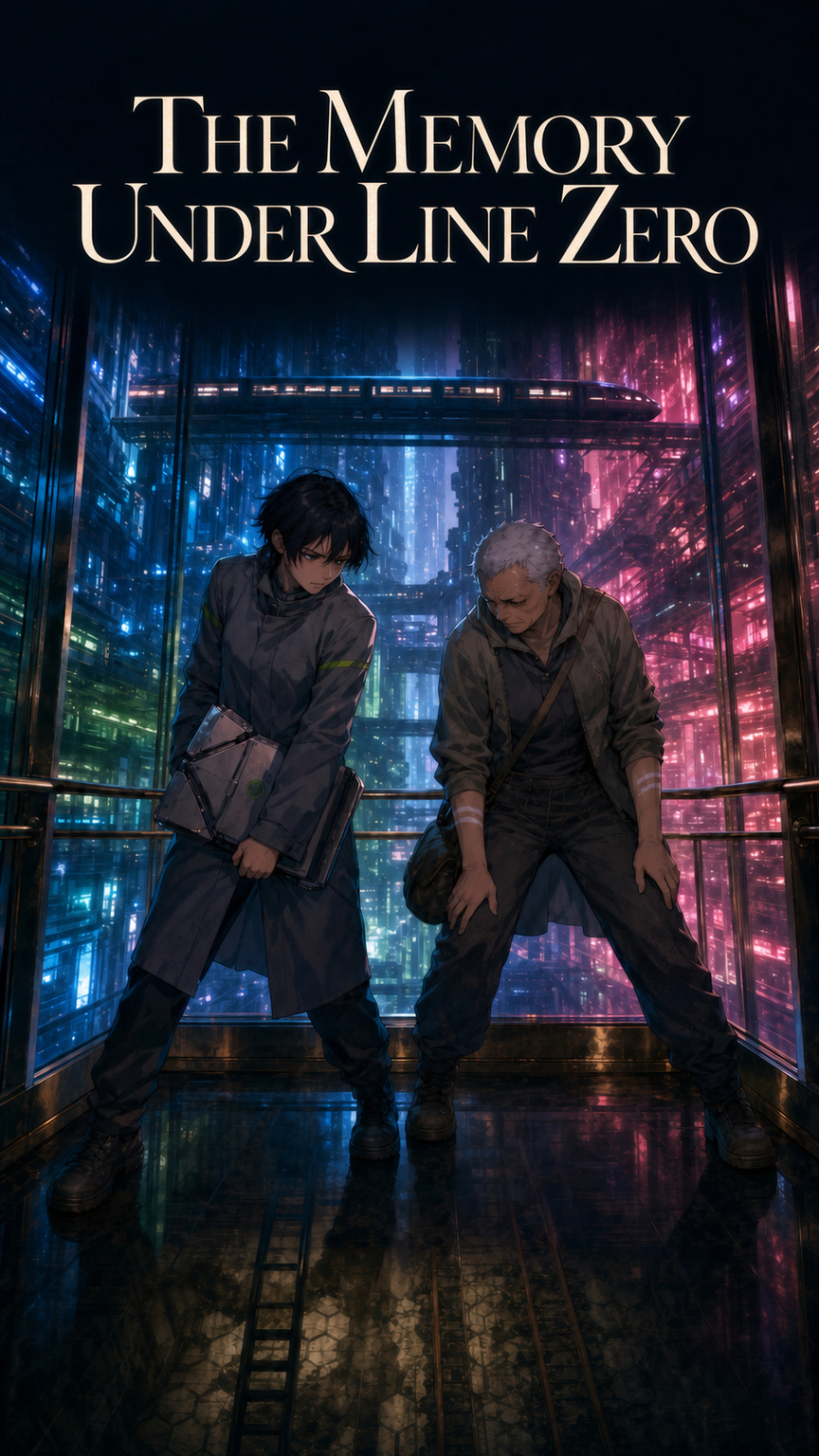
The booth door would not seal because Haru Dent’s coat was caught in it.
Amel Krail pointed to the strip of amber light at his elbow. “Your sleeve.”
He looked down as if the coat belonged to somebody standing very close beside him. Then he pulled the cloth free. The door drew shut with a soft double knock, and the strip changed to green.
“That one never meets square,” he said.
“It passed its seal test.”
“Seal isn’t square.”
Amel set the repossession case on the shelf between their chairs. A train crossed somewhere above them. The booth’s wall pressed against her shoulder blade, released, then pressed again. She watched the case level compensate by two degrees.
“Are you refusing calibration?” she asked.
“No. I’m telling you why your crown will drift left every time an eastbound brakes.”
The chair restraints lay open across Haru’s lap. He had not touched them. Forty-three minutes remained before Line Zero returned to full service and the booth had to be cleared. Amel had allowed fifty for her first unsupervised disposition. The manual recommended seventy.
She unfolded the contact crown. “Keep your head against the rest. I’ll account for the drift.”
Haru settled back. “You been down here before?”
“This booth?”
“The line.”
“No.”
“Then you’ll account for the wrong thing.”
Amel did not answer. She fitted the wet contacts along his temples and behind his ears, working around a pale pressure mark where an older crown had sat that morning. Before the default, Haru had chosen which pieces paid each month’s rent. Eviction had given the housing company the choices. The display listed what it had already taken against his debt: a season of upper-tier sun, twelve meals tagged for texture resale, the calm portion of a ferry crossing. Editors would remove faces and place names, blend the clean sensations with other tenants’ leases, and sell them as weather, appetite, escape. Haru would keep weakened originals until his contract expired. If his account did not recover, those went too.
Her item was different.
INCIDENT 0-14: BELOW-LINE ACCESS. DISPOSITION: ERASE AT SOURCE. NO DERIVATIVES.
“State your full name,” she said.
“Haru Dent.”
“Do you understand that the lien holder has acquired disposition rights over the pledged interval?”
“They put it in the eviction notice.”
“I need yes or no.”
He looked at the green seam around the door. “Yes.”
“Do you understand the interval will be copied to a sealed work cache for validation, removed from accessible and associative recall, then destroyed?”
“You mean I’ll forget it.”
“Yes.”
“Say that first next time.”
The crown found his baseline. Blocks filled on Amel’s screen: balance, temperature, color depth, pain response, language. The booth shook again. This time the case corrected before the contacts slipped.
Haru noticed. “Westbound. Empty stock.”
“How can you tell?”
“Nothing underneath the third carriage.”
Amel selected the target interval. “We’ll make a route pass, an object pass, and a consistency pass. Answer only what I ask while playback is active.”
“There isn’t an object pass.”
“There is on my form.”
“I mean you won’t understand what you’re looking at if you split it up.”
She pressed EXTRACT.
The booth vanished without going dark.
For four seconds Amel stood inside Haru’s body at the public end of Line Zero, taller than herself and sore through the right knee. The last passenger train had gone. Maintenance lamps made white coins on the platform. In the recollection, Haru carried a red survey case whose handle had worn a hard groove across two fingers. He did not walk toward the marked service door. He went the other way, past the buffers, and crouched beside a drainage manifold hidden behind an advertising skin.
The memory skipped where his attention had skipped: no inventory of the pipes, no useful view of the sign overhead. His hand knew which coupling was cold. He waited with two fingers resting on it.
A train entered the opposite bore. Pressure climbed through his fingertips. When the second carriage passed, he pulled the coupling half a turn, leaned his shoulder into a maintenance panel, and let the rail’s shifting load lift the latch for him. Beyond it, a narrow shelf followed the outside of the bore. Light strobed between carriage windows. Haru stepped over the first cable trough, under the second, and stopped before the third.
Amel paused playback. The booth returned around them. “You opened a locked panel by altering a drain coupling.”
“No.”
“I watched you.”
“The coupling doesn’t open it. It keeps the condensate line from pushing the panel shut. The train opens it.”
“That’s not in the maintenance schematic.”
“New schematic or the one they actually built?”
“Current approved.”
“Then it won’t show the steel behind the skin.”
Amel drew the route backward in the case. The memory contained no access code, no concealed switch, nothing that could be summarized into a neat instruction. It was timing and pressure and the way Haru shifted the survey case before putting weight on the shelf. Without that weight, he told her, the panel would settle before a person could pass. Without the eastbound train, it would not rise at all.
“Could somebody learn the route from a diagram?” she asked.
“Somebody could fall off a diagram.”
“Mr. Dent.”
“You need the loads. That’s the route.”
She resumed.
Haru’s remembered breath shortened along the shelf. Through his feet came the changing labor of the track: rail, clip, sleeper, beam, pillar. He counted four westbound pulses, knelt, and slipped through a tear in the acoustic lining. On the other side, the city’s hum lost its hard edges. The way went down.
At first it was only a construction gap between poured pylons. Every pylon bore the city foundation mark, a sunburst cut over the numeral one. Schoolchildren were brought to copies of that mark in the civic galleries. Before the first elevators, before the first habitation decks, the founders had set their pillars into raw stone and made human life begin vertically.
Haru turned his head. The recollection widened.
Steps descended beneath the lowest pylon, not poured steps but blocks fitted so closely that the seams held only black grit. Their centers dipped under wear. A pale repair ran across the lintel below, and through that repair the builders of Line Zero had driven a modern anchor bolt. The bolt’s stamped date was the year before the city declared its First Foundation. Under it, carrying both bolt and lintel, the older stone continued into the dark.
Haru’s hand passed over a drainage channel polished at the lip. Not natural rock. Not a utility cut. It curved away behind the foundations with the patient fall of something made to carry water long before the tunnel was dry.
The case flashed a warning across the memory.
UNLICENSED HISTORICAL ASSERTION. VERIFY OR PURGE.
Amel stopped playback.
Haru blinked beneath the contacts. Sweat had gathered at his hairline. “You got to the stair?”
“You described it in your report.”
“Did you see it?”
“I saw your recollection of it.”
“Right.”
He let the word stand between them.
Amel opened the consistency tools. No splice lines appeared. The interval’s color drift matched adjacent memories, as did Haru’s headache, the pressure groove on his fingers, and a tune he had failed to notice himself humming. Coherence was not truth. A patient editor could seed all of those. A person could also build them inward by retelling a lie.
She called her supervisor.
Ovik answered before the first tone finished. His voice arrived without a face, clean and level in Amel’s earpiece. “Status.”
“Target acquired. The source interval contains structural details that could indicate pre-foundation construction. No edit seams on first test.”
“The order anticipates the claim. Purge the interval and validate zero.”
“I haven’t completed consistency.”
“You may complete required validation. Do not extend the cache.”
Haru watched her rather than the speaker grille. “Ask him why they sent memory recovery instead of structures.”
Amel muted the room pickup. “The recalled site includes a worn stair, a repaired lintel, and a load-bearing channel beneath the claimed foundation layer.”
“The subject maintained Line Zero for nineteen years,” Ovik said. “He had access to models, construction stock, and enough procedural knowledge to fabricate a persuasive episode.”
“Then it may be fabricated.”
“Correct.”
“That isn’t what I said.”
“It is the relevant classification. The company cannot authenticate a historical claim through indebted neural property. Purge the target, validate zero, close the lien.”
Amel looked at the countdown. Thirty-one minutes.
“His access report was filed six hours before his dismissal,” she said. “The deletion order was added after the report.”
“Employment timing is outside disposition.”
“Did anyone inspect the site?”
Ovik paused, not long enough to suggest surprise. “Complete required validation.”
“I’m asking whether—”
“I heard you. Your certification observation remains open, Krail. Clean completion closes it tonight. Purge the target, validate zero, close the lien.”
He did not disconnect. The line stayed live and soundless.
Amel restored the room pickup. “We’re continuing.”
“He told you to wipe it.”
“He told me to validate it first.”
“Not the same as listening.”
She set the playback index to the stair. “When you went down, what was in your left hand?”
“Range probe.”
The memory showed only a pale edge at the bottom of Haru’s vision. “What make?”
“Don’t know. Stores swapped them all winter.”
“What did the channel smell like?”
“Wet dust. Brake oil near the top.”
“You called it dry.”
“Dry channel. Wet air. There’s a cracked return pipe behind the new pier.”
She shifted to the lintel. “What do these cuts mean?”
Three shallow marks crossed one stone, too regular for damage, too few for a script.
“No idea.”
“You claimed they were evidence.”
“I said the steps and the drain were built. Those could be somebody sharpening a tool.”
He was becoming less helpful as the questions narrowed, more exact and less interested in convincing her. Fabricated testimony usually improved under rehearsal. Usually was not a result she could enter.
Amel advanced the recollection beyond the point named in the order.
Haru descended six more steps and set the red case beside the old wall. He took out a survey gauge, thumb-sized and orange, scraped mineral scale from a seam, and fixed the gauge there with a pad of blue compound. On its tiny display, two traces moved out of time: the regular hammering of Line Zero and a slower deflection traveling through the stone below.
He waited through a train. The newer pylon flexed first. The lintel received the load and passed it sideways into masonry that vanished beyond the light. Haru swore under his breath, reset the gauge to continuous recording, and left it on the wall.
Amel stopped the memory hard enough to make both of them flinch.
“The gauge is still there?”
Haru’s eyes moved to the case display. “Unless they found it.”
“It records locally?”
“Load, temperature, vibration. Date is signed by the transit clock every time a train passes.”
“Why didn’t you bring it out?”
“One reading is a bad bearing. A week shows what carries what.”
“How long ago?”
“Nine days.”
“Your report was six days ago.”
“I got enough to tell Structures the old work was taking live load. I left it running.”
Amel unmuted Ovik. “There is external instrumentation at the recalled site. A continuous transit-clock record.”
“Not within our custody.”
“It could authenticate the route and the structure.”
“Not within our custody,” Ovik repeated. “Do not convert a memory disposition into an unscheduled field inquiry.”
Haru leaned toward the speaker. The crown tugged at his temple. “Send a rail hand. Don’t send her. Five minutes at the wall, that’s all.”
“Mr. Dent, you are not authorized to direct personnel.”
“No. That’s how I ended up in this chair.”
“Krail,” Ovik said, “secure the subject.”
Amel tightened the contact at Haru’s left temple instead of closing the restraints. “If the memory is removed, can you reconstruct the route from records?”
Haru sat back. He flexed the two fingers that had carried the survey case. “Records put the panel three meters north. They don’t tell you when it lifts.”
“Could you leave yourself a note now?”
“You’d have to seize that too.”
Ovik said, “Correct. Associative residue is included in the order. Krail, you have twenty-two minutes.”
Amel’s screen offered two lawful buttons. PURGE would strip the interval from Haru, compare the absence against the sealed cache, then destroy the cache. REFER would preserve it in the job system and fail the time limit. Referral required authenticated physical evidence. The gauge might be that evidence, but the route to the gauge was the thing she had been ordered to erase.
Below the buttons sat a third control used after distressing collections: PERSONAL ANCHOR. A technician could take a sensory fragment out of the work cache and bind it into licensed private space, so the mind had somewhere familiar to put what it had witnessed. Personal-space contents were masked in routine job review. Capacity changes were not, and an audit could open everything.
Amel opened her capacity panel.
Her private license held eleven childhood clusters, all pledged against the advance that had paid for training, equipment, and six months’ rent. Until she certified, they were collateral. If an audit found outside property mixed into them, the lender could seize the entire block.
Available space: one minute, eight seconds.
Target interval: four minutes, forty-one seconds.
The largest nearby cluster opened in preview. A kitchen morning, age eight. Her mother home from a night shift, still in her blue work shirt, cutting a burned edge from a piece of toast. A fan clicked overhead. Rain freckled the window. Young Amel sat on the counter because the floor was cold, and her mother said something while pushing the good half of the toast into her hands.
Amel had leased copies of that morning twice. Once for domestic warmth, once for rain texture. She had never let an editor touch the source.
The anchor tool calculated destructive overlap.
LIKELY LOSS: PRIMARY VOICEPRINT 91%. SPOKEN CONTENT 68%. LEFT VISUAL FIELD 24%.
The playback behind the warning was silent. Amel supplied her mother’s voice from memory, impatient and low, but the moment she tried to hold its exact pitch, it shifted.
“Krail,” Ovik said. “Report.”
“I—I’m checking capacity.”
“The work cache has sufficient capacity.”
“Yes.”
“Then purge the target.”
“Yes. I heard.”
Haru could not see her private panel, but he saw what her hand had opened. “Anchor space?”
She closed the kitchen preview.
“Don’t,” he said.
“I haven’t told you what I’m doing.”
“You don’t open personal in a repossession unless the job won’t fit somewhere.”
“Will the gauge survive another day?”
“Maybe. Blue pad should hold. Maybe the return pipe lets go and takes it off.”
“If someone has the route, they can retrieve it?”
“If they can listen to the line.”
“Answer the question.”
“Yes.”
The booth shook. On the shelf, the case’s leveling feet whispered against metal.
Haru looked down at his open restraints. “I’m not asking for yours.”
“You’re asking me to erase yours.”
“They’re doing that already. I asked you to look at a wall.”
She wanted him to tell her it was worth four minutes and forty-one seconds of a morning he had never lived. She wanted Ovik to forbid it in some new way, one that would reach through the private screen and move her hand. Haru only adjusted the crown wire where it pulled his ear.
“If you keep it,” he said, “keep the route. Don’t trim it down to the pretty part.”
“The stair isn’t pretty.”
“Good.”
Ovik’s patience took on the slow spacing he used with trainees at the end of a failed simulation. “Krail. Select purge. Confirm source deletion. Validate zero. Close the lien.”
“Will you request a site inspection if I complete the disposition?” she asked.
“Complete the disposition.”
“After I complete it. Will you request one?”
“This call concerns disposition.”
There it was: not a lie, not an answer, and no opening left in it.
Amel selected PERSONAL ANCHOR.
The system asked for a destination. She chose the kitchen morning. It warned that the source cluster was collateralized. It warned that third-party content could invalidate the license. It showed her mother’s face turned toward the stove, outside the predicted field of damage, and laid the tunnel route beneath the yellow counter tiles like a second set of seams.
“Hold still,” Amel told Haru.
“I am.”
“Don’t talk. Just—please.”
His mouth closed.
She authorized overlap.
The transfer entered behind her right eye as a pressure too large to be pain. For an instant the booth, the kitchen, and the tunnel demanded the same space. Rain struck the old window; a westbound train loaded the first support; her mother’s knife rasped over burned bread; Haru’s hand found the cold coupling. Amel could not tell which body owned the sore knee. She smelled brake oil under the toast.
Then the system resolved priority.
The tunnel settled intact. Route, stair, lintel, gauge. Signed as foreign recall, source Haru Dent; no confusion about whose life it was. The kitchen rebuilt around it with pieces missing.
Her mother turned from the stove and moved her lips.
No sound came.
Amel knew the sentence had made her laugh. She knew her mother had spoken through a mouthful of her own burned half. Knowledge remained where the voice had been, a label on an empty field.
“Transfer variance,” Ovik said. “Your personal reserve changed.”
Amel blinked until the booth held one shape. Twelve minutes remained.
“Stress anchor,” she said.
“The case did not recommend an anchor.”
She selected PURGE. “I changed the assessment.”
The crown tightened its contact pattern. Haru’s hands closed on the chair arms.
“Last chance to identify associative dependents,” Amel said. The prompt came out thin and automatic. “Names, routes, objects, later decisions.”
“My dismissal. The report. The panel.” Haru swallowed. Precision began to fail him at last. “The gauge. What I put—where I put it. That whole down way.”
Each answer lit a branch. Amel marked them all. If she spared the report, he might rebuild the cause from the gap. If she spared the panel, he might find it by habit. The order covered the interval and its route-bearing residue. Half an erasure would leave him with the danger and none of the sequence that kept him alive.
“Ready,” she said.
“No,” Haru said. Then, after a breath, “Do it before the trains start.”
Amel confirmed.
The purge had no flash, no visible current. Haru’s grip loosened one finger at a time. The case walked the interval out of accessible recall, tested each linked prompt, returned to sweep what recognition had hidden. On Amel’s screen, the sealed copy reduced from color to vectors, from vectors to hashes, from hashes to zero.
Only the foreign cluster beneath her kitchen remained beyond the job system’s sight.
SOURCE ABSENT. CACHE ZERO. DISPOSITION COMPLETE.
Ovik waited while Amel ran the required checks. “Subject identity?”
“Intact.”
“Employment history?”
“Intact except ordered associations.”
“Target content in source or work cache?”
Amel looked at Haru. His eyes tracked the speaker grille, then the blank screen, then her face.
“No,” she said.
It was the narrow truth the form requested.
“Close the lien,” Ovik said.
Amel released the crown. Haru rubbed the pale marks at his temples. The train schedule beyond the booth door rolled from amber to white as Line Zero prepared to reopen.
“Did they take it?” he asked.
“Yes.”
“All of it?”
“All the ordered interval.”
He frowned at his hands. Two fingers were curved as if around the missing handle of the survey case. “I filed something with Structures.”
“You remember filing a report.”
“About the line?”
Amel said nothing.
He looked toward the wall when a switching engine passed above. “There was a place I had to…” His hand lifted, turned half a circle, and stopped. “No.”
The absence did not make him peaceful. It made him check his pockets. He found an eviction token, an old transit badge with its clearance burned out, and three coins. “Housing desk still shut at this hour?”
“Until six.”
“They let you sit in the concourse?”
“Not after service restarts. There’s a warming bay by the freight lifts. It doesn’t scan housing status until five.”
Haru put on his coat. At the door he glanced back at the crown. “Was I right? Whatever it was.”
The tunnel waited inside Amel with the fixed patience of masonry. It was a recollection, not a date, not a verdict. Beneath it, a gauge might still be signing each passing train against an old wall.
“You left something measuring,” she said.
His face changed, but not with recognition. “Useful?”
“Maybe.”
“Then don’t wait for a quiet train. There aren’t any.”
He opened the door and went out.
Ovik remained on the line. “Your personal reserve changed by three minutes, thirty-three seconds during sealed work.”
Amel packed the contacts into their disinfecting slots. “I logged an anchor.”
“You logged one after transfer variance.”
“Is the disposition accepted?”
“The lien is closed. Your certification is complete pending review. Personal-space audit at dawn. Bring the case and your license key.”
“At dawn,” she repeated.
“Do not alter your reserve before audit.”
The call ended.
Amel had four hours.
The booth’s service panel showed the vibration faults it had collected during the session. Crown drift, shelf tilt, three contact corrections. Any certified technician could extend a site calibration onto platform hardware when environmental movement threatened capture quality. It was ordinary work, the sort assigned without a supervisor because nobody wanted the lowest line before morning.
Her hand shook once over the form. She flattened it against the shelf until the next train passed.
Location: Line Zero, booth fourteen.
Fault: recurrent eastbound load variance.
Requested time: now.
The system issued her a maintenance token and six minutes of platform access. Amel closed the case, stepped out beside the reopened line, and walked toward the buffers at the public end. Behind her eyes, under yellow kitchen tiles and her mother’s soundless mouth, Haru’s hand found the cold coupling and waited for the second carriage.