The Witchknight’s Measure
Remove the current story for "The Healer's Measure" and create new story about training of the healer to become a witchknight. this should be the normal path not some great exception focus on training, time, work, discipline; BUT all this needs a payout at the cilmax of the story.
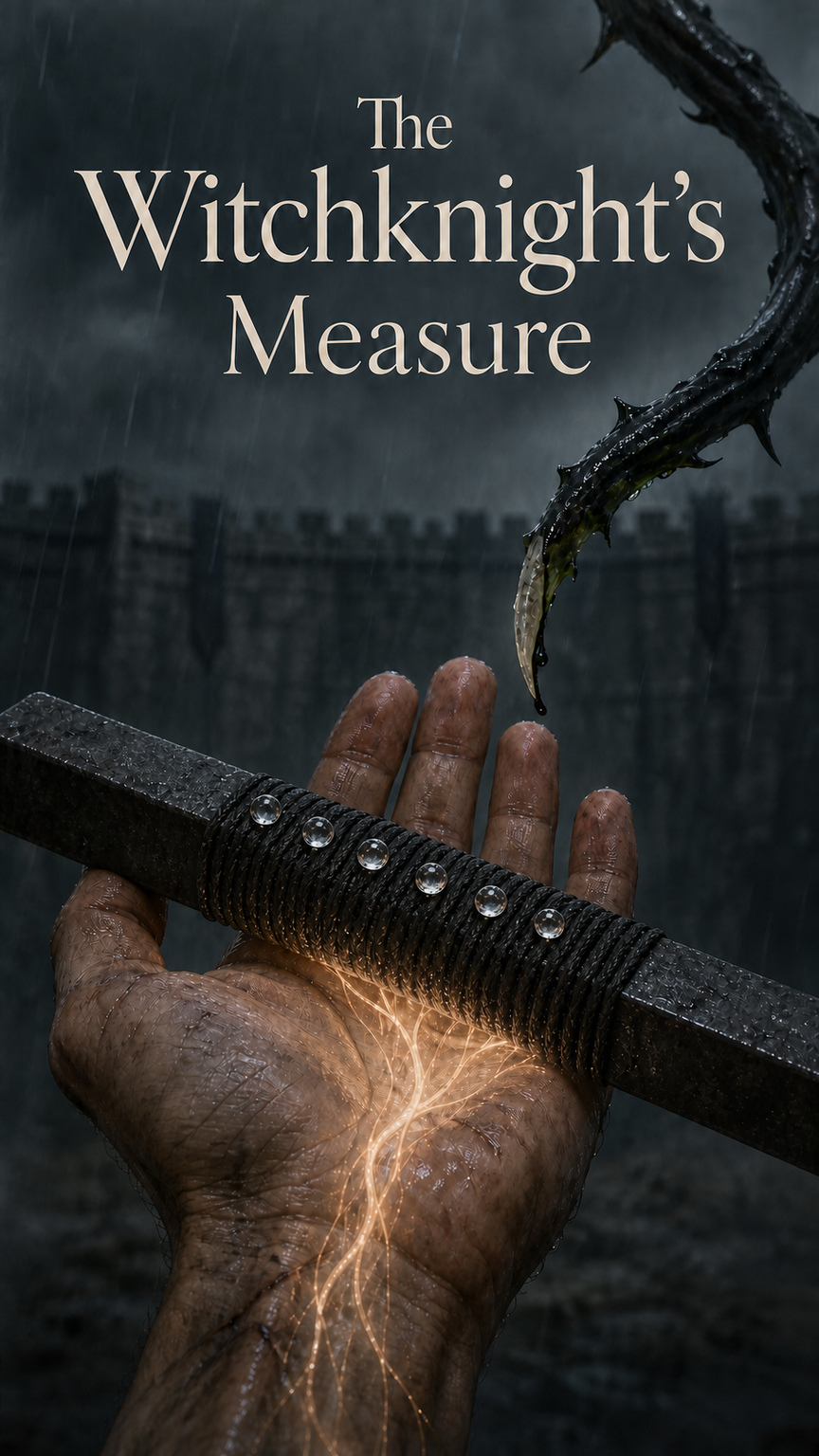
Rhoswen had two fingers against Demech’s wrist when the third bell rang.
The sound meant the pulse-thorn had crossed their lane. She knew that before she looked up. A pale barb quivered in the straw patient behind them, deep enough that its black sap smoked against the stuffing. Rhoswen’s iron lay in the mud where she had dropped it.
Under her other hand, the cut on Demech’s forearm had closed to a shining pink seam.
“Dead,” Instructor Fremda said.
Demech, who was sitting in a puddle and very much alive, glanced over his shoulder. “Which one of us?”
“Both, if the thorn was feeling industrious. Talder, release.”
Rhoswen broke contact. The warmth of her pulse-work recoiled into her palm, followed by the familiar empty flutter behind her breastbone. One breath. Two. She had been told to count six before touching prepared iron again. Knowing the rule did not stop her from wanting to snatch up the bar and prove she could still raise a guard.
Fremda crouched beside Demech and inspected the sealed cut. “Clean edges. No heat trapped. Good care.”
Then she rose and put a chalk stroke in the failure column.
Around them, eleven other pairs reset the intake lanes. They were healers from village rooms, river barges, noble kitchens, mining camps. A grey-haired bone-setter was digging mud out of his collar. Two young infirmary sisters argued over which of them had missed a signal. All had come through Candlemere Chapterhouse’s narrow practical gate: application letters, service records, and the fees or sponsorships required for twenty-four months of training, longer when a gate had to be repeated.
Rhoswen picked up her iron. It was a plain forearm-length bar wrapped in cord, heavy enough to punish a lazy wrist. “He was bleeding.”
“He was complaining, too,” Fremda said. “Neither is a mortal sign.”
“I wasn’t complaining,” Demech said. “I was reporting with feeling.”
Fremda pointed at the lane. “Reset. Talder repeats after supper.”
“Clinic duty is after supper.”
“Then you repeat after clinic duty.”
That was Rhoswen’s first morning of witchknight training.
By the eighth morning, the skin beneath her pack straps had rubbed raw. By the twelfth, she could fall in a breastplate without putting out a hand and breaking a wrist. By the twentieth, she had learned that knowing every small bone of the foot did not teach the foot where to stand.
“Your heel’s wandering,” Demech said.
Rhoswen kept her iron extended across the chalk lane. The captive pulse-thorn rustled behind its wicker screen, seeking the warm beat of the trainees beyond it. Her guard made the bar hum against her palm. “My heel is attached.”
“That’s not the same as loyal.”
He nudged the back of her boot with his own. Demech had spent six years carrying survey chains through upland bogs before training as a field healer. He could settle a load on his hips as if he had been born with pack straps. His descriptions of injuries, however, were criminal.
“Bend the rope behind your knee,” he said.
“There is no rope behind my knee.”
“The long bit.”
“There are several long bits.”
The thorn struck the guard. Iron rang. Rhoswen’s straight knee took the force, and she skidded across both chalk lines.
Demech caught her pack before she went down. “That bit. Bend it.”
At dawn they marched with sandbags. Before noon they drilled stance, blade work, and falls until the breastplates bruised their hips. After the midday meal came triage lanes and switching practice. The same living current in Rhoswen could close tissue or pass through prepared iron to turn the thorn’s probing pulse, but it could not do both. To change tasks she had to break contact, let the first working settle, and count six clean breaths. Switch too early and the iron gave a weak, shivering guard. Spend too much on healing and six breaths became ten, then twenty, then a hand too unsteady to hold anything.
At first she counted too fast.
“That was four,” Fremda said.
“It was six.”
“Again.”
“You weren’t counting aloud.”
“I was watching you breathe.”
Again meant that Demech reset the straw patient, Rhoswen checked its painted injuries, and they ran the lane from the first bell. Again meant sweat cooling inside her shirt while the chapterhouse kitchen carried the smell of onion broth across the yard. Again meant being late to equipment duty and rubbing rust from six practice bars after she had cleaned her own.
In the clinic that night, an orchard worker came in with two crushed fingertips. Rhoswen washed the hand, set the small bones, and fed warmth into the purple flesh until the man’s nails regained their color. There she was quick, certain, useful. The work used the same current and none of the humiliating iron.
Her hands began to tremble as she tied the last bandage.
She tucked them under the table before Fremda, passing through with a stack of clean cloths, could see.
Fremda set the cloths down. “How many?”
“I don’t need iron in here.”
“How many breaths until you could?”
Rhoswen hated the question because she knew the answer. She counted while the orchard worker told Demech that a ladder had kicked him. At fourteen, her thumb stopped jumping.
Fremda made no speech. She wrote fourteen on the slate beside Rhoswen’s name.
The first autumn stripped leaves from the chapterhouse lindens and leather from the trainees’ palms. Winter froze the practice yard into ruts. Candlemere did not shorten the loaded marches. It issued cleats and added time for boot repair.
At the winter gate, Rhoswen and Demech carried forty pounds each up the east track, crossed a ditch, and entered the screened lanes with their breath already ragged. Snowmelt ran beneath the wicker. The pulse-thorn moved where they could not see it.
Demech took the first guard. Rhoswen dragged the weighted patient to the red marker. They exchanged positions on his raised fist: his guard held; she could prepare to take it. She counted six, set her iron, and felt the working catch.
Then a concealed hook sliced Demech’s calf.
It was part of the gate, though the blood was real. He slapped his palm over the cut and said, “Surface. Still walking.”
Rhoswen saw bright red leaking between his fingers. She saw dirt at the wound edge, the shortening of his step, the small pinch beside his mouth. In the village clinic she would never have left it. She planted the iron point in the snow, caught his ankle, and poured warmth into the torn flesh.
“Rhos. Enough.”
The cut closed slowly. She chased the last seep. Demech swore and reached for her abandoned bar just as the first thorn struck.
She broke contact. One, two, three—
“Don’t,” Demech said.
She grabbed the iron on five. The guard flashed crookedly and died. Pain needled up both arms. For a moment she could not remember which marker was red.
Demech held the lane alone while she knelt in the snow, staring at her shaking fingers. He turned one strike and then another. The third caught the weighted patient’s chest. The bell rang.
Afterward, Demech limped into the reconstruction room and dropped his wet glove on the table.
“I said surface.”
“You also said rope for a tendon yesterday.”
“I know my own blood.”
“You couldn’t see the cut.”
“Neither could you. Not after you put your head down.”
Fremda laid three pieces of chalk beside the glove. She did not tell them to be quiet. She waited until they noticed her waiting.
“Talder,” she said, “what could he do?”
Rhoswen looked at the floor plan scratched into the tabletop. “Walk. Hold pressure. Guard, if he had to.”
“Demech, what could she do after the healing?”
He glanced at Rhoswen’s hands. The tremor had stopped, but she had folded them in her lap. “Nothing useful for twenty breaths.”
“Seventeen,” Rhoswen said.
“Delightful.”
Fremda pushed the chalk toward them. “Mark where each of you spent the other.”
They rebuilt the failure one decision at a time: the missed signal, the lowered iron, the wound that could have waited, the early switch that bought neither healing nor guard. By the time they finished, the evening lamps had been lit.
Rhoswen’s winter score put her into the standard extra quarter. Eleven names were posted with hers. Demech passed the gate, though not highly enough to leave their practice group.
“You can request another partner,” she told him.
He was scraping dried mud from his boots with a spoon he had stolen from the dining hall. “I can also request roast duck on rest days.”
“I’m serious.”
“So is the duck situation. Hold this.”
He handed her a boot and went on scraping. She held it.
Spring training began with rain blowing sideways across the yard. Their hand signals, careful indoors, dissolved in it. Rhoswen tapped two fingers to her wrist to mean capacity falling; Demech thought she meant injury here and dropped his guard to look. He swept one arm low to warn of bad ground; she mistook it for permission to move the patient. The bell rang twice in one run.
Fremda made them stand at opposite ends of the lane while water streamed from their chins.
“Again,” she called.
“Which part?” Demech called back.
“The part where neither of you understood anything.”
They reduced the signals until no gesture needed fingers or subtlety. A fist held high meant I hold the guard. A flat palm meant wait where you are. An arm chopped once across the body meant switch. For a timed cover, each open-handed strike against the chest promised five safe breaths, where the movement remained visible through rain. Demech disliked losing his low sweep, so Rhoswen made him shout about holes like everyone else.
She learned his kind of work in return. They carried sacks, practice bodies, and eventually each other. Demech shifted her stance by inches, made her settle weight over the back foot, and taught her to rise under a loaded shoulder without wasting her legs in the first ten steps. Rhoswen taught him the difference between blood that looked frightening and blood that stole strength. He continued to call tendons ropes when he wanted to annoy her, which was often.
The extra quarter was not a revelation. It was eighty-three mornings, thirteen split boot seams, and a pale groove worn into the cord of her iron. Rhoswen worked clinic shifts after drills. She mended buckles because damaged gear waited for no one’s exhaustion. She failed the ice carry, passed it on the second attempt, then failed the dusk switch by one breath. Some days improvement meant only that Fremda corrected her twice instead of five times.
On the last rain gate, Demech cut his palm. Rhoswen saw the blood, judged the grip still sound, and kept her iron up. He guarded after her switch. They moved the patient together. At the finish his glove was red.
She reached for it as soon as the lane closed.
“Now,” Demech said, and gave her the hand.
Fremda moved Rhoswen’s name out of the extra-quarter column. She ranked seventh in a group of twelve.
During the second year, the corrections grew farther apart. That did not make the days shorter. Rhoswen walked patrol roads with senior pairs, cleaned iron after wet clearings, restocked clinic drawers, and reported every time her recovery count changed. Once, beside a flooded cart track, she held a guard while another healer reduced a carter’s shoulder. The man’s shouting made every part of her want to turn. She watched the thorn hedge instead. Once she felt the first flutter of overdraw at five breaths and passed the iron to Demech without pretending she had six. Once he missed a swelling beneath a patient’s ear, and she made him examine it again without calling him a fool until after supper.
That summer Demech earned an extra quarter of his own by choosing a fast route through a flooded-ground gate and stranding both bearers knee-deep. He blamed a clump of reeds until the next morning, then redrew the route.
Their pack weights rose. Their times did not always improve. The work became less dramatic as they became better at it.
In their twenty-seventh month, Rhoswen and Demech were assigned the autumn capstone together.
The live clearing lay below the chapterhouse wall, where a pulse-thorn had rooted into an abandoned stone channel. Every autumn group worked a piece of it under supervision. Their task was ordinary: enter behind Fremda’s outer guard, reach the channel marker, remove a weighted casualty, and clear the lane. Candidates had rung the withdrawal bell before. Candidates had repeated the capstone the following season. The names of both sorts were posted in the same square hand.
Rain had softened the bank to brown paste. Demech tested it with his heel. “Left side will go.”
“Then don’t use it,” Fremda said.
“I enjoy these advanced lessons.”
The first section went cleanly. Fremda held the thorn’s outer pulse while Rhoswen and Demech moved inside it. He called the footing; she took the forward guard. Iron beat against her palm in steady, unpleasant blows. At the marker they found the weighted figure half under a root shelf.
Demech crouched to rig the carry strap.
The bank went anyway.
Mud and stone struck Rhoswen’s hip. Her knee buckled, but the stance Demech had rebuilt for two years gave backward instead of sideways. She kept the iron between them and the thorn. When she could see again, Demech lay waist-deep in the collapsed channel. A slab pinned his left boot. Blood darkened his trouser leg above it.
Beyond the wicker screens, someone reached for the withdrawal bell.
“Wait,” Fremda said. She had both hands locked around her own iron, holding back the outer growth. “Report.”
Demech tried to pull free. His face changed. “Can’t move the foot. Cut above the knee. Ground’s still sliding.”
Rhoswen’s body had already chosen to go to him. She stopped it. The thorn struck. She bent the rope behind her knee—the absurd phrase arrived in Demech’s voice—and let the force run through her stance into the bank.
“Pressure on the cut,” she said.
“Already doing it.”
“Harder.”
“There, you’ve cured me.”
The joke came too quickly. His next breath ended halfway.
Rhoswen looked without lowering the iron. The blood spread steadily but did not leap with his pulse. His skin held its color. He could answer, press the wound, and complain. Treatable. Not first.
The channel wall shifted again. Demech slapped a flat palm toward her: wait. Then he pointed above his trapped boot. “Slab’s wedged under the root. Lift me wrong, it rolls inward. Take the dirt on my right.”
She obeyed his terrain read. One-handed, still guarding, she kicked and scraped a shelf beside his hip. The thorn battered her iron. The hum climbed into her teeth.
Fremda raised a fist: she held the outer guard. Then she struck an open hand against her chest four times.
Twenty safe breaths of cover.
Rhoswen chopped her forearm once. Switch. Fremda’s answering fist stayed high.
Rhoswen broke contact with the iron and counted. The thorn recoiled from Fremda’s widened guard. One breath: she dropped beside Demech. Two: she cut his trouser cloth open. Three: no spurting vessel, no backward bend in the knee. Four: his boot remained trapped, but his toes moved. Five. Six.
Only then did she put both hands above the cut and send pulse-work into him.
Warmth drove down her arms. Torn tissue drew together under her palms, not cleanly, not completely. Demech hissed and tried to twist away.
“Still,” she said.
“Stone’s moving.”
She felt it through her knees. She stopped healing before the wound closed. Enough to slow the loss. Enough for the carry. She took her hands away.
Fremda had six breaths left.
Rhoswen wanted the iron. She made herself wait. One. Mud slipped under her boot. Two. Demech’s head sagged, then lifted. Three. Fremda’s shoulders shook. Four. The thorn pressed her guard inward. Five.
On six, Rhoswen closed her hand around prepared iron. The current caught without a stutter. She set her back foot and raised the guard.
Fremda released hers, stumbled once, and pointed to Demech.
“Slab,” Rhoswen said.
Demech wiped rain from his eyes. His answer came in pieces. “Don’t lift. Dig the heel. Pull me toward you when it drops.”
Rhoswen dug while he kept pressure on his leg. Fremda, outside the inner lane now, drove an iron spike into the firm side of the bank and hooked their carry line around it. Demech counted the small movements of the slab. On his third count it settled away from his boot.
Rhoswen hauled him free.
There was no graceful way to shoulder a wet man in armor. He knocked his chin against her helmet and called her something muffled. She got beneath his right arm, settled his weight over her hips as they had practiced with sacks and bodies and each other, and rose without spending her legs at once. The weighted figure stayed under the root shelf. The exercise had ended when the bank fell; now they had a real casualty to extract.
Fremda took the outer line. Rhoswen kept her iron forward in one hand and Demech upright with the other. Step, set, receive the strike. Step, set, breathe. His weight dragged at the repaired seam in her shoulder strap. The wound seeped against her side. It could seep for twelve more steps; his hand still pressed it, and his answers stayed clear. Rhoswen left it alone and kept the guard. Demech was conscious. Demech was helping. Demech was not the only life in the lane.
At the steep patch he lifted two fingers against his chest.
“Two breaths?” she said.
“Two steps. I can give you two.”
He pushed. Fremda pulled the line. Rhoswen held the guard, and together they brought Demech across the final marker before the thorn struck again.
The clearing bell rang once.
For several breaths nobody moved. Then Fremda lowered her iron and said, “Lane clear. Healer, you may fuss now.”
Demech sagged onto the grass. “She’s been saving it up.”
Rhoswen knelt and put her hands to his leg.
Demech spent six days in the chapterhouse clinic and another three weeks on light duty. The slab had cracked two bones in his foot. The wound above his knee needed stitching after Rhoswen’s field closure was opened and cleaned. None of this made the notice board.
The capstone results did. Three candidates qualified. One had withdrawn and would repeat in spring. Rhoswen’s name appeared between two others in the same square hand Fremda used for clinic inventories.
Fremda called her into the equipment room, where rain ticked on the narrow windows and forty iron bars waited for oil.
“Why didn’t you heal him when the bank fell?” Fremda asked.
Rhoswen had answered versions of the question for twenty-seven months. This time she did not search for the answer Fremda wanted. “He could hold pressure. You couldn’t hold both growths for long. I needed the lane before he needed me.”
“And after?”
“I stopped when he could be carried.”
Fremda looked at her hands. They were steady. “Good.”
She signed the qualification line and passed the page across.
Rhoswen read it twice. There was no commendation attached, no mention of the bank, no new rank beyond the one she had trained for. The form assigned her to an ordinary road rotation with a senior witchknight and gave the date of her first refresher gate.
When she came out, Demech was waiting on a bench with his foot splinted and her healer’s bag beside him.
“Well?” he asked.
Rhoswen handed him the form.
He studied it. “Refresher in twelve weeks. They must suspect you’ve forgotten everything.”
“Give me your foot.”
“It’s attached.”
“That isn’t the same as loyal.”
He laughed, then winced and surrendered the splint for inspection. Rhoswen set her iron within reach, opened the healer’s bag, and began.