The House of Possible Uses
A museum that collects highly dangerous artifacts sends agents to poke around your hoarder uncles’ house.
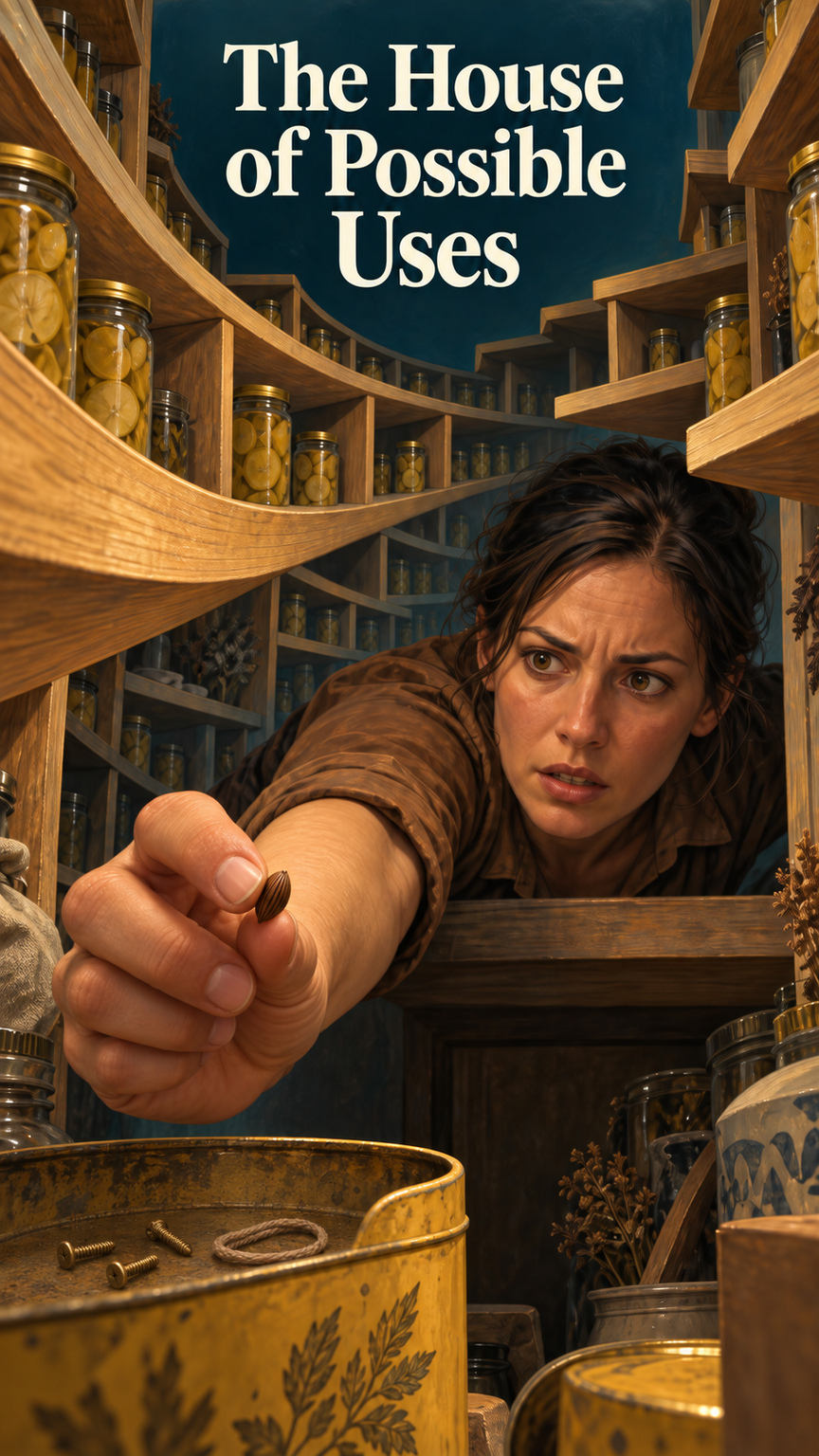
By half past four I had cleared a path from my uncles’ front door to the stairs, but only if everyone agreed to turn sideways at the umbrella stand.
That was not the path we had discussed.
“The agreement was shoulder-wide,” I said.
Tobren looked down at the washbasin occupying half the hall. Its enamel had worn through in two thumb-sized places. “It’s leaving tomorrow. I found someone who needs the taps.”
“The taps aren’t attached.”
“Hence the basin’s staying here until they are.”
Sael, my other uncle, stood three steps up with his inventory book pressed to his ribs. “The measurement began at the coat hooks. You began at the jamb.”
“A person cannot begin at the coat hooks.”
“You did.”
I had, by climbing over a crate of winter stove rings. I dragged the basin into the parlor and put a chalk line across the hallboards: front door, stairs on the right, parlor on the left, then the dining-room door, then eighteen paces straight back to the kitchen. The kitchen filled the rear of the house. Its back door opened to the yard. Its pantry stood left of the sink.
That was the house I had learned as a child. It was useful to say it to myself whenever I visited.
Outside, somebody knocked three times. Not impatiently. Officially.
Tobren picked up the basin again.
“No,” I said. “Leave it.”
He set it down inside the parlor with care. Sael descended and checked the chalk line against his book.
Kezra Vonn waited on the step in a brown museum coat, holding a document case against the drizzle. Daskar Avel stood behind her with a square metal frame strapped to his chest and a black, padded jar suspended in its center by three short webbing loops. Neither agent tried to see past me.
“Enna Laird?” Kezra asked.
“Yes.”
“Tobren and Sael Laird?”
My uncles answered together, then glanced at each other as if one of them had duplicated the other’s property.
Kezra opened her case. “We’re here about one compression marker transferred from a bankrupt salvage estate. The sale record puts it in a mixed lot of fittings purchased by Tobren Laird eleven years ago. May we inspect that lot and the rooms through which it has moved?”
“Drawer pulls,” Tobren said. “Not mixed fittings.”
Sael said, “It was first stored in the east bedroom. That room is excluded.”
“The attic’s excluded,” Tobren added.
“You told me the east bedroom,” I said.
“I’m telling them the attic.”
Kezra made two marks on her form. She did not smile. “We can begin with the current box, the route from the front door, and rooms both residents consent to. If the evidence points beyond that boundary, we stop and ask again.”
Daskar touched the frame on his chest. “I need one clear exit and a lane this wide.” He held his hands apart, wider than our chalk marks. “Anything unstable above the shoulder comes down before I pass it.”
Tobren’s mouth tightened. Sael looked up at the shelf bridging the hall above our heads. It held two fans, a sack of curtain rings, and my grandmother’s blue soup tureen.
“The tureen stays,” Sael said.
“It can stay somewhere else,” I said.
That was how the agents entered: not by defeating my uncles, but by waiting while Tobren carried the fans into the parlor and Sael moved the tureen himself.
The drawer-pull box lived under the dining-room table. Getting it out required shifting a sewing-machine cabinet that had not held a sewing machine since I was twelve. Tobren objected when Daskar reached for it.
“Lift from the base. The left hinge can’t bear twist.”
“Then you lift,” Daskar said. “I watch the ceiling.”
That was Daskar’s entire manner. He did not pretend an instruction was a discussion.
Tobren eased the cabinet out. Sael counted the floorboards it crossed. Behind it, the wallpaper showed a pale rectangle where the sun had not reached.
The box contained brass cups, bone knobs, iron loops, ceramic drops, and a green stone the size of a small plum. Kezra crouched without touching it.
“Same banding as the sale image,” she said. “Size within error. That establishes resemblance and chain of custody, not function.”
“It kept a pantry door from banging,” Tobren said. “That establishes a function.”
“A use,” Kezra corrected. “Not necessarily the original one.”
Daskar unlatched the instrument on his chest. Three shutters opened on what I had taken for a lantern. One gave off a dry tick that I felt in my teeth. The second warmed the air without visible light. The third made a thin silver thread inside the glass bow toward the green stone.
“First pass,” he said. “Nobody moves the box.”
The tick repeated.
Something whistled in the wall behind the sewing cabinet: one rising note, a pause, then two shorter notes. From the kitchen came a red flash strong enough to stripe the dining-room ceiling. Under my knees, the floor thudded twice.
Tobren stood. “There’s a hollow behind the cabinet.”
Kezra said, “I heard a tone behind it.”
“So did I.”
“That isn’t the same claim.”
The lantern ticked again. The whistle came again, matched in timing but not pitch. Red crossed the ceiling. The floor pressed up through my soles.
Sael said, “The pulses are farther apart.”
“Confirmed,” Daskar said. “Test stops.”
He shut the lantern, but Tobren already had his fingers under the cabinet’s back edge.
“Wait,” I said.
“If there’s damp in that wall, waiting costs plaster.”
He pulled.
Wallpaper tore around a narrow wooden door where there had never been one. Cold pantry air breathed through the crack. Beyond it stood white shelves loaded with jam jars, folded sacks, and three identical yellow tins.
Our pantry had one yellow tin. It stood beside the flour scoop, off the kitchen.
For several seconds none of us spoke. The red light in the kitchen flashed once more, though the lantern was dark.
Sael stepped to the new threshold and stopped without crossing it. “Seven shelves,” he said. “Ours has six. The wall occupies the yard.”
Tobren leaned around him. “We could have had seven.”
“We did not.”
I put my palm on the dining-room wall. I knew the other side: a strip of nettles, the rain barrel, the yard fence. The plaster was cold all the way through.
Daskar backed us toward the hall. “Exit check. Slow feet.”
I went first. The front door opened easily. On the other side lay the same hall, viewed from beside the coat hooks. I could see the back of my own shoulder disappearing around the door.
I slammed it. The impact traveled under us in three quick pulses.
“Don’t do that again,” Daskar said.
“I observed the hall,” I told Kezra, because she had made the distinction matter. “I do not know what that means.”
“It means the exit has folded,” Tobren said.
“No,” Sael said quietly. “It means this door does not currently lead outside.”
The difference did not comfort anyone, but it kept Tobren from boarding the door shut.
Kezra took out five numbered paper tags and set one at each known threshold. “The instrument produced three outputs. At least three objects produced responses: sound, light, and vibration. Proximity doesn’t prove they belong together. We isolate one response at a time.”
“You came for the stone,” Tobren said.
“I came because a record identified the stone as dangerous. That record said nothing about your wall growing a pantry.”
It was the first time uncertainty entered her voice. Not fear. Space for a fact she did not yet own.
We found the whistling object first. Sael led us to a brass vane packed in a crate of weather fittings beneath the stairs. The shape was almost floral, eight thin cups around a central spindle. A hairline seam had appeared across the solid stair riser beside it. No air moved, but when the seam lengthened by the width of my thumbnail, the cups turned a fraction and produced the same rising note.
“Uncle Tobren?” I asked.
“Roof salvage. Good brass. The spindle catches.”
“Observed,” Kezra said, “it produces sound while an altered opening forms nearby. We don’t know what it detects.”
Tobren opened his mouth, then closed it.
Daskar slid the vane into a waxed evidence sleeve, wrapped it in a folded wool coat, and buckled both under the stair rail. The front door opened two inches onto the same hall, then shut again, without a whistle.
In the kitchen we found the red source: a palm-sized pane of black glass propped behind the spice jars. It lit whenever the stove flame shifted, not at any spoken word or movement. Tobren had used it to warn when the kettle boiled dry. Kezra covered it with a doubled oven cloth and placed an opaque case over that. The kitchen went dim.
The green stone was harder. It pulsed whenever the volume around it changed—when a drawer opened, when one of us entered the dining room, when Daskar moved the washbasin out of the lane. We wedged its box between the hearth slab and two folded blankets until the vibration no longer reached the floor.
For eight breaths the house held still.
Then the dining-room wall moved toward us by the width of one shelf.
Nobody had touched anything.
“Two modes suppressed, one braced,” Daskar said. “Expansion continuing.”
Kezra watched the silver thread in her lantern bend, straighten, and bend again. “Those objects may only have announced the change. Something else acted on the pattern.”
“That is an interpretation,” Sael said.
“Yes.” Kezra met his eyes. “It predicts a fourth object. I haven’t observed it.”
The floor rose under us once, a single broad shove. The false pantry door swung shut. When I opened it again, Tobren and Kezra stood on the other side among seven shelves.
Daskar caught my sleeve before I stepped through. “Stay.”
“They’re three feet away.”
“Their floor is lower.”
He was right. Tobren’s shoes stood half a stair below ours, though the threshold remained level. Behind them, the false pantry extended farther than the whole yard.
Kezra reached toward us. The air between our hands made the hairs on my wrist rise. Then the door snapped shut.
I opened it. This time it showed the parlor, empty except for the washbasin and three copies of my grandmother’s tureen.
From somewhere to my left, Tobren shouted my name. His voice came from the dining-room wall, the stairs, and the closed front door at slightly different times.
A red glare appeared beneath the kitchen door.
“The glass is covered,” Sael said.
“Then that’s fire,” I said.
I ran for the kitchen.
The hall lengthened under my feet. The kitchen door moved away by one pace, then another. The chalk line split into two parallel marks. A crate tipped from the shelf beside me. Daskar knocked it aside and shoved me against the wall as iron stove rings struck the floor where my ankle had been.
Each impact made the house add distance. A narrow cupboard unfolded between the dining room and kitchen, then another. The red glare vanished.
“Stop moving,” Daskar said.
We stood among tilted boxes in a hall that now contained twenty-seven of my paces.
Sael breathed through his nose, once, twice. His inventory book had fallen open in his hand. “You saw red under the door.”
“Yes.”
“You interpreted fire.”
“Yes.”
“There was no smoke.”
I wanted to tell him I knew how fires began, that I had spent two years trying to get both of them to clear a route precisely because I knew. Instead I looked at the new cupboards and said, “My running made more rooms.”
Daskar checked the ceiling, the floor, the lantern thread. “More bare movement coincided with faster expansion. Treat that as hazardous until disproved.”
Tobren called again. Three copies of his voice answered from different distances.
“Uncle, stop shouting,” I called. “One answer. What can you see?”
“Shelves. Kezra. Your grandmother’s preserving jars, except half of them aren’t hers.”
“Anything changing?”
After a pause: “A blue tag moved from the third shelf to the fifth.”
Kezra’s voice came faintly after his. “Correction: the shelves changed between observations. We didn’t see the tag move.”
That was Kezra. Even misplaced inside an impossible pantry, she would not give a verb more certainty than it had earned.
The floor tapped twice beneath me. Then twice again.
“That’s Tobren,” I said. “He’s knocking.”
Sael knelt without touching the boards. “The second interval is longer.”
Daskar watched his lantern. “The green stone is still in the dining room. This is transmitted vibration, not a receipt from Tobren.”
I had already lifted my foot. I put it down in the same place.
“No more meanings,” I called. “Only what you saw, heard, or handled.”
“I handled the drawer-pull box this morning,” Tobren said at once.
Sael looked up. “You did not record that.”
“I moved one thing.”
“What thing?” I asked.
“A little brown piece. Not a pull. It kept rolling under the brass cups, so I put it in a tin.”
“Which tin?”
“Yellow.”
From beside him, Kezra said, “Shape?”
“Hard little seed. Or a bead. Had ridges. I didn’t cut it.”
Sael shut his eyes. When he opened them his voice was lower. “The drawer-pull box weighed less after breakfast. I wrote the correction. I did not ask why.”
“Original pantry,” I said. “Yellow tin beside the flour scoop.”
“There are three yellow tins here,” Tobren called.
“They aren’t the original.”
“How do you know?”
“Because the original pantry shares the kitchen’s lead pipe. These shelves occupy the yard.”
Sael pointed past the new cupboards. At floor level, a water pipe ran toward the kitchen. The false rooms had copied shelves, tins, even old damp marks, but not the pipe. Above it, three square nail scars marked where my mother’s calendar had hung before the wall was repapered.
The original house had left us a seam.
Kezra spoke through the multiplying corners, her words arriving thin and out of order. “If the seed is the active element, the three responses may be feeding it a recurring collection pattern. Reduce active outputs below two. Put the seed in darkness and sound damping. Keep it off the floor.”
“May,” Tobren said.
“May,” Kezra agreed. “It fits what we have. It is not a maker’s instruction.”
Daskar unhooked the suspended black jar from his chest. “Container meets those conditions. I need a straight lane to the pantry and no impacts.”
The straight lane did not exist. Between us and the original kitchen stood two new cupboards, the fallen crate, the washbasin, a stack of chair backs, and enough spare stove iron to break every foot in the house.
I looked at my uncles through layers of wrong walls I could not see through. “I need permission to clear.”
Tobren answered first. “Break the pine chair backs. Not the ash ones.”
“They’re intermixed.”
Silence, then: “Break them.”
Sael opened his book. “The curtain rings can go into the parlor. Stove iron stays against the left wall. The washbasin—”
“Outside,” Tobren said.
“There is no outside.”
“Then put it through the wrong pantry.”
Daskar shook his head. “No new volume changes near the stone.”
Sael crossed out one line in his book. “Leave it. We pass on the right.”
We worked without hurry because hurry had acquired square footage. Daskar carried weight low and waited for my confirmation before each step. Sael called distances: two paces, half left, shoulder clear. I snapped the pine chair backs across my knee and used them as runners under the stove rings. Each crack tightened Tobren’s voice somewhere beyond the wall, but he did not withdraw permission.
At the dining-room threshold, Daskar retightened the wool around the whisper-vane. Sael pressed the opaque cover flat over the mothglass. I checked the green stone’s brace. No whistle. No red. No floor pulse.
The cupboards stopped unfolding.
We followed the lead pipe. The wall scars brought us to a door that looked like the pantry door except for one thing: a gouge at knee height, made when I had ridden a coal scuttle down the hall at nine and failed to turn.
“Original,” I said.
Inside, the yellow tin stood beside the flour scoop.
Daskar set the metal frame over the threshold without letting it touch the boards. The jar hung in its center, lid open, black felt swallowing the lantern light. “I can hold the vessel. I can’t reach past that shelf without loading the floor.”
Sael said, “Enna’s arm is shorter.”
“Thank you, Uncle.”
“It is.”
I lay across the pantry sill with my weight on the wall studs. Daskar gripped my belt. The tin sat beyond a sack of salt and beneath two boxes of jar lids. Moving either box would change the enclosed space near the stone three rooms away.
“Tobren,” I called. “May I crush the lid boxes?”
His answer came from under the shelf, so close I flinched. “Use your forearm. The zinc lids inside are good.”
I flattened the cardboard slowly. The tin came within reach.
It held three brass screws, a waxed cord, and a brown ridged thing no bigger than my thumbnail. It had no mouth, no face, no warmth. When I lifted it, the pantry shelves lengthened toward my hand.
“Seed observed,” I said.
“Transfer,” Daskar said.
I did not throw it. I placed it into the suspended jar. Daskar closed the felt-lined lid, latched two clasps, then a third. Kezra counted the receipts from somewhere beyond the wall.
One. Two. Three.
The false pantry vanished without drama. Shelves thinned into the dining-room wallpaper. The stretched hall shortened so quickly that Daskar and I landed against the original kitchen door. A spill of copied jam jars became cold light and was gone before it reached the floor.
Tobren and Kezra stood behind the sewing cabinet, exactly where the yard wall should have been. Then they were in the dining room with us. Tobren’s hand remained raised around a jar that no longer existed.
He lowered it. “Those were not all ours.”
“Observed,” Kezra said, breathing hard. “And I am not assigning ownership.”
Nobody laughed. We sat down wherever the house allowed.
The front door opened onto the wet street again.
It took the agents until midnight to separate the four objects. The whisper-vane went into a sound case, the mothglass into a dark thermal sleeve, the green step-stone into a braced carrier, and the collector’s seed remained in Daskar’s suspended jar. Kezra read each description aloud and asked Tobren where he had acquired it. When he did not remember, she wrote that. When Sael had a date but no seller, she wrote those as different facts.
“Are you taking everything?” Tobren asked.
“These four, under emergency containment authority,” Kezra said. “The museum will send separate ownership notices. Nothing else enters our custody without inventory and consent, unless it presents an immediate danger.”
Tobren looked around at the crowded rooms. “You’ll call all of this a danger.”
Daskar rested a hand on the clear section of chalk line. “I’ll call the blocked side door a danger. I’ll call the load above the stairs a danger. I haven’t assessed all of this.”
Sael wrote both items in his book.
Kezra gave him four receipts. He checked every number before accepting them.
The next morning I returned with work gloves, labels, and no cart.
My uncles had already moved the washbasin to the dining room. The side door was visible behind it, still blocked by six crates of drawer hardware.
“One route,” Sael said. “Front to side. Nothing else today.”
“One category,” Tobren said. “Drawer fittings. We test what’s usable before anything leaves.”
It was less than I wanted and more than they had agreed to yesterday.
We made three places on the dining-room floor: usable now, unsafe, and hold for a later decision. Sael recorded each box we opened. Tobren tested hinges and gave up two cracked brass cups without being asked twice. I did not touch the boxes under the table.
Near noon, the side door opened far enough to show a stripe of yard and the rain barrel beyond it. Tobren passed me a bent iron pull.
“Hold box?” he asked.
Sael checked the route behind us. “Hold box.”
I put it in. Then we cleared the next six inches of floor.