The Hollow Cask
You purchase a crumbling, run down pub in rural country side, determined to bring it back to its once grandiose ways. But the pub hides an ancient secret..
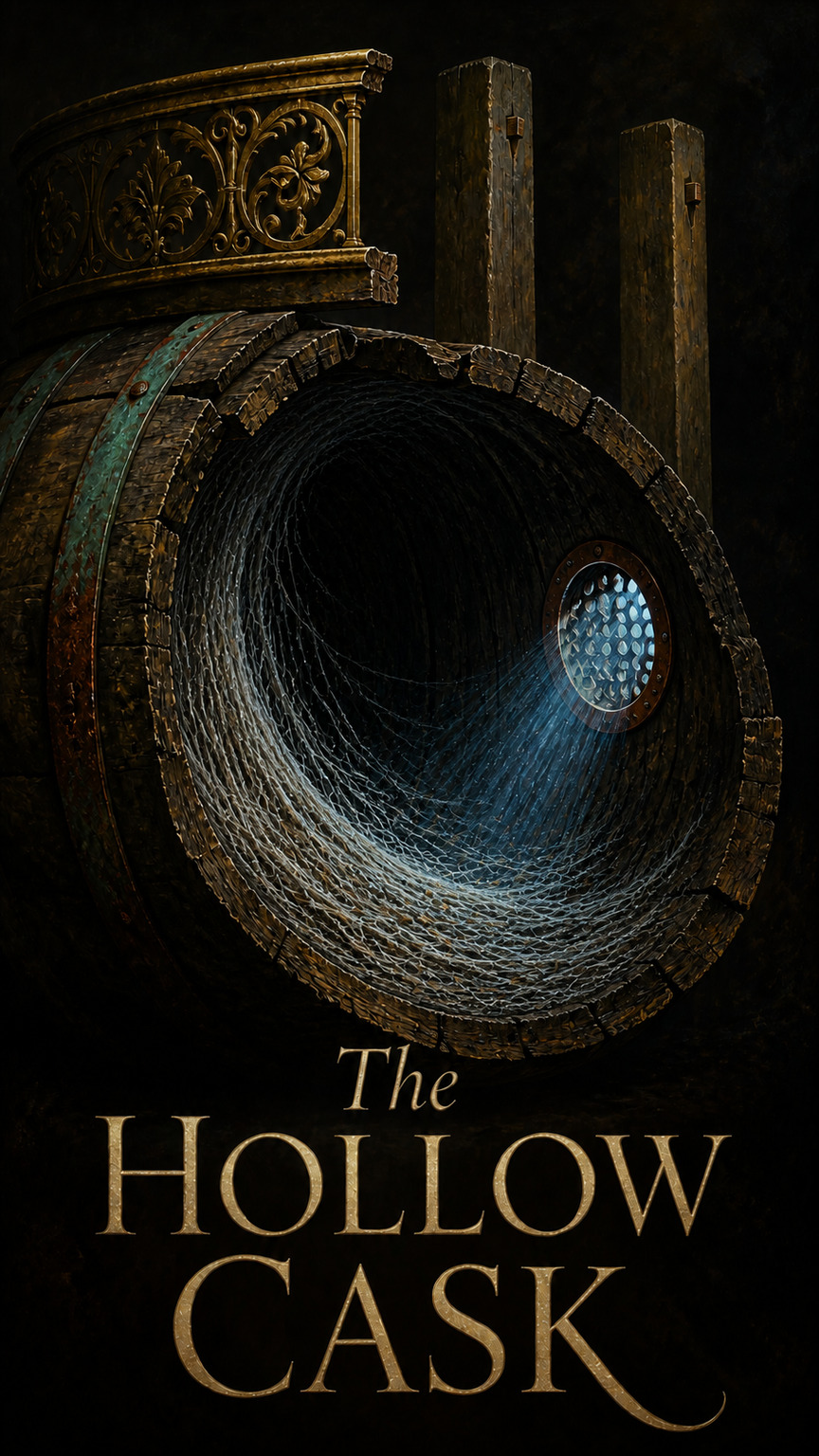
The first roof tile fell before the cart carrying the conveyance clerk had reached the lane. It punched through a bladder of wet plaster and shattered on the counter where Agnes Wold meant to serve harvest ale in twelve weeks.
She stood beneath the dripping rafters with the deed rolled in one hand and watched brown water run among the shards. Three roof breaches showed white sky. The north wall plate had gone soft enough to take the point of her knife. A burst downpipe poured against the outer wall, the plaster below it bulged like soaked bread, and the gallery bowed over the room with a drop of nearly four inches from end to end.
There was still an honest hour in which she might call herself an investor. Board the place. Sell the old oak, the hearthstone, the acreage behind. Recover perhaps two-thirds of what she had spent and tell no one how close the remaining third came to all she owned.
Instead Agnes unloaded her props, wedges, adze, lime tubs, and the long box of planes she had carried from one rented workshop to another. She set a sole plate on sound flags, raised a temporary shore beneath the gallery’s worst bay, and drove the top wedge until the timber answered with a dull, burdened note.
While pulling tarred cloth from a bracket, she found a carved vine beneath the flaking brown paint. Gold leaf still clung in the cuts. Across the hall, empty mortises showed where the gallery had once turned both corners and wrapped three walls. The floorboards were hollowed by feet before a broad hearth and a shallow speaking step. Not aristocratic grandeur, then. Better. A room made splendid by being full.
Agnes pinned the deed above the driest end of the counter. On the gallery fascia she chalked one word in carpenter’s red.
SAVE.
Then she climbed onto the roof before the next tile could fall.
By the fifth day she had made the rain travel somewhere it was wanted. New lead lined the broken valley; the downpipe emptied into a cleared stone runnel rather than the wall; patched slates covered two breaches, while a tarpaulin and battens held the third. The building still smelled of wet ash and mice, but the upper courses had begun to dry.
Agnes was picking hard grey cement from the north wall when Silas Cray came through the door. He carried a sawyer’s rule and looked first at the shore, then at the red word on the gallery.
“A shore isn’t a cure,” he said.
“It isn’t priced as one. I need two oak sisters cut to these measures.” She passed him a scrap of board. “Straight grain, no sapwood. I pay on delivery.”
Silas did not take it. “Pay won’t make that gallery worth standing under.”
“No. Timber might.”
She turned back to the wall. The cement came away in sharp cakes, bringing some of the old face with it where damp had been trapped. Behind it lay soft lime plaster, still sound at the edges. Agnes misted a handspan and worked with a horn scraper. Brown became madder red. A procession emerged: sleeves, ribbons, the curve of a brass instrument, and a gold ground darkened to mustard beneath the dirt. Above it, square nail shadows marked the former places of blue-glass lamps.
At shoulder height, different hands had scratched feast days, grazing meetings, birth cups, and roof funds into the plaster. Some marks were formal; others wandered uphill as if their writers had been laughing.
Silas finally took the board. “Pretty wall.”
“Public wall.” Agnes nodded toward the gallery. “And those treads are worn to the left turn. It held dancers.”
“Then it held them badly.”
They measured together because numbers were harder to refuse than hope. The cantilever ran too far beyond the post line. The surviving joists were shallow, the outer rail absurdly heavy, and the wall mortises had spread under thrust. Even before rot, the span should have sagged under a quiet row of chairs, never mind generations of stamping feet.
Silas rapped the nearest post with his rule. “Take it down while it still agrees to come in pieces.”
Agnes pressed her thumb to one of the tiny bores polished through the mortise. There were hundreds, each no wider than a barley straw, running with rather than across the grain. “These aren’t beetle holes.”
“A hole is a hole when the beam breaks.”
“Cut me the two sisters. I shore one bay and open no more than that. If the timber gives us no answer, we dismantle.”
“You dismantle.” He folded the board once, precise as a refusal. “My saw stays out of it.”
Agnes set a peg against one bore and tapped twice with her mallet.
From under the floor came two faint knocks. A pause followed, long enough for Silas to turn toward the door. Then came a third.
He unfolded the board.
The wet joist betrayed the route. Its upper face looked sound, but Agnes’s awl sank to the haft beside a black iron nail. Rather than skin it over, she numbered the floorboards in chalk and lifted them from the gallery wall toward the middle of the room.
Beneath the ordinary boards lay an older sprung floor of elm laths. Bits of blue glazing glittered in the dust. A border of green-and-white tile survived under the later skirting, and in the dead spaces Agnes found three stamped dance tokens, a bone button, and enough bent pins to furnish a dozen lost sleeves. Whoever had built the grand room had spent money on light, color, and a floor gentle under moving feet.
They had also patched, generation after generation, around the same hollow oak dowels.
The dowels descended through the wall frame beside a copper gutter. Unlike the green metal around it, the gutter’s inner lip shone where repeated pouring had worn it smooth. It sloped toward the swollen cellar door and vanished through older masonry.
“What did they pour?” Agnes asked.
“Cellars take ale.” Silas kept his eyes on the lifted boards.
“Ale goes down by cask and comes up by jug. It doesn’t need a serving gutter inside a wall.”
He answered by fetching the pry bar.
They freed the cellar door a fraction at a time. Beyond it, stone steps fell into air warmer than the hall. Agnes’s lamp showed a cracked drain, clay pipes, and a copper grille furred shut with verdigris. At the back, built into stonework older than any wall above, lay the curved shell of an enormous oak cask. Tool marks on it were broad and shallow, unlike the crisp later mortises that accommodated its shape. Three floors had been raised around it. None had disturbed it.
The smell was not rot. It was warm malt after rain.
Pale cords webbed the cask’s broken staves and entered the hollow dowels overhead. They withdrew from Agnes’s lamp, not all at once but in tightening ripples. Among them moved amber mites, grain-small and glossy. Some carried damp pulp toward a pale cluster of brood. Along one charred stave, old fungal tissue had ridged over a burn.
“The Underbreath,” Silas said behind her.
Agnes lowered the lamp. “You know it.”
“Knew the name. A cellar pest. Old folk blamed it for sour barrels.”
“Old folk built it a copper trough.”
“Old folk built many foolish things.”
One loose gallery peg stood proud above them. A fresh cord entered its dowel. As Agnes watched, the cord tightened and the oak grain drew fractionally closed. Upstairs, the peg settled by the thickness of a shaving.
The cord was fine as sewing thread. Its flesh could not by ordinary leverage have closed a handspan of old oak, much less shifted a peg upstairs. Yet its contraction had travelled through the dowel, and the old joinery had carried the impossible force. The life below supplied what the cask and pipe could only route.
Agnes shaded a dry margin with her hand, fed it a spoonful of water, and waited. Fresh translucent tips emerged along the damaged edge. A mite returned with pulp. Another followed.
“You wanted the cellar opened,” Silas said. “Now you’ve seen why it was shut.”
“I’ve seen why someone wanted me to think shutting it was sensible.”
She refused his jar of fumigating bitter. Instead she set shallow dishes of watered malt, opened three temporary vent runs, and marked every peg above with a hairline of chalk. Silas watched her work without helping.
“If that brings the gallery down?” he asked.
“Then I learn before there are customers under it.”
“And if it brings something else?”
Agnes looked at the brood gathered in the cask’s damp seam. “Then you may try answering the question you keep stepping around.”
The drain had been laid with a mean little rise just before the outer wall. Agnes lifted two stones, reset the clay channel on packed lime and gravel, and gave the water a clean fall. She scraped the copper grille open and hinged it outward. Over the cask’s split stave she fitted an oak sleeve with breathing gaps instead of packing the crack with mortar.
Only then did she test the structure.
She hung one measured sandbag from a colonized peg and gave two taps. Two taps returned through the dowel. That proved response, perhaps only habit. She needed a choice the old system had not taught.
From the cask she laid three covered channels. One held fresh air from the opened grille. One held watered malt. The third followed a smoke-stained clay branch toward the gallery wall; she placed malt there too, so food and safety would not point the same way.
The pale cords nosed first toward both dishes. At the bitter soot they recoiled. Mites left the nearer food untouched and began carrying brood toward the fresh-air channel. Agnes blocked that channel with a tile.
The sandbag peg released.
It dropped half an inch into its mortise, and the bag touched the floor. The cords did not take the offered food. They spread along the cask seam, found the edge of her tile, and sent one bright thread past it toward the copper grille.
Not speech. Not proof of a mind shaped like hers. But it was no echo either. Faced with three poor choices, the colony had refused two, protected its young, and surrendered a load.
Agnes removed the tile at once.
She traced the smoke branch upward. Behind the hearth, the flue divided through a shutter and a leather-bellows throat she had already rebuilt from fragments because its curve matched the earliest plaster. Bitter black lay only in the branches leading to structural bays. On one exposed beam, pale cords had grown around old burns and sealed them with scar tissue.
The wall tallies changed too. Early accounts paired malt measures with feast nights. Later hands bought more bitter fuel, recorded less feed, and demanded larger crowds from the same thin joists. That showed a change in practice, not what the first builders had intended. The oldest truth remained below the oldest readable wall.
Silas arrived near dusk and found Agnes scrubbing SAVE from the fascia. Beneath it she wrote, SUPPORT WITHOUT IT.
“That’s a dear sentence,” he said.
“Less dear than a funeral.”
“You’ll lose half the room.”
“I’ll lose the part that doesn’t know how to stand.” She held out a soot-black flue tile. “Who taught them to drive it with this?”
Silas looked past her to the chalked plan. “Put your roof on before the storm. Questions keep better than lime.”
He left the tile in her hand.
The deed still hung above the counter. It conveyed beams, stone, fixtures, and land by boundary. Nothing written there could turn the small lives below into stock. Agnes took up her rule and began drawing posts.
The storm arrived a day earlier than the carter’s forecast. Wind rammed rain beneath the temporary roof and pressed smoke down the chimney. Agnes smelled the bitter residue before she heard the gallery move.
The rebuilt bellows shutter clapped open.
Smoke drove through the old clay branches into the hollow dowels. Beneath the floor, the Underbreath contracted in flight. Its force tightened the colonized oak, drew two pegs home, and lifted the bowed gallery almost level.
For one terrible moment the grand room returned. Gold brackets aligned. The rail rose straight. Agnes could see the lamps, the musicians on the speaking step, the crowd above moving as one body.
Then a rotten mortise split with the report of an axe.
Silas came through the main door carrying a wrapped book under his coat. “You’ve set the draw back.”
“I set it to the earliest profile.” Agnes braced a second prop beneath the inner beam. “The front bay is taking more than its share. Help me shore it.”
“Earliest you could see.” He put the book on the counter and opened it to a page of flue diagrams. “My forebear kept this. My family kept it after.”
The sketched branches matched the ones in the wall. Late entries grew meaner: brood dead at east stave; feed shortened; drive the Underbreath hard for festival. Beside one blot, a hand had drawn the same bellows shutter Agnes had restored.
“You had this while I was opening the floor?”
“I wanted the place shut.”
“You wanted the evidence shut.”
The gallery lurched. A peg sprang across the room and struck the hearth. Silas flinched, then caught the prop Agnes shoved at him.
“Blame me when the roof is holding,” he said.
Closing the shutter would stop new smoke. It would not cool the oak already hot, open a path for the colony, or support the frame when panicked cords let go. The outer bay had begun to peel away from the wall. If it fell uncontrolled, it would wrench the sound inner beam off its shores.
Agnes looked once at the gilded rail. Nearly all her savings, made visible.
“We’re not shoring the front,” she said. “We’re cutting it free.”
The safe door was behind them. The smoking hearth stood to their right. Across the room, beyond the bowed gallery, the cellar steps led to the drain and the copper grille. Agnes set out the order before fear could disorder it.
“Inner beam first. Both shores under sound heartwood. Then the grille full open. Then I break the shutter out.”
Silas looked up at the carved outer bay. “We can stand two more props under that rail.”
“On the sprung floor? It will punch through and trap us beneath it.” Agnes drove her rule into the scarf line where the decorated cantilever joined the inner beam. “This joint is already half opened. We support here, cut here, and wedge the dead bay outward.”
“That’s the room you bought.”
“It’s the room that was bought before.”
There was no time to make the sentence better. Another contraction jerked the rail upward and showered them with lime.
They raised the independent shores. Agnes held each plumb while Silas struck the wedges. The first seated under the inner beam with a clean knock. The second skidded on wet flagstone; she kicked grit beneath its sole and made him drive again.
“Three blows,” she said. “No more. One. Two. Three.”
The inner beam settled onto honest timber.
Silas ran for the cellar. Agnes crossed to the hearth, keeping outside the gallery’s fall line. She hooked her pry bar behind the shutter she had so carefully fitted, levered until the new screws tore from old brick, and ripped the whole bellows throat into the ashes. Smoke burst into the hall, then thinned as the pressure found the open fireplace instead of the clay branches.
From below came the clang of copper and Silas shouting, “Grille’s open!”
Cool wet air entered at floor level. It carried the smell of rain on nettles. Through a gap beside the dance floor, Agnes saw the pale cords still drawn taut, their edges gone translucent with heat. They did not release. Familiar smoke had taught flight into the beams too well.
She laid the long saw into the old scarf joint.
The teeth caught gilding first, then oak. Each pull cost her a month’s rent, ten chairs, another strip of gallery she would never be able to claim as original. Sawdust fell red-brown through the gold. Above her, the outer bay shuddered as the Underbreath tightened; behind her, the independent posts held the inner beam without complaint.
Silas returned dripping. “Let me take the saw.”
“Take the wedge. When I reach the hollow, knock it outward.”
“The carving could be braced after.”
Agnes pointed with the saw handle. The scarf had split past its shoulder; rot ran through the decorated face; the colonized dowel bound the dying bay to the sound frame. “If we keep that, we keep the smoke route and the false load. The whole piece goes.”
He put the maul to the wedge.
Agnes cut. The saw passed solid grain, soft rot, then the hollow dowel. Warm, bitter air hissed from it. Beneath the floor, pale growth streamed toward the damp channel. Amber mites crowded the open route. A fresh cord touched the copper lip.
The load changed.
“Now,” Agnes said.
Silas struck.
For an instant the Underbreath pulled against the old command. The gallery rose a finger’s width. Then the colonized peg slid free. Cords withdrew from the severed dowel in a pale rush, abandoning the outer bay.
The carved rail tipped away from them. It struck the cleared, roped floor in one vast cracking blow. Blue-glass fragments leapt from the dust. Agnes felt the impact through her boots, but the inner beam remained on its new posts. The roof did not follow.
Neither of them spoke until the last small piece of plaster had fallen.
In the cellar, the cask-shell was scorched but damp. Fresh cords filled its shaded seam and reached along the open grille; none returned to the separated gallery stump. The colony had stayed where it had a way to leave. That was a choice for tonight, not a promise Agnes could nail in place.
Upstairs, the deed had come loose from its pin. She picked it out of the dust, folded it, and put it in her pocket.
By the harvest gathering, the hall carried itself.
Two new oak posts stood where the gallery’s front bay had been. Agnes had left them visible, their wedges and tool marks plain. She conserved the surviving madder procession and one jagged end of gilded rail, but she did not paint in the missing bodies or pretend the gallery still wrapped three walls. The smaller room held fewer tables. It also held no concealed load.
Beside the cellar door hung a notice describing the cask-shell, the living colony, the smoke damage, and the limits of what the records proved. The cellar was occupied habitat, not storage and not entertainment. The copper grille remained open. Water and malt went down whether or not any peg ever moved again.
Silas inspected both posts before he took off his coat. He had brought sound oak at his own cost and placed the maintenance book beneath the notice in a glass-fronted box. Agnes had thanked him for the timber. The notice still said how long the book had been kept back.
“Six tables lost,” he said.
“Five. I made the counter narrower.”
He read the notice again. “People will ask to see below.”
“They may ask.”
Silas tested the cellar latch, found it locked, and nodded toward the doors. “They’re waiting in the rain.”
Together they opened the Hollow Cask.
Neighbors filled the speaking step and the floor. Musicians tuned where the dancers had once worn elm smooth. Agnes drew the first mug, listening despite herself for strain in the posts. There was none.
Music began. Warm barley air rose through the open copper grille, and one small, voluntary tremor dimpled the foam.