The Last Day of the Watch
Every century, the horned elves of the deep forest choose one archer to guard the ruins of a civilization when the newest guardian discovers fresh footprints leading inside, she realizes someone has been living there for years.
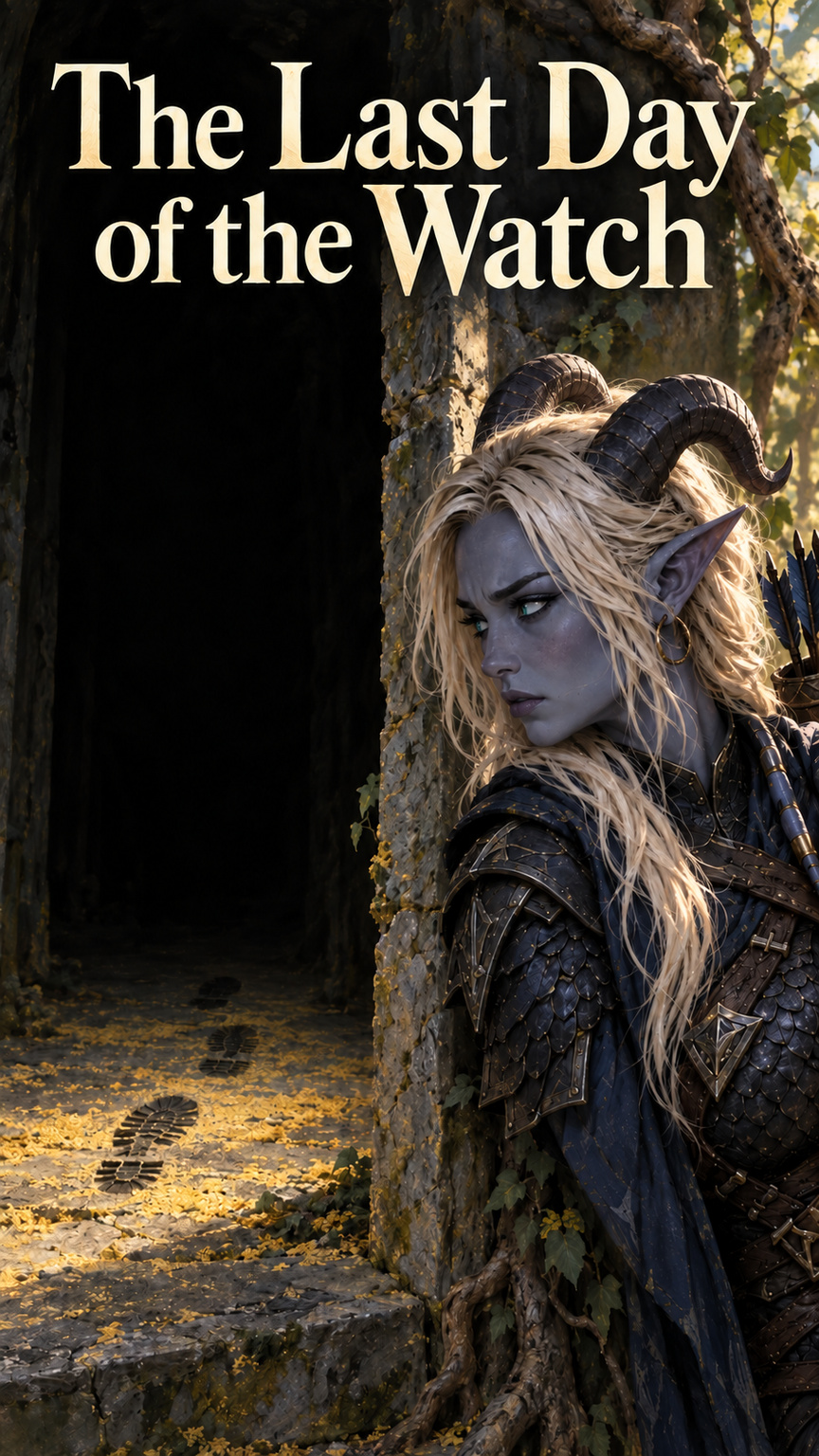
Kostral had shown her the gate, the alarm whistle, and the place where her name would be cut beneath his. He had not mentioned the footprints.
Phelnis found them beyond the first fallen column. Yellow pollen lay over the avenue, unmarked except for a line of boots going north into the city. One heel had a square patch. Wet earth still clung to its edges.
She looked back. Kostral had disappeared along the eastern wall to finish his circuit. Above the closed gate, his shutters stood open. He had told her to leave her pack in the guardroom and make herself familiar with the lower courts. At dawn, in the presence of the escort, they would inspect the outer seals on the burial chambers. Then he would give her the keys and leave.
Every hundred years, the horned elves of the deep forest chose one archer for the ruins. As a child she had recited their names in order, taking breath in the same places as her mother. She had been afraid she would stammer over Kostral’s name when she met him. He had only asked whether the gold carving on her bow caught the light, and she had turned it in her blue-gray hand to show him the dull finish.
“Good. Pretty things give you away.”
He had smiled when he said it. She was still pleased with herself for having thought of that before he asked.
The footprints left the avenue through a broken doorway. Phelnis loosened an arrow in her quiver and followed.
There were trees inside the rooms. Their roots had lifted floors where the vanished people had laid dark tiles in spirals; their branches reached through upper windows and held the surviving roofs apart. Under one roof, behind a screen of branches recently cut, grew beans. Someone had planted them in four stone bowls carved with kneeling figures. Beside them stood a fifth bowl, empty except for dry stalks and carefully broken eggshells.
A blanket lay in a recess. Its original blue survived in a strip along one edge. The rest was patches, themselves patched with smaller pieces, and beside it were three worn-out shoes with their useful leather cut away. On a shelf sat a wooden cup polished smooth where a thumb would rest.
Phelnis touched the blanket. Someone had been keeping warm here for a long time.
“Leave that.”
The voice came from above her. She stepped out from under the shelf, arrow on the string.
A man stood on a broken stair, holding both hands away from his sides. His beard had been shortened with something blunt. A thread of bean fibre hung from his sleeve.
“You’re the new archer?”
“Come down.”
“Where’s the other one?”
“On the wall. Come down where I can see you.”
He descended sideways, favouring one ankle. Human, and much older than the first startled glimpse had suggested. The square on his heel was fresh leather against a sole made of several different scraps.
“You wanted me to find you,” she said.
“I put those prints halfway across the city. I thought you’d walked past.”
“How long have you been here?”
“Take me to the gate. Get him to open it.”
“How long?”
He glanced at her bow, then at the doorway behind her. “Thirteen years.”
She looked again at the blanket. Her twenty years of practice for the choosing had included winters when she hated the bow and put it away. Thirteen years here: the same walls in every weather, that little square of bed.
“Kostral knows?”
“He knows I’m somewhere. I wish you hadn’t left him up there.”
Phelnis stepped into the doorway and looked along the wall. Empty stone, a pale shimmer of leaves. “Why does he keep you here?”
“Because I was quicker than the others.”
“What others?”
He rubbed his hands down his coat. “I can show you. It’s close. Then you’ll take me out.”
“What’s your name?”
“Osmund.” He waited, and when she did not move, added, “Please.”
The stair led into a burial gallery above the avenue. Phelnis had expected small tombs; this passage was wide enough for six people abreast, with doorways continuing beyond sight along its inner wall. On the other side, gaps between columns opened onto a landing and broad steps down to the street. Sunlight came through the gaps and the holes left by missing roof slabs.
At the third doorway Osmund stopped beside a heap of brushwood. More branches had been pushed against the next entrance. The leaves were still green.
“Those weren’t here last week.” He pulled one away. “He put them at every mouth he could find. I watched him carrying oil yesterday. He means to smoke me out before you open the chambers.”
“You think that.”
“I wasn’t going to wait underneath and find out.”
Osmund lifted a loose panel beside the sealed door, revealing a hole cut through the wall. He stooped through it, and Phelnis followed. Inside, two shapes lay near a cracked stone coffin. She saw boots, a buckle, the collapsed sleeves of a coat. One arm extended towards the hole. A rusted chisel rested beyond its fingers.
She remained on the threshold. Small gold plaques had spilled from the coffin onto the floor. Its lid lay on wooden rollers.
“You opened this.”
“He shot them there. I was behind the coffin.”
“You broke into the tombs.”
“Yes, we broke in! He told us which ones to open.” Osmund caught himself and looked up towards the gaps in the roof. His next words came lower. “We had six chambers open. He said we’d get our shares when we finished the seventh. I was putting a wedge in. That was why he missed me.”
He pointed at the door. “He put the seals back afterwards. Shut the front, covered the cuts. You’d never know from the avenue.”
Phelnis looked from the tools to the passage. Nothing here told her who had killed these people. Osmund knew the chambers, knew what they held. Kostral had sworn to keep them untouched.
“Where did you meet him?”
“At the gate. Where do you think? We came looking for a way in and he let us through. I thought we’d been lucky.”
“He hired you?”
“We were thieves. There. Can we go now?”
Beyond the roof, stone scraped against stone. Phelnis looked up. Someone was crossing the wall above the gallery.
“Stay beside me,” she said, reaching for the whistle.
Osmund seized her wrist. She pulled free and lifted her bow between them.
“Don’t call him.”
“He won’t shoot while I’m here.”
“You don’t know him.”
She knew a grave robber who wanted her to leave the keeper out of her inquiry. She put the whistle to her lips and blew the three clear notes Kostral had taught her.
Osmund ran.
He got back through the hole and across the landing before the arrow caught him. It tore his coat along the thigh and knocked his leg sideways. He fell against the steps, reached for the rail that was no longer there, and began to slide.
Phelnis caught his collar. A second arrow broke on the step beside her hand.
She dragged him backwards across the landing and through the hole. His weight pulled her down with him, one dark horn striking stone hard enough to fill her vision with white. She crawled clear of the opening and put her shoulder against the wall.
“Well found, Phelnis.” Kostral’s voice carried easily from the western colonnade. “Keep away from him now.”
Osmund had both hands clamped over his thigh. Blood came between them.
“He’s unarmed,” she called.
“There’s a knife in his coat.”
She had seen no knife. He could still have one. She could still be wrong about everything except the second arrow striking beside her fingers.
“Put down your bow, Kostral.”
“Come out of there. Let me finish this.”
Osmund pushed at her shoulder. There was a low opening behind the coffin, almost hidden by the fallen lid.
“It comes through,” he whispered. “Go.”
“Where?”
“Anywhere that isn’t here.”
She heard Kostral’s boots on the colonnade, moving towards the gallery’s northern end. He knew how to get in here.
She hauled Osmund towards the opening.
*
They came out into darkness that smelt of old dust and nuts. Osmund found a little lamp without searching and struck a light with hands that shook. While Phelnis bound her neckcloth around his thigh, he kept trying to pull his coat over it.
“Leave it. I need to see.”
“He’ll follow the blood.”
She folded the torn coat under his leg. They listened. Above them came a slow dragging sound, then a thump. Kostral was shifting the coffin lid.
Osmund blew out the lamp.
He led her by touch through a gap between two burial chambers. She had to turn her head to pass her swept horns between the stones. On the other side, faint evening light showed a room crowded with baskets. Nuts, dried fruit, beans in their pods. A small green pear lay on a flat stone with a bite taken out of it.
“He hasn’t found this one,” Osmund said. “He found the other five.”
The scrape of stone had stopped. Phelnis waited, listening for it to begin again.
“You can get outside from here?”
“Outside a room. Outside a tomb. Always another wall after it.”
She remembered the approach: a narrow neck of rock under the gate, deep clefts on either side continuing round the whole citadel. The forest grew far below its walls. From the causeway she had thought the drop beautiful.
“I tried the north face,” Osmund said. “Made a rope. It broke before I got halfway. That’s the ankle.”
“And the gatehouse?”
“Locked every night. Key on him. You saw the court. You can see a mouse crossing it from his window.”
“Someone must bring him provisions.”
“At the far end of the causeway. He goes out and locks up behind him. Once I shouted until I couldn’t speak. They were too far away, or he told them something. I don’t know.”
Phelnis knelt to look through a low window. The avenue ran south to the gate. Kostral’s guardroom occupied the upper floor on its western side; the door below, which he had left open for her pack, was still open. Twenty strides of bare court lay between it and the nearest cover.
“He said he hunted rabbits for food.”
“So do I.” Osmund tried to straighten his wounded leg and stopped. “And pigeons. There’s a whole orchard growing out of the west roofs. Mostly I eat what I can hide away before winter.”
He reached for the bitten pear, thought better of it, and put it in his pocket.
Kostral appeared at the far end of the avenue. Phelnis drew back from the window. He was taking the open route south, towards his rooms, glancing into each doorway as he passed. The old archer walked as if he had plenty of time.
“If we get through that door first,” she said, “we can bar him out. The gate handles are inside.”
“He’ll be waiting.”
“I just saw him. He’s still north of us.”
Osmund looked at her. Then he pressed his hand against the bandage and stood.
They went down through three adjoining rooms, following the line of the avenue. In the last, Phelnis stopped. Two travelling chests stood beneath a shelf of empty coffin niches. One was open. Under a folded green cloak lay gold plaques exactly like those scattered around the dead men.
Kostral had been wearing that cloak when he admitted her.
Osmund tugged her sleeve. She went with him.
At the edge of the court she made Osmund wait while she looked up at the guardroom. Empty window. The western colonnade blocked her view farther north.
She went first, with him two steps behind. At the fourth stride an arrow hit the paving in front of her boot.
Phelnis drove Osmund sideways behind the base of a fallen statue. Another arrow passed across the place where her face had been. He cried out as his wounded leg struck stone, and she pressed a hand over his mouth before she knew what she was doing.
Above the gate, Kostral stood behind the guardroom’s narrow northern window. The colonnade gave him a raised path straight to it. He had never needed to stay on the avenue.
Osmund bit her palm. She took it away.
“Phelnis.” Kostral had returned to the patient voice of their first meeting. “Your pack’s here. Come and get it. Tomorrow we can open the chambers together.”
“What about him?”
“Leave him.”
She could see only a sliver of his face beside his bow. No shot there. He had enough arrows to keep them crouched behind this stone until Osmund bled through the cloth.
“You were going to take all that gold out with the escort.”
Kostral drew back from the slit.
“I kept this place safe for a hundred years,” he said. “When my wife died, I stayed here. I couldn’t even stand at her grave. Do you suppose I did it for the little line they’ll carve over the gate?”
Phelnis looked at the stone under her hand. This morning she had run her fingers over the space left for her name.
“Come down,” she said. “Leave the bow there.”
An arrow struck the statue’s base hard enough to send a chip against her cheek.
Osmund caught her elbow and pointed behind them. A narrow doorway opened beneath the eastern gallery, three body-lengths from their stone. Keeping low, they crawled towards it. Kostral could see their feet; an arrow struck the heel of her boot as she pulled it through. The point skidded on its iron rim.
She lay with her cheek on cold paving until Osmund dragged the door’s fallen timber across their legs.
“Don’t talk to him,” he said. “He’ll just keep you talking.”
*
Night was gathering in the room. Through the broken doorway Phelnis could see Kostral’s window across the court. To its east, a little shooting terrace overlooked the gate steps. The northern window protected him from anyone on the avenue. The terrace had lost its eastern wall, leaving a low stone rail and two broken pillars.
Above her, the gallery faced that open side. Its stair had fallen in a heap outside. She had passed the wreckage on her way in.
“Is there another stair?” she asked.
“No.”
She pulled her pale hair free where it had caught under her black shoulder scales. There had to be somewhere. A man had lived here thirteen years, and Kostral had never found all his beds.
Osmund followed her gaze upwards. “You couldn’t fit.”
“Show me.”
Behind a wall panel, a sloping hole climbed through the stone. He had cut footholds along one side. At its upper end was a crack wide enough for his narrow shoulders.
“I made it when we were still working,” he said. “Before the last chamber. I didn’t tell the others. I meant to come back and take things for myself.”
Phelnis looked at his ragged coat, at the torn pocket holding half a pear.
She unbuckled her armour. Without it she could squeeze her shoulders through; the horns would be harder. She passed her bow and quiver ahead into the hole and started upwards, tilting her head until the tips scraped stone. Halfway up, one horn wedged against the ceiling. She backed down, turned onto her other side, tried again.
“Left,” Osmund said. “There’s a hollow on your left.”
She found it with the crown of her head and pushed through. Stone tore the sleeve at her elbow. For a moment her boots hung clear of the footholds and she had to drag herself by her forearms. Then she was in the upper gallery, breathing dust through her teeth.
She crept to the opening. Across the court, perhaps thirty paces away and a little higher, Kostral still watched the statue through his northern slit. The corner of the guardroom hid his body. To shoot at the doorway where Osmund waited below her, he would have to step onto the terrace. From here she could shoot across it, between the broken pillars.
Phelnis returned to the crack.
“I need him to come out of the guardroom.”
“Call him again.”
She let that pass. “He’ll shoot from cover if he knows where I am.”
Osmund was silent below her.
“There’s a pillar beside the gate steps,” she said. “Can you reach it?”
“That’s open ground.”
“Yes.”
“And this time you’ll stop him?”
Her bow hand had begun to shake. She pressed it against the stone. “I’ll have a shot.”
For a while she could hear only his breathing. Then he shifted under the crack.
“Don’t whistle. Just tell me when you’re there.”
Phelnis returned to the opening and set an arrow on the string. Kostral’s outline moved behind the slit. The last light lay on the white stones of his terrace, enough to see a man standing there. She brought the string back a little, then let it forward to ease the tremor in her fingers.
“Here,” she said, as quietly as she could.
Below, Osmund shoved aside the timber and stumbled into the court.
He had scarcely cleared the doorway when his leg failed. He caught himself on his hands. Kostral came out onto the terrace with his bow raised.
Phelnis drew. A broken pillar obscured his chest; only his shoulder and horn were clear. She shifted her weight without lifting her feet, bringing the bow around the edge of her opening.
Osmund was trying to stand. Kostral stepped to his left to see past the terrace rail, and the pillar no longer lay between them.
Phelnis loosed into his side. His arrow went down into the court. He struck the rail with his hip, dropped to one knee, and reached towards the guardroom.
She had another arrow drawn before he fell. For several breaths she watched his hand beside the threshold. The fingers did not move.
Below her, Osmund was still crawling towards the pillar.
“He’s down,” she called.
Osmund kept going until he reached the stone.
*
She climbed into the guardroom by its inner stair with her bow drawn, though there was no room to turn it. At the top she found Kostral where she had last seen him. She waited beside him, watching for breath, then crouched and touched his throat.
The keys were on a cord beneath his collar. She had to lift his head to get them free. His horn caught the cord and she worked it loose, carefully, as though she might hurt him.
In the room behind her, someone had turned down the bed for a last night. Her own pack rested beside it.
Phelnis took her cloak and went downstairs.
Osmund would not come inside while she opened the gate. He sat against the pillar, watching the terrace. When the gate finally moved, he pushed himself upright before she could reach him and went through, dragging his bad leg.
She followed him across the narrow causeway. The clefts were full of darkness now. At the first tree he stopped and put his forehead against the bark.
Phelnis settled the cloak around his shoulders. Under it, his breathing broke into short, angry catches. He gripped the tree with both hands. She stayed a little way off, holding her bow.
After a while he turned. “Did you get your pack?”
“No.”
“Good. Don’t go back for it.”
She sat down beside him.
They spent the night there. Whenever Osmund woke, he reached out and found the bark. Phelnis watched the open gate. By dawn she could make out the carving above it, but from this distance she could not read the names.
The escort came with a white mare for Kostral. Someone had tied ribbons to its bridle; the woman leading it carried a folded robe across her saddle. She smiled when she recognised Phelnis, then saw the blood on her sleeve and brought the horses to a halt.
“Where is he?”
Phelnis got up. The bow had left a deep mark across her palm.
“Kostral is dead. I shot him.”
The woman looked towards the gate. Behind Phelnis, Osmund struggled to his feet, still holding the tree. She put out her free hand, and he took it to steady himself.