The Counted Road
Your family has passed down a curse for generations, but nobody remembers what it actually does. Today, it finally activates.
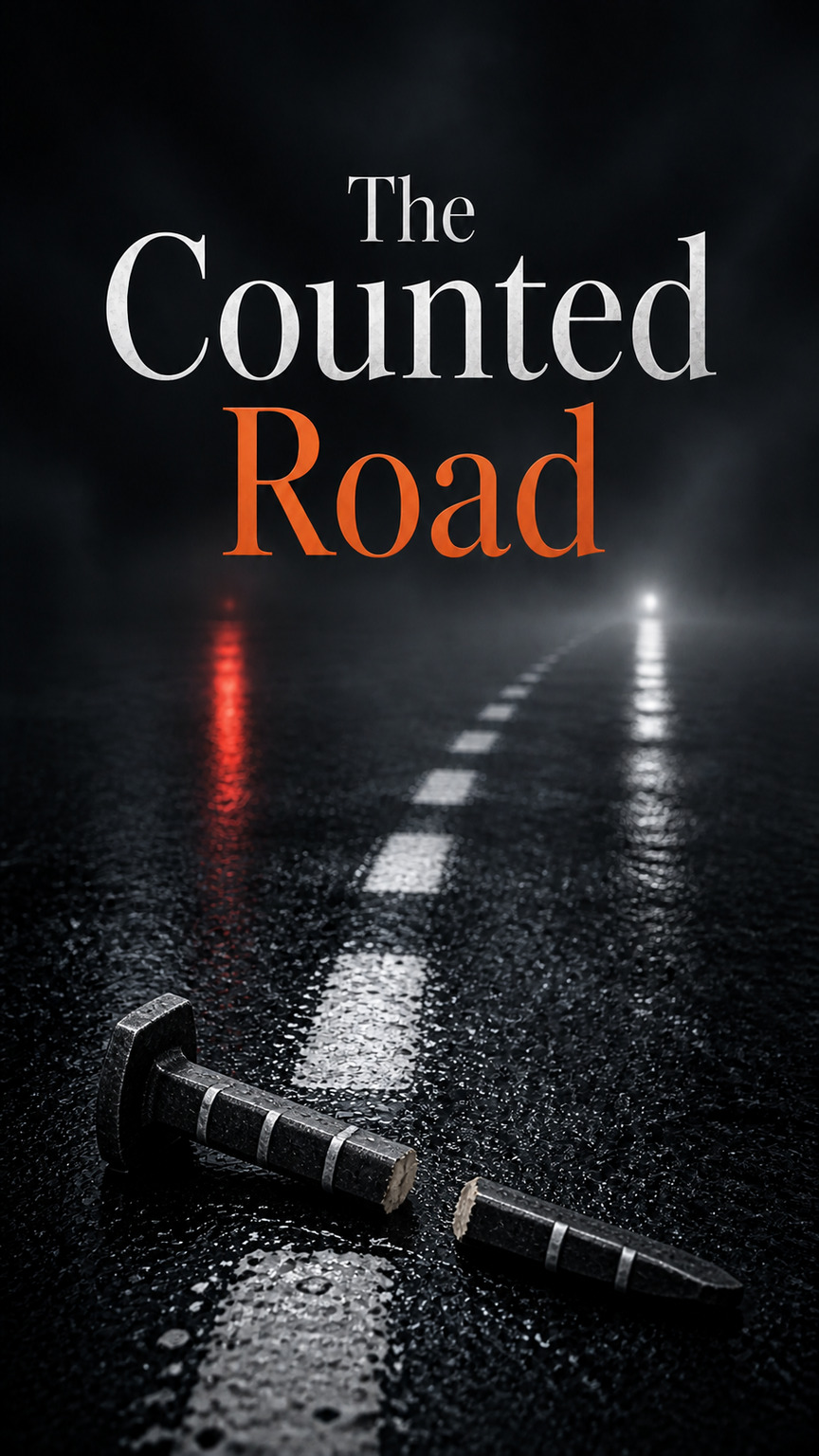
By the time the excavator reached the front step, Elsidra had painted two hundred metres of temporary centerline past the Talwin house and answered the same question about rain four times.
“Forty minutes,” she told the flagger through the open cab window. “If it starts before that, we close the lane and do it again.”
Across the cones, the excavator bucket lifted the old stone threshold. A demolition worker crouched in the cavity it left and pulled out something black and narrow.
Vaudessa Talwin moved faster than Elsidra had seen her move all day. She ducked under the tape before the worker had straightened.
“Put that back.”
The worker held up an iron spike as long as his forearm. Its square head had been hammered almost flat. Hooked grooves wound down its shaft, packed with pale mortar.
“Can’t,” he said. “Step’s coming out.”
“Then don’t take the step.”
He looked toward Elsidra, because Elsidra wore reflective orange and therefore appeared to be in charge of every machine on the street.
She shut off the spray bar. “It’s Vaudessa’s property until handover. Bag it for her.”
“It was under the threshold,” Vaudessa said. She did not take her eyes off the spike. “That isn’t the same as being in the house.”
“Do you want it or not?”
Vaudessa took it in both hands. The grooves left four white hooks across her palms.
Caelumar came out carrying the second battery for his delivery bike and a paper sack of screws he had promised to save for Rovandis. He was the last of them still using the old house as if it might ask for one more favor. He checked the upstairs windows, pushed the gate until its loose latch caught, and swung onto the bike.
“You’ve got your rear light?” Elsidra called.
He tapped the brake lever. Red flashed against the wet-looking new line.
“And your charger?” Rovandis asked from beside his parcel van.
“That’s what the battery is.”
“The charger charges the battery.”
“It’s in my bag.” Caelumar pushed off. “Both of you can stop inventorying me.”
He rode between the cones, raised one hand to Vaudessa, and turned downhill.
Vaudessa watched the empty bend. Her thumb traveled from hook to hook on the spike.
“One,” she said.
Elsidra opened the paint valves again. “One what?”
Vaudessa wrapped the spike in her cardigan. “Last out.”
The flagger called that the first drops had started. They had not, but the western cloud had gone the color of dirty steel, and Elsidra had forty minutes of work left.
She put the rig in gear.
At the roundabout, the paint display showed 8.0 liters remaining.
Elsidra knew that was wrong because she had filled the tank herself. She thumped the gauge housing, checked the pressure, and leaned out to inspect the line. The white stripe behind her ran clean for six metres, bent into a hooked black-edged mark, then ran straight again.
She stopped so hard the bead dispenser clicked against its mount.
“What did you feed it?” her crew lead asked over the radio.
“Nothing. Hold traffic.”
Elsidra reversed along the closed lane. The mark was not a splatter or a blocked tip. It was deliberate-looking: one short downstroke and a curve biting back toward the house.
Her phone rang. Rovandis.
“Did Caelumar change his first stop?” he asked.
“Ask dispatch.”
“Dispatch asked me. His parcel scan has no destination.”
“Bad label.”
“Three bad labels. Same route.”
The paint display changed to 7.0. The tank gave no settling knock. Pressure stayed at one hundred eighty.
Elsidra took a photograph of the hook. When she opened the image, the road was visible, the cones were visible, and the mark sat on blank gray pavement without the roundabout behind it. She lowered the phone.
“Call him.”
Rovandis already had. The connection opened on chain noise and wind.
“Caelumar?” Rovandis said. “Pull over.”
“I am over.” Caelumar sounded irritated, then less certain. “I’m by the… the blue…”
“Shop?”
“No. Tall thing. Water in it.”
Elsidra knew the tower. Caelumar had used it since he was twelve to judge the river turn.
“Which side of the river?” she asked.
Silence, except for the tick of his freewheel.
“What river?”
The line behind Elsidra’s rig trembled in its wet edges. The display read 6.0.
Her other phone line chimed. Vaudessa’s name appeared, though Vaudessa said nothing when Elsidra answered. A sequence of vibrations traveled through the call: six blunt knocks, a pause, then six again.
“Your phone’s against something,” Elsidra said.
“The spike.”
Rovandis spoke over her. “This is a routing outage. Caelumar, give me your coordinates.”
“Screen’s blank.”
“Compass heading.”
“I don’t carry a ship, Dad.”
“Your courier app has a compass.”
“My courier app has a white square.”
Elsidra watched the fresh hook reach for the unpainted lane as rain began ticking on the windshield.
“Don’t move,” she told Caelumar.
“I’m in a traffic lane.”
“Move to safety. Then don’t choose a turn.”
“Those are different instructions.”
“Do both.”
He breathed once into the phone. “Bike lane. Stopped. Rear light on.”
The count stayed at six.
They met under the fuel-station canopy three blocks from the work zone. Vaudessa arrived in Rovandis’s van with the wrapped spike across her knees. Elsidra’s crew waited behind the cones, the paint rig idling, until she told them to secure the roundabout and take their break.
Rovandis spread his parcel scanner, two phones, and an old printed route sheet across the van’s hood.
“Network’s up,” he said. “Dispatch can see every driver except him.”
“Can they call him?” Elsidra asked.
“They can call. They can’t place.”
Vaudessa pressed her fingertips into the cardigan. The phone beneath it gave six vibrations.
“Stop doing that,” Rovandis said.
“I’m not.”
He pulled up a photograph. Caelumar stood beside his bike holding a birthday cake badly balanced on the parcel rack. Rovandis tapped the empty distance behind him.
“That was outside the old place.”
Elsidra saw Caelumar clearly: hair blown across one eye, knee muddy, smile impatient with the camera. Behind him was a wall with no door, no number, and no street.
“You know him,” Vaudessa said.
Rovandis’s look made her retreat half a step. “Of course I know him.”
“Say what he’s carrying.”
“Cake. Bike lock. The ridiculous green bottle he won’t throw out.”
“Where?”
Rovandis enlarged the blank wall until the pixels broke apart.
Vaudessa unwrapped the spike. “My mother counted everyone across a sill. In and out. So did hers. Four people, four taps. If someone left alone, you waited for them to answer before you shut the door.”
“You said it was courtesy,” Elsidra said.
“It was courtesy. We didn’t know why.” Vaudessa touched the first hook. “There was another part. Don’t lift the spike with one still out.”
“And if somebody did?”
Vaudessa’s thumb stopped.
“Nobody remembered.”
Rovandis snatched up his keys. “Caelumar is not being hunted by a nail.”
The scanner in his hand chirped. A saved stop vanished from the route sheet. The vibration beneath Vaudessa’s palm struck five times.
Rovandis stared at the screen, then at the van.
“Which stop?” Elsidra asked.
“I don’t know.”
“You were looking at it.”
“I know.” He pressed the key fob hard enough to sound the van’s horn. “Get in.”
They tried Rovandis’s route first because he had driven it five days a week for eleven years.
At the first turn, the municipal sign showed bolt holes and a clean green rectangle. Rovandis turned anyway. Two minutes later they passed the same fuel station, though neither Elsidra nor Rovandis remembered making a circle. Vaudessa’s phone struck four times.
Rovandis braked beneath the canopy.
“Again,” he said.
“No.” Elsidra took his printed sheet. The line after DEPOT read three blank spaces and an arrow pointing nowhere. “Every old cue costs one.”
“You don’t know that.”
“We lost the tower. Six. Lost your stop. Five. Lost this turn. Four.”
“Then I use a road I don’t drive.”
He chose one. The van’s map drew a blue line through three buildings and returned them to the same intersection.
Vaudessa’s fingers jerked. Three knocks sounded against the van door.
Rovandis reached for the gearshift again.
Elsidra put her hand over it. “You don’t get another guess.”
His knuckles whitened beneath hers. “He’s stopped in traffic with no route.”
“And every route we already know is feeding that thing.”
Vaudessa tilted the spike. One groove had darkened where her pulse pressed it. “It catches when we turn toward home.”
“Which home?” Rovandis demanded.
Vaudessa looked at the blank street sign. “If I knew, we wouldn’t be here.”
Elsidra called Caelumar. Wind battered his microphone now.
“Battery?”
“Forty-three on the bike. Nineteen on the phone.”
“Road surface?”
“Old asphalt. Patched edge. Trucks close. I haven’t turned.”
“Can you see any fresh road paint?”
“No.”
“Anything that wasn’t there this morning?”
Caelumar took time to look. “Temporary sign. Orange back facing me. New trench plates. Someone dumped a blue chair.”
His reporting steadied as the objects became smaller and newer. Elsidra walked around the van, checking what the rain had done to her work. At the mouth of the service lane behind the fuel station, her crew had premarked a short white dash that morning. Caelumar had never used that lane. Elsidra had not painted it until an hour ago.
“I’m going to give you a mark,” she said. “Fresh white dash, about a hand wide. It may be nowhere near you. If you see it, flash the bike lamp twice.”
“How?” Rovandis said. “We can’t tell him where.”
“We don’t.” Elsidra climbed into the paint rig. “We put it where he can answer.”
She extended the hand sprayer and drew one new dash across the service lane entrance. Not a road name. Not an arrow home. Just wet white paint placed after the count began.
For six seconds, nothing happened.
Then Caelumar said, “White dash.”
In the distance beyond the garages, a point of light blinked twice.
Vaudessa counted the vibrations against her palm.
Three.
Still three.
Elsidra started the rig. “Rovandis, get your van behind me.”
“That’s an alley.”
“Tonight it isn’t.”
Elsidra painted only what did not exist before she reached it.
Elsidra added Rovandis to the call and set her phone to speaker. At each junction she laid a single dash on the safe branch and waited. Caelumar answered with two white flashes when he saw it. Rovandis followed at a distance, using one short horn blast to hold and two to advance. Caelumar answered each instruction with his brake light: steady red for holding, two taps for moving.
They built the route a piece at a time. No destination appeared on a screen. No one named a street.
Dispatch called Rovandis twice. The first time he said there was a family emergency. The second time he asked them to keep trucks off any closure with fresh hand marks and hung up before they could demand a permit number.
At the third junction, Vaudessa slapped the dashboard.
“Not left.”
Elsidra held the rig straight. “Why?”
“The third hook’s pulling.”
Rovandis’s voice came through the speaker. “Metal doesn’t pull.”
“Then my hand does. Straight.”
Elsidra painted straight. Far ahead, the bike light answered.
The count remained three.
Rain silvered the lane and smeared the edges of every old marking. Elsidra kept the pressure low and the dashes short. At a fork beside a shuttered garden center, Caelumar’s light appeared on the wrong branch, moving away.
Rovandis laid on the horn.
“One,” Elsidra snapped.
He released it, waited, gave one short blast. Stop.
Caelumar’s brake light burned red.
Vaudessa turned the spike between both palms, flinching as the hooks caught. “Back him six turns of the wheel.”
“You can’t feel wheel turns,” Rovandis said.
“I can feel when this loosens.”
Rovandis gave three clipped horn taps, the new signal they had chosen for reverse. The brake light vanished, returned, vanished again as Caelumar walked the bike backward. On the sixth pulse, Vaudessa opened her cramped hand.
“There.”
Elsidra painted a dash across the other branch. Caelumar saw it, turned, and answered.
That should have been enough to persuade Rovandis. It wasn’t enough to make him patient.
When Caelumar’s phone battery fell to eight percent, Rovandis pulled around the rig and accelerated toward the next junction.
The road sign there said NINE-LARCH. Elsidra recognized the name, then did not. The letters seemed to drain while she looked at them, leaving a wet green board.
Vaudessa’s phone struck twice.
Rovandis braked sideways across the lane. “I can reach him faster.”
“You just spent one.” Elsidra stopped the rig nose-to-nose with his van. “Back behind the paint.”
“His light is dying.”
“Wait for the next flash.”
“I can’t see him.”
Elsidra pointed through the rain. A faint red pulse appeared beyond the bend, reflecting off the wet trunks rather than shining directly at them. Caelumar had stopped. He was waiting for the next thing they made.
Rovandis reversed.
This time, when Elsidra painted, he did not move until the red light tapped twice.
The road narrowed between a ditch and a line of dark larches. Trucks moved on the far side of a temporary divider, spraying dirty fans over the cones. Elsidra’s tank gauge still read full. The other number held at two.
Then the old centerline vanished under the rain. Elsidra did not mean faded. Her headlights found only black asphalt where reflective glass had shone a breath earlier.
The spike twisted in Vaudessa’s hands. Her phone struck once.
Ahead, Caelumar’s white lamp wavered near the ditch.
Rovandis’s hand went to the horn. “What signal?”
Elsidra looked at the road. The shoulder ended at a culvert. The traffic lane beyond the divider was no place for a bike. Her sprayer could reach the near edge, but not the far verge where Caelumar waited.
“Hold,” she said.
One short blast. Caelumar’s brake light came on and stayed on.
Vaudessa slid her thumb over the grooves. “It’s tight straight ahead.”
“Straight ahead in the lane or along the ditch?” Rovandis asked, but quietly now.
“Give me your flashlight.”
He did.
Vaudessa pressed the light against the spike’s head and rotated the shaft. The hooked grooves threw thin crescents across the cab. Three pointed toward the traffic lane. One lay along the ditch, ending at the concrete lip of the culvert.
Elsidra climbed down with the hand sprayer. Rain rattled on her hard hat. She walked to the last cone, clipped her safety line to the rig, and stretched as far as the hose allowed. The first paint struck water and feathered away. She lowered the nozzle until it almost touched the road and drew a thick white bar from the lane edge to the culvert lip.
“Advance,” she told Rovandis.
Two horn blasts.
No answer.
“Again?” he asked.
“Wait.”
The display held at one, and they had no useful word for where Caelumar stood. Elsidra could see his lamp only as a weak stain through the trees. She crouched and put one glove on the fresh bar. The paint was cold and gritty with beads. New all the way across.
She took the flashlight from Vaudessa and blinked it twice along the white bar.
Caelumar’s lamp answered once, failed, then answered again.
Rovandis gave the two horns.
Red brake light: two taps. Moving.
Vaudessa counted the grooves under her thumb, not aloud. Elsidra kept the flashlight on the paint. Rovandis leaned on the open van door, listening between the passing trucks for the small electric whine of the bike.
It came from the ditch side, stopped, then came again. A front wheel edged into the beam at the culvert. Caelumar walked behind it, soaked to the skin, one hand over the dead phone clipped to his handlebar. He did not look at the van. He looked down at the white bar.
Rovandis inhaled to call him.
Elsidra raised one finger.
Two horn blasts.
Caelumar squeezed the brake twice, released it, and pushed the bike across the fresh paint.
The display on Elsidra’s rig held at 1.
Rovandis reached him first. He checked Caelumar’s face, shoulders, hands, then the bike as if dispatch required a damage code.
“Anything hurt?”
“Left ankle. Not bad.” Caelumar blinked rain from his eyes. “My charger is in my bag.”
Rovandis caught the back of his jacket and kept hold of it.
Vaudessa stepped down from the van. The spike shook between her palms hard enough to make its hooked light jump across the road.
“Elsidra.”
Elsidra took the short sledge from the rig’s barrier box. She set the spike across the concrete culvert lip.
Vaudessa removed her hands.
The metal went still.
Elsidra struck once. The spike rang and jumped. Rovandis put his boot on the square head, away from the grooves.
“Again.”
The second strike bent it. The third split the shaft through a pale seam beneath the rust. Vaudessa’s phone vibrated once, a loose mechanical buzz, and displayed three missed calls from Elsidra.
Behind them, the green road sign carried its white letters again.
No one read them aloud.
Elsidra’s crew lead arrived with the closure truck and an opinion about every unauthorized dash on the route.
“Rain’s ruined half of them,” he said.
“Good,” Elsidra told him. “Cone the culvert. We’ll strip the rest in daylight.”
Rovandis wrapped Caelumar’s ankle. Vaudessa collected both halves of the spike in a plastic paint tray without touching the grooves. Caelumar changed his bike battery under the open rear door of the van, then tested the headlamp.
“One flash,” Elsidra said. “Not two. Two means advance.”
He gave her one white blink.
She answered with the rig horn and went to secure the wet line before traffic opened.