The Kingdom of Later
You’re a commoner in a fairytale kingdom just trying to get by. Frustratingly, nothing really ever gets done because ...
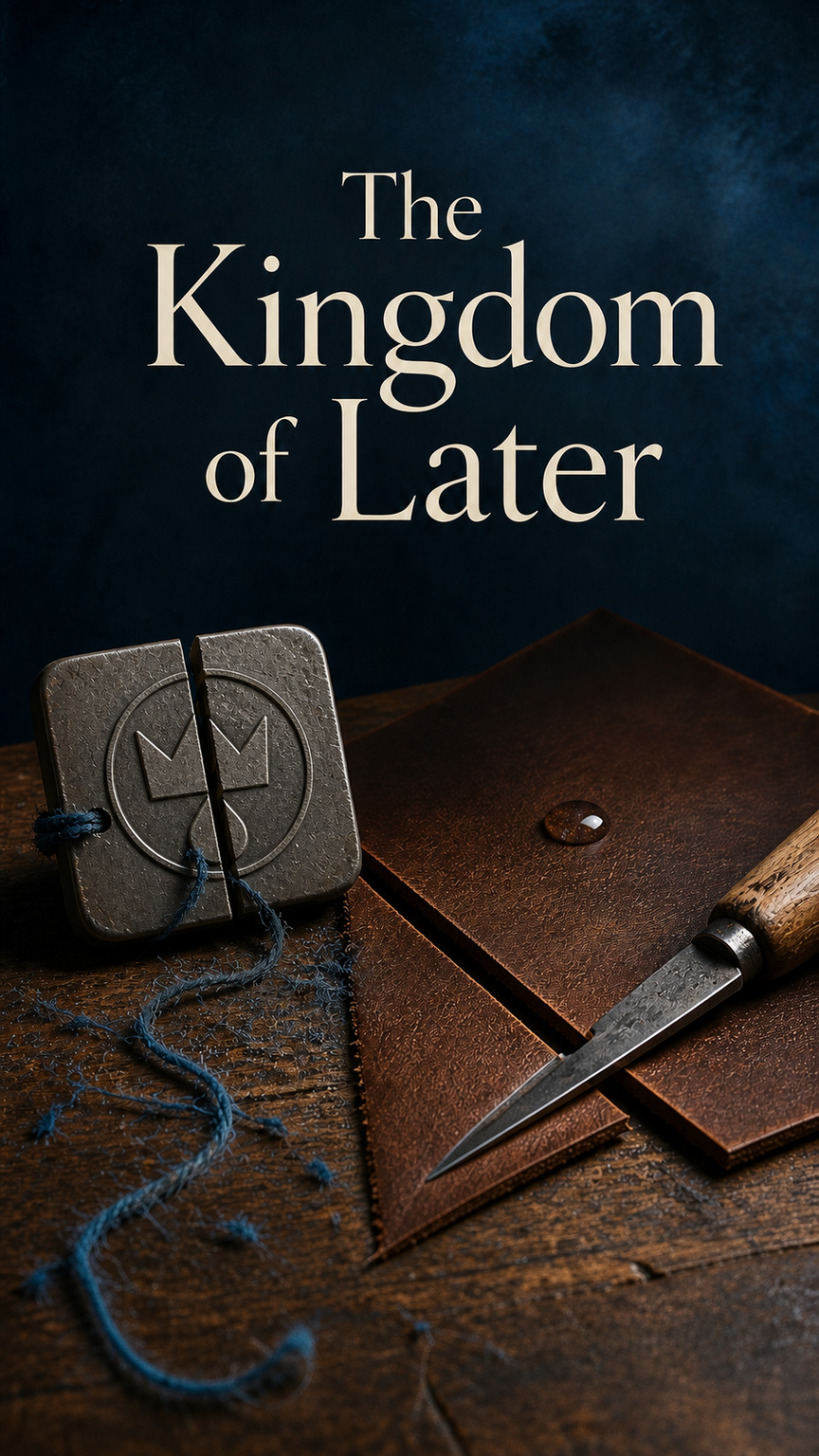
The first drop struck the boot between my hands just as I drew the closing stitch tight.
It left a dark coin on the new brown leather. I stared at it, needle lifted. A second drop hit the cutting bench, close enough to the rolled hide that I felt the splash on my wrist.
Above me, under the rafters, the crown’s roof token chimed for dawn.
The token was a thin square of tin nailed beside the attic ladder. A blue thread ran from its stamped seal, through the keyhole, and out toward whichever royal office had promised to repair my roof. At every dawn bell the date scratched on the tin moved ahead one day. I had watched it do so for three months. Still, habit was quicker than sense.
“They said they would come today,” I told the empty shop.
The blue thread brightened. On the token, today slid neatly into tomorrow.
Water found the edge of my best hide.
I lunged for it. The hide was heavy, half a winter’s money wound around a wooden core, and damp had already curled the outer handspan. I dragged it under the worktable, kicked a basin beneath the leak, then dabbed the boot with my apron. The mark lightened but did not vanish. The pair belonged to a miller with wide feet and exacting heels. The miller was coming at dusk. The payment was meant to buy a week’s rent, lamp oil, and enough onions and oats to keep me from counting crusts.
Someone rapped twice and opened the door before I answered. The rent collector ducked beneath the lintel, shook rain from a dark wool shoulder, and opened the ledger carried against his chest.
“The week’s rent is due at sunset.”
“The roof was due before the last three rents.”
He found my line with one clean finger. “The tenancy ledger and the repair claim are separate processes.”
“The rain has joined them.”
His gaze moved to the basin, the hide beneath the table, and the boot in my hand. He did not smile. Collectors were commoners too; this one had soles worn thin at the outside edge. “I can record interior damage for future assessment. Payment remains due now.”
Due now. Those two words passed through the kingdom’s grace untouched. Kings had never wished their taxes postponed.
I pressed my thumb over the darkened leather. “Come back at sunset.”
“I am required to.”
He shut the ledger and left me with the rain.
The roof clerk kept morning hours beneath the covered market, where the gutters overflowed in silver ropes and half the petitioners held blue-threaded tokens. I wrapped the miller’s boots in oiled cloth, shoved every scrap of leather away from the leak, and carried my token there in my pocket. Its thread paid out through stone and timber without tangling. The fairy’s magic lived in it, everyone said. No scissors had ever proved otherwise. A cut end simply shone from both pieces until morning and the promise remained.
The clerk sat behind a high counter with three calendars and no basin. I laid the wet token before him.
“The slate over my stock is open. I need someone on it now.”
He turned the token with a quill. “Your claim remains eligible.”
“My leather does not.”
“Interior goods are assessed after the exterior remedy is complete. An inspector will attend after the next scheduling dawn.”
The thread looped once around the quill. The clerk’s hand stopped an inch above the calendar, held there as gently and completely as a nail clenched on the wrong side of a sole.
He exhaled through his nose. “As stated. After the next scheduling dawn.”
“Send the inspector now.”
“Immediate dispatch is not available until the future inspection has established emergency eligibility.”
His words grew longer when pressed, each condition sheltering behind the next. I put both hands on the counter. “There is daylight through my roof.”
“Then your evidence should be straightforward to verify.”
Behind me, someone shifted weight with a grunt. The slater had come in out of the rain carrying a trowel and a coil of narrow ladder rope. Lime dust lived in the creases of his coat. One trouser knee was bound with cloth.
The clerk nodded toward him. “You accepted preliminary observation on this claimant’s roof. State the undertaking for the record.”
“From the lane,” the slater said. “My other roof requires me before noon. This knee gives me one climb if the ladder is kind.”
“Your physical limitations can be entered after the observation.”
The slater looked at the rain beyond the awning. “I’ll point out the damage from the lane. Nothing else.”
The clerk wrote it down. Blue light passed from his calendar into the thread at the slater’s wrist.
“If temporary mitigation is appropriate,” the clerk said, “eligibility will be determined following authorization.”
“Don’t add to it.”
“The sequence requires no additional undertaking at this stage.”
The slater tried to lift his trowel. It jerked flat against his thigh, the first useful motion of the promise already held for dawn. He swore once, without ornament. I snatched up my token and led him out before the clerk found another stage.
At my shop, the rain had eased to a fine mist. From the lane we could see where one slate had slipped sideways above the back eave, exposing a black gap no wider than two fingers. Water did not need more. The slater planted his sound leg, leaned back, and squinted.
“I can look from here,” he said. “There. Rotten lath under the left corner. Patch can’t bear on that.”
He raised the trowel to point. It would not rise. The promise held its first useful movement until morning.
“Use your other hand,” I said.
“I undertook the observation, not the trowel. The grace is thorough when it gets the chance.”
A gust came over the chimneys. The loose slate lifted, slapped once, and skated down the roof.
The slater moved before either of us spoke. He caught it against his coat, staggered under the edge, and thrust it into my arms. It was colder than the rain and heavy enough to bruise.
We both looked at his hands.
“You caught it,” I said.
“Didn’t say I would.”
The trowel still hung at his thigh. The slate rested freely in my arms.
I set the slate on my bench. “Put it beside the basin now. If you choose.”
He did. No thread stirred.
I put my hand on the fallen slate and lifted it. Nothing stopped me.
The slater would not climb. His knee was swelling under its binding, and another household had paid him for the one height he could manage. He would not lend me his ladder either; it was his way down. But he measured the gap by eye and told me I needed three sound slates, not one, because the neighboring edges had gone soft. He had two salvaged pieces in his yard and would sell them now. He would stand below my ladder for the price of a heel repair, so long as standing did not grow into a promise of rescue.
The rope-maker in the next row had a short tarred coil already finished. She flexed both hands while I counted coins on her counter. The skin along her thumbs had split and been wrapped in linen.
“I can’t make another length today,” she said. “No hemp left dry, and I can’t close my hands by noon.”
“This coil. Its price now.”
She named it. The coins I set down had been folded in cloth for the rent collector.
“I need one pull from the lane as well,” I said. “When I call down.”
Her hands closed carefully around the money. “One pull now, if now comes before I shut my stall. Not a climb. Not a catch.”
“Agreed.”
I bought the slates with the rest of the rent money and carried everything to the shop. The blue thread from my token followed, bright against the wet gray lane.
In the attic, the leak sounded bigger. Drops struck the basin in quick uneven taps, and a dark tongue spread along the underside of the lath. I laid out what I had: three slates, the tarred rope, a jar of pitch, short nails, my cobbler’s hammer, and leather.
Not scraps. Scraps were too small to run uphill past the gap. The underlay had to reach beneath the sound course and extend below the broken one. I unrolled the hide I had saved that morning. The outer turn was water-marked; the next was flawless, thick enough for boot soles. I measured a rectangle with my hand.
My knife would not descend.
Blue light ran along its back.
“The covered remedy has begun,” said a voice near my ear.
I turned so sharply I struck my shoulder on a rafter.
The fairy stood on the roof token. She was no taller than the length of my awl, a living woman in a rain-dark coat, with four clear wings folded tight to keep them from the rafters. Blue thread passed through loops at her belt and away in every direction. The seal beneath her feet was only tin. She was the one holding my knife.
“Let it go,” I said.
“Do you withdraw the action, the request, or the claim?”
“My roof is open.”
“That is a condition. It is not consent to a withdrawal.”
The knife waited in my fist. Beneath us, another drop struck leather.
“I want to patch it myself.”
“A replacement promise does not release the first one. Your claim includes a guaranteed remedy. Any first action toward that remedy remains postponed while its undertaking is framed for later.”
“Then move the undertaking back to now.”
“The grace does not permit an official to turn promised labor into immediate compulsion.”
“No one is being compelled. No one is here.”
The fairy’s gaze went to the ladder rope and the bought slate. “You are here. The slater is below. The rope-maker has accepted one present act. I will protect each refusal separately.”
She spoke without haste, even while the wet spread over the lath. Promise, protection, withdrawal, consent: each thing had its own edge for her, as clean as pieces cut from a pattern. Mine were all piled together under the word roof.
“Can you make the clerk send someone?”
“No.”
“Can you decide they’ve neglected it?”
“No. The grace preserves the right not to begin work merely because a crown or master has made later impossible. It cannot judge whether delay is being abused.”
“You can see what it’s costing me.”
“Yes.”
I waited for more. She did not decorate the answer.
“If I withdraw the claim?”
“The knife becomes yours to move. The crown’s guarantee ends. No reimbursement for materials, lost stock, labor, or failure. No reinstatement by renaming the same promise.”
The miller’s good leather lay under my hand. The rent collector would return at sunset. I knew how to keep water out of a boot. A roof had different weight, different wind, and a fall beneath it. The sensible choice was to preserve the guarantee.
A drop struck the cut line I had marked.
“I withdraw the roof claim now,” I said.
“Entirely and without a substitute undertaking?”
My mouth had already shaped I will do it. I shut it, swallowed, and looked at the knife. “Entirely.”
The fairy put one hand on the tin seal. The light came out of the blue thread and gathered beneath her palm. All the lengths running through the attic went slack. They were ordinary dyed fiber for one breath; then they faded, leaving lint on the rafter and a pale groove across my wrist.
The knife dropped through the leather.
Its sound was quiet. That hurt worse than the price.
I cut the underlay, warmed the pitch, and worked it into the rough side with a stiff brush. Below, the slater braced my short household ladder at the back eave. It reached the low roof if I stood on the last safe rung and hauled myself over the edge. He tapped that rung with two fingers.
“No higher from the ladder. Your weight goes to the roof before your foot.”
“The rotten lath is left of the gap.”
“Wider than you think. Keep your knee on the sound run.”
The rope-maker came into the lane, coat buttoned over her bandaged hands. “Where’s the pull?”
I tied one end of her rope through the holes I had punched in the leather. The other end went over the roof on a stone wrapped in cloth. She took it loosely.
“Draw it toward the chimney now,” I called. “Stop when the knot reaches the gutter.”
“One pull,” she said.
“One.”
The fairy hovered beside the eave. Blue light touched the rope-maker’s wrists, not binding, only present.
“She may stop before the knot,” the fairy said.
“I heard her,” I said.
The rope-maker pulled. The leather slid up the wet slope. Halfway, the knot caught beneath a tile edge and her wrapped hand opened.
“That’s my pull.”
She let the rope fall and went back to her stall.
I wanted to call after her. Instead I climbed.
Rain began again as I got my chest over the eave. The roof smelled of wet lime and old wood. Slate was not leather. It gave nothing under my palms, then shifted all at once. I kept my right knee where the slater pointed and crawled far enough to free the knot. The gap showed the attic below: basin rim, cutting bench, the pale roll of hide. From up there my livelihood looked small enough to cover with my body.
“Send the underlay beneath the top course,” the slater called.
“I need tension or it will buckle.”
“Not boot tension. Let the slate carry it.”
I fed the pitched leather uphill, using the awl to lift the sound edge. It went crooked. Water ran along the raised side and poured through the gap in a sudden sheet.
Below, the basin clanged over.
I pulled harder. The leather stretched; pitch squeezed from the seam.
“Stop,” the slater said. “You’re thinning the middle.”
“A loose seam drinks water.”
“A roof sheds it. Top over bottom. Ease your pull.”
My fingers had gone slick. I loosened the rope a handspan and the underlay settled. He passed me one slate at a time from the ladder, never taking the last rung. The first covered the lower gap. The second had to tuck beneath the surviving course, but my cut leather bunched under its corner.
A gust lifted the whole patch.
The slate in my left hand skated. I caught its edge against my forearm. Pain burned to my elbow. Below, the slater gripped the ladder and could do nothing else without trusting his bad knee to it.
“What are you doing?” he shouted.
“I’ll reset—”
Blue thread flashed around my hammer hand.
The hammer stopped above the nail.
The fairy hung level with my face, wings thrashing in the wind. She had supplied the grip in that thread; I could feel her living attention holding the first stroke away from tomorrow.
“Withdraw those words,” she said.
Rain ran into my eyes. The loose slate sawed at my sleeve.
“No undertaking. I withdraw it.” My breath came short now, too small for explanations. “Hammer. Mine. Now.”
The thread released.
I struck the nail—not through the slate, which would split, but through the leather tab below it. One hit, then another. My work knew that much: where piercing weakened a surface, where a hidden fastening could take strain. I folded the bunched corner under itself as I would skive a heel seat, thick side downhill, and pinned the fold beneath the slate’s weight. The runoff divided around my wrist and went over the lower edge instead of under it.
“Left side,” the slater called. “Still high.”
I felt under the slate. A nub of old mortar held it up. The awl knocked it free. The slate settled with a flat stone click.
We placed the third piece while the wind worried my coat. The slater’s directions shortened to body and work.
“Knee right.”
I shifted.
“Hand off that edge.”
I moved it before it broke.
“Enough pitch. Nail the tab.”
I did.
When I backed down, my legs shook so badly that I sat on the attic floor. The fairy landed on the rafter. The slater climbed only far enough to put his head through the hatch and inspect the underside.
“Basin upright,” he said.
I righted it. We waited.
Rain drummed over the roof until speech would have been work. A thin stream appeared along the far rafter and dropped into the basin. The patched lath darkened at one nail, then stopped. Beneath it, the cutting bench stayed dry. So did the boots, the remaining hide, and the shelves of finished shoes.
The slater touched his bound knee. “That corner needs proper lath. Not me today.”
“I know.”
“Your heel repair is due now.”
“Leave the boots.”
He did, and limped toward his paid roof.
The fairy lifted from the rafter. Beyond the walls, blue threads shone through the rain, hundreds of them leading toward kitchens, bridges, fields, and chambers I would never see. She chose one and took hold of it. The thread brightened with her departure.
My token remained dull.
By dusk I had dried the miller’s boot, worked color into the water mark, and burnished both toes until the stain hid in the grain. I had no lamp oil for work after dark. A strip of good sole leather was gone from the roll. My rent cloth held three copper bits and nothing else.
The miller arrived while rain still whispered in the gutter. He turned the boots over, pressed each welt with a broad thumb, and pointed to the darker patch.
“Wet?”
“Dry now. Put them on.”
He sat. The right boot went on easily. The left caught at his heel.
“Pull there,” I said, pinching the back seam. “Now stand.”
He stood, stamped once, and walked the length of the shop. Above him, one drop fell into the basin. None touched the leather.
He counted the payment onto my bench. Outside, the sunset bell began, and all across the kingdom tomorrow moved one day farther away.
I pushed the coins toward the rent side of the bench and crouched at the miller’s ankle.
“Again,” I said. “Left foot first.”