The Kingdom Was the Easy Part
After saving the kingdom, a legendary adventuring party retires together to a sprawling old clubhouse—only to discover that staying friends through peace, romance, old grudges, and one increasingly bored dragon may prove harder than any quest they ever survived.
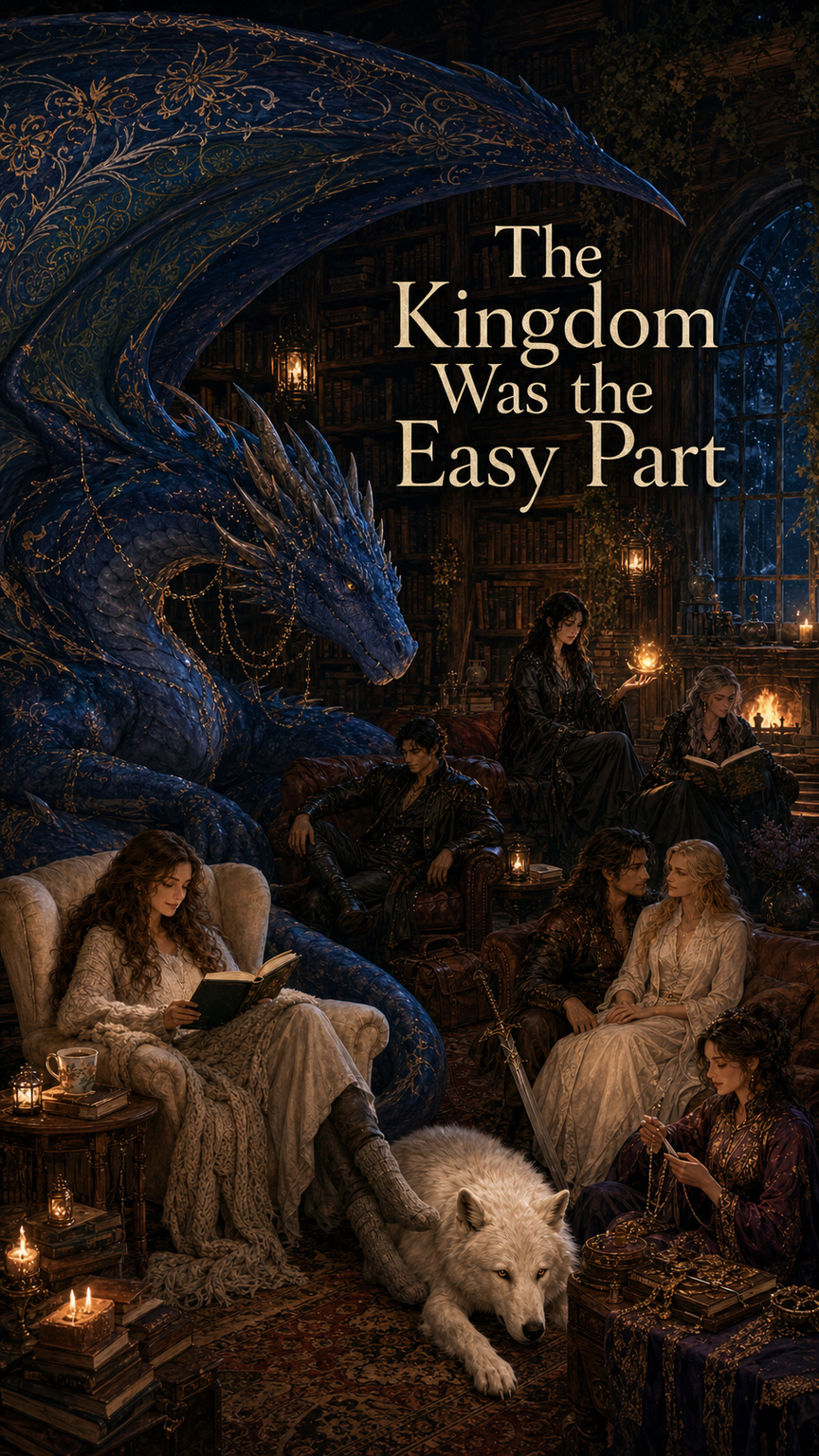
Six weeks after they saved the kingdom, Dabria Finne got everyone into one room. Brum spoiled the effect by carrying Cavren’s road strap through the middle of it.
The large white wolf emerged from beneath Cavren’s chair with the leather loop between his teeth, pleased by the number of people available to admire him. He was no enchanted guardian, despite what visiting ministers liked to believe. He was an ordinary, heavy-pawed wolf with a talent for taking what had just been cleaned. He crossed the red carpet, passed under the arch of Oruvane’s blue neck, and deposited the strap in Oshara’s lap.
“Not ours,” Oshara said. She was reading sideways on a settee with her feet tucked beneath Torvik’s thigh. He had one arm along the cushion behind her and had been attempting, for most of a page, to court her away from the book. She gave him the strap instead. “Make yourself useful.”
Torvik inspected it. “I don’t know what it is.”
“That has never stopped you before.”
Around them, Manydoor Hall’s library rose warm and crowded to its smoke-dark rafters. Books filled three tiers of shelves, climbed the mantel in wavering stacks, and lay open wherever an elbow had recently been. Firelight moved over the ladders and the tall windows, where the night beyond was hard and blue. The three other adults who had retired here after the campaign occupied their accustomed islands: the silver-braided scout reading under Oruvane’s left wing; the former quartermaster stitching a split cushion at the tea table; the hedge-worker coaxing amber lights from her cupped palms into three glass lanterns. Every light lasted only as long as she fed it breath and attention. Brum, having completed his delivery, nosed hopefully among all three.
And Oruvane filled what remained.
He lay comfortably between hearth and astronomy shelves, vast enough that his folded foreleg made a backrest for the scout. Fine gold chains looped from his swept horns to the ridges of his throat. Curling tracery, painted for the victory procession and kept because he liked it, ran across his deep-blue wings in tarnished gold and green. One wing curved behind the readers; his tail circled the chairs and ended beside the wine. In the firelight he looked less like a guest than the room’s oldest, most ornamented piece of furniture, if furniture could watch everyone ignore it.
Dabria stood by the library arch with the evening card still in her hand. Seven adults, one dragon, one wolf. All present. No kingdom had ever required more work for a less impressive victory.
Cavren rose from the chair nearest the hearth. “Brum.”
The wolf looked at him, then at Torvik, who had begun fastening the road strap around his own forehead.
“I believe,” Torvik said, “it denotes rank.”
“It denotes that you need to give it back.”
Torvik did. Cavren took the leather without smiling and returned to the chair, where a shield pack sat open at his boots. A whetstone, a road kettle, and a roll of oiled wool showed beneath its flap before he folded the strap over them.
Dabria crossed to him. “The end has stretched. Give it here.”
“I can mend it.”
“I didn’t say you couldn’t.”
“Good.”
He reached for the awl. Brum leaned his great white shoulder against Cavren’s knee, then slid down until his muzzle rested on the man’s boot. Cavren’s hand left the leather long enough to rub between the wolf’s ears. He had not accepted help from Dabria with a buckle, a shield rim, or an aching arm since the final stair of the black keep. She had decided not to notice that in front of everyone. Her decisions had once been more obedient.
At the settee, Torvik put his mouth near Oshara’s ear. She turned a page without looking at him.
“If you two are going upstairs,” Dabria said, “we haven’t chosen tomorrow’s reading.”
Oshara lowered the book. “We’re not going upstairs.”
“Then choose.”
“I am reading this one. Torvik is failing to.”
“I was waiting for the dangerous parts.”
“There is a tax dispute.”
“There. You see?”
Oshara raised the book again, ending the matter by hiding her face behind it. Torvik caught Dabria’s eye and made a tiny, pleading gesture toward the pages. Dabria ignored him. The evening card promised conversation, shared reading, mending, and games until third bell. She had written the words in different colors so it would not look like a roster.
Oruvane lowered his chin onto one foreclaw. “We could hunt the dumplings.”
The quartermaster bit off a thread. “We ate them.”
“Then the hunt will be difficult.”
No one answered. The scout turned a page. The hedge-worker sent one new light into a lantern and lost another; it guttered above Oruvane’s nose. He blew it gently across the room. Brum bounded after it, struck the quartermaster’s table, and sent three spools rolling under the settee.
For a moment the library came together. Torvik caught one spool between his boots. Oshara rescued the wine. The scout laughed into her book. Cavren seized Brum by the ruff before he reached the lantern stand, while the hedge-worker hurriedly drew her wandering light back into both hands. Oruvane’s eyes brightened.
Dabria restored the table, the lantern, and the wolf. By then the moment had dispersed.
“We need something with rules,” she said.
Oruvane’s lids descended halfway. “Do we?”
“Tomorrow. Second bell. You choose the game.”
“Any game?”
“Within reason.”
“There it is,” he said. “The little fence around every adventure.”
Dabria wrote Oruvane’s recreation on the back of the evening card. When she glanced up, Cavren had closed his pack. Oshara and Torvik were whispering behind the raised book. The scout read, the quartermaster stitched, and the hedge-worker kept her small suns alive. Everyone was still in the room. Oruvane was in the center of them, his painted wing making a blue night over half the library.
Brum left Dabria and went to lie against the dragon’s foreleg.
For the next six days, Oruvane gave them games.
He turned the dining chairs toward the walls and strung retired climbing rope between the pantry and the plates. He hid challenge cards in books no one had opened since the old king’s grandfather learned to lie. He moved the handbell to the highest gallery, tied spoons to half the door latches, and declared the sugar jar a besieged fortress. The hedge-worker supplied sparks for one treasure map and singed its north edge; the quartermaster sewed colored markers while complaining that none of the quests respected fabric; the scout found Oruvane’s hiding places too quickly and began pretending not to.
Some of it was fun. Torvik cheated with such confidence that Oshara joined the opposing side solely to catch him. Brum dragged an entire rope course into the library and bound Cavren’s ankles together. Even Cavren laughed, once, before looking annoyed at having done it. On the fifth night, though, Oshara had a headache and Torvik refused a map Oruvane had spent all afternoon painting. He went upstairs with her. Oruvane hung the map anyway.
Dabria wrote clearer rules. She posted starting times. When a chair cracked under Oruvane’s tail, she added limits on moving furniture. The games became smoother and shorter. At second bell people appeared in the library and asked what he had prepared. At third bell they disappeared down corridors that admitted his narrow head and foreclaws but stopped him at the shoulders. Oshara and Torvik closed their door. Cavren took maps to the smaller stove in the east room. The three old campaign hands returned to their separate work. Oruvane remained among the books, surrounded by abandoned clues.
On the seventh night, Dabria woke to cold air moving through her bedchamber and found that her door was gone.
So were its hinges.
The hall had become indecently audible. Water ticked into a basin two floors below. Someone poked a fire. Torvik said, “I have trousers,” and Oshara replied with a word she had once reserved for a necromancer.
There were thirteen empty frames between Dabria’s room and the library.
Light poured through the library arch. Inside, the missing doors stood upright in a crooked maze around Oruvane. Green, blue, oak, and iron panels leaned against benches and retired spear shafts. Shields hung from their knobs. A hooked pole lay beside coils of rope leading back through the empty frames; he had drawn each freed door toward the library inch by inch. Challenge cards promised treasure, peril, and one “truth too terrible for polite architecture.”
The rest of the household was already containing the damage. The scout braced a ladder while pushing a drift of books out of danger with one boot. The quartermaster crawled along the outside of the maze collecting hinge pins in her apron. At the arch, the hedge-worker breathed fresh lights into being one by one and sent them where people called; each floated only while her fingers remained spread. None of the three offered an interpretation. They had survived six years of Dabria’s interpretations and knew when to protect the shelves instead.
Brum plunged between two doors and vanished.
“Put them back,” Dabria said.
Oruvane raised his head above the maze. A gold chain slipped down his throat with a soft bright sound. “Welcome to the Labyrinth of Lingering Fellowship.”
Oshara arrived in a robe over her nightclothes, with Torvik one-booted behind her. Cavren came last. He saw the gap where Brum had disappeared and stopped.
The wolf backed into view, tugging Cavren’s packed traveling chest by its handle.
“Brum,” Cavren said.
Brum pulled harder. The chest slid out from behind the blue drawing-room door, bumped over a carpet ridge, and sprang open. Winter cloak. Wrapped rations. Whetstone. Road kettle. The shield straps from the library evening lay neatly coiled on top.
Torvik glanced at Cavren, then at Dabria. Whatever joke had offered itself, he let it die.
“East side is clear to the outer corridor,” the scout called. “If you want privacy for the murder, use that.”
“No murder near the books,” said the quartermaster from beneath a door.
Dabria climbed onto a bench. The lovers’ oak door, marked by a pale scratch near the latch, blocked the west aisle. Cavren’s stood across the hearth beside his chest. Beyond the inner turns, the iron-banded gate to the roof court made a final wall.
Dabria was still furious when the route began arranging itself in her head.
“Oshara, Torvik, take the west route. Cavren, come with me. We clear the small panels and make a path to the roof gate.”
“No,” Cavren said.
Not loud. Not negotiable.
Oruvane’s tail slid between the doors and pulled one brace sideways. Benches groaned; the west route folded shut.
“The labyrinth rejects stale tactics,” he said.
“The labyrinth took the privy door,” Oshara said. “Its judgment is compromised.”
For several minutes they accomplished nothing. Torvik climbed a pantry door and knocked down a copper warming pan. Dabria found a gap and lost it when Oruvane shifted his elbow. The hedge-worker’s lights bobbed over the maze in answer to three contradictory requests. Brum crossed wherever he pleased, moving from Cavren to Oruvane to the scout as though the household had no walls at all.
At last Oshara gripped the bottom of the scratched oak door. “Dabria. Lift.”
Together they tilted it free. It was heavier than it looked, and the narrow passage forced them sideways, Oshara walking backward while Dabria steered from the latch.
“Left,” Dabria said. “No, your left. On three.”
Oshara lowered her end to the carpet.
“What?”
“You pinned the first evening card to this door.”
“It was nearest the library.”
“It was ours.”
Behind them, Torvik announced that the warming pan had always been that shape. Oshara did not turn.
“You moved the card,” Dabria said. “I thought it had fallen.”
“We moved it twice.”
“You could have said something.”
“I did. You were explaining the colors.”
Dabria tightened both hands around the latch. “The card brought everyone down.”
“Our door did that. You kept putting things on it. You kept opening it.”
“I knock.”
“While you open.”
The distinction had seemed small in the campaign. A closed door had meant someone might be bleeding or burning evidence behind it. Dabria had learned to cross thresholds quickly and apologize when everyone was alive.
Oshara wiped hair from her mouth with an angry wrist. “Sometimes Torvik and I are busy with each other. Sometimes I am reading and he is making up songs about the plumbing. I want one room where you don’t come in because you’ve lost a whetstone.”
“That happened once.”
“Twice,” Torvik said from beyond the door. “The second time it was my whetstone.”
Oshara shut her eyes.
“Sorry,” he said. “I thought accuracy might help.”
It did not. Dabria could feel her own reply assembling: the door unlatched, the danger over, the whetstone needed. All the reasonable parts of it.
“Where do you want this?” she asked.
Oshara looked at her across the width of the door. “Out of our way. Slowly. There’s a nail by your knee.”
They carried it to the arch. Dabria set it where the quartermaster directed and did not hang the next light from its knob.
When she returned, Cavren had freed his own door. His left forearm shook under the weight. He shifted his grip before Dabria could mention it.
“Where are you going?” she asked.
He looked toward the open chest. “East road. Escort work until the first snow.”
“When?”
“Eight days.”
“You were going to leave a note?”
“I was going to tell you.”
“When?”
“Not while you had a card in your hand.”
A brace cracked near the hearth. The green pantry door lurched. Torvik slipped beneath it; Cavren dropped his end, caught Torvik by the belt, and threw him clear before the panel struck the carpet. The maze answered with a shivering clap of wood.
“North brace,” Dabria said. “Cavren, take the weight.”
He remained crouched beside Torvik. “No.”
“It’s slipping.”
“I heard you.”
“This is not the time.”
Cavren stood. His shaking hand closed and opened. “It never is. You promised relief on the final stair.”
No one asked which stair.
“The lower breach opened,” Dabria said. “I had to send Oshara and Torvik.”
“I know.”
“Then you know there was no one else.”
“I know that too.” His voice had shortened until each word seemed put down separately. “You promised. You couldn’t come. Both happened. You only tell the part that makes you right.”
Dabria had defended that choice to generals, ministers, singers, and herself. Cavren had held the stair. The kingdom had lived. In the songs, this was proof of her judgment.
“You held,” she said.
Cavren’s mouth tightened. She had reached the wrong thing again.
She saw him after dawn, sitting against the stair wall with his split shield across his knees. She had come with healers, a prince, and half the victorious court. She had asked whether the shield would survive the procession.
“I should have come back alone,” she said.
“You didn’t.”
“No.”
“Then stop there.”
All her reasons crowded behind her teeth. She swallowed until her jaw hurt.
“All right,” she said.
Cavren did not soften. His chest remained open. His east road remained eight days away. But when the brace slipped again, he chose where to put his shoulder, and Dabria took the other side without directing him.
Beyond the last turn of the maze, Oruvane had laid the roof gate flat. Travel bags hung beneath his wings: canvas pouches, two small casks, a rolled blanket, and the brass pan he used to warm sand for his joints. No saddle. No battle harness. Nothing that offered a rider any place upon him.
Predawn silvered the open court beyond.
Oshara saw the bags first. “You’re leaving too.”
“I am embarking upon a voyage of private magnificence,” Oruvane said.
“Where?” Torvik asked.
“Away.”
“Poor roads. Worse inns.”
Usually Oruvane met Torvik’s foolishness with something larger. This time he worried a groove in the flagstone with one claw.
Dabria looked back through the tilted doors. Four human thresholds stood around the one room Oruvane could inhabit easily. Each evening they passed through openings too small for him and called their disappearance privacy.
“Was this meant to stop us leaving?” she asked.
“It was meant to be a quest.”
Brum walked to him and sat on one blue foot.
“You took my chest,” Cavren said.
“It was packed. Suspiciously.”
“You searched my room.”
Oruvane’s gaze moved to Oshara’s door at the arch, then away. “The quest was poorly designed.”
“Yes,” Oshara said.
Smoke leaked between his teeth. “I wanted to know whether you’d notice one of us gone.” His gaze found Dabria. “Without a card.”
The question had needed thirteen stolen doors and Cavren’s chest before Dabria heard it. She started to ask why Oruvane had not simply told her. Then she remembered dumplings.
“Do you want company?” she asked.
Oruvane considered. “No.”
Torvik’s expression pinched before he covered it. “Do you want an insulting wave? I have several.”
“One. From a distance.”
Oshara pointed at the doors. “You are still putting ours back.”
“When I return.”
“Before you go.”
Oruvane sighed smoke over her hair, but bent his neck to the work. The quartermaster brought hinge pins. The hedge-worker held three trembling lights above the frame. Cavren took one edge of the gate; Dabria reached for the other, then stopped.
“Do you want me here?” she asked him.
He adjusted his grip. “Upper pin.”
Dabria took the upper pin. Together they hung the gate crooked, and it opened.
They went with Oruvane as far as the roof court. The wind lifted the gold chains at his throat as he stepped to the parapet.
“I may be gone three days,” he said. “Or not.”
“If it’s more than eight, I’ll be gone,” Cavren said. “East road.”
Oruvane turned sharply. “Then I may find you.”
“You may.”
Dabria could have asked for routes, dates, signals. She could have made departure safe enough to feel like permission. Instead she put both hands in her empty pockets.
“I’ll miss you,” she said. “Even if the roof leaks. That isn’t—” She stopped. “I’ll miss you.”
Oruvane watched her long enough that she nearly explained. Then his wings opened, painted blue and gold against the whitening sky, and he left without an order to return.
It took two days to put the hall’s doors back. Dabria knocked on Oshara and Torvik’s even while carrying the missing hinge, and waited until Torvik opened it a hand’s width. Cavren repacked the chest Oruvane had disturbed. When Dabria offered to help, he said no. When she asked whether he wanted company on the east road, he said he had not decided. The final stair stayed between them, neither buried nor crossed.
On the third evening, the library filled without a card.
Not completely and not all at once. The scout came first with her book. The quartermaster brought the cushion she was still mending. The hedge-worker lit only two lanterns and let the fire provide the rest. Oshara and Torvik arrived together, took separate chairs, and gradually failed to remain separate. Cavren sat on his packed chest with Brum at his knee. Dabria read three pages of a history and understood none of them.
The room held clusters, not a formation. People left for wine and returned. The quartermaster went to bed. No one accounted for her.
A shadow crossed the high windows. The roof gate struck stone once, and Oruvane shouldered into the library smelling of rain and some sharp mountain herb crushed beneath his claws. Conversation snagged. Brum rose so quickly that Cavren’s book fell from his lap, bounded across the carpet, and pressed his whole white body into the hollow behind Oruvane’s foreleg.
No one had posted a watch. No one had prepared a welcome.
“You began without me,” Oruvane said.
“Twice,” Torvik told him. “It was peaceful. We hated it.”
Oruvane lowered himself among the chairs. The scout shifted closer to his wing without losing her page. Oshara moved the wine. Cavren picked up his book, but his packed chest stayed beside him.
Dabria did not ask where Oruvane had gone or whether he would leave again. She lasted almost half a minute.
“Did you find a quest?” she asked.
“No.” He settled his chin onto one foreclaw. “I found weather. Tomorrow I may tell you about it.”
“Tomorrow?” The old instinct reached for a time.
Oruvane’s eye opened.
Dabria stopped. “If you want.”
“Perhaps after the dumplings.”
There were none. Torvik proposed hunting them anyway. Oshara told him to hunt quietly. Brum rolled onto his side against Oruvane’s scales, Cavren’s boot resting in his fur. Torvik’s proposed dumpling trail crossed the scout’s complaint about his shuffling; Oshara asked the hedge-worker about a lamp and answered Cavren by mistake. One conversation broke apart. Another started before it had finished. Dabria let her unread history close in her lap.
Across the fire, Cavren met her eyes. He was still leaving. He was still there.
This time she did not count either fact away.