The Last Bus to Briar Hill
A fairytale about going on an adventure but set in modern day.
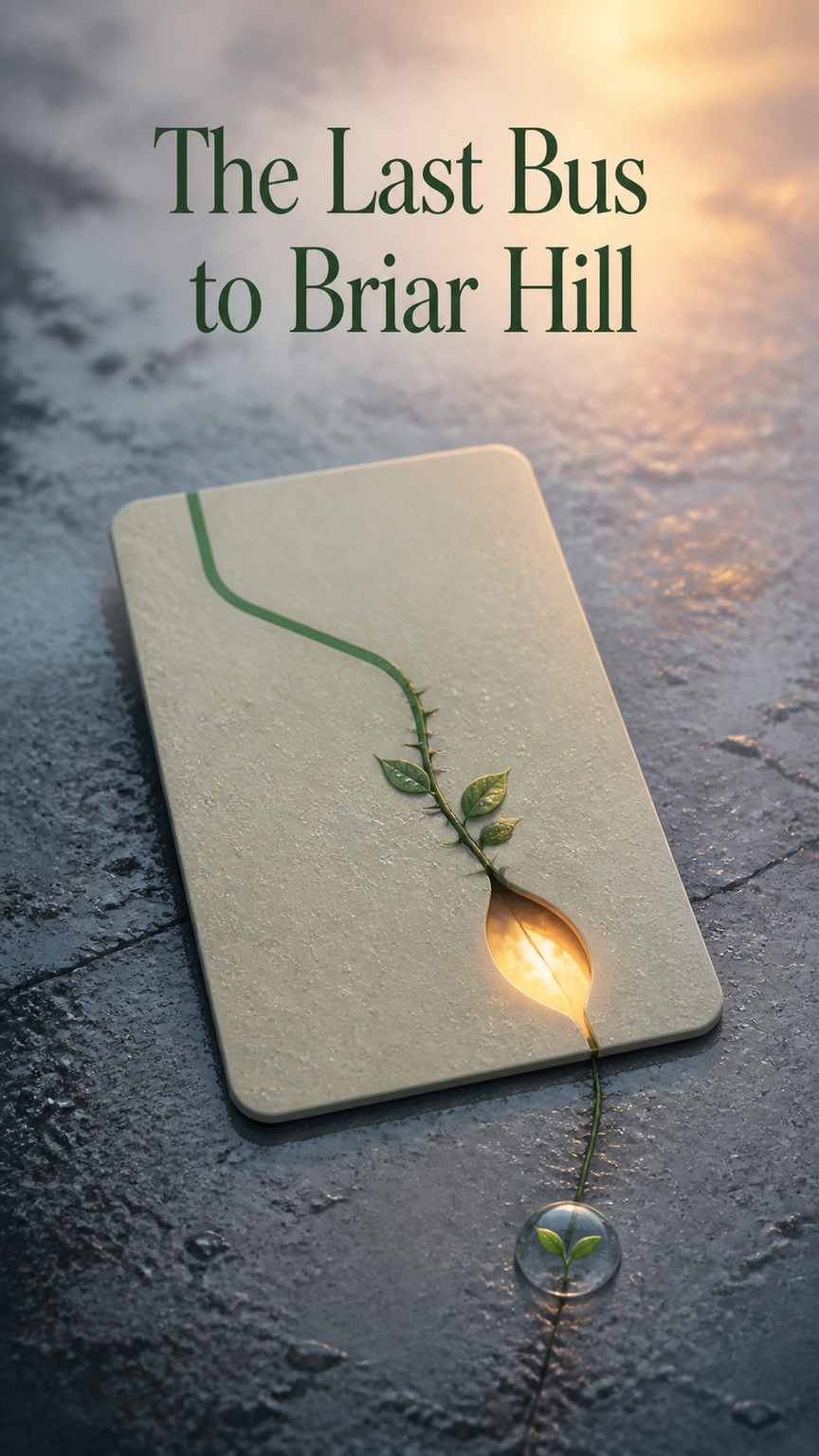
At 12:47 a.m., with rain ticking against her helmet and somebody’s noodles cooling in the insulated box on her back, Miriam Velez promised her brother an adventure for the thirty-second time.
“After this month,” she said into her headset, braking at a red light. “Rent first. Briar Hill when things settle down.”
Mateo was quiet long enough for the courier app to offer her a surge block: three deliveries, guaranteed bonus, accept within twenty seconds.
“Things don’t settle down,” he said.
“They do if people stop adding emergencies.”
She regretted it before the words had finished leaving her mouth. Fifteen was old enough to hear the accusation inside a joke. Miriam watched rain polish the empty intersection. Her battery showed thirty-one percent; the offer counted down from twelve.
“I didn’t mean you,” she said.
“You never do.”
The call ended. Miriam accepted the block.
She delivered the noodles to a lobby bright as an aquarium, photographed the paper bag beneath the apartment number, and turned her bicycle toward the next pickup. The bonus would cover the short edge of rent. That was not imaginary. Neither were the electric bill, Mateo’s growing feet, or the fact that two years ago their mother had died on a dry road in ordinary traffic while going somewhere she had gone a hundred times before.
Briar Hill had been their mother’s idea. The old voicemail was still saved offline on Miriam’s phone: traffic hissing behind her voice, a bus number remembered wrong, then laughter interrupting the promise that they would all go up to the hill together—
Miriam never played the final second. There was no final second, only breath and laughter cut off by the recording limit.
Her phone chimed.
The message had been scheduled rather than sent live. Mateo had used the safety check-in settings Miriam had taught him.
I found our adventure. I researched the route. Location is on. If I’m not back by sunrise, follow it. I’m sorry.
Below the message, his live-location pin moved along the last ordinary bus line toward their apartment.
Miriam called. No answer. She called again while riding hard enough that rain
needled through her gloves. The pin crossed the municipal bus terminal, paused
at its western shelter, then acquired a transit label she had never seen:
Route 0.
She opened the city app one-handed at the next light. There was no Route 0. Mateo’s pin moved north along two streets that ran parallel, crossed a canal without using either bridge, and vanished into a gray patch where the map stored no road at all.
Miriam pulled over beneath a leaking awning and inspected everything the fear in her wanted to skip. Mateo had packed his transit card and rain shell. His location sharing had been switched from one hour to indefinite. The safety message had been written that afternoon and scheduled for the last ordinary service of the night. He had not stumbled onto the route or been snatched from his bed. He had planned an adventure using every emergency precaution she had taught him, except the one where he asked permission.
The courier app vibrated: Proceed to pickup. Late arrival may affect your standing.
Miriam swung west.
The terminal shelter was empty when she arrived. The last scheduled bus had gone. Sodium lamps burned through the downpour, making every drop look briefly solid. She locked her bicycle to a rack and discovered Mateo’s green charging cord was missing from the side pocket of her delivery box. He had taken that too. Planning, not panic.
A pair of headlights appeared where the terminal lane ended at a concrete wall.
An unmarked white bus rolled out of the rain. It was old enough to have square
windows and new enough to carry a contactless fare reader. Its front display
held a plain service label: Route 0.
The doors folded open under the driver’s hand.
The woman behind the wheel wore a charcoal coat over an ordinary transit uniform. Silver hair brushed her jaw. A brass name badge read Maude Dallow.
“You are late,” she said.
“Where is Mateo Velez?”
“Ahead of you.”
Miriam put one wet shoe on the step.
Maude raised two fingers. The fare reader remained dark. “Not yet. You should understand what you’re choosing.”
“I’m choosing my brother.”
“You are trying to choose two destinations.” Maude glanced at the courier countdown glowing on Miriam’s phone. “This crossing opens for a person willing to leave the destination the city already expects. Cancel it. Name whom you seek. Pay the usual fare. There are three request stops before Briar Hill and one return at sunrise. Miss that return, and I promise nothing.”
“This is a bus.”
“Yes. Metal, glass, wiring. None of it is alive, and none of it makes bargains.” Maude laid her palm against the fare reader. Fine green light traveled from the creases of her hand into its black screen. “I tend this end of the crossing. The Briar Host tends the Hill. The bus carries what I give it. It decides nothing.”
The courier timer showed forty-three seconds. Miriam could board, find Mateo, and preserve the block if she hurried. The thought lasted until Maude looked at her.
“Unchosen destinations do not count as abandoned,” Maude said.
Miriam opened the courier app. Canceling after acceptance forfeits the guarantee and may reduce future offers. Her thumb hovered. Rent first, she had said, as though fear had never hidden behind arithmetic.
She canceled the block.
“Mateo Velez,” she said, and tapped her ordinary fare card.
The reader chimed because Maude’s green light had awakened it. The doors closed at her touch. Maude drove into the terminal wall.
For one instant the windshield held only wet concrete. Then Maude pressed her hand to the wheel, green light ran beneath its vinyl, and the bus passed into a street Miriam had never seen.
Thorn hedges crowded the sidewalks. Rain shone on them like strings of beads. Behind the glass, the city still appeared in fragments—laundromat, tower block, all-night pharmacy—but never in an order any map would accept.
At the first request stop, an exhausted woman in scrubs stood beneath a broken shelter with a dead phone in both hands. Maude braked and opened the doors.
“Finally,” the woman said, climbing aboard. “I need to call my client again. The first call dropped. Then the regular service disappeared from the board, so I have to tell her what changed.”
She was real: rain-reddened eyes, plastic grocery bag, an identity card turned backward on its clip. No crown beneath her hood, no bird feet, nothing from a storybook. Just someone stranded between night shifts.
“We continue when she has made her call,” Maude said.
Miriam’s phone showed Mateo’s location frozen somewhere ahead. Twenty-four percent remained in the power bank clipped inside her delivery box. Enough to keep tracking him—or enough to lend.
“How long does that call have to be?” Miriam asked.
“Long enough for someone waiting to know she has not been forgotten.”
Miriam almost laughed. Instead she pulled out the power bank.
The woman’s phone drank charge slowly. One percent, then two. Miriam watched Mateo’s pin fail to refresh and imagined sunrise bleaching an empty hill.
At three percent, the woman made the call. “I’m safe,” she said, hunching over the borrowed power. “We got cut off. The service changed. I’m still coming. Lock the door until I buzz.”
She stayed connected until the person at the other end understood the new arrival time. By then, the power bank had fallen to nine percent.
When she finished, she unwound a green cord from her phone and held it out.
“A boy lent me this at the last bus,” she said. “He said his sister would be angry if he gave away the power bank too.”
Miriam took Mateo’s cord. Warmth from the woman’s phone still clung to the connector.
“Which way did he go?”
“Up the steps beside the stop. He waited until my first call connected.” The woman looked from Miriam to Maude. “Said he was going to finish something.”
Maude drove on after the woman transferred at an ordinary lit corner. Within a block, rain erased the corner from view.
Miriam connected her own phone to the power bank. Its remaining charge kept Mateo’s location trace and the municipal text service running until the thorn ring road came into view. Then the bank’s indicator lights went dark.
“The Briar Host makes copies,” Maude said. “Stored maps. Old signs. Anything a screen or a memory has already shown within its hedge.”
“Why are you telling me?”
“Because a test with no rule is only cruelty.” Maude watched the road. “The Briar Host can repeat what it has received. It cannot forge a new reply freely made outside the crossing after you entered.”
The thorn hedges opened onto a ring road divided into three identical exits. Each sign said BRIAR HILL. Each navigation preview on Miriam’s phone showed the same blue line. Rain struck all three roads at the same angle, and beneath each sign stood a municipal stop placard.
The numbers differed.
Miriam enlarged the map, but the roads crawled and exchanged places under her fingertip. She held to Maude’s rule: the Briar Host could repeat stored images, and some such copy was reaching the screens and signs. The phone itself was only displaying what reached it.
“You have six minutes,” Maude said.
“Until what?”
“Until this stop becomes your destination.”
Miriam knew the municipal text service because couriers used it when the app’s arrival times lied. She sent the three stop codes in one message. Two automated replies returned at once, both naming ordinary neighborhoods miles apart. The third request passed to a late-night responder.
The battery fell to eleven percent.
Stop 4312: Briar Hill park entrance. Temporary service access only. No scheduled pickup at this hour.
A current reply, written beyond the hedge. By Maude’s rule, the Briar Host could not have stored it before she asked.
“Middle exit,” Miriam said.
Maude turned the wheel. The other two roads folded behind curtains of thorn, as though the Briar Host had drawn its hedge closed behind them. The bus continued along the only strip of wet municipal asphalt underneath.
The third request stop was a closed shopping concourse. Steel grilles covered the storefronts. A children’s ride sat unplugged beside a vending machine. Maude opened the doors.
“I don’t see anyone,” Miriam said.
“Truth is waiting,” Maude replied. “It usually does. The Briar Host will shape what reaches your eyes and ears from material already stored here. An offer is not a person. An imitation is not an answer from the dead.”
As Miriam stepped down, her phone screen filled with notifications.
Bonus reinstated. Return to pickup.
Then a message marked as Mateo’s: All clear. Went home. Don’t follow.
Then an incoming voicemail bearing their mother’s old number.
Miriam stopped under the dead strip lights.
She knew. Knowing did not stop her hand from shaking.
She pressed play.
Her mother’s voice came smooth and near, without traffic or breath. “Miriam, sweetheart, you were right. Loving someone means keeping them away from danger. Go home. Mateo is safe if you stop.”
Warm kitchen light spilled from a storefront. Beyond the grille stood the old table, the chipped yellow bowl, their mother in the raincoat from her last photograph. The glamour smiled with her mouth.
Miriam held to Maude’s warning. It was not a ghost. It was not their mother restored, nor a living copy of her. What confronted her was a sensory lure assembled from cached photographs, recordings, and whatever grief supplied when a shape was almost right.
Almost was terrible.
Miriam opened the authentic voicemail saved on her phone. Four percent.
Traffic hissed. Their mother said the wrong bus number, corrected herself, laughed, and began, “We’ll take sandwiches up to Briar Hill when—”
The recording ended inside the laugh.
The kitchen imitation had no room for error. It offered certainty in her mother’s voice because certainty was what Miriam had wanted from the dead.
“Money matters,” Miriam said into the empty concourse. “Rent matters. But it isn’t why I keep saying later.”
The false kitchen waited.
“She died going somewhere ordinary. I thought if I chose anything unnecessary, anything happy, it would be like asking the road to take somebody else.”
The confession did not make the fear foolish. It made the fear hers. Mateo had been paying for it without ever agreeing to the debt.
Her phone went black.
For one breath Miriam stood without maps, messages, work, or the saved voice. Then the kitchen light vanished. Steel grilles became steel grilles again, and the mother-shaped lure broke into reflections on wet tile. Miriam could only take the timing as the Briar Host’s reply.
Maude opened the bus doors. “Now you know what you came to finish.”
At Maude’s last green-lit turn, she said, “The Briar Host is opening the Hill.” A hedge drew aside. Briar Hill rose behind the last row of apartment towers, though Miriam had never seen a hill there before. The rain thinned near its crown. Roots surfaced through the pavement and braided themselves into steps, lifting one after another as though something beneath the soil flexed.
Mateo stood at the top with his hood down and wet curls plastered to his forehead.
Miriam ran. She stopped one arm’s length from him, because the urge to seize him was so strong it felt like falling.
“You came,” he said.
“You left.”
“I sent the safety message. I shared my location.”
“You took an impossible bus after midnight.”
“Because if I asked, you would have said after this month.”
Both facts struck cleanly. Neither canceled the other.
Behind Mateo, a trunk wider than the bus shelter divided into the suggestion of shoulders. Thousands of thorn twigs lifted and settled with a sound like quiet applause. Two green hollows opened in the bark.
The Briar Host was alive. Miriam felt its attention move through root and leaf, patient and immense.
“I didn’t get an exception,” Mateo said. “I was on the last ordinary bus home. At the terminal, I canceled the saved trip in the city app even though I’d promised to be home when your block ended. I named Miriam Velez. I tapped my transit card and paid the normal fare.”
His eyes dropped. “I got the aide’s first call connected. At the false exits, I requested the stop codes after we crossed the terminal wall. The fresh reply came from outside, the way Maude said it had to. And I said no when it showed me our mother.”
Pride arrived tangled with anger. Miriam let both remain.
“You still scared me.”
“You scare me too,” he said. “Every time you act like keeping me alive is the same as us having a life.”
He rubbed rain from his eyes. “The posts about Briar Hill said it finished promises. I thought maybe it could finish her voicemail. Not bring her back. I knew that wasn’t—” His voice caught. “I thought there might be one real thing she meant to say.”
The Briar Host bent its living branches low. “I know only what was brought within my hedge. I can arrange stored sound. I cannot make your mother choose new words, and I cannot turn an arrangement into her.”
Mateo nodded. Grief moved over his face without taking his decision away. “So I said no to the thing it made.”
Miriam looked at the brightening edge of the sky. “I am taking him home.”
The Briar Host’s branches leaned toward her.
“That is not yours to complete,” it said. Its voice came from living wood, not from the bus, the dead phone, or the wind. “This road grows toward promises left unfinished at my Hill. I can complete a beginning. I cannot restore your dead, and I cannot choose a living rider’s return.”
Mateo folded his arms.
“I’m sorry,” Miriam said.
He looked startled.
“I’m sorry I made later do the work of no. I’m sorry I made you test whether I’d follow. And I’m angry that you made me.”
“I’m sorry for that part,” Mateo said. “Not for coming.”
“I know.”
“If I come home, you don’t get to call tonight proof I can never choose anything.”
“And you don’t get to call precautions permission.”
“Okay.”
It was not forgiveness tied in a ribbon. It was a boundary they could carry in both directions.
The Briar Host opened the hedge. A bridge of slick roots crossed a dark cut in the hillside to the road where Maude had parked the bus. The sky above the apartments had gone from black to iron gray.
“Will you finish the last path with me?” Miriam asked. “Then will you come home?”
Mateo studied her face, giving the question the time a real choice required. “Yes. If we schedule the next adventure before you accept another block.”
“Yes.”
They stepped onto the bridge.
Mateo led. His research had taught him that the roots with pale undersides were new growth and would bend; he tested the dark, rain-hardened ones before shifting his weight. Halfway across, a broken span opened above the cut.
“I crossed it when there were more roots,” he said.
The Briar Host drew those roots deeper into the hill. It would supply the test, not the answer.
Miriam opened her delivery box. The power bank was empty, the food compartment smelled of rain, and a length of repair cord remained beneath her tools. She looped it around a stone post on their side, pulled twice, and tied the other end around her waist.
“You know the anchors,” Mateo said.
“You know the path. Tell me where to put my feet.”
He pointed to a black root below the lip. Miriam lowered herself onto it, crossed the gap, and braced the cord around the far trunk. Mateo followed. When his wet shoe slipped, he caught the line; when the anchor shifted, Miriam leaned back with all her weight. Neither hauled the other across. Each made the other’s next choice possible.
At the far end, the Briar Host cast one last glamour across the road.
The warm kitchen appeared with two empty chairs drawn out. Their mother stood between them, whole and dry, holding the yellow bowl. No demand this time. Only the invitation to stop before leaving.
Mateo’s hand found Miriam’s.
“It showed me this before,” he whispered.
“I know what it is.”
“Me too.”
They walked through. The false kitchen scattered into rain, its borrowed light withdrawing into the Briar Host’s hedge.
Maude opened the bus doors. Mateo boarded first by his own choice. Miriam followed by hers.
Sunrise touched the thorns.
The Briar Host closed the Hill end of the crossing, and Maude drove the bus through the narrowing gap. Her green light moved from her hands through the wheel and along the window frames. Outside, impossible streets aligned one by one with ordinary city blocks.
At 6:08 a.m., Maude stopped at the western terminal shelter. Rainwater lay in the gutters. Commuters had not yet arrived.
Miriam’s fare card showed one ordinary charge. Mateo’s location history ended at the terminal, resumed briefly beside an unlisted park access, and stopped when his battery had died. The evidence looked like bad service and bad judgment because most of it was.
Before they stepped down, Maude held out a flat brown token punched in the shape of a leaf.
“The Briar Host grew it after you chose the return,” she said. “It completes beginnings, not wishes. Plant it if you like.”
Miriam put it in Mateo’s palm.
“Ms. Dallow,” he said, “will Route 0 come again?”
“I promised one return,” Maude said. “Do not embroider that into two.”
They got off. Maude closed the doors and drove the bus into the thinning rain, her hands steady on the wheel.
At home, charging cables revived their phones but repaired nothing else. Miriam’s app recorded an abandoned block, removed the guaranteed bonus, and warned that fewer offers might follow. The rent remained short. Her jacket dripped onto the floor, her bicycle needed a new brake pad, and their mother remained dead.
Miriam and Mateo sat at the kitchen table until the windows paled. They agreed that safety messages were not permission to vanish. They agreed that fear was not permission to make every decision alone. Mateo accepted a week without unsupervised night trips. Miriam opened their shared calendar.
Together, they chose a Saturday morning two weeks away: municipal bus, free greenhouse, packed lunch, home before dark. The leaf-punched token lay in a flowerpot beside the window. It did nothing.
Two weeks later, the lost bonus still mattered. Miriam had taken extra midday deliveries, and the numbers in her banking app remained unfriendly. Rain threatened again. Every practiced part of her wanted to say they should wait.
Instead she zipped sandwiches into her cleaned delivery bag.
Mateo checked the ordinary bus time. Miriam locked the apartment. They left together.
When they returned that afternoon with damp sleeves and an empty sandwich bag, Miriam found the token split open in the flowerpot. A green shoot, small enough to shelter beneath one raindrop, had pushed into the light.