The Last Flames
Dragons come to the frozen temple only when they are ready to die, and Alexstrasza is its immortal keeper—the one who receives their final flames and carries their memories. But this winter, young dragons are arriving in droves, all fleeing something they refuse to name.
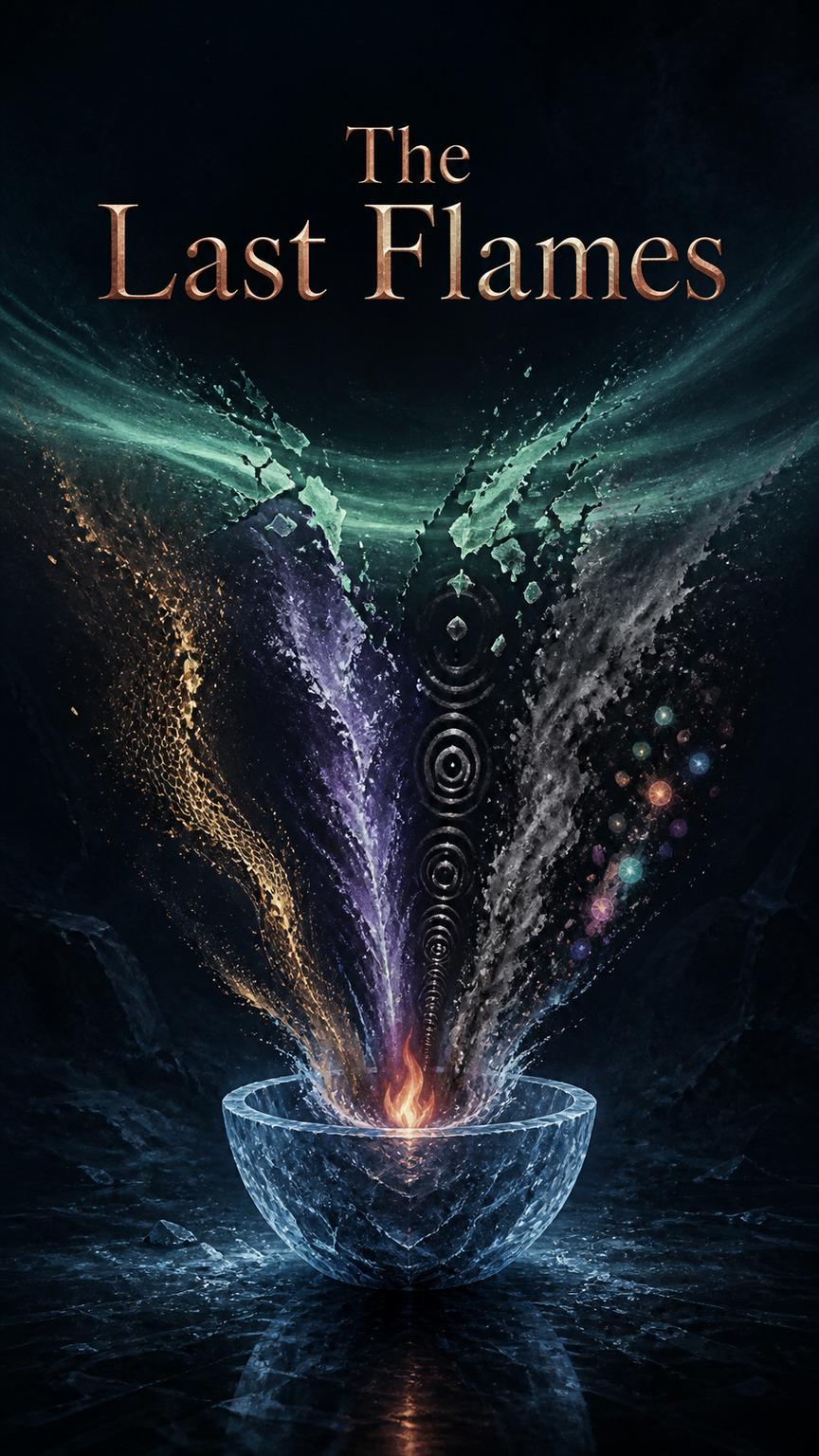
Alexstrasza had one foreleg braced inside the eastern flue when Ygdrane landed.
She felt him through the temple before she saw him: a heavy scrape across the outer shelf, then a pause long enough for loose rime to stop falling. The flue was half choked with black ice. She hooked out one last slab, let it smash on the stones below, and backed into the receiving chamber with soot between her scales.
Ygdrane stood in the doorway. Snow had crusted over the ridges of his face and packed into the folds beneath his wings. He did not shake it off. His chest moved once, shallowly.
“Is the basin clean?” he asked.
“It will be.”
“That’s keeper talk for no.”
Alexstrasza crossed to the low bowl at the center of the chamber. She swept out the chips her flue work had scattered into it and wiped the blue ice with a square of felt. Around the bowl, narrow channels climbed the walls, white and empty.
“Now it is.”
Ygdrane eased himself down beside it. One hind foot slipped. Alexstrasza shifted toward him, and he opened an eye.
“Don’t start carrying me before I’m dead.”
She stopped. “Salt?”
“Thick.”
She mixed ash salt with warm fat and held the dish while he licked twice. He made a face at the second taste.
“Too much resin.”
“You asked for thick.”
“Those are different failures.”
The eastern flue drew cleanly now. Air moved across the basin and lifted the smallest ash grains. Alexstrasza checked the four shutters, the drain groove, the felt under Ygdrane’s jaw. Procedures first. They had served her longer than any kingdom she could still place on a map.
She settled opposite him.
“Did you come to Stillfire Temple by your own choice?”
“I did.”
“Do you ask shelter while you live?”
“For however much of that remains.”
“At the end, will you offer your final flame?”
Ygdrane looked into the bowl. His throat showed no light yet. “If I can. If I don’t, you leave it with me.”
“Yes.”
That was the rite. The rest was waiting.
For an hour his breathing snagged and resumed. Alexstrasza warmed more paste. He refused it. Near dusk, he lifted his head without her help and placed his chin above the basin.
Flame appeared between his teeth, no larger than a candle at first. It did not leap when he coughed. It gathered. Ygdrane’s claws tightened against the floor, then opened. Only then did the flame leave him.
It rolled into the basin in a dull red coil. The channels answered one after another, carrying its warmth up the walls until the whole receiving chamber held a low copper glow.
Ygdrane exhaled. He did not breathe again.
Alexstrasza bowed her head. The final flame entered her as heat beneath the breastbone, and with it came what the dying chose to leave: not words, not a second mind, not Ygdrane looking out through her eyes. Sensation, stripped of its explanation.
The three memory gates beneath the bowl warmed under her claws. They let a keeper return carried sensations to the ice during the burial. She closed them when the last copper light faded.
Snow rising instead of falling. The metal scent of a bitten tongue. Five pressures against the breastbone, evenly spaced. A horizon gone pale and cold in every direction.
Then nothing but her own body and the quiet weight beside the basin.
Alexstrasza had received storms, kitchens, mating flights, the ache of old wings and the smell of hatchlings breaking shell. She had never received upward snow. She marked five short lines in the ash ledger and went to close Ygdrane’s eyes.
The first young dragons arrived before she had wrapped him.
There were eleven on the outer shelf, pressed so close that the smallest stood beneath other bodies. Their scales ranged from mud brown to hard blue. None carried the loose, inward posture of a dragon nearing death. They watched the receiving basin as if it were an open pit.
The gray dragon at their front kept one wing stretched across the doorway.
“You’ve come for the basin?” Alexstrasza asked.
“No.”
“Then why—”
“Roof,” the gray one said. “Heat. Somewhere the little ones can stop moving.”
Behind her, a narrow green youth tapped the stone with his tail: two quick contacts, a drag, one more. Three throats showed brief bars of blue. The smallest shifted deeper into the group.
“Your name?” Alexstrasza asked.
“Ceryth. There are eleven. Count again when we move.”
“What follows you?”
Ceryth’s wing came down hard. “No questions that take a sentence.”
A copper youth behind her tried anyway. “It began where the—”
His voice lengthened on the last word. The flame behind his teeth thinned into a bright thread and pulled north, though the outer wind blew south. Ceryth struck his jaw shut with the soft edge of her wing. The others broke at once into motion: claws scraping different intervals, tails touching shoulders, throat-lights flaring amber, blue, blue, white. Resin scent puffed from a crushed pouch.
The thread snapped. The copper youth folded down, coughing smoke.
Alexstrasza stepped aside from the doorway.
“North alcoves,” she said. “Not the receiving chamber. Keep the floor channels clear.”
Ceryth counted them across the threshold. Eleven.
By midnight there were thirty-four.
Stillfire had twelve funeral alcoves, four work chambers, two salt rooms, and one kitchen built for a keeper who rarely fed more than three guests. Alexstrasza moved Ygdrane to the cold resting room and turned the north alcoves into sleeping bays. She spread ash in firebreak lines, put stone jars beneath the meltwater seams, and opened the waste trench beyond the west wall.
The youths did not wait to be tended. Ceryth assigned two to each doorway and refused to put siblings in the same watch. A broad rust-colored dragon called Parrox found the driest fuel, rejected half of it as rotten, then announced that the kitchen’s smoked goat had probably died before Ygdrane was hatched.
“It is four days old,” Alexstrasza said.
“Then time has been unkind to it.”
“Eat or don’t.”
Parrox ate. He also found three blocked vents before dawn.
They slept in brief, ugly drops. Anyone who heard five knocks woke every dragon still breathing in the chamber. No bell, no shouted warning. Five contacts passed from tail to floor to claw, steady enough to recognize and short enough not to hold a tone.
The pattern pressed against Alexstrasza’s breastbone each time. Ygdrane’s residue answered with the same five beats.
She told herself it was resemblance. Carrying final flames trained the body to find one sensation inside another. It did not make coincidence into testimony.
At second daylight, sixty-one dragons filled the temple.
Alexstrasza stood beside the unused basin and watched them spend their strength on living. Two chipped ice from the meltwater drains. A row of younger ones mashed dried fish into fat because the smallest hatchling could not keep down goat. Ceryth argued over sleeping space with a black youth who wanted a wall between his group and the open flue. Neither yielded elegantly. In the end they shifted an ash line, moved six bodies, and made room.
No one asked for the rite. No flame offered itself to Alexstrasza.
They had not come to die.
The thought should have arrived sooner. Her work had made death the first question and shelter a pause before it. She scraped too hard at a patch of basin soot and scored the ice.
“That cup is singing,” someone said.
A pale, narrow dragon lay with her jaw against the kitchen floor. She had arranged seven meltwater cups in a crooked line. The third trembled, making a faint glassy note.
“Ulune,” Ceryth called from the passage. “Move. We need the water.”
“Take the other six.”
“There are thirty mouths waiting.”
“Then don’t spill this one.”
Parrox hooked two cup handles over a claw. “A workable compromise. Six drinks and one musician.”
Ulune ignored him. She shifted the singing cup a claw’s width east. Its note weakened. West, and the surface shivered harder.
“Not louder,” she said when Alexstrasza approached. “Closer together. The little waves.”
“Closer to what?”
Ulune looked at Ceryth.
“No questions that take a sentence,” Ceryth said.
“Then give me an answer that doesn’t.”
Alexstrasza set a strip of cured hide on the floor. With one claw she scratched a line for the temple and another for the northern shelf. “Direction?”
Ulune added three hooked marks farther north. Her throat flashed once, white.
“Distance?”
Two blue flashes. Not known.
“Metal?”
Ulune’s pupils narrowed. Ceryth’s tail touched her ankle: wait.
Alexstrasza went to the tool wall and brought back a moon-iron pin, one of the old fasteners she used when the winter doors warped. She laid it beside the singing cup.
The water flattened.
For one breath, all was still. Then heat crossed the ice beneath the pin and cast a dark band on the far side, a shadow made by warmth rather than light.
Inside Alexstrasza, an elder’s long-carried residue tightened the muscles along her left wing in an urgent southward turn. Another left the taste of cold metal behind her teeth. Ygdrane’s snow rose against gravity.
Fragments. None told her what had happened. Together they made her look again.
“Show me,” she said.
Ceryth put herself between Alexstrasza and Ulune. “One attempt. Outside the sleeping rooms. Vent open. Basin shut. If her flame pulls, we stop.”
“Agreed.”
“And you don’t ask her to say it.”
“Agreed.”
They used the eastern work chamber. Parrox cleared the flue and wedged its shutter wide. Ceryth sent everyone else behind two closed doors. Alexstrasza packed expendable frost across the floor so Ulune could mark it.
Ulune began with the route: claw cuts for ridges, a long gouge for flat ice, then a crescent crosshatched until the frost glittered gray. She pressed the moon-iron pin into the crescent.
She showed the aurora with throat-light, a green wash pulsing unevenly beneath her jaw. Her left wing tapped a separate rhythm against the wall. Her tail stayed in contact with Ceryth’s foreclaw. At intervals she bit the resin pouch and released a sharp pine smell.
Alexstrasza understood none of those pieces alone. Their lack of agreement was the point.
Ulune stopped her wing. The throat-light smoothed. The moon-iron pin began to hum.
A line of flame slid between her teeth.
Ceryth struck the frost mark through. Parrox knocked the pin aside. Alexstrasza dropped the flue shutter and raised it again, breaking the air column. Ulune’s tail never left Ceryth’s claw. She changed her throat-light from smooth green to three blunt colors, out of order.
The flame withdrew.
“Enough,” Ceryth said.
Ulune shook her head. “One thing.”
Her voice was rough and short. She pointed north, then to the line of sleeping rooms, then drew the smooth crescent again. Finally she dragged it south to the temple mark.
“It followed the matched pitch,” Alexstrasza said.
Ulune flashed white once.
“Speech makes one held shape. Crowds make it stronger.”
White again. Then Ulune scraped through Alexstrasza’s second line and replaced it with a mess of short angles.
“And difference breaks it.”
Ulune leaned against Ceryth. Precision had cost her. “Sometimes.”
Parrox picked up the moon-iron pin with a folded cloth. “Good. I was worried the answer would be convenient.”
The aurora reached Stillfire on the third night.
It came as a green band above the southern ridge, wrong only because it moved against the stars. Frost loosened from the ceilings. Every meltwater cup in the temple began to sing.
Five knocks passed through the floor.
The youths woke into crowding. Wings struck walls. Bodies pressed toward the warmer center before Ceryth’s watchers could split them. Their fear gave them the same quick breath, and the same quick breath gave the temple a note.
The receiving channels lit.
Alexstrasza reached the basin as pale flame lifted from the nearest mouths. No one bent willingly toward the bowl. No claws opened in release. Yet the channels climbed blue as if dozens of final rites had begun at once.
“Not the basin!” Ceryth shouted.
“I know.”
Alexstrasza slammed the receiving shutter across it. Flame struck the underside and spread through the wall channels instead. Stillfire had been built to carry a surrendered flame without letting it gutter. Now every provision of the temple served the thing outside.
The hum deepened. A hatchling collapsed beside the salt room, throat shining.
Ceryth climbed onto the kitchen ledge. “Groups of seven. Different chambers. Watchers count out of order. Go.”
Some moved. Others stared at her, their breath already pulling smooth.
Ceryth repeated herself, louder and faster. “Seven. Seven to a room. Move.”
The repeated word joined the hum.
Her jaw snapped shut. She beat one wing twice, the other once, then pointed.
That they understood.
Parrox shoved through the kitchen door carrying a fuel basket in his teeth. He dropped it at Alexstrasza’s feet. “West vent frozen. East is pulling too hard.”
“Can you free the west?”
“If no one asks me to count while I do it.”
“Take the ash rake.”
He ran.
Ulune crouched over the line of cups. She no longer spoke. White light, wing drag, amber, two claw taps. Across the passage, a youth answered with a tail scrape and a burst of bitter scent. Another answered differently. The signal moved without ever repeating whole.
The basin channels still gained light.
Alexstrasza put both foreclaws on the scored ice. Procedures first: close the shutters, clear the flues, keep the dying warm. Every procedure assumed the flame belonged here.
This one did not.
She opened the memory gates.
Final flames moved through her, but the dead did not rise and offer counsel. There was only the material they had entrusted: a summer ledge hot beneath the belly; salt spray striking the right eye; the greasy scent of river fish; a wing joint catching on the downstroke. Alexstrasza pressed those residues into separate channels, never long enough for one to settle.
Gold heat ran east. Violet cold answered west. One channel gave a low broken tone, another the smell of crushed fennel. Ygdrane’s five breastbone pressures entered last, and Alexstrasza changed the spacing before the temple could make them even.
The blue light faltered.
Ceryth saw it. She stopped trying to direct everyone and began touching one shoulder at a time. A white throat-flash here. A tail strike there. Seven became six in one chamber and nine in another because the doors were blocked, and she left them that way. The unevenness mattered more than her count.
The youths chose their own breaks. One held a wing still while another rattled both. Two stopped their throat-lights entirely and fed resin into the vent. A hatchling who could manage nothing else clawed a single trench through the ash, ruining the smooth ring around the basin.
The hum caught, lost them, caught again.
“West open!” Parrox called.
Air punched through the temple. Ash rose in a black sheet. The receiving channels rang against one another, every tone wrong for its neighbor.
Alexstrasza felt the pull enter her own throat. Immortality had not made her fire young, but it had made her carry more patterns than the temple had ever held at once. She could smooth them. She had spent ages smoothing them, giving each last flame a clean passage and a quiet place.
She did the opposite.
She let heat stumble into cold. She set wing ache against the remembered pleasure of rain on an open mouth. She broke Ygdrane’s five pressures into two, one, and two.
Around her, claws, vents, cups, wings, scents, and colored throats made no chorus. They made a crowd: frightened, stubborn, badly coordinated, alive.
The auroral band shuddered above the roof. Its green narrowed to a line. For a moment the moon-iron pin in the eastern chamber screamed against the stone.
Then the line tore into pale scraps and went out.
Flame dropped back behind the youths’ teeth. Several sprawled where they stood. One began to laugh and choked on soot instead. Parrox emerged from the west passage with the ash rake bent around one foreleg.
“Vent’s open,” he said.
“We noticed,” Ceryth said.
It was the first thing anyone answered aloud.
Morning showed every failure the dark had hidden. Two wall channels had split. The kitchen floor was ankle-deep in gray meltwater. Resin stuck to the ceiling, and half the smoked goat had acquired an ash crust no one intended to eat.
No one had lost a final flame.
Alexstrasza moved among the sleeping bays with salt paste and clean water. Ulune was awake, copying the night’s broken patterns onto hide in marks that did not form a repeating strip. Ceryth sat beside her with a headcount scratched in the floor.
“Sixty-one,” Ceryth said. “Still.”
“I counted sixty-one.”
“Count again after breakfast.”
Parrox limped in with the bent rake. “There is no breakfast. There is evidence.”
Ulune looked at the ash-covered goat. “Boil it.”
“In meltwater?”
“We have plenty.”
Parrox considered this, then dragged the meat toward the largest pot.
By midmorning, some of the older youths had chosen to fly to nearby rookeries with copies of Ulune’s marks. Three wanted to go north when their strength returned and find the fracture without speaking near it. Ceryth did not assign either group. She checked their wing edges, divided the resin, and made each dragon choose aloud only when a short answer would do.
Others stayed to repair Stillfire. They packed clear ice into the cracked channels and hauled spoiled ash outside. The smallest slept through the hammering.
Alexstrasza returned at last to the cold room. Ygdrane lay as she had left him, wrapped and waiting. His rite was unfinished. The living had not made it less real; they had only made it wait.
She carried him to the outer shelf. Ceryth came behind with the ash cloth, limping from a bruise Alexstrasza had not seen her take.
“You have work,” Alexstrasza said.
“So do you. This takes two.”
It did, though Alexstrasza had performed it alone for centuries.
Together they settled Ygdrane beneath the cairn stones. Alexstrasza spread the cloth over him. Ceryth held one corner against the wind without being asked.
From inside the temple came five floor knocks. A pause. Then three, one, two.
Ceryth looked back toward the doorway.
“Breakfast,” she said.
“Go count.”
She went.
Alexstrasza placed the last stone, cleared the snow from the eastern vent, and followed the smell of boiled goat inside.