The Last Monster
you don’t know how long you been lost in this dungeon but you are losing your mind and just want to get out. You can’t tell what a monster or an adventurer anymore so you just been killing anything in sight. It gotten to a point where the dungeon monsters are now scared of you
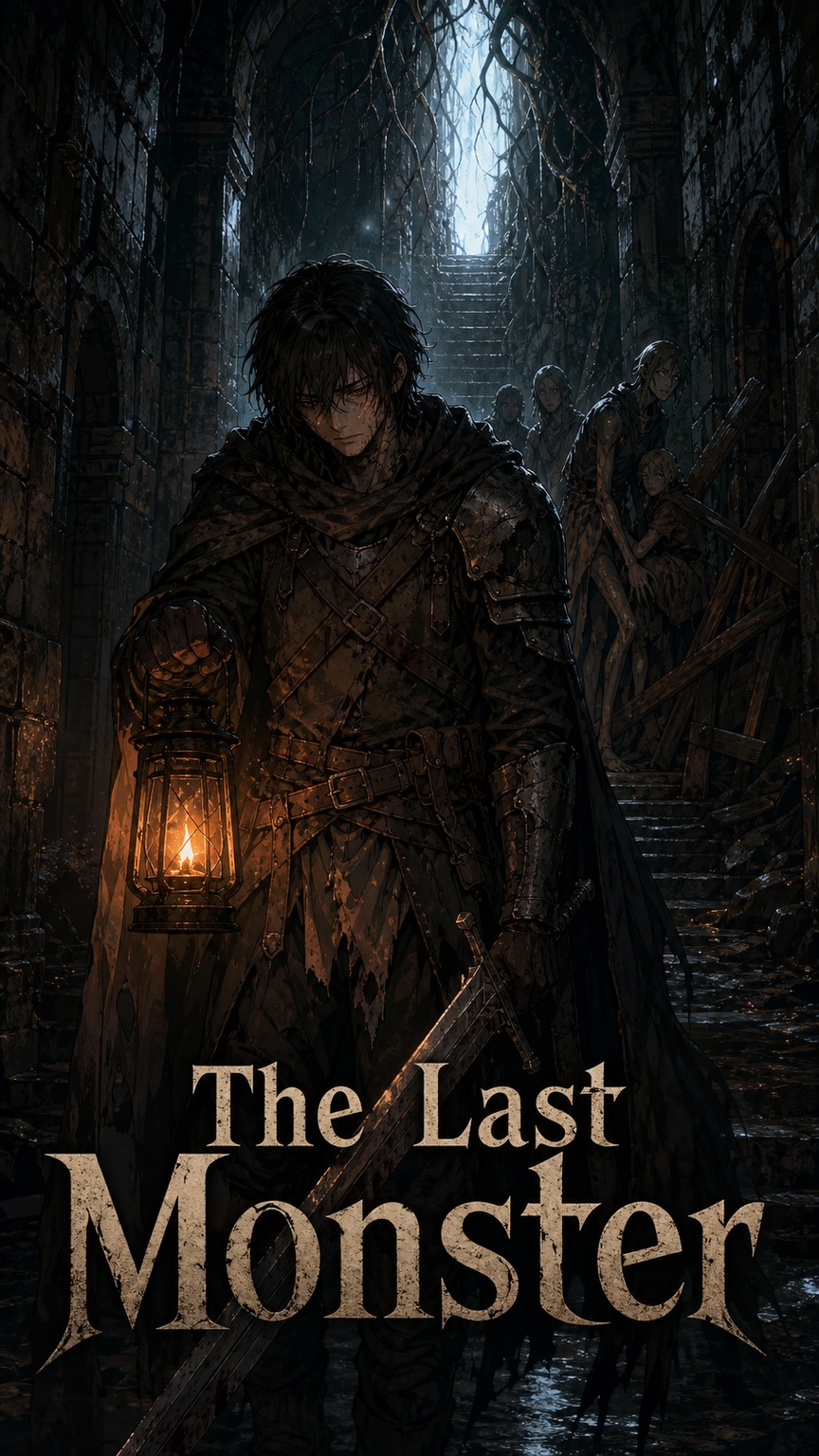
The shape comes around the corner carrying a lantern, and you kill it before the light reaches its face.
Your sword catches first on something hard, then goes through. The lantern swings. In its orange pass you see a hand wrapped in clean cloth, worked leather at the shoulder, a metal buckle stamped with a curling line. You also see a jaw too narrow, perhaps, and teeth too many, perhaps. Then the shape folds against the wall and the lantern settles upright between its knees.
It had been turning away.
Movement means attack. You know this. Waiting is how the others died.
Still, it had been turning away.
You take the lantern and fasten its strap at your shoulder with the stamped buckle. The dead shape’s bag contains four strips of dried meat beside a wad of pale cave growth, food gathered by an adventurer or carried by a monster. Its flask gives you three swallows. You take all three too quickly. The corridor tilts, the flame divides into twins, and the next thing you know you are crouched with your shoulder against the wall and your sword lifted at the sound of pursuit.
Water drips into water. Nothing else moves.
Your gear keeps the count that your mind cannot. There is rust on the lower half of the blade. Your belt closes through a hole punched with the knife point, two holes beyond the last proper one. Cord holds both soles to your boots. A white seam crosses your forearm beneath three newer cuts. You remember receiving that shallow wound yesterday.
You remember several yesterdays. They cannot all have been yesterday.
The lantern gutters. When you cup a hand around it, the flame leans toward the left-hand passage and stays there. You hold still. A loose thread at your cuff lifts the same way. Against your wet fingertip, the air is cold.
Air goes somewhere.
From the left passage comes a measured sound.
Knock. Knock. Knock.
A pause. Farther ahead, three knocks answer. The signal travels away through the stone.
A hunting call, you think.
But the flame bends left. The thread lifts left. Cold touches the wet side of your finger. For the first time since counting stopped, three things agree.
You step over the body and follow the light it carried.
At every branching you make the same tests.
You shield the flame. You watch the thread. You wet one fingertip with water you should be saving. When your eyes insist that one corridor rises and your knees insist that it falls, you trust the air instead. The draft strengthens by degrees. Enclosed rot thins. Beneath it comes the smell of leaf mold, so faint you almost mistake wanting for evidence.
Then the flame bows, the thread trembles, and the damp of your finger turns cold. Evidence enough.
Something scrambles ahead.
You raise the lantern. A long-limbed figure crouches at a wall crack, hauling a smaller shape through by two of its four—or perhaps merely bent—arms. Its eyes catch the light. It bares its teeth.
No. The teeth are already bare. The lips may not close over them.
The figure shoves the smaller one into darkness, tears down a woven sleeping mat, and stuffs it into the crack between you. It never advances. It never reaches for you. When you take one step, it disappears after the smaller body.
Knock. Knock. Knock.
The warning races ahead. Claws answer it from a ceiling niche. Feet answer from below a broken stair. A cluster of low, gray scavengers abandons a fresh carcass without feeding and squeezes beneath a slab, the largest going last. Points of reflected light vanish whenever your lantern turns toward them.
They are taking positions. They are drawing you on.
The corridor ahead goes silent.
You slash at a dark shape hanging in a niche. Hide parts beneath the sword. The thing gives no cry because it is an empty sling, still warm where a body lay in it. The stroke pulls pain down your ribs and bursts sparks across your vision. For several breaths you cannot make the two lanterns become one.
At the next narrow place, stones and cracked boards fill a side opening. Their rough ends point toward you. Beyond them, tracks lead away: narrow feet, broad pads, dragging knuckles, a sweep like bundled reeds. They all overlap in one direction. A sack has split in flight, spilling cave bulbs and scraps of bedding. There are no spear points waiting through the barricade. It has been built from the far side to keep you out.
The word ambush remains ready in your mouth. The facts will not fit inside it.
Behind you, a stone grinds across stone. One of the passages you passed has been sealed. The creatures are closing the route after themselves, and if they close the airy route ahead, you will be left with the drip, the dark, and however many yesterdays your body has survived.
You begin to run.
The warning runs faster.
The passage spills you into a cistern chamber broad enough to swallow the lantern light. Bedrolls huddle near old fire pits. Gear lies scattered where a waiting party has dropped it for quick hands. Cuts score the wall in groups you cannot count at this distance.
You stop at the threshold, sword forward.
Nothing charges.
The flame shows a soot patch on the floor. Beside it sits a cup fashioned from the cheek plate of a helmet. Its rim bears one square dent.
Your thumb knows the dent before you do.
You made the cup. You slept beside that soot. At arm’s height on the wall, one of the counting marks has a crooked tail because the notch in your knife catches when you pull it downward. You fit the knife to the groove. Stone dust flakes out.
The last time you stood here, the cut along your forearm was open. Now that cut is the white seam beneath the newer ones.
You have not found a new chamber. You have found a place that already survived you.
More things return as the lantern moves: a shield split through its painted face; a small wooden splint tied with careful knots; a blackened cooking spoon. Behind the cistern, a blanket-wrapped bundle has been dragged partly out of sight. One end is weighted by the unmistakable shape of a foot. The boot might fit you. The toes beyond it might not.
You do not uncover the face.
At the far side, tracks of every shape converge on a rising arch. Mud has been slapped across the walls at the height of your shoulder. Three blunt finger streaks here. Three charcoal bars there. Three scratches cut by a claw or a tool. Old signs have dried. New ones gleam wet.
When you move toward the arch, the knocking begins again.
Knock. Knock. Knock.
Nothing has followed you into this room.
The thought arrives whole, and you cannot starve it back into pieces. Nothing has been following you. Everything that could move has moved before you. You remember a horned silhouette dropping a bowl and flattening itself against a wall. A mail-clad figure backing away with both palms out. A face hidden behind thin hands while you approached.
Fear can be bait. Surrender can hide a knife. The old rule answers at once: if a shape can reach you, kill it before it decides.
But all the barricades face backward.
You cross the room. The strongest current of cold air passes over the bundle and pulls you toward the rising arch. The way out and the record of what you have done are the same trail.
The arch climbs into a steep spillway. Roots probe through mortar high above. The lantern flame streams almost flat, and beyond it, at the top of a broken stair, a seam in the stone is gray instead of black.
Not lamplight. Something paler.
A corroded grate covers the human-width throat. A fallen block pins its lower corner. Beside it, a smaller opening disappears behind a curtain of moss, its edges scored by fresh passage.
You strike the grate.
The clang fills the spillway, hits the curved walls, and comes back larger. You strike again. Rust showers down. On the third blow the sound becomes screaming: not here, not now, but close enough to lock your elbows. Someone is shouting behind you. Someone is not getting up. There was a bridge, or a stair, or a floor that gave way. You waited once. Waiting is how—
Light blooms below.
Two figures stand in the lower arch. Their lantern is bright and clean. One carries a coil of rope. The other says words that should have meaning.
“—hear me? Put—”
The grate’s ringing sits inside your skull. The voice breaks around it. One figure lifts empty hands. The other reaches across its body, toward the rope, toward a hilt, toward either.
Your feet choose before the words can reform.
You descend with the sword high. The first figure stumbles backward, palms still open. The second throws the rope between you. Your boot catches it. When you wrench free, the coil whips upward, snags the lantern hanging from your shoulder, and tears its strap at the iron loop. Your lantern tumbles loose and skitters toward the moss-hung opening, still burning. Steel rings once; the bright lantern falls and bursts dark against the stones. One figure goes down and does not rise. The other makes a sound too raw to be a battle cry, snatches up the dying stub of your lantern, and crawls through the moss-hung opening.
Then you are alone with your breathing.
The fallen figure’s hand is open. There is no weapon in it.
You turn over the pack. Clean bandages. A stoppered bottle of water. Two iron wedges. A charcoal map drawn on oiled cloth: the curve of the spillway, the grate, the side opening. Above them, a circle with short lines around it.
An open sky, drawn by an adventurer. Or a mark copied by a scavenger. The doubt comes as faithfully as hunger.
It changes nothing about the empty hand.
You drink, slower this time, though every part of you demands the bottle. You bind the fallen figure’s wound, though the bandage stays unstained by any living pulse. You do it because the cloth was carried for saving someone and because you have ruined enough of its purposes.
The dropped rope reaches a ledge below the grate, but from there the stone still will not move. Your repeated blows have bent the bars inward and spoiled the best place for a wedge. The better lantern is gone. Yours, abandoned by the small opening, burns with a wick no brighter than a red pin.
The escaping figure has torn the moss aside. Cold air pours through the gap hard enough to stir the hair at your temple.
You cannot force the broad way. The only open route is the route taken by something fleeing you.
You take the rope, the map, and your failing light. You leave the bandaged dead where it fell and crawl into the crack.
Stone closes around your shoulders. The sword must go ahead of you, shoved along on one forearm. Your breath returns hot from the wall inches before your face. Behind you there is no room to turn. Ahead, the last flame shrinks until darkness seems to lean over it from every side.
The thread at your cuff lifts. Cool air touches the sweat between your fingers.
The flame goes out.
For a moment there is no route, no stone, no hand. The dark is complete enough that your body invents motion inside it. Teeth graze the back of your neck. Nails hover above your eyes. You know they are inventions because the cold current continues across your knuckles, steady and indifferent, and because the thread brushes your wrist in the same direction.
You crawl toward the air.
Gray light appears as a flaw ahead. In it, a small figure stands at a crack in the rising floor. Its knees bend backward, unless the joints are merely long. One hand grips a sharp strip of metal. Behind its legs, a smaller body curls beneath a bundle of woven fiber.
The metal points at the floor.
You reach forward. The guardian strikes the stone with its free hand.
Knock. Knock. Knock.
No answer comes from above.
It shifts over the smaller body. Its limbs shake. Its face turns away from what remains of your light, though the light is only a gray stain now. When it crouches, you see teeth. When it tightens its hand, you see claws. When its weight moves forward, you see the beginning of a spring.
You see these things second.
First: the shaking. The averted face. The sharp scrap held down. The guardian folding its own body over the smaller one and leaving its narrow back bare to your sword.
You pull yourself close enough to reach the crack. Its weapon could enter the soft underside of your wrist. You feel the point touch your skin.
It does not push.
Your sword rises as far as the low ceiling allows.
Movement means attack. Waiting is how the others died. The lantern-bearer had been turning away. The barricades faced backward. The hands below were empty. Every warning traveled ahead of you, never toward you.
Your ragged breath fills the chamber. The guardian flinches at each exhale.
The warning is not telling hunters where you are.
It is telling everyone else.
You lower the sword.
Not a slip. Not weakness. You make yourself finish the choice. You slide the weapon flat across the floor until it lies beyond your immediate reach. You open both hands. Then, though the air lies beyond the guardian and death may lie behind you, you push yourself backward through the tight stone.
One body length. Two.
You wait with your palms visible.
The guardian could close the crack. It could come after you with the metal. It does neither. For one breath, then ten, it watches. At last it gathers the smaller body against its chest and retreats through the opening. It does not bow. It does not soften. It bares its teeth once, whether from effort or terror, and vanishes.
The gray flaw remains open.
You retrieve the sword only because the shaft may still be barred. You hold it by the middle of the blade so the hilt trails behind.
From somewhere above comes a faint sound.
Knock. Knock. Knock.
Then roots rustle, and small feet move away.
You follow at a distance.
The bypass joins a slanted shaft where your shoulders no longer touch both walls. Cool air flows downward around cords of root. At the upper end, loose leaves tremble against a grate outlined in dawn.
Dawn. The word hurts more than the climb.
Fresh scrapes score the shaft. Bedding fibers snag on stone. Prints stipple the dust, some still crumbling at the edges. This is not a private path offered to you. It is the road along which the dungeon has been emptying itself.
The guardian moves ahead as a bent shadow, the smaller one clinging to its back. When it stops, you stop. When it turns its head, you lower your eyes. Twice the old need surges through you: close the distance, control the hands, strike before the turn. Twice you put your palm against the cold wall and wait until the air confirms itself by flowing over your fingers.
At the top, a shifted stone pins the grate. Roots as thick as rope have pried its frame from the mortar but not freed it. The guardian thrusts its metal scrap into a narrow retaining gap. The tool bends. The grate lifts no more than a finger’s width.
The smaller body whimpers. The guardian answers with three soft taps against its own chest.
Your sword will fit beneath the frame.
You set it down where the guardian can see. It drags the dependent to the far side of the shaft, teeth bare, scrap raised at last. You do not approach until it lowers the point.
Then you wedge the blade beneath the grate and lean on the hilt.
Your arms shake. The grate rises. Soil showers your face. One root snaps with a noise that nearly makes you release the sword, but above the opening the leaves jump in open wind. The guardian understands the gap before you can gesture. It pushes the smaller one through, wriggles after it, and disappears into brightness.
The stone shifts.
You throw both hands against it. The sword bows beneath the grate. For one instant you could pull it free and let the opening close. Instead you shove until your shoulder enters the gap. The stone drops onto the flat of the blade and holds there, trapping it between iron and earth.
You leave it.
Your head clears the drain. Wet grass touches your cheek. Your shoulders scrape through, then your hips, then your knees. You crawl until no part of you remains beneath the stone.
You are outside.
The sky is colorless with early morning and vast enough to make you clutch the ground. Wind moves over the hillside without striking a wall. Damp earth yields beneath your fingers. Birds call from more directions than you can endure. You press your face into the grass, not to hide from a vision, but because daylight is real and your eyes have forgotten how to bear it.
In the brush, the guardian pauses with the smaller one clutched close. You see only a narrow back, long joints, the glint of its metal scrap. Then leaves close behind them.
They do not thank you. They owe you nothing.
Boots beat through wet grass.
Voices overlap. Metal leaves sheaths. Your hand closes on emptiness where the sword should be, and terror makes the whole bright hillside into another narrow passage.
“Down,” someone orders. “Hands where I can see them.”
You can see almost nothing. Human shapes, perhaps, ring you in the glare. One carries a bow. One has a hooked pole. One comes close enough that you hear their breath catch.
“Salken?”
The sound passes through the ringing in your head. It does not tell you what the shapes are. It tells you what you are: not innocent, not safe, not nameless.
You open your hands and kneel.
They bind your wrists. The cord burns the cuts beneath it. Someone holds a cup to your mouth and lets you take one measured swallow, then pulls it away while you beg for the rest. Care and restraint arrive together, and your body knows how to understand neither.
A searcher touches the stamped buckle at your shoulder.
“That belonged to one of ours.”
You look down at the curling line in the metal. It might have come from the lantern-bearer. It might have come from someone dead many passages ago. You cannot build certainty from the fact that it is easier to survive.
“I killed people below,” you say. Your voice sounds scraped hollow. “I killed others. I don’t know what they were. I don’t know how many.”
The hands on your bindings tighten, but no one strikes.
You turn your face toward the drain. “There may be survivors. I can show you the chambers.”
“And the monsters?” someone asks. “The tracks in the grass?”
The brush has stopped moving. You cannot tell where the guardian went.
“They led me out,” you say. “Let them go.”
No one promises. Judgment does not arrive in a clean shape. Neither does forgiveness.
Sunlight clears the hill and falls across your bound, open hands. Behind you, the sword remains wedged in the dark mouth of the drain, holding the way open.
The air is free.
You breathe it while they take you away.