The Last Thing I Could Fix
You are a legendary blacksmith, sought out for your ability to fix anything. Talking swords, obsidian breastplates, staves made of crystal, daggers forged from dragon scales, you've done it all. The real challenge today is a young hero asking you to fix what they call their 'plot armor'.
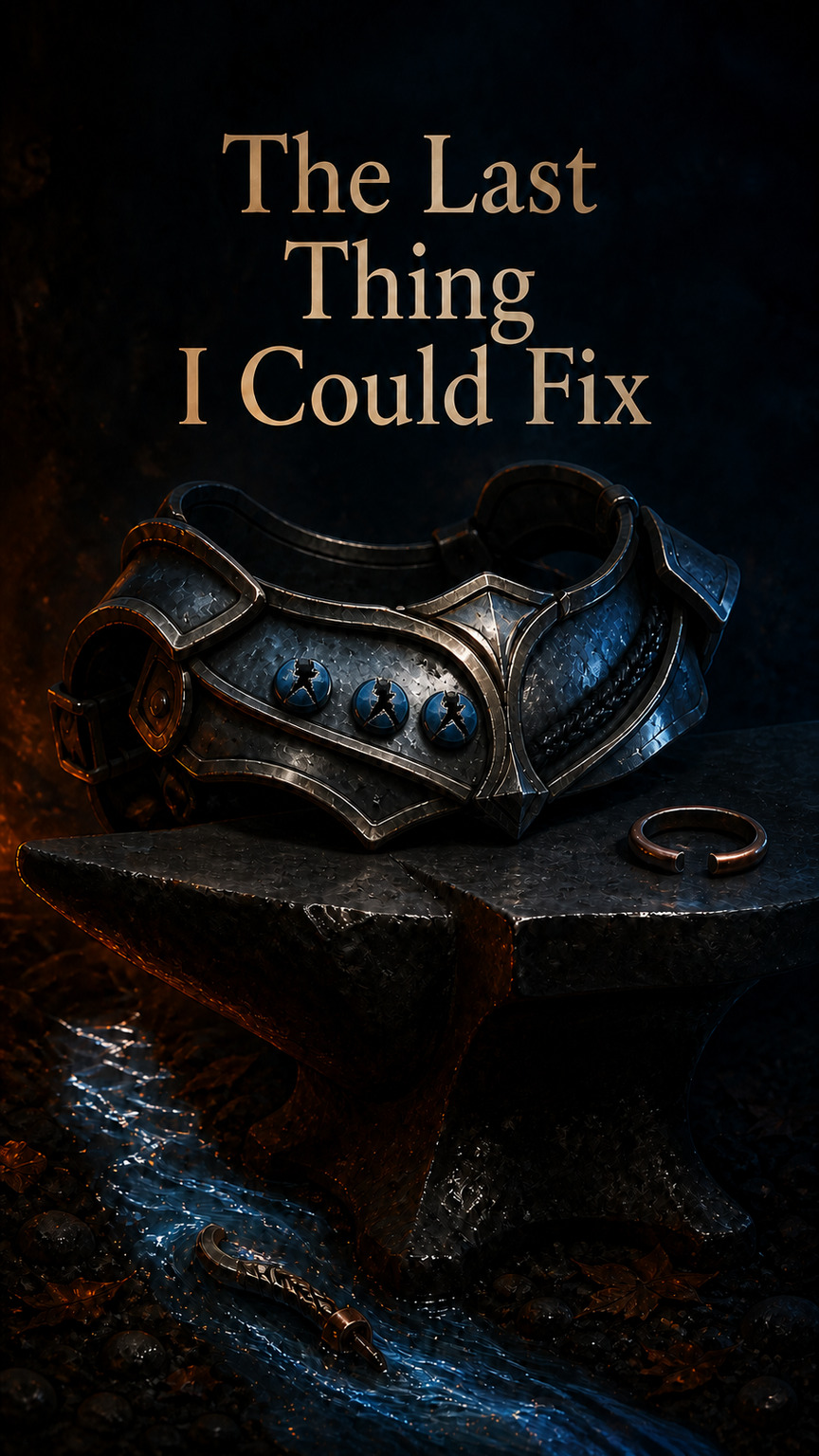
I had corrected the manners of talking swords, which is harder than sharpening them and only slightly easier than convincing their owners to pay. I had mended obsidian breastplates without turning their wearers into pincushions of black glass. I had spliced crystal staves whose two halves disagreed about the direction of lightning. I had even reset the scales on dragon-scale daggers, a task best undertaken after establishing whether the dragon was finished with them.
In short, I was Hadrik, and I fixed anything.
The sign over my forge said so. The words were cut deep enough to outlive me and gilded thick enough to suggest they might. Travelers came up the valley to point at it, then at some impossible wreck in a velvet box. Nothing left my bench until it did what its maker had intended.
That last part was not on the sign. At the time, I thought it too obvious to carve.
Aven arrived in a thunderstorm with a bundle under one arm and bloodless determination holding their young face together. Water ran from their hair, their sleeves, and the toe of one split boot. They put the bundle on my bench. Scorched metal showed through the wrapping.
“I need you to fix my plot armor.”
I waited for the grin. Aven did not provide one.
“That is what the court chroniclers call it,” they said. “Because it keeps the hero alive for the next great deed.”
“Chroniclers,” I said. “Of course. Smiths call things by what they are. Chroniclers call them by what rhymes with the wine.”
I unwrapped a close-fitted under-harness: small overlapping plates, a mesh of silver-gray response wire, and enough scorch marks to trouble me. Then the reservoir bell sounded uphill, one iron note rolling beneath the thunder.
Aven told me the relief gate had jammed. The reservoir was climbing toward the rim. On their first attempt, a gate bolt had torn loose above them. Their guide had reached out—and the harness had dragged the guide beneath the falling iron. The bolt broke the guide’s leg instead of Aven’s back.
“They told me to try again alone,” Aven said. “Nothing near me for the armor to hurt.”
“A practical solution, if one is a wheelbarrow.”
“I am not wearing it again until I understand what it does.”
That was the first sensible thing anyone had said about the harness, myself included. I still gave the answer expected of a legend.
“You will have it by midday.”
The reservoir bell sounded again before the echo of my promise had died.
Off Aven’s body, the harness was as magical as a soup pot. I laid it in salt, passed a lodestone over every plate, warmed it by the forge and cooled it in rainwater. Nothing answered. The response wire held a faint stored tension, but no heat, pulse, or motion of its own.
“It needs someone living,” I said. “Likely you. Put it on.”
Aven’s hands stopped at the buckles.
“We test with cloth, not gate bolts,” I said. “And I stop when you say.”
They searched my face long enough to make me glad I had said it plainly. Then they stripped off their wet coat and fitted the harness over their shirt.
I blackened every wire junction with soot and hung a sack of rags from a ceiling chain. It made a gentle pendulum, by heroic standards. By mine, it was still a weight moving toward a client.
“Do nothing,” I told Aven. “I will catch it.”
I drew the sack back. Aven nodded. I let go.
The sack swung. Nothing warmed in advance, no invisible hand tipped it aside. The canvas touched the center plate with a padded thud.
Only then did the wire tighten.
A rivet at Aven’s sternum flashed hot. A line of lampblack leapt outward along one narrow hook. I had planted my boots and sworn to hold still, but some older part of me saw a young person in danger and reached before pride could stop it.
That reach completed the open circuit.
My arm jerked across Aven’s chest and into the sack’s path. I caught the chain with my other hand before the returning weight could crack my elbow. The pendulum had not swerved by a finger’s width. I had.
Aven went pale. “That was how the guide moved.”
I examined the hot center rivet under a lens. A hairline split ran through the metal and left its tiny assent gate jammed open. The outward hooks were made to take the intention of a nearby protector, but the choice rivet was supposed to admit only someone who actively joined the circuit. Cracked, it could turn a flinch, a reach, the bare wish that Aven not be hurt, into a bodily pull.
The wire had not foreseen the sack. It stayed cold until contact. Then Aven’s alarm and my protective reflex supplied the current, and the open circuit routed the pull through me as the nearer shield.
I drove ceramic wedges beneath the witness hooks and swung the sack again. It struck. The plates cinched hard around Aven; the split rivet heated; but the soot stopped at the blocked hooks, and I did not move.
There are diagnoses one enjoys being right about. This was not one of them.
“The central rivet is split,” I said. “I can drill it out, forge another, and reconnect the hooks. With the assent catch sound, it will take only a willing protector. Two hours.”
I reached for my smallest punch.
“No.”
“It is the proper repair.”
“It is the same purpose with a better latch.” Aven touched the reddened cloth over their sternum. “The latch broke once.”
“Everything breaks once. Most things make a career of it.”
“Then I won’t wear a thing whose failure turns people into shields.”
Outside, rain hissed on my chimney cap. I looked at the sign through the open forge door, its gold letters blurred by water. Anything fixed. A promise is an excellent servant until it hears a deadline; then it becomes a magistrate.
“The adults below expect that harness to bring their hero back,” I said.
“They expect me to go where they won’t because they think it has always brought me back.” Aven swallowed. “I don’t know how many times somebody else moved because of it. I don’t know which victories were mine.”
That landed harder than the sack had.
“The armor did not climb the road for you,” I said. “It did not learn the gate or decide to return here. But it changed who paid when things went wrong.” I put down the punch. “Tell me what fixed means.”
Aven looked surprised. So was I.
“It means I choose what I do,” they said. “It means nobody else pays unless they know the price and say yes. It means if it can’t save me honestly, it doesn’t pretend it can.”
The reservoir bell began ringing in strokes of three.
“That,” I said, “is a much slower repair.”
“Can you do it?”
“I did carve the sign very deeply.”
I cut away the witness hooks. One curved piece—the old bypass hook—could bridge an assent gate without a rivet and leave the outward path permanently open. I coiled it and dropped it into my tool roll, because smiths save dangerous scraps with the faith that labeling them dangerous makes us wise. Then I unfolded the response braid, turned every other outward path inward, and stitched it back through the plates.
The split choice rivet came out under my drill in bright curls. In its place I forged a will-catch: one contact beneath Aven’s sternum, one beneath the palm of their working hand. Aven stood beside the quench trough with their fingers on both while I tempered the fitted circuit. Their intent ran warm through the wire; my tongs and fire shaped it but supplied none of their own.
Last, I forged three rivets from soft iron, heated them to straw, then violet, then the blue of deep water. I set them where overload would break them before the braid could seek another body or hide the strain.
“Three hard uses,” I said. “Visible ones. After the third, this becomes rather uncomfortable ordinary armor.”
“What counts as a use?”
“First, danger must actually touch you. No warning. You must be conscious, understand the motion, press the will-catch, and say what you choose to do. One verb. One direction. The braid will brace that line for about one breath.”
“And the force?”
“Still exists. It spreads through the plates and through you. A blow from the side remains a blow from the side. Too much force will injure or kill you, whether the rivets have admired your courage or not.”
Aven gave the three blue heads a sober glance. “Better.”
I retained one outward loop of copper, isolated from the rest. “A second person may share the load by taking this consent ring with bare skin and saying yes, then and there. Let go, and the join ends. No stored permission. No borrowed reflex.”
We tested the redesign before trusting a town to it.
First I swung the padded sack slowly. Aven watched it come and stepped aside. It passed them. Nothing warmed; nothing pulled. They laughed once, mostly from surprise.
Then they returned to the mark. The sack touched the breastplate.
Aven pressed sternum and palm. “Stand.”
The inward braid lit beneath its soot. The plates drew tight along the line from their boots to their shoulders. The sack drove them back half a step and left a bruise they would feel by supper. It did not throw them. One blue rivet snapped with a crack like a seed in flame.
My arms remained entirely my own.
For the consent check, I gripped the copper ring while Aven leaned into a lightly padded press. They said, “Stand.” The mesh warmed around them. The ring stayed cold in my hand.
“Yes,” I said.
Heat crossed my palm, mild but unmistakable, and the resistance divided between us until I let go. The remaining two rivets stayed blue.
The bell above us rang three strokes again, with less silence between each set.
I packed my hammer, wedges, and tool roll.
“You said I would have it by midday,” Aven said.
“You have it.” I tied on my rain cloak. “I did not say you would have the poor judgment to field an unproven redesign without its smith.”
I had serviced the spillgate years before, an ordinary job of rust, hinges, and a locking wedge that swelled every wet season. Less glamorous than dragon scales. Considerably more useful that morning.
The path climbed beside the relief channel. Rain had turned its stones black and slick, and water boomed behind the reservoir wall like something enormous objecting to architecture. Aven led. They knew where the first attempt had torn loose railings and which stair had split.
Halfway across the upper catwalk, a support gave way under me.
There was no omen. One moment I had iron under both boots. The next, the bracket peeled from wet stone and the walkway dropped. I caught the rail with one hand. My hammer dragged at my belt while the relief channel hammered below.
Aven turned. For one naked instant, they stood perfectly still.
They were waiting for rescue to happen.
Nothing did. The wire could not choose. The old hooks were gone. The harness offered no warning and took no one’s body.
Then Aven saw me, saw the intact support behind them, and made a decision.
They dropped flat, hooked one knee around the support, and caught my wrist. The load struck their shoulder. They pressed the will-catch against the rail with their free hand.
“Catch.”
The braid braced backward along their chosen pull. Aven hauled; I kicked against the wall; together we got my chest over the broken edge. The second rivet sheared.
When the breath ended, Aven rolled onto their back with their injured arm clutched close.
“Shoulder?” I asked.
“Strained.” Their face said more than the word did.
I checked the joint as gently as my hands allowed. Painful, still placed. I looked at the single blue rivet remaining.
“We can go back,” I said.
Below the clouds, the valley town was a huddle of slate roofs beside a river already too broad for its banks. Aven stared down at it.
“The armor didn’t make me catch you,” they said.
“No.”
“And it didn’t make me freeze.”
“No. That habit came from people teaching you rescue was automatic.”
They flexed their good hand. “Then I can learn a different one.”
We went on.
The relief gate shuddered in its stone throat. Water sprayed through every seam. The release bar had jammed halfway, exactly where rust had always loved it, and the locking wedge beneath it had swollen fast. Worse, the final retaining bracket was peeling from the wall. Each surge bent it farther. When it tore free, the bar would kick loose and the gate would stay shut until the reservoir overtopped.
I laid out the work. Aven would brace beneath the release bar while I drove the wedge through its lock. When the wedge seated, the gate would fall open toward the empty relief channel. We would both drop left, behind the stone pier, before the first water struck.
“One rivet,” Aven said.
“One breath,” I agreed.
“Will it work?”
The old answer rose easily. Of course. Hadrik fixed anything. The words even sounded like courage if one did not inspect them closely.
“It can work,” I said. “The upward load is within the design. The bar may twist. Your shoulder is already strained. I cannot promise either of us leaves unhurt.”
“Can we retreat?”
“Yes.” The bracket shrieked. “We would probably live. The lower town would flood.”
Aven shut their eyes. When they opened them, there was fear in them and room beside it for thought.
“I’m not doing this because the court called me a hero,” they said. “I’m doing it because I know what happens if we leave, and because you told me the truth.”
“You may still say no.”
“So may you.”
That was the soundest safety rule either of us had made.
We took our places.
The release bar slammed down until it met Aven’s raised hands. Contact first. Metal groaned against metal. Aven perceived the direction and set their boots. They flattened their working palm beneath the bar, compressing that contact against the iron, and leaned into the breastplate until the second contact seated beneath their sternum. Their other hand never left the bar.
“Hold.”
The last blue rivet began to whiten at its edge. The inward braid tightened from Aven’s palms through their back and legs. They cried out as the real weight spread through them, but the bar stopped descending.
I swung my hammer.
The first blow cracked rust. The second moved the locking wedge the breadth of a thumbnail. The gate shifted under water pressure—not down, but sideways.
Aven’s protection held the upward line they had chosen. It did nothing about the lateral wrench. Their strained shoulder buckled toward the wall.
One breath was not enough.
My tool roll lay open at my knee. The old bypass hook gleamed among the wedges. I could jam it across the empty assent seat in a heartbeat. The open path would seize the nearest protective impulse—mine—and turn my body into whatever brace the harness required. It was the old guarantee, close enough to touch. I could preserve the legend and call the coercion sacrifice afterward.
I dropped the hook.
Instead I tore off my glove and seized the copper consent ring.
“Yes,” I said. Not forever. Not for the court. “Yes, now.”
The ring burned into my palm.
My living intent joined Aven’s for that single hold, and the fitted wire divided the upward strain between us. It did not erase the sideways force. Aven’s shoulder still took that; my hand took heat enough to make the hammer swim in my vision. But their knees stopped folding. The whitening rivet endured one moment longer.
I struck the wedge a third time.
It seated.
The release bar leapt. The gate dropped open. Water roared into the empty channel, exactly where stone and old iron had directed it, not where luck preferred. The third rivet sheared. The response braid flashed once and fused black against the plates.
“Left!” I shouted.
We fell behind the pier as planned. The first wall of water tore through the place where we had stood, carrying rust, branches, and the discarded bypass hook down the safe channel.
For some time there was only stone under my cheek, rain on my back, and Aven’s breathing beside me.
Then the reservoir bell changed to the long, steady toll for water falling.
We had opened the gate. The lower town remained a town rather than becoming a shallow and badly planned lake. Aven could walk, though their shoulder needed a sling. I kept my burned hand wrapped against my chest. The harness hung from them as dead weight: all three blue rivets broken, the response wire fused, no warmth left anywhere in it.
Back at the forge, I laid the harness on my bench.
“Failed repair,” I said.
Aven, pale with exhaustion and dry at last, looked at me as if I had announced that anvils were migratory birds.
“It did exactly what I chose,” they said. “It stopped when you said it would. It charged nobody who hadn’t agreed.”
“The wire is ruined.”
“Then it spent itself honestly.”
I had spent my life returning objects to what their makers intended. It had never occurred to me that an intention might deserve refusal, or that a thing could be fixed by giving it an honorable way to end.
“I could make another,” I said. The offer came from habit, but not entirely. “More rivets. A stronger braid.”
Aven shook their head. “Ordinary mail. A crew. A plan. And the right to refuse the next great deed before anyone starts writing about it.”
“Ordinary mail I can guarantee against reasonable stabbing.”
“Reasonable stabbing?”
“The sign is under revision.”
The next morning, with my good hand and a narrow chisel, I climbed a ladder outside the forge. The gilding came away first. Then the wood. I cut the word anything out of the promise I had made so deeply.
In the space beneath, in smaller letters because truth is seldom brief, I carved: Before I take the job, I will tell you what the repair can do and what it will cost.
The new sign brought fewer velvet boxes. It brought better questions.
I remained Hadrik. I remained a blacksmith. I fixed many things after that, though never everything, and never by myself merely because my name was over the door.
The plot armor was the last thing I ever claimed I could fix alone.