The Lights Beyond
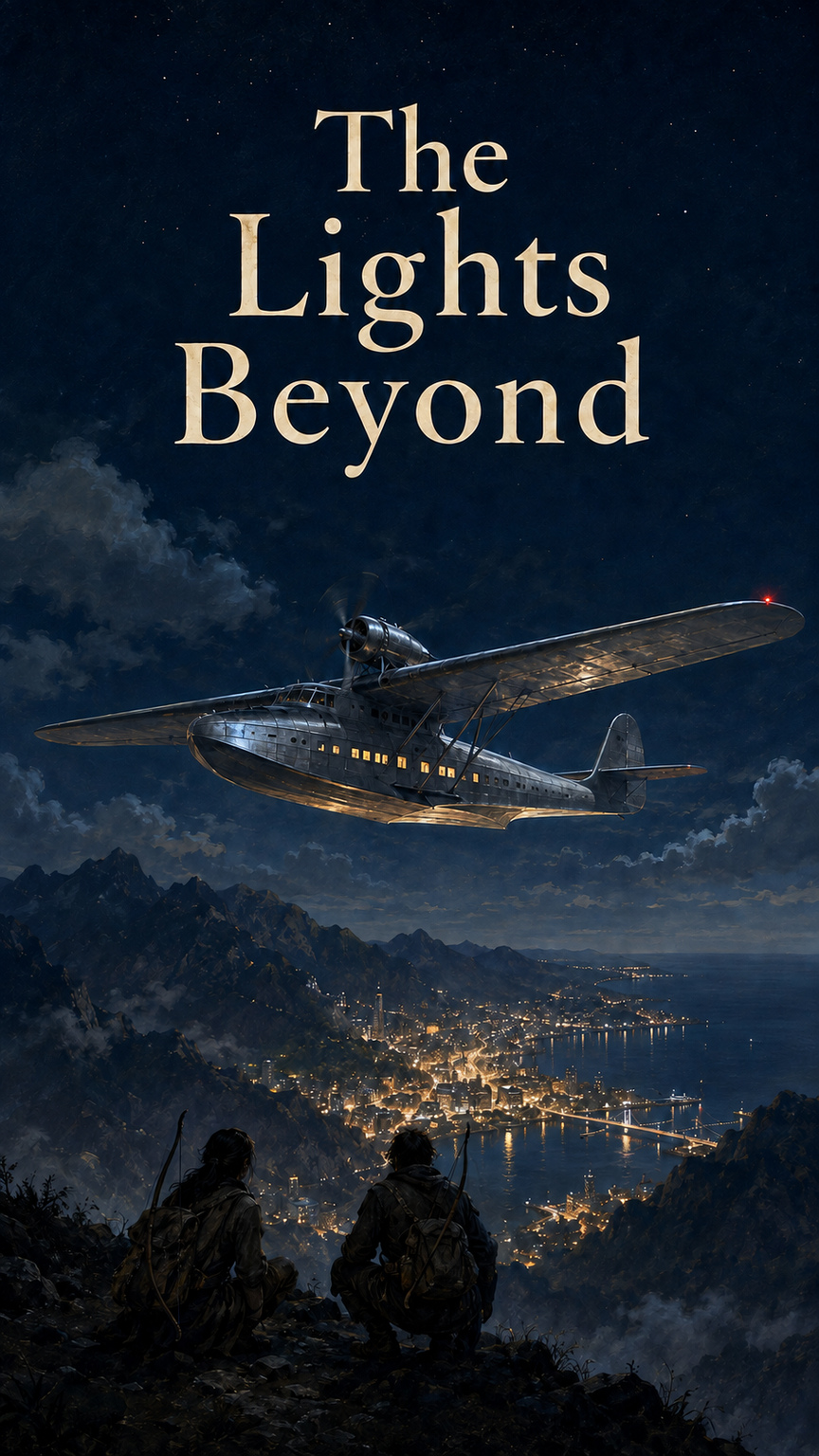
500 years ago the horde was defeated and pushed beyond the Great Wall. You are the first human scouts to explore beyond the wall since the war. You see a city covered in lights and metal birds soaring through the night sky.
The northern gate caught on its own threshold. Dunley put his shoulder to it, and Haskett slipped through sideways with the brass edge scraping her pack. Behind them the victory bells began.
Five hundred years ago, the horde had been defeated and driven through this pass. Since then, human scouts had watched from the Great Wall and gone no farther. Haskett and her brother were the first to step out into the north. The anniversary commission, which had taken three councils and most of the summer to approve, allowed them six days.
“Noon on the sixth,” she reminded him.
“I heard the captain.”
“You were looking at his boots.”
“He had yours on.”
Haskett had put in three requests for new boots. She looked down at the twine binding the toe of her left one, then up at the gatehouse window. The captain was still there. Dunley waved at him with terrible friendliness.
The gate shut. They stood on an old military road, between saplings rooted in its paving. Haskett waited until she could hear something besides bells: water under stones, a bird, the small creak of Dunley’s shoulder strap.
He reached across and tightened hers. “There. It’ll stop knocking.”
They had been scouting together for eleven years, mostly along the southern slopes, where smugglers and lost sheep supplied the work. Haskett could walk all day without turning to see whether he followed. Next winter they meant to leave the service and buy an inn with a leaning stable and a pear tree growing through the back fence. Six hundred crowns lay in their barracks strongbox, three hundred apiece. Forty more would meet the asking price.
“I thought of a name,” Dunley said as they started climbing.
“For the inn?”
“The Captain’s Boots.”
“You can paint the sign.”
She laughed, and the road bent enough to hide the Wall.
It crossed the first ridge by noon. Beyond lay another ridge, higher, with a blue seam of snow in its shade. The road descended into alder scrub, lost a bridge, and resumed on the opposite bank. They camped under a fallen slab and ate cold barley. Human law had kept this road shut for five centuries; scree and winter had done the rest. Along the Wall’s flanks the mountains rose into glaciers. Even their oldest maps showed no other pass.
They spent the second day finding a way through the saddle above the vanished bridge. Near dusk the wind changed. Salt reached Haskett first, so unexpected that she stopped and licked her upper lip. Then came a sound too steady for thunder.
She caught Dunley’s wrist. Together they crouched below the crest.
The coast lay on the other side.
A city filled the basin between the mountain and the sea, and it was covered in lights. They ran along streets, climbed buildings, outlined a bridge in two bright sweeps. Whole faces of tall houses shone. Beyond them a hundred white streaks trembled on the harbor water. Haskett searched for the smoke such burning must make. There was some above the eastern roofs, but nowhere near enough.
Something crossed the moon.
It had rigid wings, a thin body, a red light beneath one wingtip. As it banked toward the sea, the city flashed silver across its underside. Metal. Another followed, lower, with a row of little windows. The noise came after it: a deep, working drone that pressed against her ribs through the rock.
Dunley had his hand on her sleeve. She had never known his fingers so still.
The second bird passed over the water. It settled, throwing two long fans of spray, and its windows drifted toward a line of piers.
“There are people in it,” he said.
She had seen a pale shape at a window. A face, perhaps. She wanted it to come back so she could be certain.
He took out their map. The northern sheet showed an army’s encampments, wells, and a river that their descent had proved misplaced. Beyond the last ridge someone had drawn three waves for the sea. The city would not fit between them.
Haskett watched a light move across the harbor bridge. Many lights. They flowed in opposite directions without colliding, halted together, moved again. Farther inland, a square went dark, then bright with a green brilliance that stained the low cloud. She could make out no fire there at all.
“We need to see it from lower down,” she said.
Dunley put the map away so quickly he tore it on a buckle.
The path into the basin became a lane between orchards, then a smooth black road still warm from the day. Wires hung above it on poles. A wheeled box came humming toward them without horses, windows lit, somebody standing inside with one hand raised to the ceiling. Haskett dragged Dunley off the verge. It passed smelling of hot metal.
He rose from the ditch with grass on his chin. “I was moving.”
“Move sooner.”
After that they watched from behind a wall until they understood which side the boxes used.
At the first houses, a woman was shaking a cloth out of an upper window. Her face was broad, the lower jaw thrust forward. Two pale tusks caught the light. Haskett knew the shape from the carved enemy beneath the victory arch, though the carving had no hanging washing and no little child trying to squeeze past it to look out.
The woman saw them. Her hands stopped. She called into the room, and another face appeared beside hers.
Haskett loosened the strap that held her bow against her pack. Then she let it lie. There were people at the next corner, people behind her, people stepping from a lit doorway. If this became a fight, she would have chosen its place very badly.
A man carrying two loaves gave them a wide berth. An older woman stared directly at Dunley’s mouth. He pressed his lips together, which made her lean closer. Somewhere a child laughed. They continued toward the waterfront with their hands hanging empty.
Light poured through shop glass onto their muddy knees. In one window, six small suns burned inside transparent globes; Haskett could get close enough to see there was no wick. Beside them stood a chair with one broken leg and a notice in writing she could not read. She found herself looking from the light to the chair, wanting to know what a person who could make one would do about the other.
At a crossing, a bell rang overhead. The crowd waited. Dunley waited too, watching a little red figure on a pole, and when it turned white everyone moved. On the far side he looked back at her with an expression she knew from difficult fords: pleased to have understood the footing.
Then something wonderful was wasted on a dog. A shopkeeper set a little caged wheel in his doorway and pressed a white disk on its base. The blades blurred, lifting the dog’s ears in a draft. It got up and lay in the rainwater gutter instead. Dunley laughed aloud. The shopkeeper glanced at him, followed his gaze, and gave the animal a weary little shove with his shoe.
They reached the water by following the sound of another landing.
The bird came in low over their heads. Haskett flinched at its size, but it was smaller than the one they had seen from the ridge: a shining hull beneath high wings, with an engine and whirling blades above the roof. It struck the harbor, skipped, and drew a crease through the reflected windows. As it approached a floating dock the blades slowed into sight.
A man climbed out at the front and caught a rope tossed from shore. Two passengers emerged behind him, a young couple in good coats. The woman had to sit on the dock for a moment. Her companion crouched beside her, laughing, until she pushed his face away and laughed herself.
Dunley went all the way to the dock’s gate.
There was a board there with a painted view of the harbor. A little winged hull followed an arrow around an island and back to the same pier. Below it, two seats had been set beneath an awning, beside the moored aircraft. Haskett had seen carriage owners arrange seats like that outside an inn. Waiting customers could occupy them while the carriage was away.
The pilot approached, saying something and holding up two fingers. He wore an oil-marked jacket. A silver cap covered the end of one tusk.
Then he saw their faces properly. His fingers folded. He stepped back through the gate and pulled it halfway shut, looking from Dunley’s mouth to Haskett’s bow.
She took the bow off slowly, gripping its middle, and set it on the paving. Dunley did the same. The pilot pointed at their belts. They unbuckled those too, laying the sheathed knives beside the bows, then moved back three paces.
The pilot said something over his shoulder. The couple stopped on their way up the dock and looked. The young man put a hand across his companion’s arm; she moved it away so that she could see better. Neither approached.
Dunley lifted one hand, palm out. “We don’t understand you.”
The pilot stared a little longer. Then he came out of the gate. He touched his own chest, carefully clear of his jacket pockets.
“Pirvek.”
They gave their names. He made Haskett repeat hers, trying the middle sound twice before abandoning it. When Dunley pointed at the painted city, Pirvek said, “Roskell,” and turned to indicate the buildings rising behind them. Haskett repeated it. The word brought no answer out of anything she had been taught.
Pirvek pointed south, over the black ridges. Haskett nodded. She drew the Wall in the dust with a finger: towers, gate, two tiny figures coming through. He crouched to look. His fingertip stopped beside the figures; then he looked up at the two of them, and for a while nobody tried to explain anything more.
Finally Dunley pointed at the aircraft.
Pirvek stood, glanced at the waiting couple, and said something that made the young woman laugh again. He opened the gate. With a pointed look at their weapons on the ground, he beckoned them only as far as the awning.
Up close, the bird had scratches. A plate near its tail had been replaced with duller metal, and a dark streak ran from under the engine. Dunley bent toward a joint in the wing. Pirvek caught his wrist before he touched a thin projecting tube, then demonstrated with an outstretched hand where he could put his weight.
“He thinks I’m going to break it,” Dunley said.
“You nearly broke your map.”
Pirvek opened a side hatch. There were two seats abreast behind his own, with belts across the cushions. He showed how a buckle closed, pulled hard on the strap, and opened it again. When Dunley reached for the buckle himself, Pirvek let him try. Dunley got it wrong. The pilot waited while he worked it out.
Only then did Pirvek point from them to the seats. He traced the arrow on the board: dock, island, dock. Two fingers again, followed by an extended palm.
Haskett produced a crown from the four she carried for traveling expenses. The six hundred for the inn were far away and safe. Pirvek turned the silver coin over, rubbed his thumb across the stamped tower, and set it on the board’s narrow ledge. He tapped it and held up two fingers again.
“Two,” she said. She put a second crown beside the first.
He nodded and left both on the board’s narrow ledge. Then he pointed at the bows and knives, unlocked a long cupboard beneath the awning, and opened it for her inspection. Empty except for rope. He held up its key.
Dunley was already looking back toward the hatch.
“We have enough to report,” Haskett told him.
“We’ve barely been here an hour.”
“We saw the whole city from the ridge.”
He gave her a look so openly disbelieving that she wanted to take the words back. She hadn’t seen the dog from the ridge. She hadn’t seen anything properly.
“We don’t know what happens once we’re in there,” she said.
“I know.”
“He shuts the door. He takes us wherever he pleases.”
Dunley looked at Pirvek, who had begun checking the rope that held the craft to the dock. “Yes.”
“Then why are you standing there waiting for me to say it’s sensible?”
“I’m waiting for you to decide if you want to come.”
She heard the difference. So he would go by himself. Pirvek might refuse a single passenger; she caught herself hoping he would.
A larger aircraft rumbled above the harbor mouth. Dunley followed it until it disappeared behind a warehouse. Haskett had seen him watch distant roads like that, but always with a destination in common.
“You’re still coming home,” she said.
“Of course I am. We said the sixth day.”
“I mean afterward.”
He looked down at the two crowns on the ledge. “Don’t give the innkeeper a deposit.”
There it was, in a form that she could do nothing with except hear it.
“You chose that place,” she said.
“I know.”
“You measured the kitchen. You said we’d get two tables in if we moved the stove.”
“I wanted it.”
“This morning you wanted it.”
“This morning I hadn’t seen any of this.”
Pirvek came back and held up the belts again. Haskett shook her head, not at him, and he shut the hatch. Dunley started forward. The pilot pointed toward the coins, leaving them where they were, and stood back with folded arms.
“You don’t know whether they’d let you live here,” Haskett said quietly. “You can’t ask for a bed.”
“I don’t know if I want to live here. I want to find out how that thing works. I want to see where the big ones go.” He rubbed his forehead. “I can’t spend my three hundred yet.”
She looked past him to the city. The green light they had seen from above was a great glass sign on a roof, going through its colors even though scarcely anyone on the street looked up. It could be doing anything. Advertising fish. Giving orders. Announcing the hour. She had crossed two mountains to stand beneath it and remained unable to tell.
“The inn may be sold.”
“Yes.”
She could have borne another joke more easily.
Pirvek took one coin from the ledge and held it out. He pointed at Haskett, then the shore; at Dunley, then the aircraft. Even he had understood that much.
Haskett left the coin in his hand. She walked back to fetch her weapons.
Dunley made no attempt to follow. That hurt too, although she could hardly have wanted him to chase her across the paving. She picked up both bows, gathered the belts, and returned to the cupboard.
When she had put everything inside, she held out her hand for the key.
Pirvek gave it to her. She tucked it beneath her shirt, tapped the crown he held, and pointed at the second seat. He put both coins in his pocket and opened the hatch.
“I want the side with the city,” she told Dunley.
He looked toward the painted circuit to work it out. She was glad he took the trouble.
Pirvek put them in the rear seats, Haskett on the left, Dunley on the right, and checked the belts himself. He pressed Dunley’s pack beneath the seat until it stayed, then did the same with hers. His own seat was in front of them, beyond a low partition full of little round dials. He pointed out a handle above their hatch, making them each touch it before he closed the door. Through the window Haskett watched him cast off, push the hull away from the dock, and climb through his forward hatch.
The engine started with a cough that shook the teeth in Haskett’s head.
Pirvek pulled his belt tight. Light appeared inside the dials. He moved a lever, and the dock began to slide backward past her window. Water slapped the hull with a familiar, reassuring sound. For fifty paces they were only in an unusually noisy boat.
Then Pirvek opened the engine.
The noise became too much to hear through. Haskett felt it in the soles of her feet, in her jaw, in the fastening across her belly. Spray burst against the window. They struck the water again and again, each blow harder as they gathered speed. The island ahead had rocks along its edge. She had seen those rocks on the board, and now they were coming much too fast.
Beside her, Dunley gripped the front of his seat. His mouth was open. Had he thought they would float gently away?
The next blow did not come.
Water dropped beneath the window. She saw their pale wake continuing by itself, two trails unraveling into the black harbor, while the roofs along the shore sank down and showed her their chimneys. A gull flung itself sideways below them. The wing held steady over her head, impossibly thin to be doing so much.
She put both palms against the glass.
They climbed past the warehouse that had hidden the larger craft. Beyond it lay another dock, four more winged boats, men moving crates beneath lamps. Farther along the coast, a chain of lights curved north until the land ended in darkness. Behind the city the mountains rose much higher than they flew. She could no longer pick out the saddle they had crossed.
Pirvek turned, saw her at the window, and grinned around his tusks. Then he faced forward and brought them round the island.
Roskell tilted. Streets stood almost upright beyond the wing, their intersections bright as open furnaces; there was the bridge, and the green sign, and a rectangle of grass where figures ran beneath tall white lamps after something too small to see. At the edge of that dazzling field, a row of houses had dark gardens. Somebody there had gone to bed while this was possible above them.
She tried to find the dog. The notion was so absurd that she began to laugh, and found she had been crying a little, without noticing when she started.
Dunley touched her arm. He pointed through his own window at a second aircraft passing farther out to sea. Its lit windows floated level with them. Haskett could see people, certainly people this time, seated inside. One raised an arm. She waved back with her whole hand, although the stranger might have been reaching for a bag.
The turn brought the city straight ahead. Pirvek eased the lever and lowered their nose. Haskett wanted him to wait. They had paid two crowns; she would have given him the other two for another circuit, if only he could have heard her.
The harbor spread wider beneath them. She understood the landing only when the first slap of water came up through her seat. Then there were three more, a rush of spray, and they were a boat again, settling heavily into each small wave.
At the dock she had difficulty standing. Dunley climbed out and sat down exactly where the young woman had sat. He tried to speak, but his throat produced only a rasp. Haskett joined him, their feet hanging above the water, while Pirvek made fast the ropes.
When he came to let them out, she gave him back the cupboard key. He fetched their weapons, careful to offer the knives hilt first. Dunley bowed. Pirvek bowed too, uncertainly, and on straightening knocked the silver tip of his tusk against Dunley’s forehead. They both recoiled. Haskett laughed so hard she had to hold the gatepost.
Pirvek laughed too, rubbing the silver cap, and raised a hand as they started back through the city.
They slept above the orchards and left at sunrise. On the return journey, they measured the road more carefully and marked where its broken bridges could be forded. Dunley found a way around the worst scree. Haskett sketched the harbor circuit in the margin of their map, then tried again on the back, giving it more room.
They reached the Wall on the fifth morning. In the barracks, before either had washed, she opened their strongbox and divided the savings into two bags. Dunley watched from his bunk.
“I’m keeping mine here for now,” he said.
She set his bag back inside. “Keep your own key.”
The captain sent for them while she was still undoing the twine around her boot. He had unrolled a fresh map across his table and left a large blank space above the Wall.
Haskett began with the road. She described the ridges, the salt wind, the lights. When she reached the flying boats, the captain put down his pen.
“You saw them leave the water?”
“We were inside one,” she said.
He looked at Dunley, who nodded. Haskett tried to explain the speed and the blows against the hull, but Dunley interrupted because she had left out the moment when they stopped.
“I was getting to that.”
She pulled her chair beside her brother’s so that the captain could see how they had sat, and they tried again.