The Mercy Circuit
you run an independent electronics repair kiosk, but rather than the typical phone and computer fix, you specialize in bionics, implants, even the occasional plasma blaster here and there
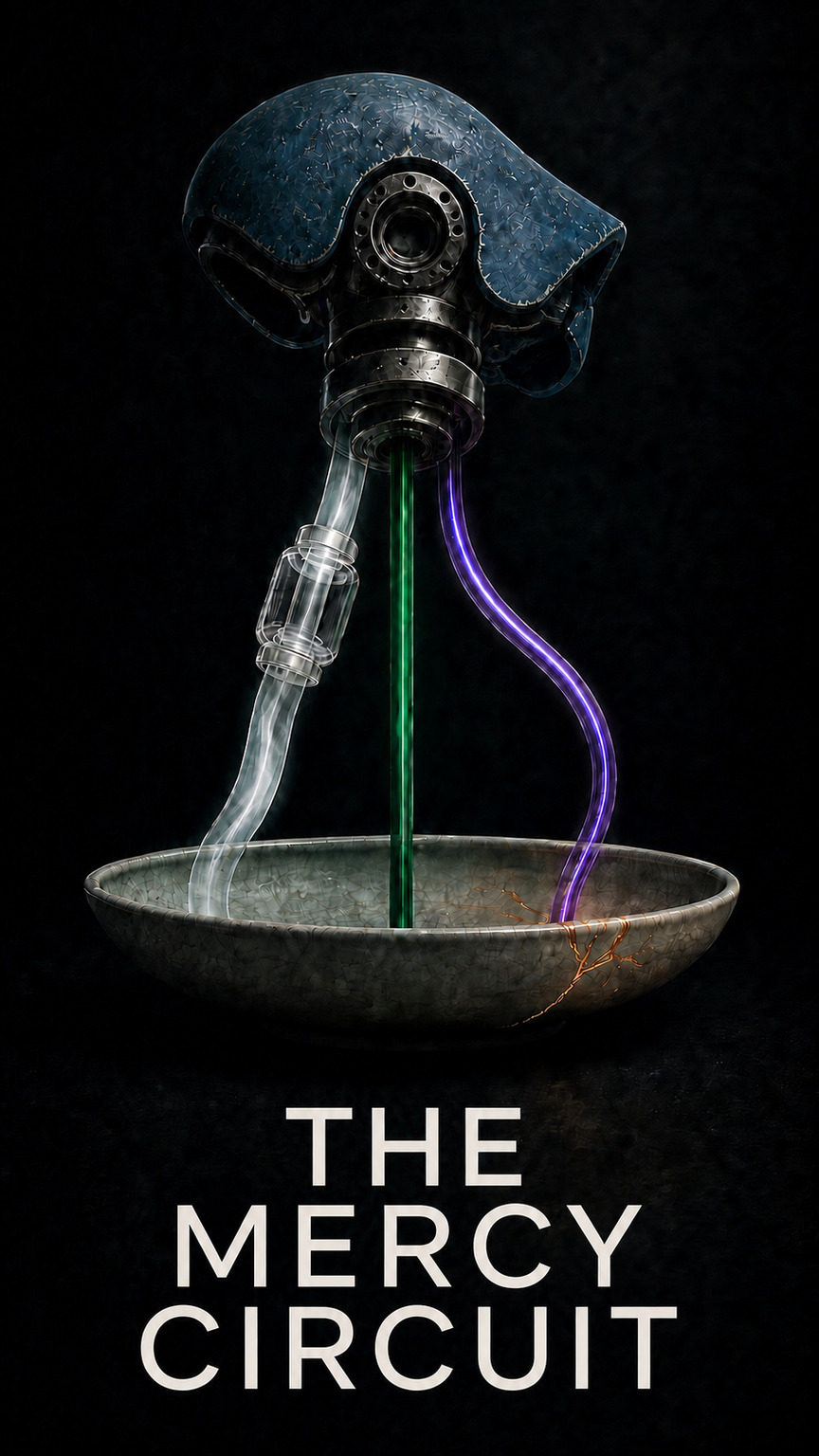
At fifty-two minutes to gatefall, you are explaining to a man that his hearing implant does not need a new ear.
“Battery cradle,” you say, turning the little crescent of ceramic under the bench lamp. “The contacts are green. I clean them, change the gasket, and you stop wearing it in the steam room.”
“I went once.”
“The corrosion went more than once.”
He considers arguing, then peers past you at the closing clock. Behind him, two courier riders wait with a knee actuator and a cracked navigation slate. Bevro is calling the last tray of pepper buns at his stall across the aisle. The Gantline Exchange has begun its evening contraction: awnings ratcheting inward, destination boards dimming one column at a time, floor-cleaners nosing under benches for dropped skewers and ticket chits.
You print the man a claim strip. The kiosk drawer records forty-two in promised labor and six in parts. Promised does not pay the stall fee, but the shape of the evening has finally begun to resemble enough.
Then three low notes sound from the aisle.
Not a horn. Not music. The first tone is a warning, the second the failed dump, the third the warning again because the failure has not gone anywhere.
“Back,” you tell your queue.
A woman stands at the edge of the floor mosaic with her left arm clamped across her chest. Her right arm is sleeved in scarred blue composite from shoulder to knuckle. A plasma caster hangs below the forearm on its coupling rails, too large to hide and too hot to mistake for dead. Violet thread crawls along its emitter cage. Every few breaths the arm gives a small inward jerk, and the woman’s jaw locks with it.
Bevro has already stopped serving. “How far back?”
“Past your red tile. Nobody crosses it.”
“My counter starts before the red tile.”
“Then close the front for one minute.”
He looks at the six customers holding coins. “Make it a minute.”
You drop the shield curtain around the left half of your bench and kick the ceramic catch tray out on its floor track. The woman does not move.
“Can you set it in the tray?” you ask.
“If I could detach it, I wouldn’t be here.”
Her words come out measured, each one fitted between something happening in the shoulder. You keep your hands visible.
“I’m going to guide the caster, not your arm. You choose the movement. If it starts another tone, stop where you are. All right?”
She nods once.
“I need it spoken. The shield recorder doesn’t count nods.”
“Guide the caster. I move the arm. Stop on tone.”
You take the weight through an insulated sling while she lowers the arm. At the lip of the tray, the violet fringe thickens. Her fingers close. The three notes sound. Heat punches through the sling into your palms, but the tray’s ceramic vanes rise and drink the charge into a dull orange seam.
The woman sways against the counter.
“No hands,” she says before you can reach for her.
You don’t. “Chair behind your left knee.”
She finds it and sits.
Bevro pulls his display shutters down halfway. A customer asks whether the buns will still be hot. Bevro says, “Still hot. Counter’s closed,” and starts returning coins.
You bring up the kiosk intake screen. “Name for the receipt?”
“Serren.”
“Caster charged how high?”
“Thirty-eight percent when the lockout began. Thirty-four now.”
“What happened just before?”
“Cutting a radiator spine at the twelfth dock. Clean release. I let go. It dumped. Then it kept deciding I’d let go while I was holding it.”
You point to the privacy choices on the screen rather than turning it toward yourself. “Noninvasive diagnosis is forty-eight. It may end with the caster sealed for transport. I can test derived readings without copying your sensory log. If I need the raw log or your shoulder socket opened, I ask again. You can stop any test.”
“If you copy the raw log?”
“I don’t unless you authorize it. If you show it to me, it stays on your arm unless you choose an export.”
“And the arm?”
“Yours. The caster can be sealed. The arm doesn’t become shop property because it came through my curtain.”
Her eyes move to the closing clock. “Test it. No raw-log copy.”
You touch ACCEPT on the screen only after she does.
The clinic seal identifies the mercy circuit as a paired shunt, one path across the shoulder socket and one at the caster coupling. The maintenance port gives you four lines of color and a haptic tick through the probe handle: contact green, co-contraction green, cone heat amber, charge violet. Under those, the circuit insists that control contact has been lost forty-one times in eleven minutes. Each recorded loss coincides with a safe dump. The record is tidy enough to accuse her hand.
Serren watches your face. “It says I released it.”
“It says the return path opened.”
“My hand stayed shut. Then the pain came.”
“Where?”
She draws two fingers along the upper edge of the composite shoulder. “There. Then through my teeth.”
You abbreviate too far, the habit that saves seconds and loses people. “Need differential obstruction and false-clear, then isolate flex.”
“In words I paid forty-eight for.”
“I make the circuit stop a firing condition on purpose. Then I fool it. After that I test the arm against a separate cable, without you in the loop.”
“Do that.”
The first target is a heated gel block shaped like nothing alive. You swing it into the marked cone. Serren presses her thumb to the arm’s service pad. A pale firing glyph appears over the caster, then folds closed. One low note. Correct block. No ignition.
You replace the gel with a cold ceramic bar wrapped in packing foil. The range sensor sees the foil’s clean reflection and reports empty air around it. The firing glyph opens.
Metta Orun arrives before you can cancel the test.
She wears the grey overshirt of Exchange Safety over ordinary work trousers, her inspector seal clipped at the collar. She takes in the foil target, the live glyph, Serren in the chair, and Bevro’s half-closed stall.
“Kill the authorization,” she says.
“Already local-zeroed.”
“Say when.”
You hold up the deadman key. “Now.”
The glyph vanishes. Metta checks it on her own meter, then sets two folding beacons across the aisle. White lines join them on the floor. The remaining pepper-bun customers retreat without being asked twice.
“Other false reads?” she asks.
“Hot cargo can block empty space. Foil can clear an occupied cone. Poor contact and field noise corrupt the grip return.”
“Can any channel identify a person, permission, or need?”
“No.”
Bevro comes around his counter. “No. Those lines eat my whole front.”
“Live caster with a false-clear reading,” Metta says. “Until sealed or bounded.”
“How many minutes?”
“Unknown.”
“That isn’t a number I can claim.”
Metta looks at you. “Can you bound the next test?”
“Shielded, no ignition, isolated flex harness. Six minutes.”
“Eight,” Bevro says. “You’ll always say six.”
Metta moves one beacon half a tile inward after checking the angle to the ceramic tray. Bevro’s register remains outside the line, but his hot case does not. He exhales through his nose and writes the time on a paper sleeve.
Metta crouches far enough from Serren not to crowd her. “I can seal the detached caster if it comes off safely. I can also witness a bounded repair and certify tests. I don’t have authority over your arm. Do you want to continue here?”
“If you seal it, can I work at dawn?”
“No.”
“Then I continue.”
“The answer can change.”
Serren turns to you. “Harness.”
You fit the caster’s service plug to a flex rig rated above its charge, brace the plug in ceramic jaws, and leave Serren’s shoulder lead physically disconnected. Your hands make the motions her arm would make: grip return closed, co-contraction high, aim cone clear. Green, green, violet. You bend the harness three degrees.
The return line disappears. The rig snaps with the same three-note error. Its dump vane glows; Serren’s shoulder does not jerk.
She shuts her eyes for half a breath. Relief, perhaps. Or only the absence of the next pain. You cannot meter which.
“That clears my hand,” she says.
Metta does not give her the easy victory. “It proves the dropout happens without your hand. It doesn’t prove the assembled caster is safe.”
“Fine. Prove the rest.”
You open the compatibility record from the coupling liner. The record names a reclaimer, a lot, a conductivity band, and six approved prosthetic families. The seventh line says EXTENDED HIGH OUTPUT in a field that contains only a dash.
“There,” you say.
Serren leans forward. “A dash isn’t a fault.”
“It’s missing provenance. Liner’s carrying socket return. Caster ripple gets into it, flex raises resistance, mercy circuit reads release. Dump current looks for ceramic and finds your sensory bus on the way.”
“Can you stop compressing?” Metta asks.
You point with the probe. “This layer was sold as compatible. It has no high-output rating. It is doing two jobs it should not share. When it flexes, the safety circuit mistakes a good grip for no grip. Then the safe dump hurts her because its path crosses the arm’s feeling path.”
Bevro, from behind the beacon line, says, “Is that six minutes?”
“Seven,” Metta says.
“Write seven.”
You send the lot number to the reclaimer’s night service. A synthetic chime promises a reply in three business hours. You call the voice address printed under it. Someone answers amid clattering metal.
“Lot?” the vendor asks.
You give it.
“Low-draw liner. Hands, elbow tools, weld pointers. Not plasma.”
“Your record lists six families and no ceiling.”
“Record should say low-draw.”
“It doesn’t.”
“Then it copied wrong.”
Metta taps her recorder awake. “Name and role for that statement.”
The vendor hangs up.
The audio remains. It is evidence of a bad record and a bad part, not a new part.
You pull inventory onto the bench screen. The matched shoulder assembly is three days away. Your certified contact layer will fit, but only with a separate optical isolator between the mercy circuit and the sensory bus. The caster will also need an output cap until the matched assembly arrives.
Serren asks, “Bypass?”
“I remove the mercy shunt, you stop getting dump pain. You also get a caster that can fire after your hand loses contact.”
“Price.”
“Bypass is thirty-five. I won’t do it. Safe interim repair: ninety-two for the contact layer, sixty-eight for the isolator, forty-seven for the limiter and calibration, one twenty-three labor. Diagnosis rolls in. Three hundred thirty. It gives you reduced output for one shift if Metta certifies.”
Bevro makes a sound that might be a laugh if anything were funny. “Three hundred thirty for less fire.”
Serren does not look at him. “I have two hundred ten. The dawn cut pays after inspection.”
You need tonight’s receipts. The stall fee withdraws at midnight whether your principles balance or not. The installment form offers a collateral field. You clear it. Her arm is not stock, and holding the caster would prevent the job that could pay the balance.
“Two ten tonight,” you say. “One twenty due after the cut, seven days at the outside. No interest. Parts warranty thirty days; labor warranty ends if another shop bypasses the shunt.”
“If the cut fails because you cap it?”
“You owe the parts, not the remaining labor. I document the output ceiling before you choose.”
Metta says, “The certificate will state one shift, capped salvage use, matched assembly pending. It won’t promise your job accepts the cap.”
Serren studies the output chart. She does not ask whether the offer is fair. She asks whether the cap will cut radiator spine.
“On clean salvage, yes. Slower. Not on armored keel.”
“It’s clean salvage.” She places her left thumb on the estimate. “Do it.”
“Socket access is separate,” you say. “Privacy curtain closed. You can keep the raw log local. I need you awake enough to tell me what the haptic codes and the pain are doing. Stop at any time.”
“Open the shoulder. Don’t copy the log.”
You record the scope. She accepts it.
Bevro lifts the hot case from his counter. “Where can this go without crossing the line?”
“My ordinary wall socket,” you say. “Not the orange one.”
“And when the Exchange kills the row?”
The clock shows twenty-nine minutes.
Metta calls facilities and asks for an inspection extension on the isolated work rail. Bevro listens only until she begins describing load classes.
“My case,” he says. “Power or no power?”
“No power after gatefall unless it moves to the kiosk’s ordinary socket now.”
“Then move your courier knee. I’ve lost nine customers, and I’m not losing the tray.”
The courier takes his actuator and claim strip to the bench outside the cordon. Bevro wheels his case against the kiosk wall, plugs it into the marked socket, and begins selling through the narrow end of his stall. He tells each customer where to stand. He writes every refused sale on the same paper sleeve.
Behind the closed privacy curtain, Serren releases the shoulder latches herself. The composite shell rises on captive hinges. Beneath it, the service bay is warm and densely layered: clinic seals, braided control lines, a milky sensory ribbon, and the dull grey liner installed by the reclaimer. You do not touch anything yet.
“Local display or mine?” you ask.
“Mine.”
She brings the raw sensory log up as colored bands along her forearm. You see no memories, no intentions, no names. You see pressure, heat, charge bleed, the body’s enormous traffic reduced to what the clinic chose to sample. Even that is more intimate than your bench needs to keep.
You send a test pulse through the contact layer. Her forearm answers with two blue taps.
“Location?”
“Upper socket. Outside edge.”
You flex the liner. Blue, then amber.
“Now?”
“Same. Warmer.”
Three degrees more. The return line thins. Red breaks across her display.
“Now?”
“Stop.”
Your hands come off the rig. Metta checks the bench zero from beyond the curtain. Serren breathes through her nose, shallow and regular.
“Do you want the shoulder closed, or leave it open and wait?” you ask.
“Wait.”
The clock gives the fifteen-minute power warning. Outside, someone asks Bevro whether the pepper buns contain river nuts. Bevro says, “No nuts. Yes peppers. Two for nine.” The ordinary answer reaches through the curtain and makes the silence inside it less medical.
After a minute you ask, “Can you choose the next step? Remove the bad layer only, or fit the replacement and test?”
Serren’s answer is a single sound that might mean either.
You do nothing.
Her eyes open. “Why did you stop?”
“I can’t use that answer.”
She swallows. Looks at the parts on their clean mat. With her left hand she points first to the grey liner, then to the new contact layer, then to the isolator.
“Remove, replace, isolate,” you say. “Is that your choice?”
“Yes. If I say red, hands off.”
“Agreed.”
The misrated liner peels away in one warm strip. Its underside bears a green-black track where the caster return has been wandering. You seat the certified layer without bridging the socket return, route the sensory ribbon through the optical isolator, and fit the limiter at the caster coupling. The mercy circuit remains where the clinic installed it. Its raw log remains on Serren’s arm.
Bevro calls the ten-minute warning before the Exchange does.
“Seven,” you call back.
“You said six last time.”
“Seven to first result.”
“I wrote seven.”
You close the shoulder shell, but Serren locks its latches. The caster stays in the ceramic tray while you attach a dummy grip to its coupling. Contact green. Co-contraction simulated. Cone clear. Charge now twenty-one percent.
Metta reopens only the shield-side test lane. “First test: deliberate contact loss. No ignition authorization.”
You load the dummy grip and bend the isolated harness. The green contact line holds through the angle that failed before. Then you open the grip on purpose.
Three tones sound. This time the middle note resolves downward. Violet charge leaves the emitter cage and enters the ceramic bank. Nothing enters the sensory path. Serren watches the color bands on her arm stay blue.
“Again,” she says.
You repeat it. Same result.
For the obstruction test, Metta places the heated gel inside the cone. Serren takes control of the arm. The caster is coupled now, its weight returning to her shoulder by increments while you remove the sling.
“Grip?” Metta asks.
“Mine,” Serren says.
“Target?”
“Hot block.”
“Authorization?”
“Test only.”
She presses the firing surface. The circuit reads heat and range, gives one low note, blocks ignition, and sends the ready charge into the tray’s ceramic bank. On the arm display, a red bar covers the firing glyph: OBSTRUCTION.
Bevro is already dragging a scorched support from an old stall sign toward the shield lane. “Is this the thing you need to cut?”
“If you’re giving it up,” you say.
“It has owed me storage for four months.”
Metta scans it for pressure cells and trapped charge, then sets it in the cutting cradle. The lane seals. Serren sights down the radiator-thin brace.
“Cap is live,” you say. “It will feel slow.”
“I know slow.”
The beam ignites no wider than a knitting needle. White light pools against the brace. Serren steadies it, adjusts half a degree, and takes nine seconds to make a cut her usual output might finish in three. The severed end drops into the tray.
No cheer follows. Bevro looks at the clock. Metta looks at her meter. You look at the socket return, which remains green.
Serren opens her hand. The caster powers down without dumping.
Metta signs the bounded certificate at four minutes to gatefall. “One shift. Clean salvage only, within this output curve. Matched assembly before any renewal.”
“I heard you,” Serren says, already reading the curve for herself.
“Sign that you received the limits. Not that you agree with my taste in limits.”
Serren signs.
You turn the privacy screen back toward her. Her forearm display still holds an eleven-second sensory window around the test pulses. You never exported it; the kiosk holds only the derived electrical readings.
“Save that window to your private log, authorize a warranty copy, or delete it?”
“Keep the electrical readings. Delete the window.”
She selects the eleven seconds. You check that the electrical capture remains separate. Together you watch the blocks vanish, then the temporary cache report zero.
The receipt takes longer. Two hundred ten paid now. One hundred twenty due after the dawn cut or waived as labor if the documented cap prevents that specified clean-salvage job. Contact layer and isolator under thirty-day parts warranty. Limiter temporary. Mercy circuit retained. Raw log not copied. Reclaimer lot and vendor audio attached as provenance. Metta’s certificate attached separately; it covers only the conditions she witnessed.
Across the aisle, Bevro totals nine returned sales, three chilled buns, and twelve minutes of restricted frontage. Metta stamps the cordon start and end on his Exchange claim.
“You missed the hot case,” he tells her.
“It stayed powered.”
“On their socket. That isn’t free power.”
You add the meter reading to his claim. He reads it, folds the paper sleeve around the printout, and finally lifts the beacons himself when Metta unlocks them.
The gate begins to lower with a chain-on-stone rattle.
Serren stands. The repaired shoulder bears the caster without the inward jerk. She tests each finger once, not for you, and settles the arm close to her body before stepping into the remaining aisle.
“Dawn,” you say, because the debt field needs a date.
“If the dock inspector can count to nine seconds.”
That is all. She goes.
The man with the hearing implant is still waiting by the narrow end of Bevro’s stall. He has bought the last two pepper buns and is holding them under his coat for warmth.
“You said battery cradle,” he reminds you.
You look at the green contacts, the six-part gasket kit, the gate with half a metre left to fall, and tonight’s receipts at last beginning to add up.
“Ten minutes,” you say.
Bevro uncaps his marker. “I am writing down ten.”