The Morning Her Hand Moved
For a thousand years, an entire civilization has lived in the temples, streets, and gardens carved into the body of a colossal stone goddess they believe died before history began—until one morning, her outstretched hand moves.
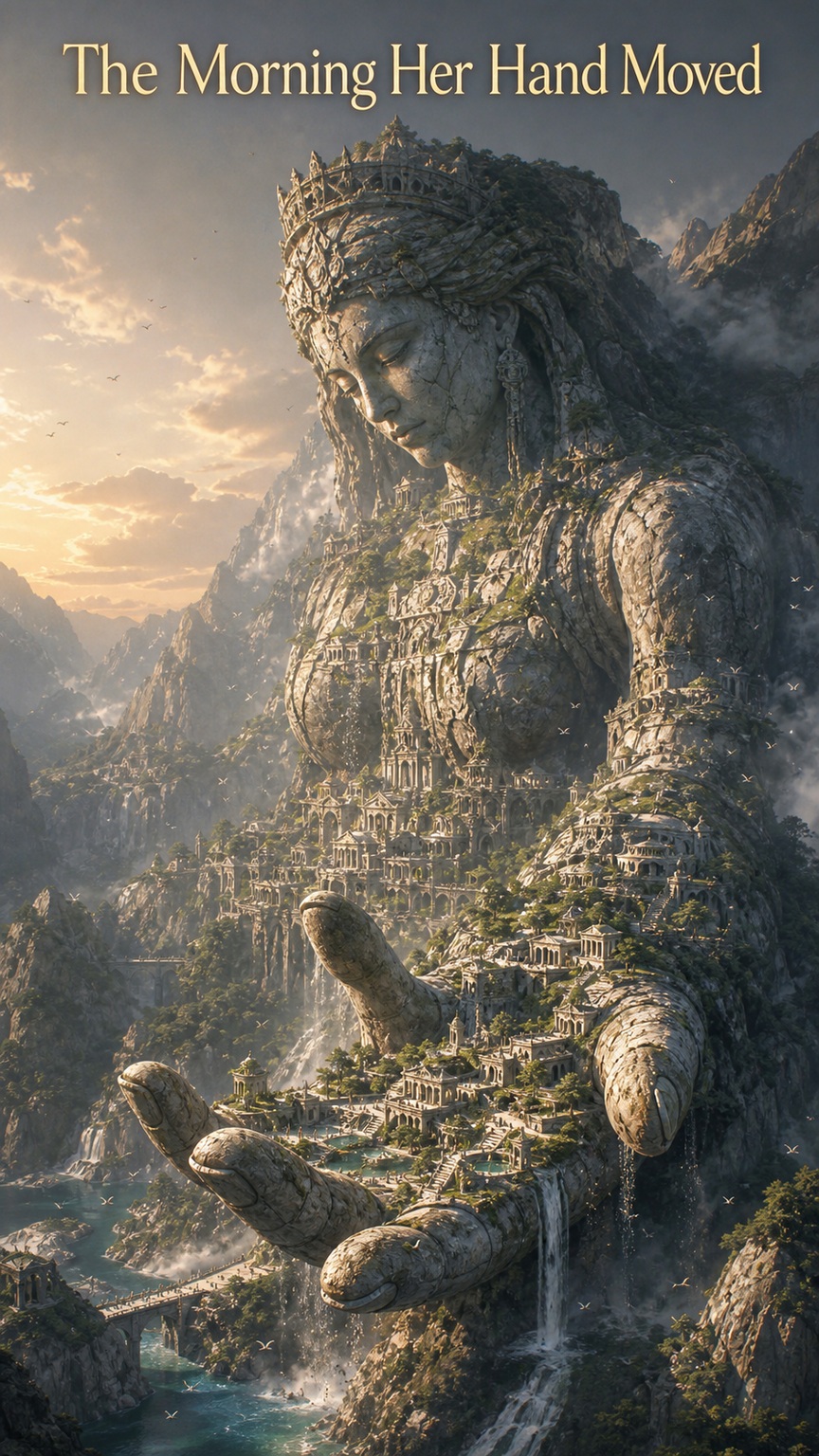
The water in the heel cistern was running uphill.
Zunel noticed because the white gauge float, which should have rested against the dawn mark, climbed the eastern wall of its cage and stayed there. Beyond it, the whole right palm lay in blue half-light: nearly two miles of crease roads, basin wards, and steep knuckle temples, all carved into stone that had been level since the oldest survey. The four fingers made a low black horizon. Between their roots, bells waited for sunrise.
The goddess lay supine beneath every place anyone knew: rib towns, throat stairs, ankle quarries, the gardens on this forearm. For a thousand years, the ledgers had said her death came before their beginning. They preserved neither a name nor an origin for her, only the work of living on what remained.
“Close the lower sluices,” she told the two waterkeepers. “Leave the forearm feed open.”
One stared at the tilted float. “The gate wheel’s below the waterline.”
“Then use the dry bypass.”
The other keeper was already running. Zunel set her tool case down and knelt. The street under her palm felt warm—not sun-warm, not yet, but a shallow heat moving just beneath the polished gray surface. It passed under her hand toward the fingers. Dust lifted from the joints between paving cuts and hung there.
A bell rang once behind her. Not a struck note. Its bronze mouth had swung on its own.
“Zunel!”
Aksor came down from the wrist gardens without his dawn mantle, carrying one of the red clay bowls in both hands. Water lapped over its rim at every step. Yeshal followed with a plumb reel bouncing against one knee.
“The first bowl warmed up-arm,” Aksor said. He was trying for the measured cadence he used at the garden tables. “Then every one down to mine at the wrist, in the order we fill—”
The stone struck the soles of their feet.
It was not an impact from above. The pressure came lengthwise through the goddess, from the unseen torso beyond the forearm gardens, and compressed the palm so broadly that the cistern cage gave one clean iron note.
“One,” Yeshal said. She caught her plumb reel before it fell. “Up-arm shafts crossed first. I think they crossed first.”
The second wave shoved water over the cistern’s eastern lip. All along the heel ward, shutters rattled inward.
“Two. The interval is shorter here. Or the clocks disagree. They may disagree.”
Aksor lowered his bowl to the street. Tiny rings ran across its water before the third compression arrived. That one made the crease road sound: a deep tone under the paving, too low to be heard in the ears alone.
“Three,” Yeshal said. “Three. There were exactly three.”
Zunel looked from the climbing float to the black finger horizon. “How long after the third up-arm?”
“Nine seconds at the first shaft. Perhaps eight. I can’t promise the clocks.”
At seven, the eastern bells began to swing.
At eight, the middle finger rose.
Its three joints changed angle without crumbling. The temple on its first knuckle tipped toward the palm, every lamp in its colonnade drawing a bright diagonal. Then the ring finger followed, and the smallest finger after that, slow enough for Zunel to see streets becoming slopes and fast enough that people spilled from doorways before any alarm keeper reached a rope.
She seized the heel bell and struck evacuation.
The first plan lasted eleven minutes.
Zunel ran for the main wrist avenue with her tool case hammering her thigh. Its broad bridge crossed the deepest wrist crease from the palm heel to the first forearm gardens. Beneath the deck, an aqueduct carried most of the hand’s stored water up-arm. If the avenue held, every litter and cart could leave on a road six abreast.
“Bring the cross-braces,” she told the bridge crew. “Clamp both lips before the heel rises.”
Behind her, Polaq was coming down the avenue against the first stream of residents, his register cords looped from shoulder to wrist.
“The finger relays are emptying,” he said. “Small knuckle sent two hundred six. Middle sent four hundred eleven but the temple undercroft hasn’t answered. A woman at the dye steps says her father can’t climb.”
“Put him on a shutter. Keep everyone up-arm.”
“She needs four carriers.”
“Then find four.”
The palm shifted beneath them. Not yet a jointed lift—only the consequence of the curling fingers. Water abandoned the outer channels and began to braid toward the center crease. Fruit carts rolled sideways until their owners caught the shafts.
Aksor reached the avenue as the crew laid the first iron cross-brace over the wrist crack. He put one bare foot on each side, then stepped off at once.
“Those sides don’t rise together,” he said.
“They don’t need to. The brace shares the load.” Zunel drove a holding pin through the near shoe. “West anchor first.”
“When I set the bowls along the crease, I level each side alone.” Aksor crouched and pressed his fingertips to one lip, then the other. “This one is rolling toward my heel. This one is drawing away.”
“I heard you.”
She had not. Polaq was listing unanswered terraces, Yeshal was calling pulse intervals from the forearm, and the avenue was still the only route wide enough for the infirmary carts. Zunel fastened the second shoe. The brace bowed as the gap widened beneath it.
“No more weight on the center!” she shouted. “Carts to the edges.”
“The edges are what are parting,” Aksor said.
The palm began to cup.
It happened first as a change in water. The heel cistern spilled out of its square and sent a silver sheet down the avenue toward the palm center. Farther away, whole channels reversed, carrying roof tile, baskets, and garden soil into the deepening hollow. Then the street itself bent. The palm-side lip rolled down while the wrist-side lip stayed high.
The cross-brace did exactly what Zunel had ordered: it fastened surfaces moving apart.
Its west anchor tore a slab from the avenue. The slab struck the aqueduct housing; a bright crack raced up the pipe. One bridge worker fell to her knees, still holding the pin maul.
“Cut it,” Aksor said.
Zunel was already sawing through the brace lashing. The iron sprang free hard enough to take her case into the widening crease. Half her instruments vanished without reaching bottom.
“Main avenue closed!” she called. The words hurt more than the lost tools. “Sever the aqueduct on the forearm side. Save the upper head.”
Yeshal caught her sleeve. “The wrist plumbs are changing. Not another three—this isn’t another set, I don’t mean that. It’s the same strain moving outward. The thumb shafts are next.”
Zunel pulled loose. “Which route remains?”
Polaq answered before Yeshal could qualify again. “Outer-wrist ledge. Single file past the lamp quarry, two abreast after. The medicine cart won’t fit. The goat pens will jam the turn. There are still one hundred thirteen in the heel ward, not counting whoever came down from the fingers.”
“Empty the cart into hand bundles. Release the goats up-arm one pen at a time.”
“People will go back for cistern jars.”
Zunel looked at the cracked aqueduct. The lower pipe bucked once, showering them with cold water.
“No one goes back.”
The outer-wrist ledge had been cut for lamp trimmers, not a city.
It ran along the little-finger side of the hand, skirting the heel above a drop into the wrist crease, then climbed to the forearm gardens. As the palm deepened, the first half leaned inward. As the wrist began to flex, the last half narrowed. A path that had been six feet across at dawn pinched to three, then less, its outer curb shedding chips into the dark.
Zunel moved against the evacuation, one shoulder to the wall. “Eight at a time through the pinch. Space the litters. No carts.”
“My sister has the fever medicine,” a man said. He held a sleeping child and nothing else. “She was behind us.”
Polaq touched the seventh knot on one register cord. “Herb vault group. They have six bundles and the blue fever case. Keep moving; I’ll mark the child with them.”
At the turn, a girl had wrapped both arms around a horned garden goat that refused the dark ledge.
“He won’t leave me,” she said.
Aksor took the lead rope. The phrase he began had the shape of a bowl blessing, but dust shook from the wall and the goat lunged.
“No. Put your foot flat,” he told the girl. “Flat. Hip to the wall. Give me the rope.” He drew his sleeve over his free hand, covered the goat’s eyes, and pulled it through.
Above them, stone columns broke from the smallest knuckle temple. The residents had emptied it minutes before. Its bell struck twice as the columns slid, then stopped when the whole portico went down toward the palm center in a cloud of pale dust.
The thumb turned inward next.
Zunel saw the change across the palm: the broad thumb mound rising like a hill pushed from below, the thumb itself sweeping over the inner stair. That stair had been the secondary road from the basin wards. Its upper landing touched the moving thumb for one breath and shattered. Water, benches, and a row of blue doors slipped into the new seam.
“Inner route gone,” she said.
Polaq coughed dust into his sleeve. “Sixty-two from the basin wards were on it.”
Zunel stared at him.
“Were. They turned at the potters’ arch. I counted them onto this ledge. Forty adults, thirteen children, seven carrying litters, two carrying the old dog in a grain sling. Sixty-two.” His next breath hitched. “But the undercroft group still hasn’t joined the middle-finger count.”
“How many?”
“Seventeen by the temple register.”
The ledge gave a brittle snap under the people between them. The outer curb dropped away for twenty feet, leaving a tilted strip scarcely wider than a bed plank.
Zunel lifted both hands. “Stop the rear.”
Nobody could hear over the bells. Polaq turned and shouted names instead.
“Temru! Hold your six at the quarry! Burmik, sit the litter down! Iveni, don’t bring the water jars into the pinch!”
The crowd stopped in pieces, one known group at a time.
Yeshal lowered a weighted line over the broken curb. It swung toward the forearm, then back toward the palm. “The wrist is lifting and turning. The rate isn’t steady. It may narrow again in forty seconds. Or thirty. The line catches wind here; it may be thirty.”
“Send them all,” Zunel said. “No spacing.”
“No.” Aksor had both hands on the litter at the pinch. His ceremonial voice was gone. “The strip kicks when the wrist pulls. Four, then wait. Knees bent. Watch my foot.”
“We don’t have time.”
“Then stop talking and hold this corner.”
Zunel took the litter pole. The first group crossed while Aksor counted through his fingers against the wall: touch, release, touch, release. The stone tightened under the fourth pair, relaxed under the fifth. Not a prediction, only a sequence the body had given them often enough to use once.
They staggered the crossing. Four residents moved; the bearers set a litter down; three goats were hauled through blind; a water carrier abandoned two jars and kept one. At every pull in the wrist, the ledge thinned another handspan. Zunel stopped calling the whole route and began listening for Aksor’s “Now.”
When the last visible group reached the forearm side, Polaq was not at the tally post.
“He went up-arm,” Yeshal said. “To the west herb shelter. The seventeen may be there. They may be; the pump-gallery mark isn’t a count.”
Zunel looked toward the bridge releases, then away. “No weights until he closes the register.”
The stone moved under her boots. Wrist first: the palm heel lifted, increasing the ledge’s slope until discarded jars rolled down-hand. Then the change traveled into the forearm. Garden terraces that had faced the sky tilted a few degrees toward the body’s outer side. Irrigation water climbed one row and drained from another. The forearm remained broad and comparatively level, but every old straight line on it had become an argument with gravity.
Aksor caught Zunel’s belt as the terrace lurched. “Knees loose. Don’t fight the turn.”
She almost pulled away. Routes, failure, load: those were hers. Then her heel slipped toward the outer irrigation row, and she let him pull her against the wall.
A brass hand bell sounded up-arm—three quick, one late—and Polaq appeared at the top of the garden steps.
“The seventeen crossed before the main avenue failed,” he said as soon as he had breath enough to speak. “Temru sent them through the pump gallery up-arm. Six undercroft keepers, four lamp children, three old residents, two cooks, the copyist, and the copyist’s son. All seventeen are in the west herb shelter. I saw them. I touched every register tile.”
“Full count?” Zunel asked.
Polaq swallowed and looked at his cords. “Five thousand two hundred eighty-one assigned to the inhabited hand districts at last night’s close. Five thousand two hundred sixty-four crossed the ledge or the main avenue under my count. Seventeen entered the pump gallery under Temru’s count and are present in the shelter. Five thousand two hundred eighty-one living residents accounted for.”
Only then did Zunel look up-arm toward the bridge counterweights.
The four counterweights hung beneath the forearm end of the ruined avenue, each a block of dense black stone taller than a person. In ordinary use they balanced the bridge deck. Dropped, they would strike an exposed shelf of the goddess’s wrist. The impacts would travel inward. The deck, relieved of their pull, would roll into the crease and make return impossible.
Aksor put his dawn bowl on the garden wall. Half its water remained.
“At the dawn tables, we set four bowls from forearm to wrist,” he said. “For the rooms below, I touch the shelf once at each setting. Touch, wait, touch. Four spaced touches. Not speech. Enough to be unlike one fallen tray.”
Yeshal checked the line of her plumb against the new angle of the terraces. “The three compressions traveled from torso to limb. Surface pressure travels inward too; the cistern hammers prove that. I can say the impacts will enter the stone. I can’t say where they go after. I can’t say they’re felt.”
“Four weights close the bridge,” Zunel said.
“The bridge is closed down-hand already,” Polaq replied. He was still breathless, still exact. “No residents remain beyond it. Two bridge workers want their tool chest. One waterkeeper wants the lower-gate keys. Nothing living is uncounted.”
Zunel looked across the wrist. The former avenue ended in air where her brace had torn out the slab. Beyond, the palm ward lay at an impossible angle, its water gathering in a shining lake along the central crease. The fingers curved above it. No path home remained that she could certify.
“Release one,” she said.
The bridge crew knocked out the first catch. The black weight fell twelve feet and struck.
The tone passed through Zunel’s boots and continued down-arm into the cupped hand, a clean pulse distinct from the long grinding of the wrist.
Aksor watched rings widen in his bowl. He waited until they vanished. “Second.”
The second impact followed. The bridge deck lifted on one side.
Yeshal counted under her breath, checking not the goddess but the interval they themselves could control. At her raised hand, Zunel freed the third catch. The weight struck; the deck’s outer rail twisted down into the crease.
“Last,” Aksor said, and could manage nothing ceremonial beyond it.
Zunel pulled the fourth release.
The final weight hit warm stone. Four separated tones had gone inward. The bridge rolled off its remaining balance shoes and settled steeply between the parting wrist surfaces, closing the return as completely as a fallen gate. With all four weights gone, no mechanism on the limb could raise it again.
No one spoke for a while. They were listening to the ongoing strain, not for an answer.
The wrist continued to rise. Dust streamed from the crease. Then, later—long enough that Yeshal checked two plumbs and reset one—the stone tone lowered. The forearm’s gradual turn slowed. Water in Aksor’s bowl crept toward its new edge and stopped there without spilling.
“The rate changed,” Yeshal said. “After the impacts, yes. Also after the thumb completed its turn. Also after the load shifted from the bridge. We don’t know which comparison matters. We don’t know that any of them matter.”
Zunel nodded. The hand rested cupped below them, holding floodwater, broken roofs, and the long shadows of its own fingers. It had not returned to stillness as they had known it. It had merely stopped moving for now.
By late morning, the forearm gardens had become a settlement of awnings and counted cups.
The terrace keepers objected when Zunel marked the seed sheds for families, and one refused to move a tray of winter shoots until Polaq found dry wall space for it. No one voted. No proclamation traveled down the arm. Work moved by argument, bell relay, and whatever width remained between the garden beds.
Zunel drew new routes in charcoal on the irrigation wall.
“Upper cistern to the fever shelter first,” Aksor said. He had divided the surviving bowl water among four infants before beginning the larger ration. “Then one cup each by midday. The goat trough gets drainage, not drinking water.”
“The west terrace can’t bear sleeping platforms and a full cistern queue,” Zunel said. “Put the queue along the second garden wall. Keep the center clear for litters.”
Polaq followed the charcoal with one finger. “The copyist’s son can’t manage those steps. The old dog won’t either. Give them the lower seed shed, and the blue fever case needs a runner every hour.”
“Mark both.”
Yeshal had set three plumbs where the forearm began to curve toward the wrist. “I need people who can call intervals without rounding them.”
“Two waterkeepers,” Zunel said. “They know level changes.”
“Not the one who lost the gate keys,” Polaq said. “He’s gone down the garden wall to look again.”
Zunel’s first answer rose sharp enough to send him after the man. She stopped it.
“Put a barrier at the broken avenue,” she said instead. “Then bring him back. The keys don’t open anything we can reach.”
Aksor pressed the charcoal into her hand before it rolled from the tilted wall. “And if the bowls warm?”
Yeshal answered while Zunel added a second route around the seed sheds. “Call warmth first. Then each compression separately. Don’t call motion until a joint moves.”
“Three bells for the waves?” Aksor asked.
“One bell, three counts,” Zunel said. “The evacuation bell stays separate. Polaq, set runners from here to the upper gardens. No one uses the wrist ledge without my inspection.”
Polaq looked toward the cupped hand, then down at his full register cords. “And the outer route?”
“Measure it every hour. Don’t promise it.”
He went to find the runners. Aksor carried the ration bowl to the next awning. Yeshal knelt beside her plumbs with a water clock between her knees. Zunel remained at the wall, assigning shelter loads and drawing paths on the forearm as it now lay: not the old straight streets, not a map beyond the day, but two ways to water and one clear way for the litters.