The Name the Water Took
You emerge from a hidden jungle pool only to discover the water has washed away more than your clothes—it has taken your name, your past, you have no memory of who you are or how you got there.
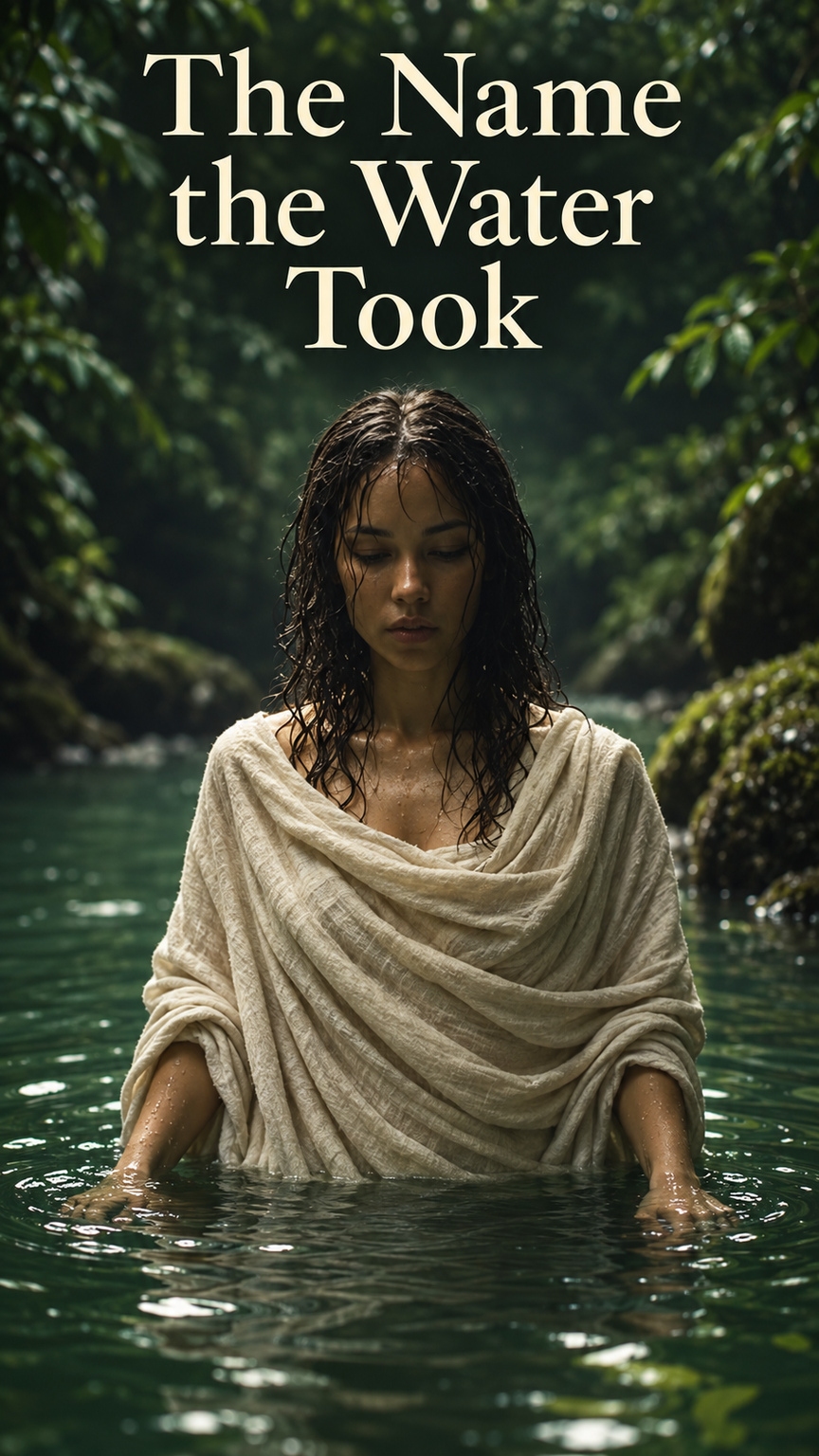
Braska came up choking on warm water and struck their shoulder against stone.
They found the edge by touch. Roots crossed it like knuckles. They caught one, hauled until their ribs cleared the surface, and stopped there because a person under the roots had drawn a knife.
The person was a lean woman with a strip of blood-dark cloth tied around one calf. Her other hand covered her eyes, though not the hand with the knife.
“Wrap first,” she said. “Then questions.”
A folded length of palm fiber lay on the stone between them. Braska reached for it. Water streamed from bare arms, bare chest, bare legs. No jewelry, no cord, no scrap of cloth. The exposure registered as a problem of insects and thorns before it registered as shame.
They dragged the wrap beneath their arms and around their torso, hitched the lower edge clear of their knees, and fixed it with a tuck that held on the first attempt. Their fingers knew how much twist the wet fiber would bear. They did not know whose fingers they were.
The woman lowered her hand. “Can you stand?”
Braska tested the shoulder, then each knee. A split on the left heel had reopened. Older cord burns crossed both wrists. “Yes. Where are my clothes?”
She looked at the pool.
Its surface was dark enough to return the green roof of the jungle, every leaf sharp between rings of falling water. Braska leaned over it and saw no face. Where their reflection should have broken the leaves, there was only an empty human shape, clear water bordered by pale lights. A collapsed shirt. Trousers. Boots. Belt. A knife in its sheath. Smaller glimmers lay among the stones.
They touched their own cheek. Warm skin, blunt nose, short wet hair. The empty shape touched nothing.
“Don’t put your head under again,” the woman said.
Braska shifted their weight off the cut heel. “Again.”
“They’re less than an hour behind me.” She glanced toward a gap under the roots, where a trail was not quite visible. “If you want an explanation, earn us enough distance to speak one.”
“Who are they?”
“Your survey.”
The phrase made no picture. Braska knew what a survey was. They knew how armed people spaced themselves on uncertain ground, how long a whetstone should kiss a blade, how to tell rain by the white undersides of leaves. None of that knowledge had a first occasion.
“And you?”
“Ioshka.” She put the knife away without relaxing. “They made me guide them. You were their route-captain.”
“My name?”
Her jaw moved once before she answered. “Braska.”
The name fit no better than the palm fiber. It was something handed over because nakedness was impractical.
A bird gave two hard clicks downslope. Ioshka turned at the first. Braska turned at the second and knew the interval was wrong: not a bird answering, but a stone knocked under a careful boot.
“Low way,” Braska said. “They’ll watch the ridge.”
Ioshka’s stare sharpened. “You still have that.”
“I have the ridge.” Braska ducked beneath the roots. “Show me the low way.”
Ioshka took three quick steps, then stopped and pointed rather than saying where. A mat of fern hid a narrow descent. Braska saw the broken tips left by someone passing uphill, the gray smear where a wet hand had touched bark, and two clean patches in the leaf mold. Ioshka had come this way. Two pursuers had not come this way yet.
They moved.
The jungle gave no straight line for long. Ioshka threaded between thorn fans and buttress roots, naming dangers only when Braska’s foot neared them.
“Red stem.”
Braska moved the foot.
“Not that vine. It powders.”
“How far to cover?”
“If the rain comes, near.” Ioshka checked the sky through a ragged opening. “If it doesn’t—there.”
She pointed with two fingers and doubled back around a fallen trunk. Braska followed her exact steps until the ground changed from damp black loam to stone. Then a habit, separate from decision, made them angle away from Ioshka’s prints and cross the stone on its bare ribs. Low sign. Split spacing. A hunter—or a route-captain—would have trouble counting them.
Ioshka noticed. “You taught them to do that.”
“Did you see me teach them?”
“I saw them wait for you to choose.”
“Was I their prisoner?”
“Not after they took me. Before that, I don’t know.”
That was not the same fact. Braska stored it anyway.
At the far edge of the stone lay a cord cut clean through. One half was caught around a sapling; the other dragged toward a patch of ash. Braska crouched. The cord had been doubled and drawn into a reverse turn, easy to tighten from behind, difficult for bound hands to loosen. Their own fingers completed the absent knot in the air.
Ioshka held up her wrists. Matching bruises ringed them.
“Mine?” Braska asked.
“Your knot.”
“That’s not what I asked.”
Ioshka rubbed one wrist with the heel of her palm. “You put it on. At the river fork. Later you cut it.” She nodded at the knife-sharp end. “I didn’t see what changed between.”
Ash shifted under Braska’s thumb. A scale of blackened hide showed beneath it, ruled in faint squares. A map, burned where it lay. Around the patch, three trees bore recent survey nicks. Every nick had been crossed out by a second blade stroke.
Braska looked back along their path. “You came to the pool after me.”
“Not after you. Behind you. There’s a difference.”
“You watched me enter?”
Ioshka opened her mouth, then looked upslope. Her hand flattened: quiet.
A branch creaked in the distance. Too heavy for a bird. Braska counted to twenty before the next sound. The pursuers were moving cautiously and losing ground.
Ioshka resumed in a lower voice. “You said your head was the last map. You took my seed wallet from their stores. Then you ran. I followed because you still had it.”
“And at the pool?”
“You dropped the marker cord. Put both hands on the rim. Went all the way under.” Her sequence broke there. She gestured downward, fingers closing. “Then you came up, and I heard them. I put the wrap where you could reach it.”
“You could have taken the wallet while I was in the water.”
“I looked.” Her chin tipped toward the pale glimmers they had left behind. “I know what full water does. I don’t know how to swim through a person’s lost things without paying the same price.”
Braska rose. “Shelter first.”
“Now you believe me?”
“Now I know what needs testing.”
The rain came as a hiss traveling through leaves. Ioshka led them to a shallow shelf beneath a tilted slab. Water curtained the entrance but did not reach the dry back wall. There she unwound the cloth from her calf. The cut beneath was shallow, packed with crushed yellow pulp.
“That leaf closes flesh?” Braska asked.
“It slows blood. The blue-veined one closes flesh. It also stops the heart if you use too much.” She inspected the knot Braska retied around the poultice. “You pull like you expect a prisoner to test it.”
Braska eased the knot half a finger. “Better?”
“Less familiar.”
For a while the rain did the speaking. Braska stripped fibers from a hanging vine, rolled them against their thigh, and made a line. A hook was harder without metal. They chose a fallen branch with a fork, shaved one tine against the slab’s rough edge, bent it under tension, and bound it. Their hands supplied each motion. They could not say where the motions had been learned, or on whom those knots had first been tightened.
Ioshka watched from the entrance. “The wallet has six pockets. Keep it dry when you pull it out.”
“What’s in them?”
“Food, if the next wet season is wrong.” She counted on her fingers, not looking at Braska. “Climbing bean. Bitter squash. Two hill rices. Redroot. A gourd that holds through flood.” Her thumb found an empty fingertip and pressed it. “And a marsh reed. No. Not reed. Pepper. The reed was traded before they took me.”
“Who needs them?”
Ioshka looked toward the rain instead of answering. “People who don’t need a marked trail leading to them.”
Fresh water coursed off the stone, carrying a sliver of charcoal across Braska’s foot. Someone had destroyed a map and crossed out marks. Someone else had first made those marks. Both sets of cuts might belong to the same hand.
“The pool gives nothing back?” Braska asked.
“Objects, yes, if you hook them and wait for them to dry. Then something from the last time you used each one. Hands, skin, sound. Once.”
“A memory.”
“A flash. Don’t make it larger. My uncle pulled his cooking spoon out and tasted burned yam from the night before. It didn’t tell him why he’d gone in.”
“If I submerge now?”
“You lose this morning too.”
Braska finished the hook and pulled the binding hard. “We circle back when the rain stops. They’ll take the direct trail and reach the pool before dusk.”
Ioshka’s attention went to the hook, then to Braska’s hands. “You’re willing to go back for seed you don’t remember taking.”
“You came back while hunted. That tells me enough.”
“It means I can’t leave it.”
Braska tightened the last binding. “Then we go back.”
The rain thinned. They left by the back of the shelf, where a fig root split the slope. Ioshka chose the first turn. Braska chose where they crossed runoff and where they stepped in it to break their scent and spoor. At a fork, Ioshka started to name the left path, stopped, and drew a short curve in the mud instead. Braska erased the curve after understanding it.
They reached the pool from above.
No one waited at the rim. A new marker of peeled bark gleamed on a trunk downhill: the surveyors had found the approach and were close enough to prepare their exit. Braska cut the pale strip away with a sharp flake of stone and tucked it under rotten leaves.
Ioshka lay behind a root shelf, watching the trail. Braska anchored the vine around their waist and crawled to the edge. The pool still reflected a hard green sky and, at its center, Braska’s absence. Pale objects circled that empty shape as if resting on invisible ground. The image did not follow Braska’s breathing or notice the hook. Water, light, stone. Nothing in it waited to answer.
The forked branch scraped a boot on the third cast. Braska drew it up, emptied it, and set it in a blade of sunlight. When the last bead vanished from the leather, the jungle dropped away.
Weight struck through both soles. Mud sucked at the heel. Braska’s breath tore hot in their throat as they ran downhill, chose a root without looking, pushed off, and drove toward a slice of dark water ahead. Behind them, a man shouted, “Captain!”
Then Braska was kneeling beside an ordinary wet boot.
Ioshka had turned from the trail. “What?”
“I ran here. Deliberately.” Braska pressed a thumb into the boot’s worn heel. “Someone called captain. Nothing before that. Nothing about why.”
The second boot gave only the other footfall from the same final stride: toes cramped inside leather, the ankle turning to avoid the split stone. Braska did not pretend it was a second witness.
Next came a compact coil of waxed cord from the drowned belt. As it dried, their hands filled with its working end. Left thumb held the crossing. Right hand pulled the reverse turn snug around two wrists while those wrists twisted. Ioshka’s breath was close and furious. A voice—Braska’s own—said, “Keep still.”
The flash ended with the bite of fiber against their palm.
Braska set the coil down. “I tied you.”
“I told you.”
“You did.” They took up the hook. “The knife.”
The sheath came first and left the remembered pressure of a palm keeping it silent against a hip. The knife itself lay deeper. When Braska finally lifted it, water poured silver from the blade. They dried it on the sun-warmed stone.
Smoke scratched the back of their throat. Their fist held the knife; the edge sawed through the survey’s taut route cord while fire consumed the gridded hide at their knee. Ioshka stood free beyond the smoke, clutching one wrist. Braska heard themselves say only, “Go low.” The last fibers parted under the blade.
Again, no reason arrived with the act. No knowledge of what Braska had believed one hour earlier. Only pressure, smoke, motion, and a cord cut through.
Ioshka had looked away before the flash ended. “Wallet,” she said.
It glowed below the blank reflection, a small rectangular light near the belt. Braska lengthened the hook by knotting on the pool’s lost marker cord. Their fingers made the join fast, with a turn designed not to slip under a dragging weight.
Ioshka caught their wrist. Her grip lasted no more than a breath. “Downhill. Two.”
Boots sounded through wet leaves.
The older surveyor entered first with a short spear angled across his body. A younger one followed, carrying a coil of white marker cord and a knife too clean for the mud around them. Both saw Braska and checked without being told. Their spacing opened to contain the pool.
The older man’s gaze traveled over the palm wrap, the recovered boots, the knife. “Captain. Report.”
Braska kept one hand on the hook line. “Name me.”
“Enough.” He pointed the spear at the water. “Recover your disk. Dress. We withdraw on the marked route.”
The younger surveyor saw Ioshka’s ankle behind the root. “Guide on the north edge.” His voice quickened. “I’ll take her. Captain can secure the line.”
Ioshka shifted. A seedpod cracked softly under her knee.
“You know I went under,” Braska said.
The older man answered without looking at the pool. “I know you ran. The rest is an excuse.”
“What did I destroy?”
“The master hide,” said the younger one. “The final cord. Three weeks of approach marks. We can reconstruct if the guide cooperates.”
The older man’s spear moved a handspan toward Ioshka. “She’s feeding you a defense. Stop.”
Braska read their stance. The older man was counting on a captain’s obedience even while he denied Braska the title’s authority. The younger had taken the old formation: spear pressing center, second person closing the open side with cord.
“A copy?” Braska asked.
“You forbade one past the black ridge,” the younger said. “Held the final approach in your head. Sensible security until you burned the rest.”
The facts locked together. After burning the copy, Braska had carried the last approach here and submerged it out of reach. Nothing in that sequence explained why they had led the survey far enough to make the map, or why they had bound Ioshka before cutting her free.
“I ordered no—” The older man stopped, jaw tightening. “Captain, stand away from the guide.”
Ioshka’s hand opened near the ground. Not surrender: four fingers spread toward the concealed root descent, thumb tucked. Four body lengths.
The hook trembled against something below.
“My wallet,” Ioshka said. “Pull.”
Braska pulled.
The younger surveyor lunged for the line. The older drove the spear across the path to pen Ioshka against the pool. They were fast, and they were exactly where Braska’s body had expected them to be.
Braska let the vine run slack. The younger stumbled one step past its weight. Braska caught the shaft of the spear under one arm, not fighting its point but carrying its force sideways, and stepped inside the older man’s reach. Their recovered knife came free. One cut opened the marker coil at the younger man’s hip. White cord spilled around his boots.
“Captain!” he shouted, more offended than afraid.
Braska cut the spear’s wrist loop. The older surveyor recoiled to keep his weapon. That gave Ioshka the width of a shoulder. She slid past him, kicked the loose marker cord into the pool, and caught the hook line before it followed.
“Left root,” she said.
Braska moved left. The older man thrust where they had been. Braska knocked the spearhead against stone with the knife’s spine, then dropped rather than contest his strength. Their hand found the peeled-bark marker at his belt and tore the bundle free.
The younger man had untangled one foot. “You released the guide. You destroyed the only recoverable route. That report carries your seal, not ours.” His words came faster as Braska stopped answering. “Return her and we can record impairment after exposure. We can still contain this.”
Braska saw the disk then, pale beneath a shallow shelf. One short cast caught its thong. They drew it out while Ioshka kept the wallet’s light pinned with the other branch of the hook.
The disk dried in Braska’s palm. A brief pressure crossed their knuckles: the same hand holding metal flat against a belt so it would not click while they ran. That was all.
On the ordinary face, cut deep enough to survive years of handling, were the words BRASKA, ROUTE-CAPTAIN.
Ioshka glanced at it. “That was on you at the river fork.”
Braska tucked the disk under the wrap.
The older surveyor recovered his stance. “Route-Captain Braska. Last command. Put down the knife.”
The two surveyors held their open formation. Ioshka kept one hand on the hook line and the other near her knife.
The hook line jerked. A small leather wallet broke the surface.
Braska caught it. As water left the seams, their body gave them its single scrap: the wallet shoved beneath the belt, one hand covering it while the other cast a burning route cord into mud. Seeds clicked inside. Ioshka said from somewhere behind, “You don’t get to lose that too.” Braska’s remembered hand tightened to keep the wallet from falling.
Then there was only leather, six swollen pockets, and the living Ioshka reaching for it.
Braska passed it to her.
The surveyors moved together. Braska threw their peeled markers into the pool, cut the remaining line at the rim, and shoved the free length after them. Pale curls sank into the empty reflection. The older man checked his advance rather than risk full submersion. That pause was enough.
Ioshka dropped through the concealed root descent. Braska backed after her, knife low. The younger surveyor seized the top root; Braska cut not his hand but the vine supporting the loose screen of deadfall above it. Wet branches collapsed across the opening. Not a permanent barrier. A costly one.
Below, Ioshka was already crossing the slope. “Stone channel,” she said, pointing with the wallet. “Before the runoff fills it.”
Braska followed, then stopped at a forked root and dragged a fallen trunk across the upper descent. The pool remained reachable. So did the choice to enter it again and discard the morning: Ioshka’s limits, the cord burns, the disk, the smoke in Braska’s throat as the route line parted. Braska wedged the trunk until the easy path back closed.
When they caught Ioshka, she held out the recovered boots. “Wear them or carry them.”
Braska pulled them on. “Which side shows less?”
“In the channel, none. After the red stone, south bank.” She adjusted the wallet under her arm. “I go first.”
“You know the route.”
“I know this part.”
They entered the stone channel before the first runoff reached their ankles. Ioshka chose where to leave it. Braska came out last, lifted the fern stems she had bent, brushed grit from the red stone, and took the exposed rear while she searched the unmarked ground ahead.