The Names on the Cups
Every Sunday, a café owner writes the same names on the same cups and watches a quiet chain of longing unfold: Nora pines for the dazzling Rae while Claire waits for Nora to notice her. After rejection breaks the pattern, Nora must learn the difference between falling for a story she invented and truly seeing the person in front of her.
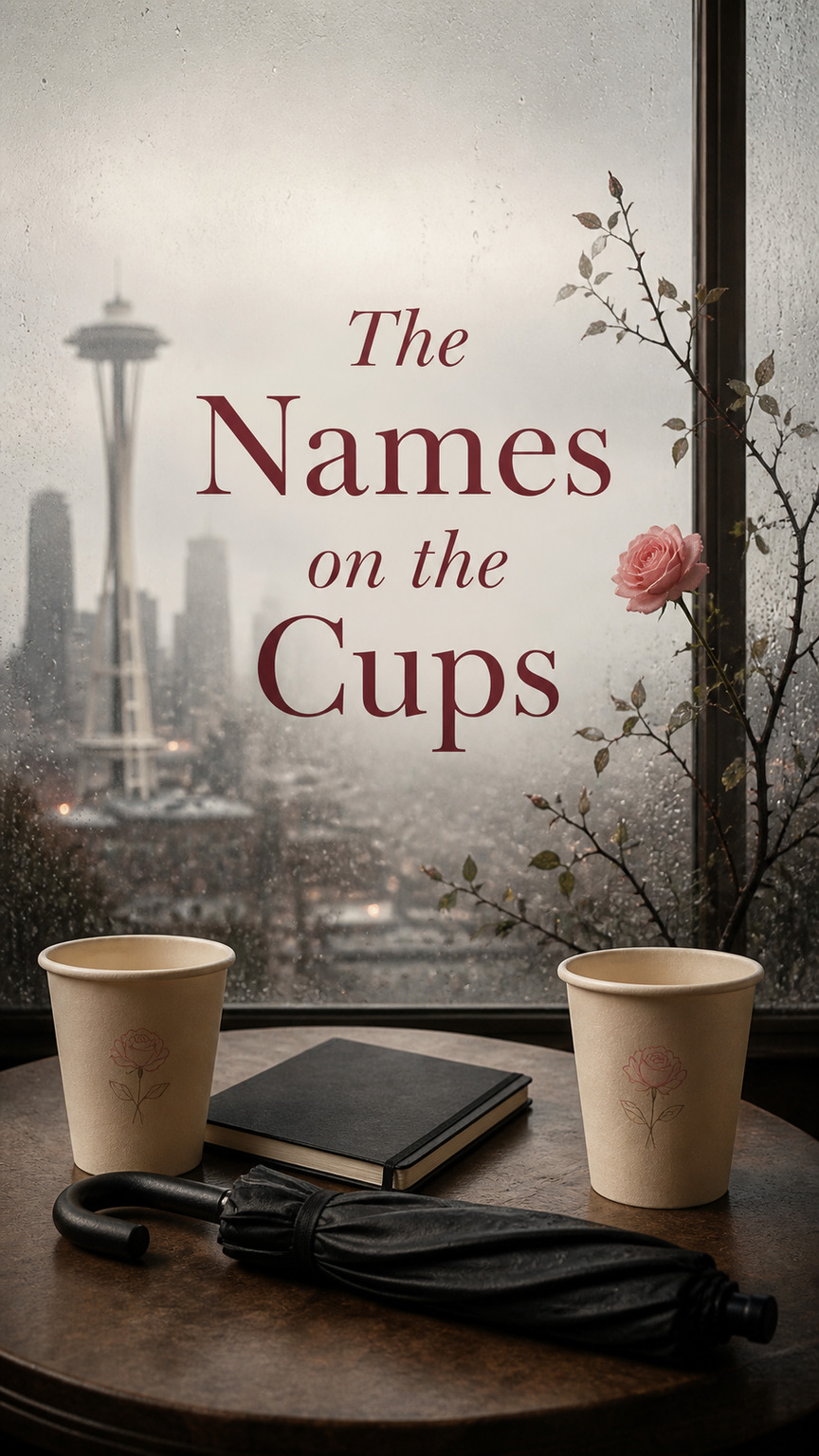
In Seattle, rain did not fall so much as move in.
By October it had keys. By November it knew which mug you liked. By December it was standing barefoot in your kitchen at midnight, eating cereal from the box and saying, What? I thought we were close.
So yes, Nora came in wet every Sunday. Everyone did. But Nora arrived at exactly 10:17, which made her different. People who arrive at 10:15 are punctual. People who arrive at 10:30 are relaxed. People who arrive at 10:17 are either avoiding something or timing themselves against a bus schedule.
With Nora, I suspected both.
My café sat on Capitol Hill, at Broadway and Mercer, where the hill briefly pretended it was not a hill. The front windows gave us the whole Sunday parade: runners coming down from Volunteer Park betrayed by their own ambition, couples disagreeing softly at the crosswalk, and dogs with better rainwear and emotional regulation than their owners. The Mercer side had our delivery door, two dented bins, and a rosebush that technically belonged to the next building but spiritually belonged to me, because I was the one who apologized whenever the compost truck backed into it.
The café was called Hinge. It was not named after the matchmaking service. My Hinge had been on the awning first, and there was no connection beyond the alarming human appetite for metaphor. I had meant a door hinge, a neighborhood hinge, the small piece on which a room might open.
No one understood this. People assumed I was desperate or ironic. I had made peace with both.
On Sundays the windows fogged by ten. The room smelled of espresso, wet wool, butter, cardamom, and the faint panic of people who had promised themselves they would answer messages before lunch. Tess worked the counter with me. She was twenty-three, terrifyingly observant, and devoted to the proposition that a name written incorrectly could ruin a morning.
“You gave Jonathan an m yesterday,” I reminded her once.
She looked at the cup on which she had written JOMATHAN. “He mumbled.”
“You cannot hear an m into existence.”
“I heard uncertainty.”
Jonathan turned the cup around, considered the evidence, and said, “Honestly, I’ve had worse weeks.”
Tess made him a new one anyway. For all her theories, she cared. Children got stars if they asked. Regulars got flourishes if they had established a preference. Frank, an older man who ordered steamed milk every Sunday “for himself” and then set it under the table, got no decoration at all, because Captain drank from anything with the solemn entitlement of inherited wealth. Captain was Frank’s gray terrier. The name caused confusion only until one met him, at which point it seemed less like a title than a statement of jurisdiction.
Nora first came into focus because of Tess’s marker. She paused just inside the Broadway door in a green coat, shook rain from her sleeves, and looked at the menu as if the cardamom latte might have escaped overnight.
“Small cardamom latte,” she said. “For here.”
“Name?” Tess asked.
There was the smallest pause, as if the woman had been asked to hand over something breakable.
“Nora.”
Tess printed NORA in four clean letters.
After that it was always Nora, always 10:17, always a small cardamom latte and an almond croissant she selected with elaborate false suspense. She sat at the window beside the radiator, opened a quiet-looking novel to page fourteen, and failed to read it.
At 10:26, Rae arrived.
Rae was a woman in her thirties with a red scarf, a shaved undercut, a gold ring in one nostril, and boots that sounded expensive but behaved badly on wet tile. She ordered black coffee, dropped loose change in the tip jar even when paying another way, and carried the Sunday crossword to the communal table. She completed it in pen. This told me a great deal about her and almost none of it was reassuring.
Nora wanted to ask Rae out so badly it changed the air pressure in the room.
She watched Rae worry the end of her pen. She watched Rae smile when a clue surrendered. Whenever Rae turned toward the window, Nora looked down fast enough to risk injury. The novel remained open to page fourteen for eleven Sundays.
Nora was not the only person watching.
Claire arrived at 9:09, before Nora, before Rae, before Frank and Captain and most of the stroller traffic. She was an adult woman with honey-blond hair cut at her jaw, worn leather boots, and a black turtleneck that seemed to belong to a more disciplined climate. She came from the Mercer side, stopped by the rosebush, and then sat beneath the crooked ferry print in the back corner with plain tea and a sketchbook.
“Claire,” she told Tess the first Sunday.
Tess wrote CLAIRE. Claire smiled at the cup, a quick private smile of relief at finding herself spelled correctly.
She watched Nora.
Not constantly. Not obviously, unless observation was part of your livelihood or your favorite vice. She looked up when the Broadway door opened at 10:17. Her pencil paused when Nora laughed at Captain. She knew, before Nora did, when Rae’s red scarf appeared on the other side of the glass.
Nora looked at Rae. Rae looked at the crossword. Claire looked at Nora. I looked at all three because I had a business to run, and because rain makes people think glass is privacy.
By the sixth Sunday, Tess had drawn a chart on receipt paper.
“No,” I said.
“It helps.”
“It reduces three grown women to outerwear and beverages.”
The circles were labeled GREEN COAT, RED SCARF, and TEA GIRL. Arrows ran in one direction. Tess had put hearts beside the arrow from GREEN COAT to RED SCARF and a small skull beside the arrow from TEA GIRL to GREEN COAT.
“The skull is unkind,” I said.
“The skull is narrative compression.”
“Do not narratively compress the customers.”
“We could swap their cups.”
“We will not.”
“One strategic misspelling?”
“Also no.”
I folded the chart and put it below the counter instead of throwing it away. At the time, I mistook theatrical disapproval for ethics. A person can say I have boundaries while keeping the receipt chart within reach. It does not make the chart less of a chart.
On the eleventh Sunday, Nora finished paying and did not retreat to page fourteen.
“Can I ask you something?” she said.
Tess became very busy arranging lids in perfect silence.
Nora glanced toward Rae, who was negotiating with a six-letter word.
“Does she ever come here with anyone?”
There are questions a café owner should answer simply. There are questions a café owner should not answer at all. This was the second kind.
“I don’t report on customers,” I said. “Not who they come with, not when they come, not what they order.”
Nora flushed. “Right. I’m sorry.”
That should have been the end of it.
Behind me, the folded chart waited beneath the till like evidence.
“You could ask her,” I said.
Nora stared at me as if I had suggested she swim across Lake Union in boots.
Then Rae laughed at something in the crossword. Just laughed, alone, at a clue that had pleased her.
Nora picked up her almond croissant, crossed the room in a determined straight line, passed Rae without speaking, deposited the croissant in the bin, and left through the Broadway door.
The bell gave a cheerful jingle. It felt cruel.
Rae looked up. “Was that about me?”
I wiped a clean patch of counter. “Not mine to say.”
It was the right answer, arriving several minutes too late to make me righteous.
At the back table, Claire closed her sketchbook. A loose page caught against the cover and folded outward. I saw Nora’s profile before I understood what I was seeing. Then another Nora beneath it: Nora looking out the window, Nora holding her latte under her chin, Nora smiling down at Captain. Small pencil studies, careful enough to be recognizable.
I looked away. Claire had already seen my expression.
“I know,” she said.
Tess stopped moving lids.
Claire pressed the page back into the book. “She didn’t know. I should not have drawn her over and over without asking.”
I could have let embarrassment appoint me judge. Instead I felt the edge of the receipt chart through the counter as clearly as if it had been in my hand.
“We didn’t ask before making a story out of all of you, either,” I said.
Claire’s eyes moved from me to Tess. She did not ask what I meant, and I was grateful not to have to show her.
“I’m going to stop,” she said. “Drawing her.”
She put money under the cup, tucked the sketchbook against her ribs, and left by Mercer. At the rosebush, she usually paused. That day she kept walking.
I took the chart from beneath the till and laid it flat.
Tess looked miserable before I said a word.
“No charts,” I said. “No codes on cups. No swapping cups. No visit histories, no theories delivered as facts, no romantic intervention.”
“I know.”
“Correct names and good coffee.”
“Tea too.”
“Exceptionally good tea.”
We tore the chart into pieces too small to reconstruct and dropped them in separate bins, because Tess said a single-bin disposal lacked ceremonial force.
The next customer told her his name was Paul. Tess wrote PAUL? without thinking.
Paul turned the cup toward himself. “Am I a question?”
Tess’s face fell. “No. I’m sorry.”
She made a fresh cup, wrote PAUL, and handed it over without commentary.
It was a small repair. Most useful ones are.
The following Sunday, rain came sideways. Broadway gleamed black, the gutter at Mercer had become a fast gray river, and Route 49 exhaled six passengers who looked personally betrayed.
Claire arrived at 9:09 carrying a plain black umbrella. She stopped at the counter after I gave her the tea.
“I owe you an apology,” I said. “We had been watching you watching. We turned it into entertainment. That ended.”
Claire studied my face with an illustrator’s patience.
“Did you tell Nora?” she asked.
“No.”
“Did you tell anyone about the drawings?”
“Only Tess saw the page when it opened. It goes no farther.”
Tess nodded once.
Claire’s shoulders loosened, though not all the way. “Thank you.”
She went to the back table and opened her sketchbook to a page I could not see. She kept the umbrella propped beside her chair.
Nora arrived at 10:17 without the green coat. She wore a blue sweater too thin for the weather, and her hair dripped onto its collar. Tess wrote NORA on the cup, plain and careful. Nora took her small latte to the window.
At 10:26, Rae did not arrive.
At 10:34, Nora looked toward the door for the seventh time. At 10:41, she gave up the pretense of reading. At 10:48, Claire closed her sketchbook.
Tess reached beneath the counter for nothing at all, caught herself, and began polishing the milk pitcher.
Claire carried the umbrella to the window table but stopped well outside Nora’s reach.
“Nora?”
Nora looked up with the faint recognition one gives a person who has occupied the background of the same room.
“May I say something?” Claire asked.
Nora looked at the umbrella, then at Claire. “All right.”
“You don’t bring one. An umbrella.” Claire’s grip tightened on the handle. “I noticed because you come in soaked. I bought this one this morning, but I don’t want it to be a bargain. You don’t owe me a conversation, or anything else. You can say no.”
Nora blinked. “You bought me an umbrella?”
“That is the accurate and unfortunate shape of the sentence.”
Despite herself, Nora smiled.
Claire did not take encouragement from it. “There’s more, and it’s worse.”
“That is not usually how gifts work.”
“I drew you.” Claire glanced toward the sketchbook in the back. “Before we met. Studies, not—there isn’t a version that sounds better. I realized I had made you into material without asking. I stopped. I’m sorry.”
Nora’s smile disappeared. She sat back. “You drew me?”
“Yes.”
“That’s a little strange.”
“It is.”
Claire did not explain herself into innocence. She did not say she had meant well, although she probably had. Meaning well is not a key that opens every locked door.
“Why tell me now?” Nora asked.
“Because offering you this while hiding that felt worse.” Claire set the closed umbrella against the empty chair. “You can take it, leave it, or tell me to take it away.”
Nora looked out at the rain. A bus sent a fan of water over the curb. Then she looked toward Rae’s empty seat.
“I’ll borrow it,” she said. “The umbrella. I don’t know about the rest yet.”
“That’s fair.”
Claire returned to her table. She did not look back to see whether Nora touched the handle.
Nora touched it.
At 10:56, the Broadway bell rang and Rae came in soaked, laughing without dignity.
“The bus stopped for ten minutes and refused to discuss its motives,” she announced.
“Black coffee?” I asked.
“Please. I’ve aged.” Rae was plainly still a woman in her thirties, but rain had plastered the red scarf to her shoulder and removed some of its legend.
While I poured, Nora stood. Her face lost color. She looked once at Claire, who kept both eyes on a drawing that could not possibly have required that degree of concentration.
Nora walked to the counter.
“Hi,” she said to Rae.
Rae smiled. “Hi.”
“I’m Nora.”
“I know. Your cup faces the room every Sunday.”
Nora looked at the cup in her own hand as though it had betrayed a confidence. “Right. You’re Rae.”
“Also according to the cup.”
“Would you like to get coffee with me?” Nora closed her eyes. “Different coffee. Or this coffee, but intentionally. Not right now. A date is the word I’m failing to say.”
Rae took one breath. Not a theatrical breath, not a cruel one. Merely the breath of an adult choosing clarity over speed.
“Thank you for asking,” she said. “No. I’m seeing Highway.”
The room seemed to notice. Rooms do that, though usually it is the people in them pretending they have not.
Nora nodded too many times. “Of course. That’s good. I mean, not the no. The seeing someone. I hope. I don’t know Highway.”
“You don’t have to make my answer comfortable for me,” Rae said gently. “You asked well. I’m answering plainly.”
Nora swallowed. “Thank you.”
Rae moved aside instead of touching her, apologizing for herself, or offering a consolation friendship no one had requested.
Nora turned toward the window. For one second I expected the Broadway door to claim her and another pastry to die. Instead she walked back to her chair and sat down. Her knees seemed unreliable, but they held.
Tess had gone motionless beside me. I put a tray in her hands.
“Table six needs clearing,” I said.
“It does not.”
“It could be clearer.”
She went. On her way, she steered two curious customers toward the sugar station with such efficient hospitality that I nearly applauded.
Claire waited a full minute before approaching Nora.
“Alone,” she asked, “or quiet company?”
Nora looked up. Her eyes were bright, but she was not crying. “Quiet company.”
Claire sat in the empty chair. She did not mention Rae, the umbrella, or the drawings. For a while she said nothing at all.
At eleven fifteen, Nora opened her novel to page fourteen. At eleven twenty, she turned the page.
They stayed until noon. Nora finished the same small latte she always ordered. The umbrella remained closed beside her chair. Companionship had begun; no one had promised what kind.
Rejection did not transform Nora into a wiser person by the following Sunday. This was disappointing to Tess, who believed emotional development should respect staffing schedules.
Nora came in at 10:17, saw Rae at the communal table, and looked immediately at page fifteen. Rae lifted two fingers in greeting and returned to her crossword. No one combusted.
Claire had moved from the back corner to a table near the bookshelves. She was drawing the radiator valve. Either that or a very mechanical root vegetable. She did not look up when Nora entered.
The next Sunday, Claire did not come at all.
Nora’s gaze went first to the empty bookshelves table. Only afterward did she notice the red scarf at the communal one. She ordered her small latte and read four pages badly.
“Do not say anything,” I told Tess.
“My mouth is a workplace of restraint.”
“Your eyebrows are violating policy.”
On the Sunday after that, it rained with quieter determination. Nora arrived carrying Claire’s black umbrella open above her head. She came through the Broadway door dry, collapsed it carefully, and caught Claire watching from the bookshelf table.
For the first time, Nora crossed the room toward Claire without borrowing courage from anyone else’s arrival.
“Do you want this back?” she asked.
Claire looked at the umbrella. “No. You may keep it.”
“May?”
“I am trying to sound like a person who has learned boundaries.”
“It sounds a little like a museum label.”
“Do you write museum labels?”
Nora paused. “Yes.”
“That was a guess.”
“It was alarmingly accurate.”
Claire smiled, then let the smile go without using it to pull Nora closer.
Nora pointed at the neighboring table. “Could I sit there for eight minutes?”
“Why eight?”
“Five would look like I wanted to escape. Ten would feel like a commitment.”
“Eight is famously free of meaning.”
“Exactly.”
Claire checked the clock above the pastry case. “All right.”
Nora sat at the next table. They both opened books. Six minutes passed before Claire asked what Nora was reading. Nora looked at the cover as though she had forgotten the book possessed one.
At eight minutes, Nora closed it.
“Time,” Claire said.
“Would nine be reckless?”
“Deeply.”
Nora stayed for twelve.
The week after, the umbrella opened again in the rain. Claire had stopped drawing people; that much was visible because her sketchbook showed cups, chair legs, the winter rosebush, Captain’s left ear after Frank gave permission, and once an extremely judgmental croissant. Nora noticed the choice without being asked to reward it.
She began taking the neighboring table without setting a timer.
In December, Nora came to the counter while Claire held plain tea in both hands and waited for it to cool.
“What kind does she actually like?” Nora asked me.
I knew. Of course I knew. I knew which tin Claire considered before defaulting to the plain black tea, which add-ons she declined, how long she let the cup stand before the first sip. Once, I would have mistaken this inventory for intimacy and offered it proudly.
“Ask Claire,” I said.
Nora leaned on the counter. “You sell her the tea.”
“I sell her what she requests. That is not the same as knowing what she likes.”
“You know what everyone likes.”
“I know what they buy here. You want a person, not a purchase history.”
Nora accepted the rebuke. The flat look she gave me suggested enjoyment was not included. She went to the neighboring table and asked, “Do you like plain tea?”
Claire considered the cup. “Not especially.”
Nora looked over at me. I made the great sacrifice of not looking triumphant.
“Then why do you order it?” Nora asked.
“It is the easiest decision. I make color decisions all week.”
“What would you choose if it wasn’t easy?”
Claire came to the counter with Nora. She smelled three open tins and chose honey-ginger because, she said, it tasted bright without pretending to be summer.
“May I get it for you?” Nora asked.
Claire looked at her, not at the menu. “Yes.”
Tess made the tea and wrote CLAIRE. Nothing else.
They carried it to the bookshelf table together. The café was briefly quiet: Frank read the paper while Captain slept under his chair, and Rae had not yet arrived. I could hear Nora and Claire without straining, which mattered to my conscience more than it would have a month earlier.
Claire touched the cup sleeve. “I want to apologize properly for the sketches.”
Nora’s shoulders tightened. “All right.”
“I watched you because it let me feel close without having to risk being known. That was about me, not permission from you. I stopped. I have not shown the pages to anyone. I can destroy them if you want.”
Nora stared at the steam. “I don’t want to see them.”
“You won’t.”
“And don’t draw me again unless you ask me first.”
“I won’t.”
“I don’t know whether you should destroy them.” Nora looked directly at Claire. “I know I don’t want them used, shown, or turned into a gift to me. Closed is enough, if it stays closed.”
“It will.”
Claire did not ask whether she was forgiven. Nora did not offer instant absolution to make the table comfortable. The honey-ginger tea cooled between them.
Then Nora asked, “What do you draw when you aren’t drawing strangers?”
Claire answered carefully. “Mostly things that cannot mind.”
It was not a joke exactly, but Nora smiled. Claire opened the sketchbook to the current page and asked, “Would you like to see the radiator valve?”
“Very much.”
Claire turned the book around.
The old pages stayed closed.
January made the city gray enough that the café’s paper lamps seemed brave. By then Nora and Claire had stopped measuring their conversations in minutes, though they still approached each other with the caution of people carrying full cups over uneven ground.
They learned each other in sentences.
Nora designed museum labels. She spent her weekdays compressing objects into seventy-five accurate words while committees tried to replace every clear verb with represents.
“I am thirty-one,” she told Claire one Sunday, “and I have lost arguments to punctuation three weeks in a row.”
Claire stirred her honey-ginger tea. “I’m twenty-nine, and yesterday I spent forty minutes explaining that a child cannot identify a mushroom from a drawing of only its charming side.”
Claire illustrated field guides and children’s nonfiction. She believed the underside of a leaf mattered because that was the side a child holding it would actually see. She disliked captions that tested readers instead of helping them. She liked open endings only when open meant the characters remained alive and capable of choosing, not that the writer had wandered off.
Nora liked quiet novels in which everyone felt terrible near water.
“That is not a genre,” Claire said.
“It occupies three shelves at the bookstore.”
They exchanged books. This exposed them to the danger of opinions. Nora returned Claire’s essay collection with notes on loose paper because writing in a borrowed book, she said, was a form of trespass. Claire returned Nora’s novel with a fern pressed between two blank cards and permission to throw it away if it seemed invasive.
“You could have asked whether she wanted a fern,” Tess murmured to me.
“You could let them have one interaction without grading it.”
“I am channeling my attention into service.”
She was. The cups carried requested names, the drinks came out exact, and Tess had become very good at asking before she decorated anything. When Frank approved a tiny portrait of Captain on his sleeve, Tess spent ten minutes getting the ears right.
At Claire’s table, the work of learning continued.
“Why do you wait until the tea cools?” Nora asked.
“Because when it is too hot, all I taste is heat. I want the ginger.”
“I had invented something more tragic.”
“You may keep it for a museum label.”
Claire mentioned that she had worn her soft graphite pencils down to silver stubs and could not get the darker shadows she wanted. The next Sunday Nora brought a paper packet from an art shop.
“You said you needed these,” she said, setting the packet on the table. “If remembering that was too much, I can return them.”
Claire opened the top just enough to read the grades. “Remembering what I told you is not too much.”
“Good.”
“Buying six is possibly too much.”
“The clerk said they break.”
“They do.”
“Then I bought you future breakage.”
Claire laughed. “Thank you.”
Nora had begun turning pages in earnest. Sometimes she sat at Claire’s table and read while Claire drew. Sometimes they talked until the cups went cold. Once Claire spent ten minutes describing how an illustration could be accurate and still lie if it hid the feature a reader needed most. Nora listened with the stillness she had once wasted on Rae’s scarf.
One morning Claire came in with graphite on her cheek. Nora noticed while they were arguing about the ending of a book.
“You have pencil here,” Nora said, pointing to her own cheek.
Claire wiped the wrong side.
“Other side.”
Claire found her chin.
“May I?” Nora asked, holding up a clean napkin.
Claire went still, then nodded. “Yes.”
Nora stepped closer and wiped the smudge once, gently. She retreated before either of them had to ask.
“There,” she said.
“Thank you.”
Tess kept her eyes on the register with heroic effort. I busied myself with the grinder. The grinder did not need me, but it understood sacrifice.
That Sunday Nora ordered a large cardamom latte.
Tess froze with the cup in her hand.
“It is a drink size,” I warned.
“I know what sizes are.”
She wrote NORA in letters proportionate to the vessel and handed it over.
Nora carried it to the table she now shared with Claire, sat down, and knocked her knee hard against the underside. The spoon jumped from Claire’s saucer. Nora caught the cup but not her dignity.
Claire laughed so hard she had to turn away.
Nora rubbed her knee. “I’m glad my pain has made us closer.”
“That is not why I’m laughing.”
“Then your cruelty is less structured than I thought.”
Nora began laughing too. Rae looked up from the communal crossword, smiled at the noise, and went back to her clue.
Their tables had moved together without anyone in the staff moving them. That distinction had become important to me.
In February, Rae came through the Mercer door with Highway.
Highway was a man in his thirties with silver beginning at his temples, round glasses, and the calm of someone who had never fought a wet umbrella indoors. Rae hooked two fingers through his sleeve as they approached the counter.
“This is Highway,” she said.
I did not ask whether the form was a surname, nickname, or prophecy about traffic. Tess did not ask either. She wrote HIGHWAY on his cup because that was the name he gave her.
He thanked her, moved aside, and listened with grave interest while Rae complained about a crossword clue from the previous week. He was friendly in the unperformed way of a person who had arrived to have coffee with the woman he was seeing, not to enter anyone else’s drama.
Nora looked at Rae.
It looked like the old reflex, and it was not a small one. Rae took off the red scarf and laughed at something Highway said. Nora’s gaze held for a beat too long.
Claire saw.
I knew because she lowered her eyes to the same line of her book three times. I did not know what she thought, and I had learned not to fill that blank for her.
Whatever Nora read in Claire’s lowered gaze, she set her book down.
“I looked,” she said.
Claire’s finger stayed between the pages. “You did.”
“Rae is still beautiful.”
Claire gave one short nod.
“And I am still embarrassed,” Nora continued. “Seeing them brought back standing by the counter and hearing no. I was remembering how much I wanted the floor to open. I wasn’t wishing Rae were available.”
Claire studied her. “I don’t want to be the person you chose because I was sitting nearby when someone else said no.”
“I don’t want that either.”
“You understand why I might not know the difference yet.”
“Yes.” Nora folded her hands around the large latte. “I can’t make you know it with one good sentence. I’m not asking you to decide today.”
Claire looked toward the window. Outside, the rosebush held only thorns and dark red hips.
Nora waited. She did not offer evidence Claire had not requested. She did not ask Claire to reassure her for telling the truth.
After a while Nora said, “You were explaining why a drawing of a gull’s foot was rejected.”
“It was not elegant.”
“The foot?”
“The rejection.”
“I have recent professional interest in the topic.”
Claire’s mouth shifted. Then she reopened the book to a page of small coastal studies and turned it toward Nora.
She had chosen to remain.
At the communal table, Rae took Highway’s pen without permission. Highway took it back. They continued their own morning, which was exactly where they belonged.
March softened the rain. The drops hung in the air like a thought rather than a punishment, and the rosebush produced new leaves with red edges.
Claire noticed first.
She also brought a clock into the room, though at the time it looked like a folded sheet of work notes.
“I got the coastal assignment,” she told Nora.
“The field guide?”
“Six weeks. I leave at the beginning of June.”
Nora smiled quickly. “That’s good.”
“It is.”
“You wanted it.”
“I did.”
They both looked toward the clock above the pastry case. It was only 10:38, which was not the time that concerned them.
“Six weeks,” Nora said.
“Yes.”
“There will be Sundays there.”
“Probably the standard number.”
Nora laughed, but the new fact stayed between them. Their careful routine now had an edge. June would arrive whether they named what was happening or not.
Later that morning, Claire went outside to draw the new leaves. I was sweeping grit from the Mercer threshold, a task with the useful moral quality of being real. Nora followed with her latte.
“What are you drawing?” she asked.
Claire held the sketchbook against her chest. The movement echoed the day I had seen the unauthorized pages. Nora’s gaze dropped to the closed cover; Claire followed it.
Then Claire lowered it. “Do you want to see?”
Nora considered before answering. “Yes.”
Claire turned the current page toward her. It held three studies of the rosebush: thorn, leaf edge, the wrinkled remains of a winter hip. Nothing was prettified. Every part seemed worthy of accuracy.
“You put the underside in,” Nora said.
“That’s where the early aphids hide.”
“A useful truth.”
“Not every drawing needs to be flattering.”
Nora leaned closer only after Claire angled the page toward her. “May I hold the branch out of the wind?”
Claire nodded. “The one with the three leaves.”
Nora held it carefully while Claire drew.
When they came back inside, Nora paused at the counter.
“There’s an exhibit in May,” she began.
Claire waited.
Nora arranged her face into the precision I had learned to distrust. “At work. It will have labels.”
“I would hope so.”
“I was just mentioning it.”
“All right.”
Claire carried her tea to the table. Nora watched her go, then looked at me.
I polished a cup and offered no translation.
By April, the café door sometimes stayed open. The air smelled less of wool and more of wet pavement, cardamom, and the green breath of the plant shop across Mercer. Nora and Claire often sat at the window now. They disagreed about books and table stability. They had learned how to make each other laugh. They had not learned how to call what they were doing.
Claire raised the subject on a quiet Sunday after the rush.
“Nora, what is this?”
Nora looked at the two cups, the open books, Claire’s sketchbook turned faceup between them. “Sunday?”
“You know that isn’t what I mean.”
The grinder was off. I could hear them, but I kept both hands occupied sorting spoons.
Claire spoke evenly. “Are we becoming friends? Am I part of your recovery from Rae? Are we moving toward a date?”
Nora’s face emptied in the way it did when she tried to fit too much truth into too few words.
“Our interactions have developed beyond their initial context,” she said.
Claire blinked. “That is a museum label.”
“I’m trying to be accurate.”
“Accurate about what?”
“I value what we have. I don’t want to impose an interpretation before there is enough evidence.”
“Evidence accumulates because people act.” Claire closed her sketchbook, not hard, but decisively. “I like you. I am willing to go slowly. I am not willing to stay an unnamed possibility while you wait for certainty.”
“I’m not waiting for Rae.”
“That is only one thing you could be waiting for.”
Nora opened her mouth. Nothing came out.
Claire put on her coat. “You do not owe me a date. You do owe yourself an answer before you ask me to keep making room for one.”
She left through Mercer. At the rosebush she paused, touched one new leaf, and continued down the hill.
Tess appeared beside me holding a marker.
“No,” I said.
“I didn’t propose anything.”
“Your marker is uncapped.”
She capped it. “Nora could send a note.”
“Not through us.”
Nora had remained at the window, staring at Claire’s half-finished tea. After a minute she came to the counter.
“What did Claire mean?”
I could have answered. I had six months of observations and a recently improved conscience. The combination remained dangerous.
“Claire’s meaning is Claire’s to explain,” I said.
Nora pressed her lips together. “Do you think she’ll come back?”
“I don’t know.”
“Has she ever missed more than one Sunday?”
“I won’t report her visits to you.”
Nora recoiled as if I had accused her of something.
“I’m sorry,” I said. “I know you’re asking because you’re frightened. The answer still belongs to her.”
“Could you tell her I want to talk?”
“No.”
Tess shifted beside the pastry case. I could feel how much she wanted to turn refusal into a gentler form of interference.
Nora looked down at her cup. “You told me to ask Rae.”
“I did. I was trying to move a story I thought I understood. This time I am telling you that your question is yours to ask.”
“What if I ask badly?”
“Then you listen to the answer.”
She stood there for a long moment. Then she took the folded napkin Tess had silently placed near her, started to write, and stopped.
“No note,” Nora said.
“No note,” I agreed.
She put the marker down.
The following Sunday Nora arrived at 9:04.
Claire did not come.
Nora waited until eleven, ordered one small latte, and left without asking us where Claire was.
The Sunday after that, Nora arrived at 9:03.
Again, Claire did not come.
Nora waited until ten. She read sixteen pages and left.
The third Sunday was the first one in May. Nora came at 8:57, before I had turned the sign, and stood beneath the awning while I set out the chairs.
“I’m not asking you anything,” she said.
“Good morning to you too.”
“Good morning.”
At 9:09, Claire came up Mercer with her sketchbook under one arm.
She stopped at the rosebush.
Nora went to meet her.
The first roses had opened small and pink, more stubborn than elegant. A breeze worried one bloom against the brick. I was just inside the open Mercer door, arranging chairs. I kept my eyes on the work. Their voices carried anyway.
“Claire,” Nora said.
Claire looked at her. “You’re early.”
“I have recently discovered that 10:17 is not a law.”
“That must have been difficult.”
“I’ve had support.”
Claire’s smile appeared and went again. “What did you want to say?”
Nora did not look toward me. She had finally stopped treating the counter as a translation service.
“I know you like honey-ginger tea because it tastes bright without pretending to be summer,” she said. “I know you put the underside of leaves in field guides because people deserve the part that helps them. I know you hate endings where nothing is chosen and everyone calls that depth. I know you use soft graphite because you would rather make a true shadow than a tidy one.”
Claire held very still.
“You told me those things,” Nora continued. “I did not collect them from your cup or ask someone else to tell me. You chose to tell me, and I liked listening. I like how exact you are when accuracy is kindness and how impatient you get when it is only hiding.”
“Nora—”
“I looked at Rae for a long time because I could invent almost everything about her. She was bright and far away, and wanting her asked nothing from me except wanting. Rae’s no hurt, but it was not a door that redirected me to you. You are not what happened because Rae was unavailable.”
Claire’s gaze dropped to the rose between them.
Nora drew a breath. “You are frightening for the opposite reason. You answer back.”
Claire laughed once, softly.
“I want to know you outside Hinge,” Nora said. “Before you leave in June, will you go on one date with me? Saturday afternoon. A walk through Volunteer Park, then dinner somewhere we do not have regular orders. Intentional. Specific. One date.”
Claire looked toward Broadway, where the first bus of the hour sighed at the curb. Then she looked at the café windows, at the cups stacked behind me, at Nora.
“Are you ready to go slowly?” she asked.
“Yes.”
“Slowly cannot mean pretending we have not chosen anything.”
“Then yes to moving slowly. No to pretending.”
“And the field assignment is still six weeks.”
“I know.”
“We do not have to decide what happens after it before one date.”
“I know that too.”
Claire let out a breath. “Then yes. One date.”
Nora’s relief was not graceful. Her shoulders dropped; one hand flew to her mouth; she laughed into her fingers.
“I had another museum label ready,” she admitted.
“Burn it.”
“Gladly.”
The wind pushed the nearest rose away from Claire’s sketchbook. Nora reached for the stem and stopped.
“Do you want me to hold it?” she asked.
Claire opened to a new page. “Yes, please.”
Nora steadied the branch while Claire made three quick lines, then another. The closed portion of the sketchbook remained beneath Claire’s hand. The old pages did not become proof of devotion or a gift redeemed by romance. They stayed what Claire had promised they would stay: closed.
When Claire lifted her pencil, Nora released the branch.
“May I see what you’re drawing now?” she asked.
Claire looked at the page, decided, and turned it toward her.
It was only a rose study. Thorn, wind-bent stem, small uneven petals. Nora studied it as though no one had ever shown her a thing by choice before.
“You made it look stubborn,” she said.
“It was.”
“Good.”
They came in together.
Not accidentally. Not because an arrow on receipt paper had pointed them there. Together because each had crossed a little distance under her own power.
“Usuals?” I asked.
“Large cardamom latte,” Nora said.
“Honey-ginger tea,” Claire said.
Tess took two cups. She wrote NORA and CLAIRE in her clean block letters. Then she hesitated with the marker poised beneath the names.
“May I add tiny roses?” she asked.
Nora looked at Claire.
Claire looked at Nora.
“Yes,” they said together.
Tess drew one beneath each name, no hearts, no arrows, no prophecy. Just two consented flowers on compostable cups.
They took the window table. Their names faced each other across it.
At 10:26, Rae arrived with Highway. Rae greeted Nora, greeted Claire, and complained to Highway about a crossword clue. The old triangle did not reform. It could not; it had depended on reducing people to positions, and everyone involved had kept living beyond the diagram.
Frank came in with Captain, who inspected the floor for steamed-milk opportunities. Tess asked Frank before drawing a tiny terrier on his sleeve. Outside, buses breathed at the curb and the roses shook rain from their petals. Hinge filled with the ordinary sound of cups, chairs, spoons, and people choosing what to say.
I had once believed the café’s name made me responsible for swinging every door open. I had been wrong about both power and responsibility. A hinge permits movement. It does not choose the direction, and it cannot make anyone cross a threshold.
Nora leaned over the rose drawing Claire had chosen to show her. Claire pointed to the underside of one leaf. Their shoulders did not touch. Then they did, briefly, and neither of them treated it as a contract.
They had one date ahead of them, a six-week absence beyond it, and no certainty worth sanding into fate.
Their names remained on the cups until the cups were empty.