The Night Harvest
Out of the blue, monsters appeared in our world. They appear at night, never seem to run out. A whole industry to profit off their corpses start to appear. One day, odd people start to appear as well. They barely communicate, and only seem interested in fighting and kill these monsters.
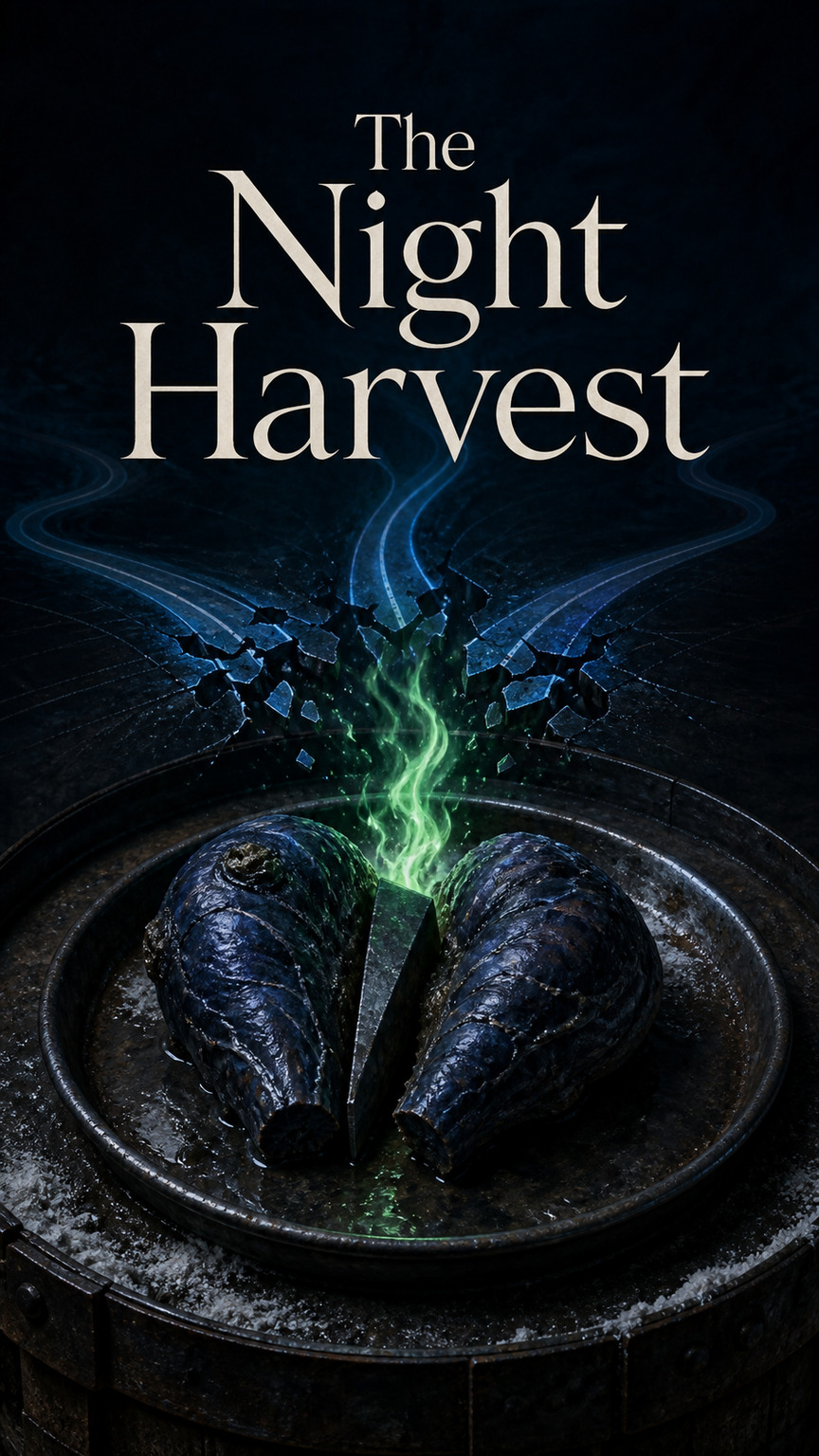
The first stranger ruined forty-three crowns’ worth of lamp-grade throat node before Brelva could get off the weighing platform.
She knew the value because she had just chalked it on the carcass board. Two nodes, no punctures, good color, vibration holding north-northeast. The creature that had grown them lay across the intake rails with its six legs trussed and its wet hide steaming in the cold. Three months ago, people had screamed at the sight of such a thing. Now a hook crew was arguing over who had misplaced the small gut knife.
The stranger vaulted the rail.
She was lean beneath a patched coat of plates, her black hair hacked short. Her long blade had opened the monster below its jaw. Before Brelva could call to the guards, the woman set an iron wedge between the paired swellings in its throat and struck once with her hand.
Both nodes cracked.
Blue fluid ran into the sawdust. The faint tremor under Brelva’s palm stopped.
“Forty-three,” Brelva said.
Perren, who had been holding the tally slate, looked at the ruined nodes and then at the woman. “You think she takes crowns?”
“She can take the consequence.” Brelva stepped down. “You. Those were ours.”
The stranger stared at her. Rain ticked on her shoulder plates. Gray monster ash filled the seams, and three healed cuts crossed the woman’s cheek.
Brelva pointed to the chalkboard, then the nodes, then held out her hand.
The woman answered with a low cluster of sounds that had no edge Brelva could catch. She lifted one broken node. Its inner membrane, thin as an onion skin, shivered in the night air. She pointed along the north road, where the monster’s living throat had faced when the hook crews brought it in. Then she pointed at the cold shed behind Brelva.
“Yes, we store them there,” Brelva said. “Very observant.”
Perren touched her elbow. “Brelva.”
Beyond the north lamps, something gave a long, hollow cry.
The stranger dropped the membrane into a brazier. It curled, flashed green, and went still. She tapped the dead flesh, pointed toward the cry, and then laid two fingers against the hard-packed ground between them.
One relation at a time. Flesh. Road. Ground.
Brelva understood none of it.
The stranger did not wait. She went over the rail again and ran north, coat plates clattering out of time with the rain.
The intake supervisor arrived after the lamps had been shuttered and the hook crew sent after the cry. He crouched over the blue stain with both hands tucked into his sleeves.
“Purchased batch,” he said.
“Ours until you pay it,” Brelva said.
“Purchased on the contract. Ruined on my floor. Your account will show the damage.”
Perren scraped sawdust over the stain with his boot. “Our account already shows an axle, two wheels, and a cart bed that leaks when it rains.”
“Then don’t let foreign scavengers onto the rail.”
“I was grading,” Brelva said. “Your guards were eating.”
From behind the brine shed came the embarrassed clink of a spoon against a bowl.
The supervisor closed his eyes. “They get twenty minutes for supper.”
“They took twenty-four.”
“Then I will purchase four minutes back from the dead nodes.” He rose, knees cracking. “Forty-three crowns deducted. Bring me three full loads before sixth night and the cart is clear.”
Brelva looked at the chalkboard. Three loads meant no short routes, no turning back because the dark sounded busy. It meant the marsh road, where their partners had died in the second week.
Perren set the slate under his arm. “We’ll bring them.”
Brelva said, “Two full, one mixed.”
“Three full,” the supervisor said. “The refiners bought fuel I promised them. The clinic bought tendon. Six crews have advances against that money, including yours.”
He did not sound greedy. He sounded tired, and the distinction annoyed her more.
“Three,” Perren repeated.
Brelva watched rain fill the stranger’s footprint in the sawdust. “If the north road stays open.”
On the second night, two more strangers appeared. One fought beside the slaughterhouse ditch with a hooked spear; the other used a short bow that punched bolts through the monsters’ knee joints. Neither answered questions. Both ignored hide, bone, heat sacs, and the pale liver combs the clinic rendered into fever wash. They killed until the street was quiet, broke every throat node they could reach, heated the membranes, and left.
The corpse industry had learned speed because rot did not care about grief. Roofers took the hides. Rope shops twisted tendon. Kilns ground the porous bones into hot-burning brick. In three months, the night harvest had put dismissed dockhands back on wages and given families a cheaper lamp than whale oil. The creatures kept coming. So did rent.
At the yard, Brelva began a second tally in the back of her ledger.
One wagon from the west ditch arrived untouched. Two creatures attacked behind it before the gate shut. A south-road load drew nothing until it passed a cold wagon carrying brined nodes; then three shapes abandoned the slaughterhouse pens and followed the wagon’s iron wheels through the rain.
Perren saw a different pattern.
“The spear man stood here.” He put a finger on Brelva’s map, on the row of cramped houses beyond the east drain. “Not where the thing came through. Here.”
“A person can stand anywhere.”
“He kept his back to the doors.”
“That is how you avoid being surrounded.”
“He had open road behind him.”
Brelva drew the wagon route in chalk. “And six houses ahead. I can count roofs too.”
Perren leaned across the cart tongue to inspect a split strap. “Didn’t say you couldn’t.”
“You meant it.”
“I meant he put his body in a place. Bodies are usually honest about what they expect.”
“Ours expected supper twenty minutes ago.”
Perren pulled the strap tight. “Stew or the heel of cheese?”
“Cheese tonight. Stew tomorrow if the west ditch pays.”
“That’s a cruel order.”
It was not a joke so much as the shape of an old complaint. Brelva cut the cheese and gave him the larger piece. He accepted it without thanks, which was how they had thanked each other since childhood.
On the third night, the guards ringed the brine shed with pikes. The supervisor had bought shutters for its vents and hired two extra hands from the roof-hide crew.
“Protection for stock already purchased,” he told Brelva when she objected to the added gate fee.
“You put the fee on the crews whose stock you claim to own.”
“Because if it burns, I still owe the refiners. If a guard dies, I owe a widow. If I do not hire the guard, I owe everyone an explanation for why I preferred the cheaper funeral.”
Perren was beneath the cart, packing grease around the left hub. “We could take the nodes straight to the refinery.”
“Their vats are full,” the supervisor said. “I purchased capacity for seventh day.”
“It’s third day.”
“Yes. That is why we have a cold shed.”
Brelva checked the brine barrels: thirty-two sealed, eight open, vibration faint but even beneath their waxed lids.
At midnight, a bolt struck the yard gate from outside. Not a monster bolt; one of the strangers’ thick black shafts. It lodged above the latch.
The guards raised their pikes. The square-faced woman stood beyond the lamps with her empty hands spread. Behind her, shapes moved along the north road.
She pointed to the brine shed.
“No,” the supervisor said.
The word required no translation.
The woman pointed to the road. Then the shed. Then she drove the edge of one hand against her other palm.
“No,” he said again, louder. “Purchased stock.”
One of the new guards glanced at Brelva. “Should we move the barrels?”
“Hold your side of the gate,” the supervisor told him.
The woman waited, watching Brelva rather than the pikes. When no one copied her, she turned and ran toward the moving shapes alone.
The attack ended two streets north. None reached the yard.
Brelva wrote that down too.
On the fourth night, the left axle broke.
It happened on the marsh road, where reeds scraped the cart and black water covered both ditches. Brelva heard the crack, felt the load sag, and shouted before Perren could put his shoulder under it.
“Don’t. Eleven hundredweight.”
“Wheel’s in the ditch.”
“I can see the wheel.”
“Then count how long until the lamps go out.”
They had nine carcasses, sixteen sound nodes packed in two brine tubs, three bad hides, and one lantern with less than a finger of oil. Behind them, far down the road, came the scrape of many feet.
Perren pulled the jack from its bracket. “I lift. You seat the block.”
“We cut the nodes loose and leave the cart.”
“The cart is the promise.”
“A promise doesn’t get to bury you.”
“Neither do you.”
He said it into the mud, already setting the jack. There was no room in the road for the answer Brelva wanted: I kept you alive after the marsh took them. I learned every weight, every safe turn, every sound that meant run. She had promised their dead partners’ families that she would not make the same mistake twice. Somewhere in keeping that promise, she had started deciding which risks belonged to Perren before he could speak.
The scrape grew louder.
“Lift,” she said. “On three. One, two—”
The square-faced stranger dropped from the reeds before three.
Perren swung the jack handle at her. She caught it on a bracer, barked one sharp sound, and pointed at the tubs. Then she pressed her palm to the road.
Vibration hummed up through Brelva’s boots.
Not footsteps. Not yet.
The sealed nodes were trembling hard enough to ring against the tubs.
The stranger ripped the waxed cloth from one. She took out a node, cracked it on the cart rim, and thrust the inner membrane over Brelva’s lantern.
Green light ran across it. The membrane shrank. Under Brelva’s fingers, the vibration vanished.
The remaining tub shook harder, each node seeming to lean north. The scrape behind them became a chorus. Ahead, beyond the bend, the dark answered.
Brelva looked from one tub to the other. “They weren’t following us yesterday.”
Perren heard what she did: one group on the road behind, another moving from ahead. “They don’t need to follow the same wagon. They only need the same road.”
The stranger pointed past them, toward the settlement. Then at the tubs.
Brelva cut the first lid open.
Perren cracked nodes while she held membranes to the lantern. The stranger stood between them and the approaching sounds, blade low. She did not supervise. When Brelva fumbled one slick membrane, the woman snatched it from the mud, burned it, and returned to the dark.
Eight nodes. Ten. The lamp oil guttered.
“Last two,” Perren said.
“One.”
He pushed the final membrane into the flame with his bare thumb. It flashed. He hissed and wrapped his hand in his shirt.
The pressure under Brelva’s boots stopped.
The creatures did not disappear. They did not turn obediently or fall dead. One came out of the reeds on six bowed limbs, its pale mouth opening along its chest. The stranger met it. Perren dragged the jack clear. Brelva shoved the block beneath the axle, and together the siblings heaved the wheel onto the road while the fight thudded behind them.
When the cart rolled, they took the ordinary salvage and left the empty tubs.
The stranger followed only as far as the first streetlamp. She put up her palm. Stop.
Then she touched two fingers to the road and drew them toward herself.
Approach.
Brelva tried the motions. Palm. Two fingers drawn in.
The woman corrected the angle of her wrist, once. Then she went back into the reeds.
By morning, Brelva had six routes and nineteen attacks marked in her ledger. She put the cold wagons in blue and the unbrined loads in white. Perren put stones on the places where the strangers had chosen to stand.
The blue lines did not explain where the creatures came from or why the strangers knew how to kill them. They showed something smaller: preserved nodes passed near every cluster. When a wagon moved, attacks gathered behind its route. When nodes were broken and heated, the pressure stopped. The brine had not made a monster. The barrels had not commanded one. They held a direction that should have faded with death, and enough held directions made the night pay attention.
The supervisor studied the map through breakfast. He ate porridge while standing, spoon in one hand, invoices in the other.
“Six crews,” he said. “Forty barrels between them. Three refineries expecting delivery. The clinic has already paid against the tendon proceeds.”
“Keep the hide, bone, tendon, heat sacs,” Brelva said. “Stop brining nodes.”
“On nineteen marks you made yourself.”
“On nineteen sequences. Cold load, route, attack.”
“And on two nights when nothing reached the yard.”
Perren laid a stone at the yard gate. “Because they stood outside it.”
“Who?”
“The people you keep calling scavengers.”
“They have not given me a name, an origin, or a bond against damages.” The supervisor put down his spoon. “I believe what can be charged to an account. That is not stupidity. It is how I make sure a hook hand gets paid after a richer person changes his mind.”
Brelva opened the ledger to their contract. Three loads. Cart cleared. Perren’s burned thumb stuck out of a fresh wrapping beside her hand.
“Refuse our final load,” she said. “No nodes.”
The supervisor rubbed porridge from his moustache. “Then the contract fails. I cannot clear a cart on goods not delivered.”
Perren looked at Brelva, waiting.
She could say the route was too dangerous. She could say his hand made the choice. She could protect him so thoroughly he became one more item under her tally, weighed and routed without consent.
“What do you want?” she asked.
His surprise lasted half a breath. “Take the ordinary parts. Leave every node here.”
“That concentrates the vibration.”
“Yes.”
“The contract fails.”
“Yes.”
“The cart stays in debt.”
Perren touched the wrapped thumb to the map. “The east road runs past thirty doors. The north past twelve. Marsh past none. If we move forty barrels, we pick which doors hear them. If we break the barrels here, the walls are stone and the streets around us are wide.”
The supervisor said, “Those barrels contain stock I bought from people who cannot absorb the loss.”
“Then don’t make them absorb it,” Perren said. “You bought it.”
The man’s mouth tightened.
Brelva expected a refusal. Instead he gathered the invoices into one squared stack. “I will not authorize destruction on a grader’s pattern.”
“What will you authorize?” she asked.
“Guards around the final intake. No wagons out after sunset. If the arrivals follow your map, I will open the shed myself.”
It was not enough. It was more than his obligations had allowed him five minutes earlier.
Brelva closed the contract. “Then we bring no nodes through housing.”
“How do you propose to harvest?”
“We don’t. Not tonight.”
Perren nodded once. His choice, beside hers.
They spent the fifth night hauling ordinary salvage into stone rooms and watching the barrel seals click faster.
The sixth night came early under storm clouds.
By full dark, the wax seals on the cold shed had begun to click. Forty barrels, eighty-one nodes, each preserving a little directional tremor. Brelva felt their combined vibration through the weighing platform. It no longer pointed north or south. It traveled up her leg and settled behind her teeth.
The first cry sounded west.
The second answered from the marsh.
Guards shut the iron gate. Roof-hide workers carried finished sheets out of the cutting room, trying to save what water would ruin. A carter shouted that his team was still tied by the east wall. The supervisor moved through them with his ring of keys, assigning doors, counting purchased batches, refusing three separate demands at once.
“Unhitch the team,” Perren called.
“Not through the east gate,” Brelva said. “Bring them behind the bone shed.”
“That pen’s full.”
“Then move the empty racks.”
One of the supper guards grabbed a rack. “This one sticks.”
“Lift before you pull,” Perren said. “Left foot’s sunk.”
The ordinary talk steadied the yard for perhaps a minute. Lift. Pull. Bar the cutting room. Find the missing lantern. Then a creature hit the north gate hard enough to bow it inward.
More shapes entered the lamplight along the west road. Not an army in lines, not creatures under command. They came from separate dark streets, colliding, clawing past one another, drawn toward the vibration that made Brelva’s bones hum.
The strangers arrived among them.
The spear man took the west mouth. The bow wielder climbed the bone shed. The square-faced woman came straight to the gate and raised her palm.
Stop.
Brelva raised hers in return.
The woman drew two fingers toward her chest.
Approach.
Brelva pointed to the cold shed, then crossed both forearms. Not yet.
The woman’s gaze snapped to the supervisor’s key ring. She made the striking motion against her palm.
The gate bowed again. One hinge tore from stone.
“Open the shed,” Brelva said.
The supervisor stared at the monsters.
“You said you would.”
“I said if they followed your map.”
“West, marsh, north. Three roads. No wagons.”
“The purchased batches—”
The gate split. A guard went down beneath the iron frame, his pike spinning away.
Perren ran toward him.
Brelva caught his sleeve, then let go before the grip became a command. “I get the keys.”
“I’ll get his shoulders.”
“Drag toward the platform. Not the cutting room.”
“I know the route.”
He did.
Brelva went for the supervisor. He had not fled. He was trying to lift the fallen gate off the guard while creatures pressed into the opening and the spear man held them there.
“Keys,” she said.
“Third key. Brass.” His words came too quickly. “Open both vents first or the mineral vapor catches. The crews signed weight at intake. Every seal has a mark. I have to preserve the marks if I pay claims.”
“Then bring the chalkboard.”
He looked at her.
“We break by batch,” she said. “You mark every barrel. You owe the loss to the people you bought from, not the refiners who never took delivery.”
The supervisor pulled the brass key free. “Claims before refiners.”
That was how he made courage: as an order of payment.
They ran.
Brelva opened the upper vent. Perren and the freed guard staggered to the platform. The guard’s leg held, though blood darkened his trousers. The square-faced woman crossed the yard backward, blade working, her attention on the shed door.
Brelva drew two fingers toward herself.
Approach.
The woman came.
The supervisor unlocked the shed. Cold mineral air rolled out. Inside, barrels knocked on their racks like a roomful of impatient fists.
The woman pointed at the upper row, then at the brazier. One relation. Highest vibration, heat.
“Top first,” Brelva said. “Perren, wedges.”
“Seals before breakage,” the supervisor said, dragging the chalkboard close.
“Then mark them.”
They found a rhythm without finding a common language. Brelva tested lids and called quantities. Perren rolled barrels down the chute, bracing them with hip and shoulder, naming clear paths and injured workers. The supervisor shouted each crew’s seal and struck it from the purchased column only after he saw the nodes broken. The stranger cracked paired nodes against her wedge, laid membranes into iron trays, and pushed the trays toward the brazier.
Outside, guards and harvesters defended their own yard with hook poles, pikes, and the heavy boards used to turn carcasses. The newcomers did not command them. They filled gaps, demonstrated angles, waited for imitation. When the bow wielder slapped the roof twice and pointed down, a hide worker understood before anyone else and pulled two people clear of a creature climbing the gutter.
“Batch twelve, six pairs,” the supervisor called.
“Five and one split,” Brelva said.
“Purchased as six.”
“Destroyed as eleven sound, one spoiled.”
“That is not how claims work.”
“It is how evidence works.”
“Mark eleven,” Perren said. “Argue at breakfast.”
The supervisor marked eleven.
Barrel after barrel. Membranes flashed green. The vibration changed from a pressure in Brelva’s teeth to a tremor in the boards, then to separate beats she could count. Thirty-four. Twenty. Nine.
A monster broke through the cutting-room wall instead of the gate. It shouldered shelves aside and lunged toward the shed. Brelva froze with a node in each hand.
The stranger stepped between them. She struck low, missed, and went down beneath the creature’s front limbs.
Perren could have run. Instead he hooked the monster’s rear joint with the cart chain and yelled, “Brelva, wheel!”
She understood his route. She dropped the nodes into the tray, seized the loose wheel from beside the repair rack, and rolled it hard under the chain. The weight lifted the creature’s leg just enough. The stranger twisted free and drove her wedge into the joint.
The creature fell. The stranger rose with one sleeve torn and pointed at the tray.
One relation. Nodes first.
Brelva burned them.
The final membrane curled into ash just before dawn.
The monsters outside did not vanish. Those already at the yard kept fighting until the eastern roofs went gray, then scattered into alleys or fell beneath exhausted hands. But no new cries answered from the roads. The boards stopped trembling.
Morning found the cold shed warm, empty, and reeking of salt.
They sorted what remained because useful things were still useful.
Undamaged hide went to the roofers. Tendon went to the clinic contract. Bone was weighed for the kilns. The supervisor sat on an overturned barrel and recalculated eighty-one nodes as purchased loss, refinery default, guard injury, and four minutes of supper he conceded had not mattered after all.
“Your cart is not clear,” he told Brelva and Perren.
Perren flexed his burned thumb. “We noticed it was still here.”
“The final-load contract failed.”
Brelva waited.
The supervisor tapped the claims column. “Your axle repair can move to salvage wages. Not forgiveness. Work.”
“At what rate?” she asked.
He named one.
She named another. They argued it down by two crowns and back up by one.
Across the yard, the square-faced woman helped the injured guard shift a rack. They had no words between them. He pointed to his bad leg; she took the heavier end. When it was set down, she raised her palm to him.
He stopped.
She drew two fingers toward herself.
He approached, slowly this time, and handed her a cup of water.
Brelva tore the blue route pages from her ledger and pinned them beside the gate, not as proof of the whole night or an answer to where anything had come from. Just roads, loads, attacks, and the order in which they had happened. Beneath them she hung a hammer, an iron tray, and an unbrined node from the morning’s last carcass.
Perren brought over two bowls of porridge.
“Stew was the promise,” he said.
“The kitchen wall has a hole.”
“Promises keep having conditions with you.”
Brelva took the smaller bowl before he could offer it. “Tomorrow, then.”
The node gave one faint tremor toward the road. The stranger saw it. So did Brelva.
Palm raised. Stop.
Two fingers drawn close. Approach.
The stranger took the iron tray. Brelva lifted the hammer. Perren steadied the hook, and the three of them went to break it.