The Night She Knew
You've known that your daughter is clairvoyant for quite some time now, but you've never confronted her about it, directly. You've decided that this will change tonight.
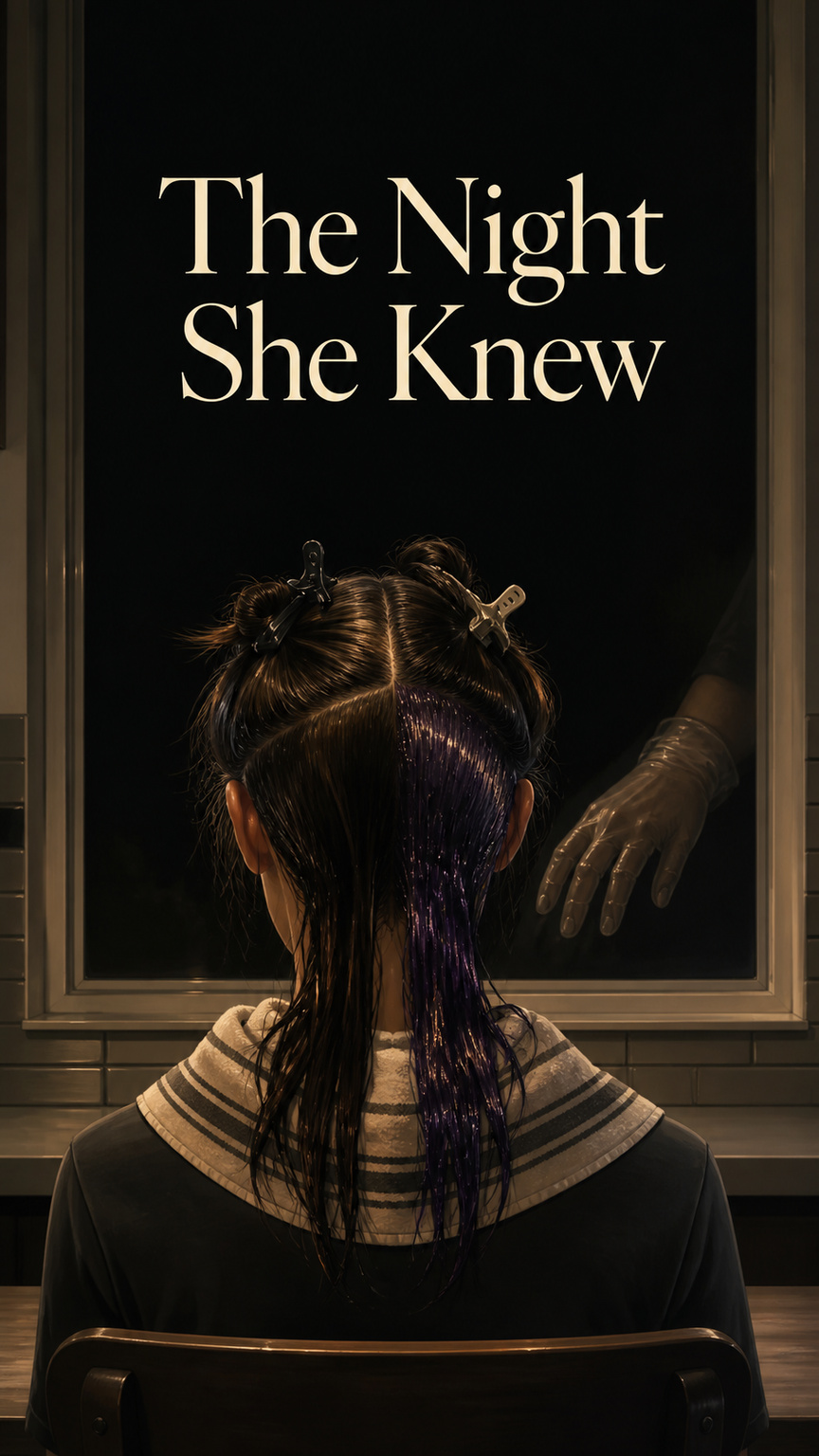
The gloves in the box were made for someone with square hands. The fingers hung an inch past mine, collapsing whenever I tried to unscrew the cap on the developer. I was shaking the bottle between my palms when my daughter said, “Since I was eight. Maybe nine. And no, the rabbit wasn’t the first thing.”
She sat backward on a kitchen chair, chin over the vinyl back, an old striped towel fastened at her neck with a clothespin. Her hair, divided into four clipped bundles, made her look like a very impatient satellite. She did not look at me. She was looking at the timer on her phone, though I had not mixed the dye yet.
“What rabbit?” I asked.
“Don’t.”
The bottle slipped in my gloves and struck the counter. Not hard. Still, she closed her eyes at the sound as if I had dropped a plate.
I had spent the afternoon arranging sentences. I had discarded I’ve noticed some things, because some things could mean cannabis or a report card. I had discarded Is there something you want to tell me? because at sixteen she had at least thirty things she did not want to tell me, most of them none of my business. While I covered the kitchen table with grocery bags and found the petroleum jelly, I had settled on a question plain enough to be kind.
How long have you been able to see the future?
“I didn’t ask you anything,” I said.
She opened her eyes. “You were going to.”
The developer bottle had a pointed white nozzle. I snipped the tip too low, and a pearl of cream pushed out onto the printed instructions.
“I know you’re clairvoyant,” I said.
Her mouth twisted. “Wow. SAT word.”
“You know what it means.”
“Yes, Mom.” At last she turned. There was an angry little patch of petroleum jelly above her left eyebrow where I had been careless. “That’s why I’m making fun of you.”
It should have been the impossible part, saying it aloud. Instead the room stayed stupidly itself: the stove clock blinking 8:03 because I had never reset it after the last outage, the grocery bags crackling under my elbows, the chemical sweetness rising from the dye bottle. She reached behind her and tugged the clothespin loose.
“Leave that,” I said. “You’ll stain your shirt.”
“I’m already wearing the condemned shirt.”
It was one of mine, gray with the ghost of a college logo across the chest. I had condemned it three years ago and continued to wear it for cleaning. She knew that.
“Turn around,” I said. “We have to start before this sits too long.”
“You started before it sat too long.”
“Your hair.”
“Right.”
She faced away again. I cut the first elastic and lifted the top section with the rattail comb. The dye was called Midnight Mulberry, though in the bowl it had the color and shine of wet cement. She had chosen it because the woman on the box had purple hair so dark it revealed itself only where light touched. According to my daughter, this was less annoying than having purple hair all the time.
I painted the first line along her roots.
“I can’t do lottery numbers,” she said.
“I wasn’t going to ask that.”
“Not lottery numbers exactly.”
I had been going to ask how accurate it was. Not for a test, I told myself. For context. If you learned your child had been carrying an unknown condition for half her life, you were entitled to understand its severity.
She snorted.
“What?”
“Your face is doing the insurance form.”
“I’m concentrating. Hold still.”
“Accuracy, range, onset, adverse side effects.”
I pressed the brush too hard. Her head tipped forward.
“Ow.”
“Sorry.” I used the pointed handle of the comb to make another part. Her scalp appeared in a pale, vulnerable line. “Do you hear my thoughts?”
“No.”
The speed of the answer chilled me more than if she had waited.
“Then how did you know?”
“I don’t know what you think. I knew what you asked.”
“I didn’t ask it.”
“You did later.”
“Later when?”
“About forty seconds from now.”
We both looked at her phone. The screen had gone black.
I set the brush in the bowl. “So it’s fixed.”
“What is?”
“If you already heard me—”
“I didn’t hear you.”
“You knew the question.”
“I knew me saying no. And the fan making that noise. And this hurting.” She touched the spot I had painted. “So I guessed the question.”
The exhaust fan over the stove had begun its intermittent tick, one blade touching its housing every seventh or eighth turn. It had done that for months.
“You could have guessed all of it,” I said, and watched her shoulders climb.
I had not meant disbelief. I had meant that guessing was part of it, that what she called seeing might arrive tangled with ordinary inference. A useful distinction. A protective one. The kind of distinction that kept us from constructing our lives around a frightened child’s certainty.
“Pick a number,” she said.
“No.”
“Take a card out of a deck. Decide which hand you’re going to use. Hide something under a cup. Come on, we can do all your classics.”
“I have never done that.”
She swung around. A wet strand escaped its clip and slapped dye against her cheek.
“The stairs at Grandma’s. The two glasses of water. That time you drove past the pizza place three times because you kept changing your mind.”
“We were early.”
“You asked me where we were going.”
“You said you knew.”
“I was twelve.”
The dye had made a comma on her cheekbone. I reached with my thumb. She jerked back before I touched her, chair legs scraping the tile.
“Don’t.”
My hand stayed in the air. “You have dye on your face.”
“Give me the wipe.”
I passed her one from the packet. She scrubbed too hard, leaving her skin pink. The stain lightened but did not disappear.
“The pizza place closed six months later,” I said. “I thought maybe you’d seen the sign come down.”
She stared at me. Then, despite everything, a laugh pushed out of her. “You thought I got a six-month vision about mediocre garlic knots?”
“You cried when it closed.”
“I was twelve. I cried because my charger cord bent.”
“You said the new restaurant would have yellow chairs.”
“And they’re orange.”
“Yellow-orange.”
“This is what living with you is like.” She turned backward again and shoved the loose hair off her face. “You keep all the hits in little baggies and lose the misses.”
That was unfair. It was also accurate enough that I picked up the brush instead of answering.
I had kept things. Not in literal baggies, but in a note on my phone titled Household, tucked beneath measurements for the hallway runner and the model number of the furnace filter. At seven, she had put both hands over her ears before the smoke detector failed during a storm. At eleven, she had carried my blue mug to the laundry room and left it on the dryer; an hour later the cupboard shelf came loose and broke every other mug. Last winter she had refused to get into the car until I checked the rear tire. The tire was low. Not dangerously low, the mechanic said. But low.
There were misses, too. The bus she swore would not come and did. The math quiz she claimed had been postponed. The blood on my sleeve that turned out to be tomato sauce after the grocery bag split. I had cherished those. Each mistake made the others safer.
I parted another narrow row of hair. “What was the rabbit?”
“Nothing.”
“You brought it up.”
“You brought it up tomorrow afternoon.”
“We are not doing that.”
“I know. That’s why I said it wasn’t first.”
The brush stopped. “I don’t understand.”
“No kidding.”
“You don’t get to be cruel because I’m trying to understand.”
“And you don’t get points for trying tonight.”
I snapped the next section free. The comb snagged, and she hissed through her teeth.
“Sorry,” I said again.
“You always say it after.”
“That is generally when an apology happens.”
She made a sound that might have been a laugh if it had contained any pleasure.
We worked in silence. I painted, folded, painted. In the dark kitchen window, our reflections sat one above the other: her face blank and brown-eyed under its four ridiculous horns, mine pinched with care. The dye took on a violet sheen around the edges. Each time I reached over her shoulder for the bowl, she moved the towel aside before I could ask.
I tried not to form questions. The effort was like being told not to test a sore tooth. When does it happen? Does it scare you? Who else knows? Have you used it at school? Have you ever seen—
“No,” she said.
I dropped the comb.
She gripped the chair back. Her knuckles had gone pale.
“No what?”
“I don’t know.” She swallowed. “There was the green towel. You said ever. Then the sink. Then you were in the hallway.”
“Are you going to be sick?”
“Stop picking things.”
“I’m not picking anything.”
“You are. You pick a question, then you decide it sounds awful, then you pick a different one. It’s like someone changing channels with the volume all the way up.”
I made my mind blank. Or I tried. The green towel hung over the oven door. I could see its frayed corner. Seeing it made me think about lifting it, not lifting it, taking it to the bathroom, leaving it where it was.
My daughter pressed the heels of her hands against her eyes.
“Okay,” I said. “Okay. I’m not deciding anything.”
“That’s also deciding.”
“What do you want me to do?”
“I don’t know!”
The force of it surprised both of us. She shoved the chair back and stood. Half her hair hung loose and dark with dye, half remained clipped and dry. She took two steps toward the hall, caught her hip against the table, and knocked the bowl sideways. I trapped it with my forearm. Gray-purple dye climbed the bristles and pooled against the rim.
She put one hand over her mouth.
I stripped off the gloves. “Let me—”
“Don’t touch me.”
I stopped beside her.
She moved into the hallway, where the light had burned out the week before. The bathroom cast a yellow bar across her bare feet. She leaned against the wall and breathed through her nose.
“Do you need water?”
No answer.
“The bathroom bin is right there if—”
“I know where the bin is.”
I stayed in the kitchen. The dye needed to be finished. The floor needed checking. Her hairline needed wiping before it set. Every useful fact pressed forward wearing the same clothes as authority.
After a minute she lowered her hand.
“It’s not the future,” she said.
I waited.
“Not like you mean it.” She kept her eyes on the wall between us. “It’s pieces. Usually if somebody I know is going to do something that gets to me soon. I get the part where it gets to me.”
“Like the question and your answer.”
“Sometimes. Or a smell. A noise. The feeling of something in my hand. I don’t get reasons.”
“The blue mug?”
“I saw the handle in the laundry lint. I thought I dropped it in there.”
“So you moved it.”
“And then the shelf broke. Maybe because you put the sugar up there instead, and the sugar was heavy, and the whole thing was my fault.”
“A bag of sugar did not break that shelf.”
“You don’t know.”
“Neither do you.”
She flinched. It was small, but I saw it.
“No,” she said. “I don’t.”
The timer on her phone chimed from the kitchen, although we had never started it. She had set it for 8:20, probably to remind us about the episode of a baking show we watched together, the one where everyone made cakes shaped like food that was not cake. On any other Sunday, she would have accused me of secretly rooting for the mean judge.
“We have to finish your hair,” I said.
“Obviously.”
“You can do it yourself, if you want.”
“The back too?”
“I said you can. I didn’t say it would look good.”
Her mouth moved at one corner. Then she looked at my bare hands.
“New gloves,” she said.
I returned to the table and took the second pair from the box. She followed but did not sit. I waited until she turned her back to me. Only then did I touch the dry section near the clip.
“The rabbit,” she said. “It was in third grade. The class rabbit. I saw an empty cage and Mrs. Whoever crying.”
“Did it die?”
“No. Somebody left the latch open. We found it under the portable.”
“Then you were wrong.”
“I saw an empty cage and her crying. Both happened.”
I separated a section with my fingers. “But you thought it died.”
“I was nine.”
“Why didn’t you tell me?”
She bent her head. For once there was no answer waiting.
I brushed dye down the roots and through the ends. The gloves whispered against her hair.
“I did,” she said finally. “I said something bad would happen to Clover, and you told me pets don’t live forever and I shouldn’t borrow trouble.”
I remembered the phrase because it was my mother’s, borrowed in turn. My daughter had cried into her cereal. I had thought she was learning about death.
“I didn’t know what you meant.”
“I didn’t either.”
There it was, the fact I had kept refusing her: she had not been a small, calm witness to coming events. She had been a child making the worst story she could from an empty cage.
I covered the last dry patch and twisted her hair under a plastic cap. This time, before wiping a crescent of dye from the back of her neck, I held up the cloth where she could see it. She nodded once.
I set the timer for twenty-five minutes.
“Who knows?” I asked.
She looked toward her phone.
“That was an actual question,” I said.
“I’m aware.”
“Do your friends—”
“One of them thinks I get migraines.”
“Do you?”
“Sometimes.”
“How often?”
Her face closed.
“I need to know if you’re in pain.”
“You need a spreadsheet.”
“I am your mother.”
“That’s not a coupon.”
“For what?”
“Everything in my head.”
“I’m not asking for everything. I’m asking if something is hurting you.”
“And then you’ll ask what brings it on. Then how far ahead. Then if it ever helps. Then if I’ve seen anything bad about school, or driving, or you.”
“I would not ask you about me.”
She stared at me until the lie became embarrassing.
“Not tonight,” I said.
“You almost did.”
“When?”
She put both hands flat on the table. “All the time.”
I started to deny it. Before I spoke, the scenes arranged themselves: standing outside her bedroom with folded laundry while I imagined asking if she ever knew things; driving her to practice, my prepared opening swallowed when she turned up the radio; washing the blue mug after its rescue and saying, Funny how you knew, in a voice that gave her no safe answer.
“You kept almost asking,” she said. “I’d get you saying it. Then I’d get you not saying it. Sometimes both. Once you asked me in the car and then we ate dinner and you acted like it never happened. Except you didn’t ask me in the car.”
The refrigerator clicked off. In its absence the kitchen seemed to enlarge.
“I thought I was giving you space.”
“You thought I’d confess if you waited long enough.”
“Confess is not fair.”
“Fine. Perform a voluntary disclosure.”
“I was afraid.”
She folded her arms. “Of me?”
“For you.”
“That wasn’t the question.”
“Both, then.” The word came out before I could improve it. “I was afraid for you, and I was afraid I would believe you, and then every ordinary choice would become something I could hurt you with. Or something I should ask you about first.”
Her eyes narrowed, not in anger this time but concentration. “You’re not supposed to say that.”
“According to what?”
She touched the edge of the plastic cap. “There was a different part.”
“Of this conversation?”
“You said I didn’t need to be afraid, and then I yelled at you.”
“I can still say it if you want.”
“Don’t make it weird.”
It was already weird. But I took the offered scrap of humor and did not pull on it.
The timer ticked down on the counter. Eighteen minutes. We moved the grocery bags and sat on opposite sides of the table. For a while she scrolled through her phone without absorbing anything. I peeled a dried skin of dye from the bottle nozzle. Ordinary time resumed, not because we had earned it but because time was rude that way.
At twelve minutes, she said, “You took different routes home to see if I’d notice.”
“Twice on purpose.”
“Six times.”
“Not all of those were tests.”
“See?”
“See what?”
“You don’t even know when you’re doing it.”
I wanted to itemize the other four routes. The impulse kept me quiet.
At nine minutes, I began to wonder what help existed. A doctor would hear headaches, nausea, visual disturbances. Perhaps that was where we should start. But a doctor might call the rest delusion. A specialist would mean records. Questions. I pictured my daughter under bright lights, being asked to name cards; I pictured refusing, then pictured the relief of somebody competent telling me what came next.
“No hospital,” she said.
“I didn’t decide that.”
“You did. Then you didn’t. Then there was a paper bracelet.” Her hand went to her bare wrist. “And orange soap. Or oranges. I don’t know.”
“I was thinking about a doctor.”
“Stop.”
“If this is making you sick—”
“Stop choosing my whole life in ten-second pieces!”
She rose so fast the chair struck the wall. Her phone skittered across the table. I grabbed it before it fell, and she snatched it from me.
“I wasn’t reading it.”
“I know.”
“Then why did you—”
“Because I saw it in your hand and a message open.” Her face changed. “Oh.”
“What?”
“It wasn’t mine.”
“Whose was it?”
“I don’t know. Maybe yours.” Color rose above the petroleum jelly at her hairline. “I got it wrong, okay?”
She stared at the phone as if it had betrayed her. I felt steadier, a response I was not proud of. Her mistakes still made the world safer.
Then she bent over, one hand braced on the table.
“Bathroom,” she said.
I followed her into the hall. She waved me back without looking. The door shut, not quite hard enough to slam.
Behind it, the tap ran. A cupboard opened. She coughed once. I stood with my hands useless at my sides and formed the question I had been circling all night: Had she seen something terrible coming? Not a thing I intended to use. Not numbers or cards or routes. Just whether she was safe. Whether I was. Whether there was any danger I could still prevent if she would only tell me.
The bathroom door opened.
Her face was wet around the mouth. “I don’t know if you’re going to be okay.”
“I was asking about you.”
“No, you weren’t.”
The denial rose quickly and found nowhere to go.
“And I don’t know if I’m going to be okay either,” she said. “I don’t know that for anybody. I see your hand holding the green towel. I hear you say tell me. I smell the dye. That’s what I have. That’s all.”
Her voice broke on the last word, and she looked furious about it.
I wanted to tell her she should have trusted me sooner. I wanted to say I could have helped, a sentence that would have required us both to forget the pizza place and the two water glasses and six altered routes home. I wanted forgiveness shaped like reassurance.
Instead I went back to the kitchen and took the green towel off the oven handle. I carried it to the bathroom because the timer had begun to beep and because her hair actually did need rinsing. She followed at a distance.
The bathroom was too small for dignity. I knelt beside the tub while she leaned over it, and then we discovered the cap had leaked a purple line down her neck. She called the box model a liar. I said the model probably had a professional colorist. My daughter said that was class warfare. Neither of us laughed much, but we tried.
I ran the water against my wrist until it was lukewarm. When I reached for the cap, she stiffened.
I lowered my hand.
“I know this,” I said. “I believe you. I should have said it before.”
She watched the stream strike the white tub and curl toward the drain.
“I’m not going to ask what you see,” I said. The next part came less cleanly. “I’ll probably want to. I already want to. But you don’t have to tell me because I want it.”
She picked at a dried spot on her condemned shirt. “That sounds temporary.”
“It might be.”
“Great.”
“I’m trying not to lie to you.”
“You’re suddenly very brave about admitting you might be terrible.”
“I contain multitudes.”
“You contain expired coupons.”
“Also true.”
Water tapped the tub. Purple darkened the drain in one slow thread.
“Can I rinse your hair?” I asked.
She closed her eyes. For a moment I thought she had gone somewhere ahead of me again, into a bathroom almost like this one where I had already reached, already spoken, already failed or managed not to fail.
“Right now I don’t have anything,” she said. She opened her eyes. “From you, I mean. It’s quiet.”
I nearly asked if that was good. Her expression told me she saw the question on my face, no clairvoyance required.
“Okay,” I said.
She knelt on the bathmat and bent backward over the tub. I slid one hand beneath her neck without touching her hair. She hovered there, holding up some portion of her own weight. Then she let it go.