The Ninety-Year Barrier
"It took me over 90 years to cast this barrier. It, was, strong enough to withstand a Dragon. Would you kindly inform me how a Village Youngin managed to break it? Before you start screaming Im not mad at you" The Witch of the Dark Forest still looks at you like a starving man looks at a feast.
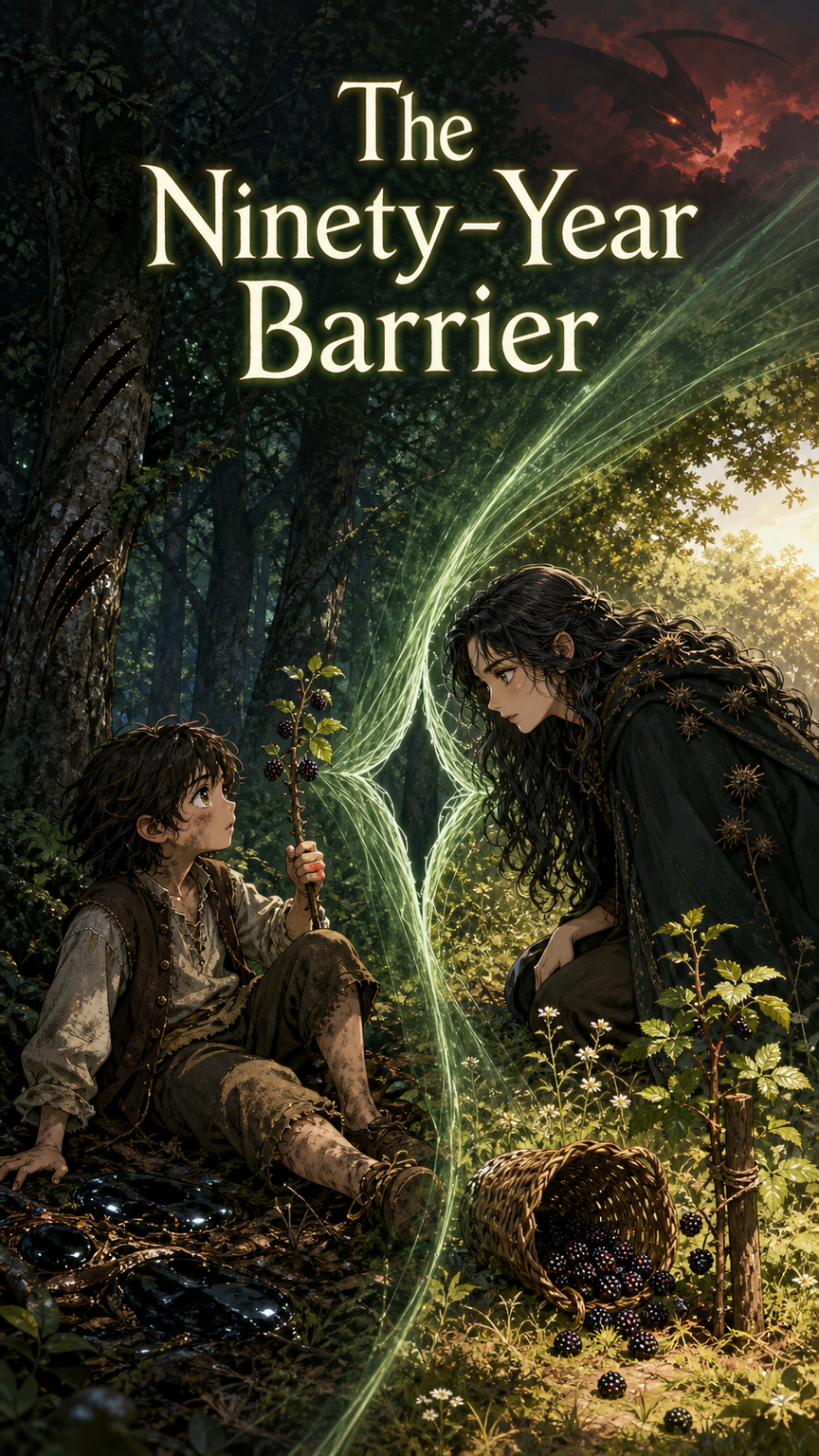
The Witch of the Dark Forest laid your reed hook on the workbench between you.
It was a poor little thing to have caused so much trouble. You had cut it from an old spoon handle, sharpened the bend against a doorstep, and wrapped the grip in waxed thread because blisters slowed basket work. A burr of black light clung to its point. Every few breaths, the pull from the western wall drew it long.
The Witch watched it stretch. Then she looked at you.
The stories had been right about her eyes. They were not red, or bottomless, or aflame. They were brown and terribly attentive. A starving traveler might look at a laid table that way. So might your uncle when he found an unpicked length of perfect willow by the river and had already decided what it could become.
Neither comparison stopped your knees from shaking.
“Ninety years,” she said. “That is how long the barrier took me to cast. A dragon struck it once and went away with a split scale.” She tapped one black fingernail beside your hook. “You opened a hole wide enough to walk through.”
You tried to swallow. Nothing happened.
“Before the screaming begins,” she added, “I am not angry with you.”
This did not help. She looked hungry enough to bite the answer out of your head.
The room offered no easier thing to look at. Blackthorn stakes leaned in bundles against the walls, their bark silvered with age. Skeins of cord hung from roof beams. Dried mushrooms, onions, nettles, and things you could not name filled the rafters with a bitter green smell. The Witch had set your gathering basket beside the stove. Its bent rim accused you almost as efficiently as she did.
“I didn’t mean to,” you said.
“Good.”
“I was only cutting willow. The rain made the bank slippery, and my aunt said she needed six bundles by supper. Seven if the thin shoots were any good, because the cooper’s wife changed her order this morning, though that wasn’t my fault either, and—”
The burr on the hook stretched toward the wall again. This time it made a sound like a wet finger drawn around the lip of a cup.
The Witch turned her head.
“Was that bad?” you asked.
“Yes.”
She picked up the hook. The dark glimmer ran onto her fingertips, not into the iron rings on her hand or the bracelet of woven bark at her wrist. Her fingers tightened. The glimmer shortened.
“Show me how you held it.”
You put your hand around empty air.
“Which hand?”
You changed hands.
“Were you facing the forest or the village?”
“The village.”
“Your basket was on your village side?”
“Yes.”
“Then the hook entered from the forest side.”
“Yes.”
Her gaze sharpened. That was the answer she wanted. You gave it quickly, pleased to have found one.
“And you pulled toward yourself.”
“Yes.”
“Hard.”
“Very hard.”
The Witch put the hook down.
“All three answers cannot be true.”
The pleasure went out of you. “They felt true.”
“Feeling is useful. Agreeing is not.” She crossed to the western wall and pressed her palm against a blackthorn slat. The slat did nothing by itself. A pulse moved from the heel of her hand into the wood, and lines appeared across the plaster: hundreds of dark, fine strands crossing at angles too dense to follow. Near the floor, one line hung slack. Then another loosened beside it.
“It is shedding tension,” she said.
You backed into the stool. It scraped loudly.
“Will it fall?”
“Not all at once. The opening will widen. Every pulse draws looseness toward the crossing you reversed.”
“I didn’t reverse anything.”
Her eyes found you again. “Then I have discovered a second problem.”
She crouched before a chest and began taking out pegs, string, and a split basket rim. She moved fast. Not angry, perhaps, but a person could be killed by someone in a hurry as easily as by someone in a temper.
You thought of the route home: out the crooked green door, around the rain barrel, down the steep path, across two fields. You thought of your aunt waiting over lentil stew, counting both bundles and minutes. You thought of the barrier around the village, which everyone touched for luck before travel and blamed for making their hair stand up in dry weather. There had always been a barrier. Old people remembered watching its last stakes driven, but even they had been children then.
The Witch hammered six pegs into the workbench with the handle of her knife.
“Come here.”
You did.
She threaded cord among the pegs, turning it back through itself. “Outside force enters here. It divides. Each crossing takes a share, and the ring draws tight.”
“Like a waling row,” you said before you could stop yourself.
“A what?”
“The row that holds the uprights apart.”
“Not exactly.”
She pulled one end. The whole web cinched. You saw what she meant, and also where she was wrong.
“A little like one,” you muttered.
“You struck from outside. The force spread. The barrier tightened around your hook, so you levered sideways until a strand tore.”
It sounded reasonable. More importantly, it sounded finished.
“Yes,” you said.
She looked down at the model, already reaching for another cord.
Your fingers twitched.
One crossing lay backward. Not wrong for what she wanted, perhaps, but wrong in a way your hands could not ignore. You had spent three years learning not to see that sort of thing, because seeing meant fixing, and fixing meant the person who had made it knew you had noticed.
The Witch made a second loop.
“No.” Your hand moved between hers. “That one goes under first.”
She went still.
You tucked the cord beneath its neighbor, lifted the crossed part on your thumb, and drew the loose end through. Tension shifted across the little web. The split rim pulled nearly round.
“Why?” she asked.
“Because otherwise the strain sits on the break.”
“It did not before.”
“It would when you pulled that side.”
She pulled. The rim bent exactly where you had indicated.
The Witch’s attention became worse. She leaned so near that a lock of her hair dragged across the pegs. It was not the gray you had expected. It was white, but white like the underside of a leaf in strong sun, with green shadows where strands crossed.
“Do it again.”
“I only moved a string.”
“Again.”
You undid the crossing. Her fingers hovered beside yours, too eager to wait and too disciplined to interfere.
“First the lift,” you said. “Only enough for the end. Then you turn back against the lay.”
“Against the load.”
“If you like. Then under this one.”
“That feeds slack across the center.”
“It stops the broken rim pulling open.”
You were both speaking about the same cord. It did not yet feel as though you were speaking about the same thing.
Another dark strand appeared on the wall. It drooped below the first.
The Witch swept the model into her apron pocket. “We need the place.”
“Now?”
“It has not improved while we talked.”
She gave you your gathering basket but kept the hook. At the door she pushed her feet into mud-caked boots. One lace had knotted itself. She bent, picked at it, and swore with plain village precision.
You stared.
“What?”
“Nothing.”
“Then put on your coat.”
That was the first thing she said which made you less afraid.
Outside, late rain ticked through the Dark Forest. The Witch’s house stood among trees so tall that their trunks disappeared into moss before your gaze reached the roots. There were no skulls on the fence. There was, however, a row of clay pots containing teeth, which was not much better.
The path pitched down through wet fern. You tried to hurry. The Witch caught the back of your coat before you put a foot on a shining root.
“Not there.”
“I saw it.”
“You stepped on it.”
“I was stepping over.”
She released you. “Do that, then.”
For several minutes, the only talk was useful.
“Low branch.”
“I know.”
“Left at the fork.”
“That’s not the way I came.”
“The way you came now contains a hole.”
At the foot of the slope, the forest thinned. Between the last oaks stood a double line of blackthorn stakes. They were taller than you and sunk so deep that ninety winters had not tilted them. Nothing shimmered between them. The village lay beyond—brown roofs, pale chimney smoke, the upper arm of the grain mill moving in the rain. Home looked close enough to reach before your aunt put the stew aside in disgust.
The Witch stopped at what seemed to be an ordinary gap.
“Wait.”
She placed both palms against the two nearest stakes. Her breath left her in a long, controlled stream. Warmth pressed against your face. It had no light, but the fine hairs along your arms rose as her living force moved into the wood and along what the wood held. The air in the gap folded inward, strand after unseen strand drawing aside.
Only when the Witch stepped through did you understand that she had opened it. The barrier had neither recognized her nor obeyed her. She had done the recognizing and the opening.
“Come.”
You hurried after her. Halfway through, something brushed the back of your neck like taut silk.
“Did you feel that?” she asked.
“Yes.”
“From which direction?”
You nearly said whichever direction she expected. Then you looked at her hands. Her palms were still on the stakes. A tremor ran in the left thumb.
“Behind me. High to low.”
She nodded once and released the passage. The pressure closed.
The tear was forty paces north, hidden behind a stand of willow. It did not look person-wide until the rain struck it. Drops vanished across a tall shape as broad as your shoulders, then burst into white sparks at its edges. One of your cut bundles lay inside, reeds scattered where you had dropped them.
The Witch stopped so abruptly that you almost walked into her.
“Show me where you stood.”
You pointed.
“Stand there.”
You did. The mud remembered your heels as two water-filled dents. Your basket had been wedged against a willow trunk. You put it there again. The bent rim caught in the same fork of bark.
“And the bundle?”
You gathered enough reeds to match the size, though not the exact stems. With the weight against your hip, the afternoon returned in pieces: rain running into your sleeve, the bite of the basket rim against your back, one green shoot refusing to come free.
“The hook snagged,” you said.
“In the barrier.”
“I didn’t know that. It felt like fishing line.”
“There is no line.”
“It felt like one.”
The Witch opened her mouth, then shut it.
“Continue.”
You braced the bundle against your thigh. “I thought a reed had caught. If you pull a snag straight, it scores the skin and the reed splits when it dries.”
“So you did not pull straight.”
Your wrist remembered before the rest of you did. You raised the empty hand, rolled it outward, and turned the imagined hook back beneath the pressure.
The Witch’s face changed. Not softened. If anything, the hunger sharpened. But now you could see what it followed: not your throat, not your fear. Your wrist.
“Again,” she said.
You repeated the motion more slowly. “Lift. Turn back. Tuck under the strand beside it. Then ease the reed through.”
“You found the inner release.”
“I found something in my way.”
“From outside.” She went to the tear and held her fingers near its sparking edge without touching. “A dragon can strike this barrier until its skull rings. Force from that direction only binds it tighter. But from inside, there must be a way to open a crossing without my presence. Fire. Flood. My death.” She said the last condition as flatly as rain. “Slow lift, reverse turn, neighboring strand. I buried the sequence so chance would not complete it.”
“Chance had a hook.”
Her mouth moved. You could not tell if it was almost a smile or a new calculation.
“Yes,” she said. “That is the difficulty.”
At the tear, the air made your teeth ache. The Witch pushed her sleeve above one elbow and held out the hook, handle first.
“You may direct me from back there,” she said. “Or you may show me with your hands. I will not require either after today.”
You looked at the village roofs. You could walk away. She had said it plainly, and the hook was within reach.
Then the tear gave its cup-rim whine. One white edge crept upward by the length of a finger.
“Hands,” you said. “But you stand on that side. If you lean over me, I’ll lose it.”
The Witch moved at once.
“And don’t pull when I lift.”
Her fingers flexed. “I need to hold the load.”
“Hold it. Don’t help.”
That cost her something. You saw it in the set of her jaw.
You took the hook. The burr of black light snapped toward the tear. At once, the remembered resistance ran from the wrapped handle into your palm. It was not like willow. It was smoother and much stronger, but strength had shape. This pressure crossed that pressure. The loose strand hid under both.
“Here?” the Witch asked.
“Lower.”
She shifted the force she supplied. The white edge of the tear trembled.
“Now?”
“Wait.”
You set the hook, lifted, and felt a narrow give.
The Witch drew breath. Power rushed past your knuckles.
The crossing cinched shut on the hook.
Pain shot through your wrist. You let go. The hook stayed trapped, humming.
“I said wait!”
The Witch’s hands opened. The warmth vanished at once. No excuse, no muttered claim that she had misunderstood. She backed two full steps away from the tear.
“Can you move your fingers?”
You could. You did, angrily.
“Again?” she asked.
“Not like that.”
“No.” Her breath came shorter now. “Tell me where to put my hands.”
You pointed: left palm low on the near stake, right hand open toward the damaged crossing. “When I say hold, hold exactly. When I say ease, follow my hand. Don’t decide what I mean early.”
The Witch took her position.
This time, when you lifted, she did not move. You turned the hook against the lay. The resistance climbed until your wrist began to shake.
“Hold.”
She held.
“Lower. A hair.”
“Whose hair?”
“Mine.”
The pressure eased by the smallest amount. You tucked the loosened strand beneath its neighbor. Something traveled around the barrier—a deep, receding thrum, stake answering stake all the way around the village.
The Witch made a startled sound.
“Was that bad?” you asked.
“No.” For once she sounded unsure. “Do not stop.”
You worked the pattern as you would work a damaged rim: not hiding the weakness, not yanking it straight, but leading strain around it until the shape could bear weight again. The Witch fed warmth through the stakes when you asked and kept it still when you did not. Sweat stood on her forehead despite the rain. The barrier did nothing on its own. In your hands it was tension; in hers, force; between you, for a little while, it became work that could be finished.
At last the white edges drew together. Rain struck ordinary air and fell to the mud.
The Witch sat down hard on a root.
You stared at the place where the tear had been. “Is that all?”
“No.”
Your stomach dropped.
“Now we find out whether we repaired it or made a prettier hole.”
She rested until the tremor left her thumb. Then she led you back to the deliberate passage, opened it, and sent you through to the village side.
“If I press from out here,” she said, “the crossings should draw tight. Do nothing unless you see light.”
“And if I see light?”
“Run sideways. Not backward.”
“You could have said that first.”
“I have said it now.”
The passage closed between you. Through the clear rain, she became a dark figure among the thorns.
She put one living hand against the outer span.
The barrier struck inward with a sound too low for hearing. Your ribs felt it. Blackthorn stakes bent toward the village, then stopped. No white line appeared. The force divided, ran north and south, and returned as a shiver beneath your boots. The stakes straightened.
Outside, the Witch lowered her hand.
“Again?” you called.
She considered. “No.”
It was a very old person’s answer, and a tired one.
Now came the harder test. From inside, you found the hidden crossing by touch alone. There was no visible cord, only pressure against your palm. Lift slowly. Turn against the lay. Find the neighboring strand. Your first attempt slipped. The second found nothing. On the third, the air folded aside in a narrow clean opening.
The Witch stood beyond it, rain shining on her white hair.
Her gaze fixed on your hand again. Hungry, yes. Frighteningly so. But she waited at the threshold until you stepped back.
Then she came through.
At the western tear, you had added one more crossing than before, a false path that took the first casual tug and returned it as resistance. A hook catching from outside would now tighten the decoy instead of feeding slack into the release. The true sequence still opened from within, but only if a hand completed all three movements in order.
The Witch tested it with your hook. It held.
She wiped the handle on her apron and gave it back.
“Should I come tomorrow?” you asked, hating yourself for asking and needing to know.
“Why?”
“To fix things. Or learn things. Whatever witches make people do after they break ninety years of work.”
“Tomorrow you should sand that burr off before it ruins your thread.” She glanced toward your abandoned willow. “And collect the bundle you left in the rain.”
You waited.
She had already turned to inspect the nearest stake.
“That’s all?”
“It is enough for one day.”
You retrieved your reeds. The Witch did not ask for your name, your promise, or your service. She asked you to hold the hook once while she checked the false crossing, then told you to move your thumb because it was in the way.
When she opened the village passage, you took the basket through first. Its bent rim brushed the invisible strands. They yielded, held, and settled behind it.
Your aunt’s chimney smoked above the wet roofs. The stew would be thick by now, perhaps scorched at the bottom. You would have to explain the missing hour, the damaged rim, the mud to your knees. Those were ordinary dangers. You knew how to survive them.
Behind you, the Witch drew the barrier closed. The pressure lifted from the back of your neck.
You shifted the willow bundle against your hip, felt every reed take its share, and walked home.