The Old Percentage
A mafia boss is caught. They are put in prison. After almost 60 years, they escape prison. They decide to re-establish the mafia. They have no idea about how the modern world works.
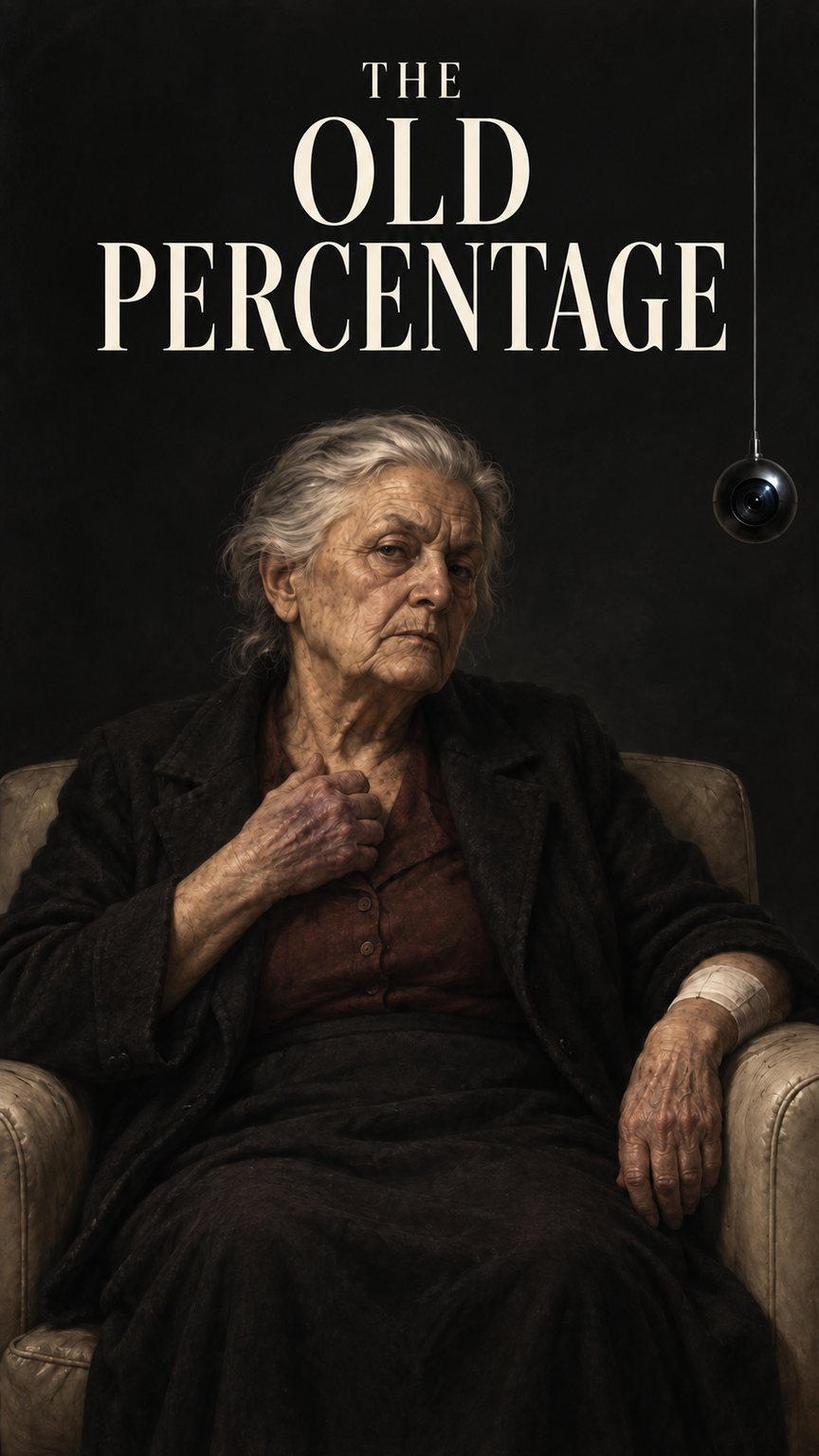
Elspeth escaped prison in a coat that wouldn’t close over her breasts. The woman pushing her wheelchair had bought it from a photograph.
“You said small,” Shona said.
“Get me another.”
“After.”
Behind them, inside the cardiac clinic, someone called Elspeth’s surname. Shona stopped arguing and pushed. Cold air entered the gap in the coat, and for the first time in fifty-nine years Elspeth went past a guard’s reach without being permitted to. She wanted to turn and see his face. Shona put a hand on her head and kept it facing forward.
At the car, Elspeth insisted she could stand. Her left arm had never recovered its full strength from the old wound; her right had acquired a tremor. Between them they managed a movement that caught her forearm on the door latch. Skin peeled back in a wet pink curl. She was still saying she could do it when Shona lifted her under the armpits and put her in.
Nineteen days after surviving the coup, Elspeth had been caught in a borrowed flat, twenty-three years old, with a half-eaten peach on her lap. The officers hadn’t wanted money. Someone had already given them her accounts, and two men who had once stood when she entered a room had agreed to testify. She was convicted of enough murders to outlast several bodies. Hers had lasted.
For a while there were lawyers, visitors, attempts to collect on her behalf. Then there were cheaper lawyers. Letters came back unopened. Money dwindled into money she had to ask for, then stopped. She had outlived an organization without receiving any single notice of its death.
In the geriatric wing they watched approved news. She knew cities had burned and governments had changed, that children now learned from people who weren’t people, that you could buy a face to wear over your face. She knew prices were high. None of this had required her to order lunch. Her meals came through a hatch, her purchases from a list, and every telephone call ended when somebody else decided it should.
Shona, a former clinic porter with a history of stealing from patients, had spent months finding reasons to be near her. She’d asked whether the old stories about Elspeth were true. Elspeth had asked which ones paid.
Now Shona wrapped a clean sock around the torn arm. She was thirty-eight, broad through the shoulders, with a chipped front tooth she kept worrying with her tongue.
“Eighty-two,” she said. “You didn’t tell me you were eighty-two.”
“You could have counted.”
“I thought the dates were wrong.”
Elspeth examined the sock. “We’re going to need money.”
“I’ve spent most of mine getting you out.”
“Then we agree.”
By the following evening she had slept for eleven hours, pissed in a stranger’s bed, and decided where to begin collecting.
The address had belonged to a bookmaker. Through the glasses Shona lent her, its frontage was cream stone, its windows full of candles. She took them off to clean a smear. Plywood covered the upper windows. There was a mattress in the entrance next door.
“Put them back on,” Shona said. “The directions are in them.”
“Who’s paying to make that look rich?”
“The businesses. The street subscription.”
Elspeth had put the rents up in her head while they were still in the car. She revised them downward. When she replaced the glasses, a painted woman in a ballgown stepped from the wall and offered her a murder supper.
The downstairs room was real enough. Somebody had put velvet over the damp. In the former counting office, a young man wearing a shoulder holster was explaining to six customers how a protection racket worked. Elspeth listened through the open door until he got to the part about affection for the neighborhood.
“That’s extra,” she said.
He laughed, thinking she had joined in. Then he came closer.
“Oh, she’s good. Shona, you found her.”
Elspeth looked at Shona.
“Corbin can get us a meeting,” Shona said. “That’s why I brought you.”
Corbin took off the holster and tucked it under the counter. He had beautiful teeth, too large for his mouth, and an expensive way of looking poor: frayed cuffs on cloth that held its shape.
“Is the face yours?” he asked.
“It had fucking better be.”
“People get proprietary about the likenesses. I have to ask.” He showed her his phone. A woman with Elspeth’s young face was advertising an experience called An Evening with the Mafia. The mouth was wrong. Too much upper lip. “We mostly use this age. But yours is interesting.”
Her old photograph had once been grounds for a man to cross the road. Corbin enlarged it with his thumb and checked her ears.
“She needs dinner,” Shona said.
They ate upstairs. Elspeth ordered lamb, discovered she could not chew it, and made Corbin fetch the menu again. He offered to have it cut smaller. She asked for fish. He returned with a spoon as well as a fork and set the spoon down without comment, which she appreciated more than she intended to.
“What do you take here in a week?” she asked.
“Me? Depends if Dacre pays on time.”
“Your employer?”
“Owns this place and two others. He brings me in for the good bookings, then says the publicity is part of my fee.”
“You can’t eat publicity.”
“I have explained that.”
Shona was smiling at her plate. Corbin noticed, and warmed to his complaint.
“They paid for a whole new face for the door girl. Me, he says I should look hungry. It’s appropriate.”
Elspeth gave him the potatoes she hadn’t touched. “I’d want a fifth.”
“Of the booking?”
“Of what comes in. You introduce me, you get your share. Shona sees to collecting. We build from there.”
“Twenty percent with two of you to cover.” Corbin considered this. “I can sell that.”
“Sell it?”
“Get Dacre to agree,” Shona said. Her knee pressed Elspeth’s under the table. “Let him finish.”
Corbin had already started a message. “He has a private group tomorrow. They want the collection, the threats, all of it. He’s bored with the regular cast.”
Elspeth put down her fork. “What cast?”
“The men he normally hires,” Shona said.
“You can sit for most of it,” Corbin added. “I’ll make sure.”
She let him send the message. There were worse beginnings than a discontented employee and an invitation from his employer. She’d had neither yesterday. Still, the pressure of Shona’s knee remained after it had been withdrawn.
Dacre’s club occupied the top floor of a former department store. Corbin met them by the lift the next night and handed Shona an envelope. She showed Elspeth the notes inside.
“Advance,” she said.
Elspeth touched the unfamiliar money. “He must want this badly.”
“Everybody wants something to talk about,” Corbin said. “Listen, if anyone says ‘House lights,’ stop what you’re doing. That’s our safety cue. A guest gets upset, somebody feels ill, we stop.”
“How upset?”
“Last month a man thought he was having a heart attack. Turned out it was indigestion, but we don’t argue.”
Shona put the envelope away. As she opened her coat, Elspeth saw the pistol she’d brought. She waited for Shona to cover it before taking her arm. Crossing the lobby, she had to ask her to slow down. The carpet was thick enough to catch her toes.
There were eight guests beyond the double doors, with empty dessert plates and glasses that smelled of expensive brandy. The room’s guard wore a soft grey suit. He asked Shona whether she’d brought a prop weapon. She said no, and he let her pass. Corbin introduced Elspeth to a man whose velvet jacket strained across his stomach.
“Dacre. So pleased.” He bent to speak near her ear, although she hadn’t asked him to. “We’ve a lovely chair for you. How long can you stand comfortably?”
“Long enough to meet a man.”
“Lovely. And you have your own dialogue?”
She stared at him. Shona took her elbow, but Dacre was already waving to the table. The guests turned; a woman adjusted the little lens pinned to her collar. Another raised a phone.
“Put that away,” Elspeth said.
The man grinned and lowered it to chest height, still pointed at her. Dacre gave him an indulgent wag of the finger.
“You’ll get the room recording afterward. Give her some space.”
Elspeth looked up. A black glass bead hung above the table.
“You’re recording a private meeting?”
“Private to us. Nobody’s broadcasting. Come, let’s have you back at the doors. Corbin, give her an introduction this time.”
“I’ve just walked from there.”
“Only a few steps.”
“Then you fucking walk them.”
The guests laughed. Dacre laughed too, a moment later. Corbin began to applaud, then stopped when she turned toward him.
“Why is he asking me to come in twice?”
Corbin’s smile held for a painful second. “We missed the entrance.”
“What entrance?”
“For the recording.” He looked at Shona. “Did you not tell her?”
Elspeth withdrew her elbow from Shona’s hand. Nobody at the table was speaking now.
“Tell me.”
“You’re doing a collection,” Corbin said. “For the guests. Dacre plays the owner who won’t pay. Then he pays. We booked you to do that.”
The guard came closer. Elspeth could hear the small squeak of his shoe against the chair leg.
“You sold me to him.”
“I booked you. You asked for twenty percent.”
“I asked for a fifth of his business.”
Corbin’s lips parted. She watched him find a smile and decide against using it.
“That’s not what he agreed to.”
Dacre reached for the chair and pulled it out. “There’s clearly been a misunderstanding. Sit down, my dear. We’ll pay the balance. No one’s going to make you perform.”
It was upholstered in pale leather. She wanted it so badly that she hated him for offering. Her knees had begun to shake. She sat.
“And I go away,” she said.
“Of course. We’ll have the car brought up.” He turned to Corbin. “The balance comes from your fee. You were to brief her.”
“I did. At dinner, with Shona there.”
“You can discuss it outside.”
Shona crouched beside the chair, bringing her mouth close. Elspeth could smell the mint she’d chewed in the lift.
“He’s got three places doing this,” she whispered. “Cash games afterward. Loans to the guests who lose. Corbin told me. We don’t have to go away.”
“You knew I was to entertain him.”
“I knew we’d get inside.”
“And now?”
Shona glanced toward the guard. “I need you to start it.”
Elspeth studied her. The woman had got her out of prison, paid for food, washed piss from a sheet. Now she wanted permission to do something she’d brought a gun to do.
She was being used. She had two aching legs, an empty stomach, and fifty-nine years of experience being used for nothing.
“Dacre,” she said. “Come here.”
“Let me just arrange your car.”
“I want my money every week. From the loans as well. Shona will be coming to see you.”
He stopped touching his phone.
“I’m not playing now.”
“Neither am I.”
The guard moved between them. “All right. Up we get.”
“Don’t touch her,” Shona said.
He took Elspeth’s wounded left arm. His thumb pressed the dressing, and she struck at his face with her right hand. It was an old, immediate intention; her body delivered a trembling scratch. He caught her wrist and forced her against the table.
Her knuckles folded under his weight. Something broke with a small dry noise. The plate by her cheek held a single raspberry and a streak of cream. She couldn’t get air to shout. Her left sleeve slid up in his grip, taking the dressing and a strip of skin with it.
“Let her go,” Shona said, much louder.
“Call the lift,” he told Dacre.
The shot struck him while he was turning. His weight left Elspeth all at once. He hit the table edge with his mouth, knocking a tooth into the cream, then fell beside her chair. Blood pumped through the hand he clamped under his jaw. He tried to speak. Bubbles swelled between his fingers, burst, swelled again.
For a moment nobody moved except him. One guest was still holding a spoon.
“House lights,” Corbin said.
The guard’s heel dragged against the carpet. Shona stood with the gun out, looking down at him as if there were another part she had forgotten.
“House lights. Shona.”
“I heard you.”
“Then stop. We have to—” He bent toward the guard and pulled back with blood on his cuffs. “We need an ambulance.”
A woman near the doors was already speaking into her phone, giving the address. Elspeth heard her say shot twice. When Shona raised the gun toward the sound, Elspeth said, “Leave her.”
The woman ran. Four others followed. A chair overturned and stayed overturned. Nobody shut the doors after them.
Dacre knelt beside his guard. “He has a little girl,” he said. “Jesus Christ. He has a little girl.”
Elspeth’s hand had begun to swell around the fingers. She held it against her chest. Each breath produced a thin complaining sound she couldn’t prevent.
“Get up,” Shona told Dacre.
He ignored her until she took his collar. Then he came up so fast he almost fell over the body.
“He was supposed to walk you out,” he said to Elspeth. “That’s all. I wasn’t having you hurt.”
“The money,” she said.
He stared at her. Blood shone on the knees of his trousers.
“You’ve been paid. Take the balance. Take whatever’s in the desk.”
She shook her head, then stopped because it made the room tilt. “You heard me. Every week. This place, your other places, the loans. A fifth. Tell her yes.”
“Yes. Fine. Yes.”
Shona jerked him toward the office. Elspeth caught her coat with the few fingers she could move.
“Don’t empty him out. He’s opening again.”
“We need to leave.”
“Then hurry.”
Corbin remained near the fallen guard. He had put a folded tablecloth under the man’s head, which had done nothing except make the blood easier to see. His phone stood propped against a glass, aimed along the table toward her.
“What are you doing?” Elspeth asked.
“Recording. I started after he told me I’d lose my fee.” His voice had become very quiet. “I wanted him to say it again.”
“Turn it off.”
He picked it up. His thumb hovered; then he put it in his pocket with the screen still lit.
“Corbin. You brought us here.”
“For a show.”
She looked at the door through which the woman had escaped. He followed her gaze.
“You can stay and explain,” she said. “Or you can come with us. I’ll pay you properly.”
He wiped his hands on the tablecloth. There was more blood on them afterward. Shona appeared at the office door with Dacre, and Corbin backed away from them.
“I’m staying.”
Elspeth could have asked Shona to stop him. She could have had the phone. She looked at the recording bead over the table, at the open doors. Her stomach rose into her throat. She swallowed and waited for Shona to help her stand.
Dacre was still talking. “If you come back, I’ll have people here.”
“Have the money,” Elspeth said, but she had to say it twice before he heard.
They had to leave the car two streets away. It had been booked to return them to the supper house; when Shona asked for a different destination, it pulled over and demanded Corbin’s approval. Corbin wasn’t answering. Elspeth shouted at the empty driver’s seat. Shona hauled her out.
She vomited against the side of the car. Somewhere behind them were sirens. By the time they reached the room Shona had borrowed, Elspeth had lost a shoe and the money in Shona’s coat had stuck together with blood.
“There’s your fucking collection,” Shona said, dropping it on the bed.
Elspeth lay beside it. She couldn’t get warm. The notes were much more than the appearance fee and much less than she had imagined. She couldn’t count them with her hand.
In the morning Corbin’s recording was on every news service Shona opened. The clip showed a shaking old woman ordering weekly payments; the guard could be heard dying below the edge of the picture. Other pictures had been found: the clinic, their arrival at the club, Shona’s employment photograph. The woman who’d called the ambulance described Elspeth’s coat in an interview. Under her picture was an appeal for anyone who’d seen her since the shooting.
The club closed. Dacre gave interviews. A man phoned Shona while she was helping Elspeth dress, said he collected Dacre’s loans, and promised to break her arms. Elspeth could hear him through the speaker. Shona went outside to talk to him and stopped playing the news aloud.
For six days Elspeth slept badly in three different rooms. A doctor Shona found wanted payment before touching her; he said the hand needed surgery. She refused a hospital. Afterward, whenever she complained about the pain, Shona offered to drive her to one. Two fingers remained bent toward her palm. She needed help with her trousers and could no longer cut her own meat.
On the seventh evening Shona came back carrying an envelope and wearing a new coat.
“From Dacre,” she said. “Other two places stayed open. This is your fifth.”
Elspeth sat up. “He sent it?”
“His collector brought it. The one who rang. I hired him. He collects the loans for us now. Dacre’s been making him wait for his money too.”
“Where is he?”
“Downstairs. He’s got somewhere for us tonight. Dacre told him he’d pay till you were caught. Reckons it won’t be long.”
Shona took the notes out and counted them onto the blanket. Elspeth watched for the hesitation that would tell her a share had already been removed. There was none. That proved very little.
“And the coat?”
“My money.”
Elspeth touched the sleeve. Good wool, with a generous lining. A woman could sit in that coat and still button it.
“You should have bought me one.”
“You can buy your own now.” Shona pushed the counted money closer. “You need help getting up?”
Downstairs was a man she hadn’t met, taking money from a man who wanted her dead. Shona had hired him without asking. Elspeth put her left arm out, and Shona bent to receive her weight. With her face against the new wool, Elspeth breathed in the expensive shop smell and began thinking how much more there must have been.