The Place We Keep
Your father wears a body of iron. Your sister lives in the river. Your mother prefers being a cat. You’re the only one who still looks like the your baby photographs. Every year, you meet at the ruins of your childhood home to watch the eclipse—until your sister arrives with a child and you ask your parents to explain what being human means.
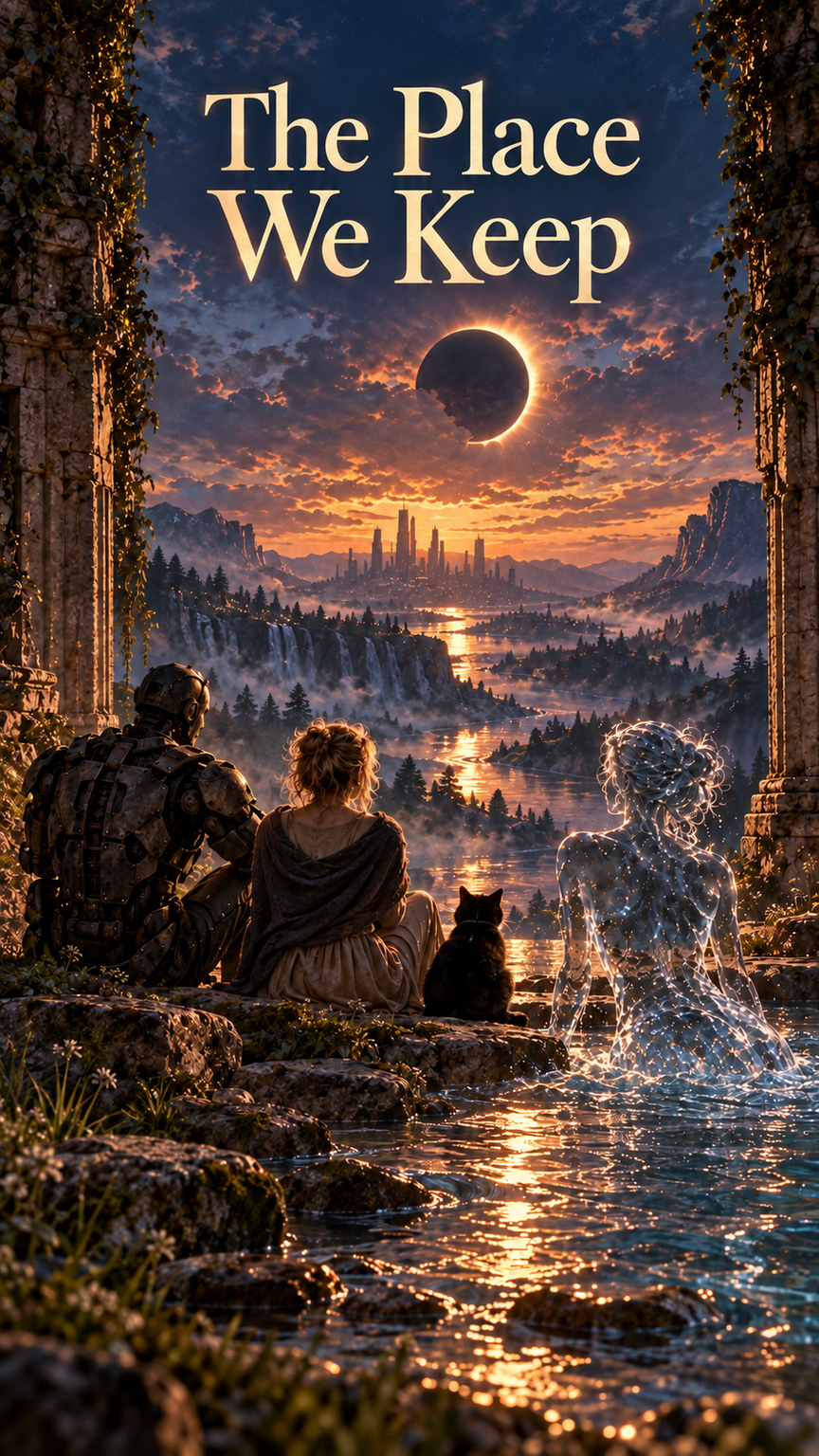
Father had put Mother where I usually sat.
She lay along the broad stone windowsill, one hind foot extended into the ruin, her black belly turned to the sun. Father stood beside her humming through his iron chest. A loose plate gave the tune an accompaniment it had never needed.
“There’s room,” he said.
“She’ll put her feet on the photographs.”
Mother opened an eye. “Then don’t put them under my feet.”
I set my basket in the grass. She moved before I could ask again, stepping onto Father’s forearm and climbing to his shoulder. The iron had been warming all the way down the hill. She settled with her chin between two rivets, and he lifted his other hand to embrace me.
I knew where to put my cheek now, against the smooth plate below his neck. The first year I had caught my hair in a joint. Inside that casing, the little living body his illness had left him worked the iron with a magic he had taken months to learn. I could feel the faint irregular beat through the plate. He smelled of metal and the peppermint he liked in his drinking mixture.
“You look well,” he said.
I had acquired two lines beside my mouth since the last eclipse. Father had acquired a new elbow.
Our valley lay beneath the same crossing of the moon each year. We had watched it from this window when there was a kitchen behind us, and from the sill after the roof fell. The house had survived all our departures before it began to come apart. Now grass grew where we had eaten, and the far wall ended in a staircase of exposed stones. Through the opening where the back door had been, the bank sloped to the river.
I opened the basket: bread, pears, Mother’s fish and Father’s little pot of custard. Under them lay the packet of photographs and, under that, the baby blanket I had been knitting since Selvi told me she and her partner were expecting.
Mother smelled the fish. “You remembered.”
“Every year.”
“Yes, but I don’t know that till you arrive.”
I gave her a strip. She took it from my fingers without catching them with her teeth.
Father wanted to see the photographs before his hands got sticky. I handed him the one of me at six months, sitting on a bed with a pear in my lap. My hair stood up in a pale tuft. It still did that if I went to sleep with it damp. I was the only one of us whose baby picture remained much use for identification.
“Look at that face,” he said. “Still you.”
I leaned against his arm to look with him, although I knew every scratch in the print.
“Are you coming down?” Selvi called.
She had risen in the shallows below the house. Sunlight passed through her shoulders onto the stones behind her. I could see a small fish dart past the place where, on a woman standing on land, her hip would have been. She could raise herself from the river, but not leave it; there were no legs folded out of sight, waiting to walk home.
Across one clear arm lay a clear child.
I had been imagining how Selvi would keep a woollen shawl dry. I had imagined a wet-haired baby with our family’s narrow chin, and worried that the river would be too cold. Here was the chin, absurdly, but I could see the pebbles through it.
“Oh,” I said.
“Come and see her. I can’t hold her up here for long.”
I took the basket down the bank, the blanket under my arm. Father followed, his steps heavy enough to dislodge little showers of earth. Mother rode him halfway, then sprang onto a flat rock at the edge. We had eaten here every year since Selvi’s change; she couldn’t hear a word from the windowsill when the river was running high.
“This is Ibby,” Selvi said. “Your aunt has brought you something you can’t use. Say thank you anyway.”
The baby’s face contracted. Her cry was small and sharp, without the watery bubbling I had expected. Selvi shifted her upright, and a tiny hand struck her mother’s chin. Where their bodies touched they remained separate: I could follow the curve of Ibby’s cheek against Selvi’s breast.
“Can I?” I put out my hands.
“In the water. Let her lie across them.”
I left my shoes on the gravel, knelt in the shallows and slid my hands under Ibby. She was warm, with a weight that yielded and gathered itself again. Her head rolled sideways, following Mother’s tail. I couldn’t tell where her fingers ended. She curled them into a small fist, then let it loosen into trailing shapes.
“Four months?”
“On the ninth.”
“Was she like this when she was born?”
Selvi watched my hands. “Yes.”
“I thought perhaps you had changed her.”
“No.”
I wished I could scratch my nose. Both hands were occupied and Selvi’s attention had become uncomfortable.
“I didn’t know,” I said.
“Well. You do now.”
Ibby opened her mouth. I could see, far inside her, something pale working in its own time. She bent towards the touch of my thumb on her cheek, then complained when it offered nothing to eat.
“She’s hungry again.” Selvi took her back. A cloudy brightness gathered at her breast as the child settled against it. “I thought we’d make it through the introductions.”
Mother crouched close to watch. “How are you sleeping?”
“Badly. He takes her when it’s light, but then I lie there listening for them. Last night I woke him up to tell him she was asleep.”
“I used to do that,” Father said.
Mother looked up at him.
“With our first,” he added.
Selvi laughed, then winced as Ibby’s hand tightened. “Ow. Don’t pull. There’s plenty.”
I laid the blanket on the dry rock behind Mother. It was yellow, with a border of white leaves. I had unravelled that border twice to make it right.
Selvi leaned to see. “Oh, you did the leaves after all. It’s lovely.”
“What was it like?” I asked. “Carrying her.”
“Heavy. I couldn’t hold myself up this high for the last month. I had to speak to people with just my face out. And I wanted eggs all the time. Cooked eggs. Getting them was a nuisance.”
“I could have brought eggs.”
“You could have visited.”
She said it without looking at me. Every week I had meant to visit once the border was finished. Selvi had been eight miles away.
Father bent to look at Ibby, who abandoned feeding to examine the dark opening of his mouth.
“Our chin,” he said happily.
I looked from his fixed iron face to Mother’s whiskers, then down at my own knees, whitening under the water.
“What does being human mean?” I asked them. “If she has our chin, does that make her human? Or if she doesn’t? What do you mean when you say it?”
Father straightened. “She’s your sister’s child. Of course she’s human.”
“Her father was born in the river,” Selvi said.
“And a very decent fellow.”
“I know he’s decent. I live with him.”
Father adjusted the photograph, which he still held between two iron fingers. He had carried my baby face all the way to the bank.
“I’m human,” he said. “This doesn’t alter that.”
He tapped his chest, gently because Mother disliked the sound.
“You remember being a man,” I said. “She won’t.”
“I am a man. I don’t spend all day remembering it.”
That stopped me. He eased himself down beside the blanket. Small movements still took preparation, but he had learned to sit without asking anyone to steady him.
“When I was ill, I wanted to get out of bed. That was mostly what I thought about. I wanted to come here. I wanted another pear, though they couldn’t promise me pears. I wasn’t deciding to become some new thing. I was scared I’d die before the work was finished.”
He looked down at the photograph.
“You wouldn’t let me have that one. Kept both fists round it, even when you fell asleep.”
“That was another day,” Mother said. “I took that picture. You were away with your brother all that week.”
“I remember the pear.”
“We had a tree full of them. You remember one of the others.”
He brought the print close to the dark apertures of his eyes. “Is that the old blue cover?”
“Yes.”
“Then perhaps.”
I knew the picture was brown and cream, yet I had always been able to see that blue. Mother must have told me about the cover before. I couldn’t remember her telling me, only the colour itself.
Selvi had lowered herself until the river touched Ibby’s back. The baby resumed eating. Mother jumped onto the blanket and began pressing it flat with her paws.
“And you?” I asked her.
“What?”
“Are you human?”
“I’m a cat.”
“But under that.”
She stopped kneading. “There isn’t a woman tucked under my fur.”
“I mean the part that thinks.”
“That part’s enjoying the blanket too.”
I pulled my cold feet from the water and sat on a patch of gravel. “You could be a woman this minute.”
“Yes. I was one on Tuesday. We played cards. I lost rather a lot.”
“Then why aren’t you one now?”
She looked at me for a moment, ears forward.
“Did you want me to be?”
I wanted to say no. I wanted the question to remain a reasonable question about what things were, without having to admit how carefully I had laid out the old photographs that morning, or how often I dreamt that I came in through the back door and found everyone where they belonged.
“Sometimes,” I said. “It’s easier to hug you.”
Mother stepped onto my leg. Her claws went through my skirt and she withdrew them when I flinched. I stroked her between the ears, in the place she liked; it was a small contact and I had asked for a large one.
“I don’t want to change today,” she said.
Father reached for his custard. I got it for him, unscrewed the lid and handed it over. His drinking tube slipped out below his chin. We could all hear him finishing the pot.
Up the bank, the jagged wall had begun to throw oddly narrow shadows. I took our eclipse lenses from the basket and set out the rest of the food. The photographs came out too. I wasn’t ready to put them away.
On top was my ninth birthday, with the kitchen full of paper birds. Mother stood behind a cake. Father had caught her laughing, her eyes closed, one floury hand against her waist. Selvi and I wore strings of birds over our dresses. I had made them from the thin paper used between prints.
“That was a good day,” I said.
Mother leaned to see. “You two ate the sugar beaks off every bird on that cake.”
“They were falling off,” Selvi said.
“Into your mouths.”
Selvi grinned at Ibby. “We were very helpful children.”
I remembered the sweetness, hard at first, softening between my teeth, and the damp string that kept brushing my lips. We had danced round the table until we tore our paper garlands on the chair backs.
“I thought you’d make those birds forever,” I told Mother.
“They took an age. I was still putting the wings on when you got up. I couldn’t get the icing off my fingers for days.”
“You loved doing it.”
“I loved you having them.”
It was close enough to agreement that I tried to leave it there. “Look how happy you are.”
She withdrew her head from beneath my hand.
“Your father had just sat on the spare cake. That’s what I’m laughing at. I had a toothache. I’d been awake since before dawn and I wanted everyone to go home.”
“They hadn’t even had the cake yet,” Father said.
“I know. I had to wait.”
I looked back at the face in the photograph. It was so entirely the face I remembered that the other morning, the one with the toothache, felt like something being done to it.
“Was any of it how I remember?”
Mother’s tail moved across my knee. “Which bit?”
“Being here. Us. You make it sound as if you couldn’t wait to get away.”
Selvi lifted Ibby higher. “Could someone move the fish? She keeps trying to reach it.”
I moved the parcel. My face was hot. The little interruption had left me sitting with what I’d said, while everyone else had something useful to look at.
“I stayed here eight years after you left,” Mother said. “You used to tell me to get a smaller place.”
“I don’t mean the house.”
“Then I don’t know what you mean.”
There was hurt in her voice now. I had heard it when I was a child and broken things, and later when I said I was too busy to come home. I put the birthday picture face down on the blanket.
“I’ve kept all these,” I said. “Sometimes I think I’m the only one who wants them.”
Father turned his photograph towards me. “You haven’t let me have this one.”
“You never asked.”
“I did. Last year. You said they should stay together.”
I remembered. I had even looked into the cost of copies, then forgotten. Father held the print against his thigh, taking care not to bend it.
“Ibby won’t remember any of that,” Selvi said. “She’ll know him like this.”
“I know. That’s what I’m trying to ask about. Whether she’s still—”
I stopped. Selvi was watching me now.
“Still what? She’s only just got here.”
Ibby thrust a hand towards the fish. Selvi caught it and kissed the place where her wrist briefly narrowed.
“I don’t mind questions,” she said. “Ask how I had her. Ask about her father. But I’m not going to spend her first visit guessing what she’ll call herself when she’s grown. I haven’t even told you she can laugh.”
Mother leaned forward. “Can she?”
“For him. Apparently I’m not funny.”
Selvi made a noise against Ibby’s cheek. The baby turned her head with an expression of absorbed suspicion. My sister tried again, less confidently. Father chuckled, and Ibby stared at the opening in his face.
“That,” Selvi said. “That’s what she’s been doing to me for weeks.”
I laughed before I could help it. Selvi glanced up. She was smiling, and I was glad she had looked at me in time to see.
I put the other photographs back in their paper sleeve. Father kept the one of me. The birthday remained face down.
“What did you like?” I asked Mother.
She looked towards the sun. “When?”
“When we were little.”
She settled against my stomach, making me lean back to give her room.
“Taking you out before anyone else was up. You were both quieter outside. Selvi collected things. You made me name them.”
“You knew all the names.”
“I made some up. You wouldn’t accept that I didn’t know.”
“I still have a stone you called a sleeping tooth.”
“Well, there you are.”
I put my hand around her warm, narrow ribs. She breathed under it, watching something small move in the grass. I had never known she invented names; I had been proud of how much she knew.
“Was it being a mother you got tired of?”
“I got tired of being needed from the moment I opened my eyes. I liked you very much when you could find your own socks. I like you now.”
She paused, then rubbed her cheek on my wrist.
“And I like going under hedges. I thought I’d do it for a week when I first learned. Then there kept being things I wanted to do the next day.”
“You didn’t tell us.”
“I tried. You asked when I was coming back.”
I had. Even after she’d moved to the little house beside Father’s rooms, where I could visit either of them whenever I liked, I had asked.
“I want to know about the hedges,” I said, although part of me still wanted to know when she was coming back.
Mother’s ears swivelled. She seemed about to answer, but Father said, “Nearly time,” and we reached for our lenses. Mother let me hook hers over her ears.
The remaining sun was a thin crooked thread. Colour drained from the grass; the river kept its brightness longer than the stones. I had seen this every year of my life and still felt a brief, childish resistance, as if this time it might go too far.
The last light went. We lowered the lenses. All along the opposite bank the trees stood black beneath a sky that had become much larger. Above our broken house the sun was a dark circle with a white, unruly edge.
Ibby cried.
“Yes,” Selvi told her. “It does that.”
She held the child close. Father kept watching the sky. Mother climbed onto my shoulder to see past his head, and her whiskers touched my ear. For the few minutes we had come for, nobody spoke.
Then a brightness broke from one side. We raised the lenses again. Birdsong began in the trees, uncertain at first, and Mother grew heavy against my neck.
I lifted her back onto my lap. My skirt was wet, my legs cold. There was bread left, and a whole pear, and we had no reason to go yet.
“After the birthday,” I said. “Did you get to lie down?”
Mother blinked at me.
“When everyone had gone home. What did you do?”
“Your father took you upstairs. I went out.”
“With the toothache?”
“It had eased by then. There was dancing in the field behind the orchard. I could hear it through the window.”
Father shook his head. “You came back with a blister the size of an egg.”
“I wore the wrong shoes. I’d forgotten how to be out for a whole evening.”
“Were you good at it?” I asked. “Dancing?”
“Better than your father.”
“I was good enough to marry.”
“I didn’t marry your feet. Anyway, there was a drummer. When they stopped to rest, he asked me. Lovely face, no idea what he was doing. He wanted to lead.”
Selvi brought Ibby near the rock. The baby was trying to get hold of the reflected light beneath Father’s hand. I turned the birthday photograph over again.
“What happened?” I asked.
“I had to teach him. There was this little sideways step, and he kept trying to cross his feet. I’ll show you.”
She stood up on my knees to show us.