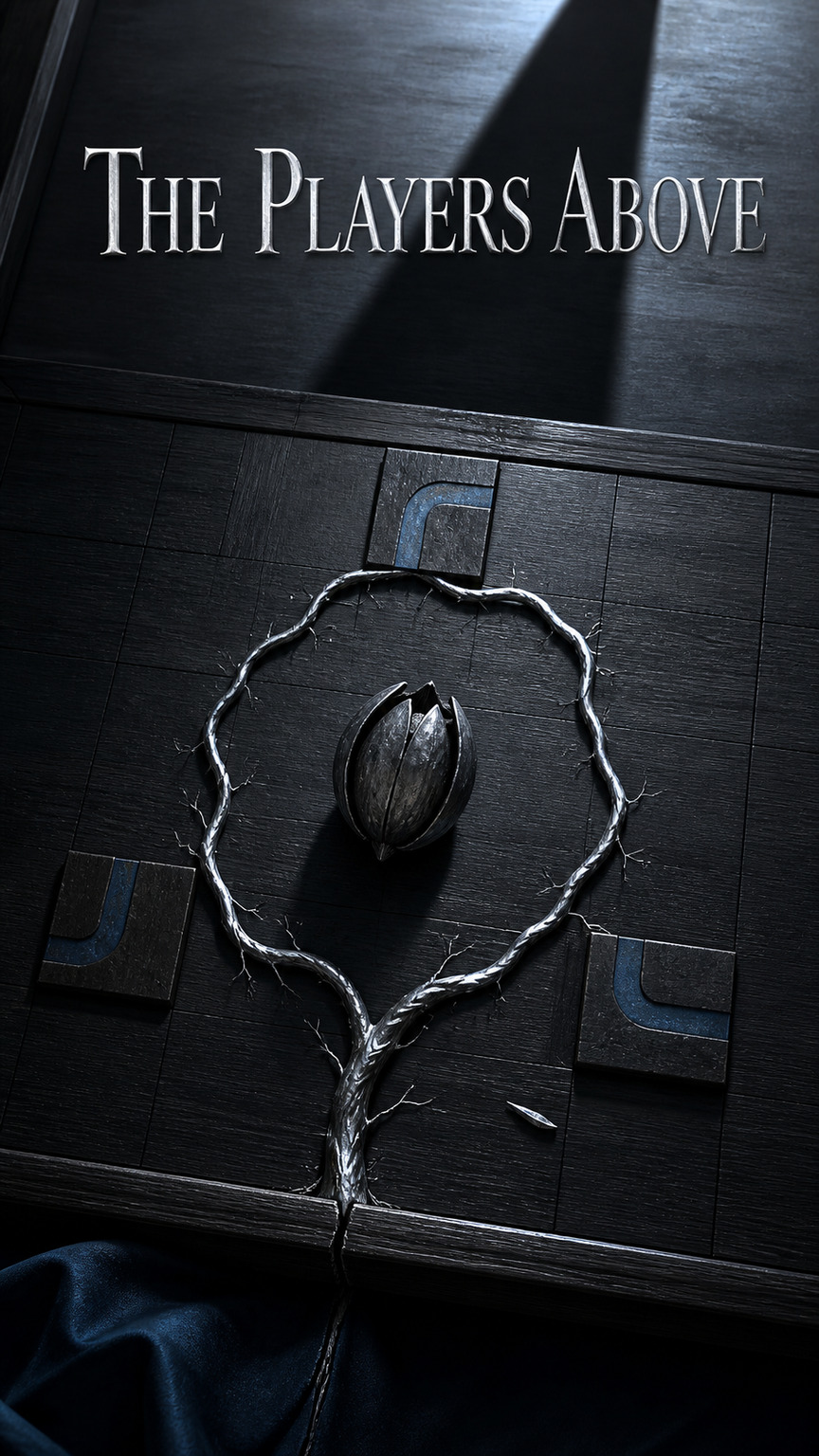
The Players Above
"I apreciate your advice, formless voice, but what do you want with me?" "Me and some friends are having a cosmic game. One of us has created a great peril and the rest of us must guide you and your companions to both figure it out and then solve it" "Like in a TTRPG?" "Oh, you have those too?"
The last die was still turning when Ludek asked which way everyone was going home.
It was the sort of question that ended every game in the mill room. Boots were found under the table. Cups were stacked beside the flour ledger. Reniya, who had spent the evening calculating the odds of imaginary bridges collapsing under imaginary armies, gathered the painted route tiles into their box and said, “I’ll walk with you past the upper press, then take the orchard stair and—”
Something chimed beneath her chair.
A silver filament pushed through the seam between two floorboards. It grew the width of her hand in a blink, following the direction her finger had drawn across the table. Its tip struck a nail, forked around it, and shed a splinter no longer than a barley awn. Reniya picked it up before Veysa could slap her hand away.
Cold bit through her fingertips.
Do not complete that move, said a voice with no place in the room.
Reniya dropped the splinter onto the table. The voice stopped. She touched it again with one finger.
“I appreciate your advice, formless voice, but what do you want with me?”
Veysa stared at her. Ludek, halfway into his left boot, remained halfway there.
Some friends and I are having a cosmic game, the voice said. It spoke as if each clause had to wait for the previous one to clear a narrow gate. One of us created a great peril. The rest of us must guide you and your companions to discover it and solve it. That is our turn.
“Like in a TTRPG?” Reniya asked.
For the first time, the presence in the metal lost its measured pace. Oh, you have those too?
Then it was gone. The splinter remained painfully cold.
“What said that?” Veysa asked.
“A player.” Reniya looked at the silver thread between her boots. “Possibly.”
“Whose player?”
“Not ours.”
Ludek pulled on his boot. “Good. I was worried I’d forgotten to pay someone.”
Veysa was already on her knees. She took the lamp from its hook, set its hood low, and ran a thumbnail along the floor seam. She had repaired the mill’s west wall after two wet winters, and she distrusted any crack that arrived with an explanation. “Lift that board.”
“It’s pinned.”
“Yes, Reniya. Mills generally prefer their floors to stay down. Get the short bar.”
They cleared the game pieces and pried up two boards. Beneath them, the old joist carried a metallic root: silver at its narrow tip, dull gray behind, its surface wrinkled like metal poured over twine. The newest length pointed toward the orchard side of the mill. It did not move while they watched.
“You were naming the orchard stair,” Ludek said.
“I hadn’t named where I was going after it.”
“It had enough to start.” He crouched without touching the root. “This afternoon I told the flour porter I was carrying receipts to the vinegar yard. Something jumped under the bins. I thought mouse, nail, old mill.”
Veysa looked toward the bins. “Show me.”
“Show you where I heard it, or tell you where I’m going?”
“The first. Keep the second behind your teeth.”
They found another gray ridge below the bin platform, aimed toward the lane that led to the vinegar yard. A third had buckled the plaster beside the delivery door. Ludek remembered a mill hand announcing a walk to the market scales before supper.
Reniya sorted possibilities because sorting them was better than imagining silver roots reaching the crowded square at dawn. The voice itself had not made the filament grow. Neither had her question. All evening they had declared journeys for their game pieces—to the ash fortress, through a paper swamp, twice to the moon—and the floor had stayed quiet. Those routes had never been theirs.
“We test one fact at a time,” she said.
Veysa’s head came up. “On what?”
“Empty floor. Short distance. No cutting.”
“On my floor, then.”
“Technically the miller’s.”
“Tonight it’s mine.”
Ludek took the lamp to the far wall. “Ask me something.”
Reniya silently decided to carry the route-tile box to the north window. She pictured the few steps, took them, and set the box on the sill. The root did not move.
Reniya understood. “Are you going to the water jug?”
“No.”
Nothing sounded below them.
“I came here by the south lane,” Ludek said. Still nothing. He pointed at the flour bins and announced, with a courier’s plain certainty, “I’m walking from this wall to those bins now.”
The silver tip beneath the lifted boards shot forward. A second filament creaked under the floor along the line Ludek had glanced across the room. It stopped when it reached the bins. Ludek walked there after it, jaw tight.
“Past travel does nothing,” he said. “A question does nothing. Something I mean to do next does.”
Reniya said, “I’m going to the bell tower.” She had no intention of leaving the room. The root did not stir.
Veysa lowered the lamp until its brass rim nearly touched the old growth. “And lies do nothing. We have enough for a working rule.”
The cold in Reniya’s fingers shifted. A new presence fitted itself around the splinter, not entering so much as finding the only open chair.
Your inquiry is permitted. The words arrived all at once, clean-edged and impatient.
Reniya nearly asked who it was. One useless question, and perhaps one answer gone. She looked at the root instead. “Exactly what feeds this growth?”
Audible, sincere intent to travel, originating within half a mile. A remembered journey is excluded. An inquiry is excluded. False declaration is excluded. Guidance without a body is excluded. I may report the condition; I cannot perceive your buried result.
Reniya repeated it, losing the formal edges as she spoke. “It says a spoken route you truly mean to take feeds it, if you’re within half a mile. Not thoughts, questions, lies, old journeys, or the voices. It can’t see underground.”
“Half a mile from what?” Ludek asked.
The presence did not respond to him. Reniya had expected that; the splinter still made her bones ache with the certainty of being the only open channel.
Veysa took up the short bar. “From the thing we find by following this.”
“Wait,” Reniya said. “We have one answer left from this one.”
“Then don’t spend it asking whether we ought to wait.”
They left the lamp burning over the open floor and followed the cooled root.
It had worked through the stone sill rather than under it, splitting a wedge from one corner. Outside, moonlight turned the lane pale and the root dark. The metal had taken the routes people imagined, not the roads themselves. One branch went under a wall where a walker would have used the gate. Another rose through packed soil on a slant toward the orchard stair, following Reniya’s unfinished intention as far as she had formed it. Behind every silver point lay a gray seam already cooling in the night air.
Ludek walked first. He knew which alleys people named and which they used without naming, where carts had worn diagonal escapes between terraces, where a courier saying upper road might mean any of three grades. He held up a hand before each turn instead of calling it.
At the base of the first orchard terrace, the root vanished beneath a retaining wall.
Veysa pressed her ear to the stones. A faint ticking answered from inside. “The face is loaded.”
“Can you tell how far?” Reniya asked.
“I can tell it wasn’t ticking yesterday.” Veysa scraped mortar from a joint with her knife. A hairline crack ran upward between two blocks. “Don’t make me improve an answer I can’t honestly improve.”
The silver root brightened at Reniya’s feet, though none of them had named a route.
“We didn’t say anything,” she said.
Ludek pointed downslope. Two late workers crossed the lane below, talking as they went.
“—taking the east cartway to the tannery,” one called.
Under the terrace, metal groaned. A bright spur punched through the mortar and aimed southeast.
“That’s inside half a mile,” Ludek said. “Market morning will be worse.”
The first produce wagons would arrive before sunrise. Porters would call deliveries. Traders would give directions to half-awake apprentices. Hundreds of sincere routes, spoken within reach.
Veysa wedged the short bar behind the shining spur.
“Don’t cut it,” Reniya said.
“I’m checking whether it’s fixed to the stone.”
“It was made by someone calling this a game.”
“The wall doesn’t care what they call it.” Veysa leaned only enough to feel the resistance, then stopped. “Ask what cutting does.”
Reniya closed her hand around the splinter. “What happens if we break the root before it stops growing?”
The living maker supplied one finite charge. Severance while charge remains releases new growth toward the last accepted destination. Intervention is not permitted to me. Warning is.
The presence closed like a door. Its two answers had been spent.
Reniya relayed the words. Ludek looked down the slope, toward the sleeping roofs gathered around the market.
“Last accepted destination,” he said. “Which was the tannery.”
“If that man meant it.”
“He works there.”
Veysa eased out the bar. “Finite is useful. Charged is the word that keeps our hands off it.”
They climbed.
Above the terrace, the root split into old courses. The cooled seams showed its history as plainly as wagon ruts. Reniya began to see a rule in their failures to overlap: a new filament would approach an older gray line, turn aside at the last finger’s breadth, and run beside it or branch away. Twice it had made long detours around its own buried track.
They followed those detours through two orchards, over a dry irrigation lip, and into a weed-choked trench built around the remains of a kiln. The kiln had been taken down years ago; only its circular footing remained, half buried above the catchment that supplied the market cisterns. Moonlight lay on the stone ring. Silver threads entered from every side.
At its center, something under the earth pulsed hard enough to shake dust from the weeds.
The third presence arrived as a fan of spoken possibilities inside the cold: outward, inward, beneath. Reniya formed a question silently and received only more branching. It could not hear her think.
If the line continues outward, it may branch at the obstruction. If inward, it may surface beside the origin. If beneath—unobserved. Choose the question that removes the most paths.
Reniya knelt beside one place where the new silver veered from a cooled seam. “Can fresh growth cross a seam it has already laid?”
Not after that seam cools. A course closed around the origin forces the remaining charge inward. The core then becomes reachable.
“It says close a route around the center. The growth can’t cross its cooled metal, so the charge knots inward and pushes the core up.”
Veysa walked the ring, counting paces. At the downhill side she thrust the short bar into the weeds and hit stone almost at once. She tried again two steps left, then right. Stone each time.
“Catchment crown,” she said.
Reniya looked from the old kiln footing to the buried wall. “The voice suggested the core might surface.”
“Beside the origin, it said. Or under it, which it cannot see.” Veysa drove the bar once more, gently now. “The catchment crown runs under this side. If we force metal down, it enters the wall. If we dig where your friend is offering branches, we unload the soil holding that wall.”
The presence spread more alternatives: excavation inward, a straight trench outward, removal of obstructing stone. None accounted for a catchment it could not perceive.
Reniya wanted to ask which path had the highest chance. The question formed perfectly. So did Veysa’s answer before she gave it: chance of what, based on whose wall?
“We don’t dig,” Reniya said.
Veysa nodded once.
Ludek had gone around the kiln and was kicking leaves from a shallow stone channel. “Here. The old service course.”
It began beside the kiln’s loading apron, curved along the uphill half of the footing, then descended at each end toward a dry spillway. Kiln carts had once used the course to circle without backing near the catchment edge. A century of silt blocked the spillway mouth.
“It comes back to itself,” Ludek said. “Or did.”
Veysa examined the downhill stones. “Open the spillway and the route can close above the crown. If anything runs loose, the channel carries it away from the wall.”
The voice offered a straight line through the footing, shorter by half.
“No,” Veysa said when Reniya relayed it. “Shorter for the root. Riskier for everyone who drinks tomorrow.”
That consequence lies outside my observation, the presence replied, unasked.
“Not an answer,” Reniya told it.
The branching pressure continued.
Ludek put his shoulder to a spillway slab. “Could the two of you settle the nature of answers while lifting?”
They lifted.
Mud sucked at the slab. The channel beneath smelled of wet lime and old apples. They cleared it with the short bar, Veysa’s knife, and their hands, passing stones downslope without saying where they meant to carry them. Reniya marked the intended loop with game tiles from her pocket, bright squares at each turn. Veysa moved three of them when the line came too close to the buried crown. Ludek stood at opposite bends and used gestures to confirm sightlines. They planned in questions, lies, and pointing. The root stayed still except when distant night workers fed it another destination.
By the time the spillway lay open, the silver at the kiln center had thickened to a fist. Dawn had begun to gray the eastern haze.
“We need an honest route,” Reniya said. “One of us could speak the full circuit and walk it.”
“Too long,” Ludek said. “The footing’s already shifting.”
Veysa put her palm to an uphill stone. It clicked against its neighbor. Her speech shortened with it. “Three legs. Joined at the tiles. Each mean your own. Each walk your own. No downhill shortcuts.”
“Does joining three intentions count as one course?” Reniya asked.
“That’s your calculation.”
Reniya looked at the root’s branching history. Separate declarations had made separate filaments, but filaments joined when their imagined courses met. The likelihood was not comfortingly high. It was merely higher than waiting for market bells.
“It should.”
Ludek wiped mud on his coat. “Should like a bridge in one of your games?”
“No. Should like every piece of evidence we have and one gap.”
“Better.” He took the longest section, the outer curve where the route bent out of sight.
They set themselves at the three bright tiles. Reniya’s mouth had gone dry. She could hear the last voice mapping branches through the splinter: if one intent failed, if one line reached a cooled seam too early, if the charge found the wall first.
Veysa struck the footing with the flat of her bar. “Now.”
“I’m going from the loading stone, around the upper kiln curve, to the blue tile,” Ludek called.
The earth opened behind him. Silver root rolled into the cleared course, fast as water down a steep gutter. Ludek ran, no joke left in him, glancing back only at turns. The metal followed the course he had pictured rather than every placement of his boots.
At the blue tile Veysa took over. “I’m going along this sound footing to the spillway head.”
Her line grew broader and slower. She watched the masonry, not the root. Halfway down, one stone dipped.
“Stop there. Reniya, move your mark uphill. Two feet. More. Hold it.”
Reniya shifted the final tile. Veysa adjusted her declared course with the confidence of someone accepting the load herself. The root curved away from the catchment crown.
Reniya began her leg. “I’m going from the spillway head down—”
“Not below,” Ludek shouted. “Not below. The service lip, then the red tile.”
The half-spoken intention pulled a bright needle toward the catchment. Reniya bit off the rest, stepped sideways, and forced herself to picture the actual safe course rather than the destination she feared.
“Along the service lip,” she said, breath clipping each phrase. “Around the outer stone. Back to the loading apron.”
The needle bent. Metal chased her through the opened channel. Heat came off it now, burning the damp from her boot soles. Ahead waited the first cooled seam, gray and unbroken across the place where her route must close.
Too late, she saw that her imagined line met it at an angle instead of joining Ludek’s starting point. Would touching count, or must it overlap? One question remained.
She gripped the splinter. “Must the new growth retrace the first seam to close the course?”
The answer divided around what the voice did not know. It must meet a cooled boundary that encloses the origin. It cannot cross. Your elevation, wall, and chosen safety are not visible to me.
Reniya relayed only what they needed. “Meeting closes it. It doesn’t have to retrace.”
The voice began another branching shape and faded before completing it.
Reniya ran the last six paces. Behind her, silver struck gray.
The impact made no grand sound. It made the small, dreadful sound of a spoon cracking a cup. The new root tried to cross the cooled seam, flattened against it, and raced both ways around the circle. Where it met the other new lines, the whole loop tightened.
At the kiln center, earth humped upward.
“Spillway!” Veysa shouted.
They threw themselves clear. A white-hot spur broke from the center and snapped downhill, but the loop turned it sideways into the open channel. It ran ten yards, shedding beads of molten silver, then thinned to wire, to hair, to nothing. The pulsing beneath the kiln stuttered. Once. Twice.
Stopped.
Veysa approached first, testing each stone before trusting it. The closed course had exposed a dark metallic pod among the kiln bricks. It was the size of Reniya’s two fists and folded around itself like a seed. No light moved in its seams.
“Cold?” Reniya asked.
“You’re holding the supernatural splinter.”
“You’re the mason.”
Veysa touched the pod with the back of one muddy finger. Then she laid her palm on it. “Cold.”
Ludek crouched at the spillway and watched the last silver bead dim. “And finite.”
Veysa set her knife in the pod’s exposed seam and tapped the handle with the short bar. The shell parted without resistance. Inside lay a dull grain of metal, no warmer and no more alive than a dropped nail.
Reniya closed her hand around the splinter. Nothing spoke. Whoever had made the peril offered no protest, no explanation, no sign of having watched. The other presences had spent their answers and gone with the charge.
They lifted the grain into the empty route-tile box and carried it to the catchment. Veysa checked the crown stone by stone while Ludek climbed down to the inspection hatch and called back dry measurements. One joint had opened a fingernail’s width. It would need mortar before the first draw. The wall itself held.
Below them, shutters began to knock open around the market.
“Mill floor first?” Reniya asked.
Veysa handed her the short bar. “Catchment joint.”
“Then the mill floor,” Ludek said, climbing out. “Then breakfast.”
Veysa looked at the mud on all three of them. “Bring mortar.”
Ludek sighed and took the heavier end of the tool basket. Reniya tucked the cold box under her arm, and together they started down to the wall.