The Ring Between Lives
The saint arrives at the Demon Queen’s castle in a wedding dress, determined to end their kingdoms’ war with a marriage proposal. She has prepared for threats, mockery, even imprisonment—not the queen kneeling before her with a ring she has kept for three hundred years. “You always ask first,” the queen whispers. “I wanted to beat you to it this time.”
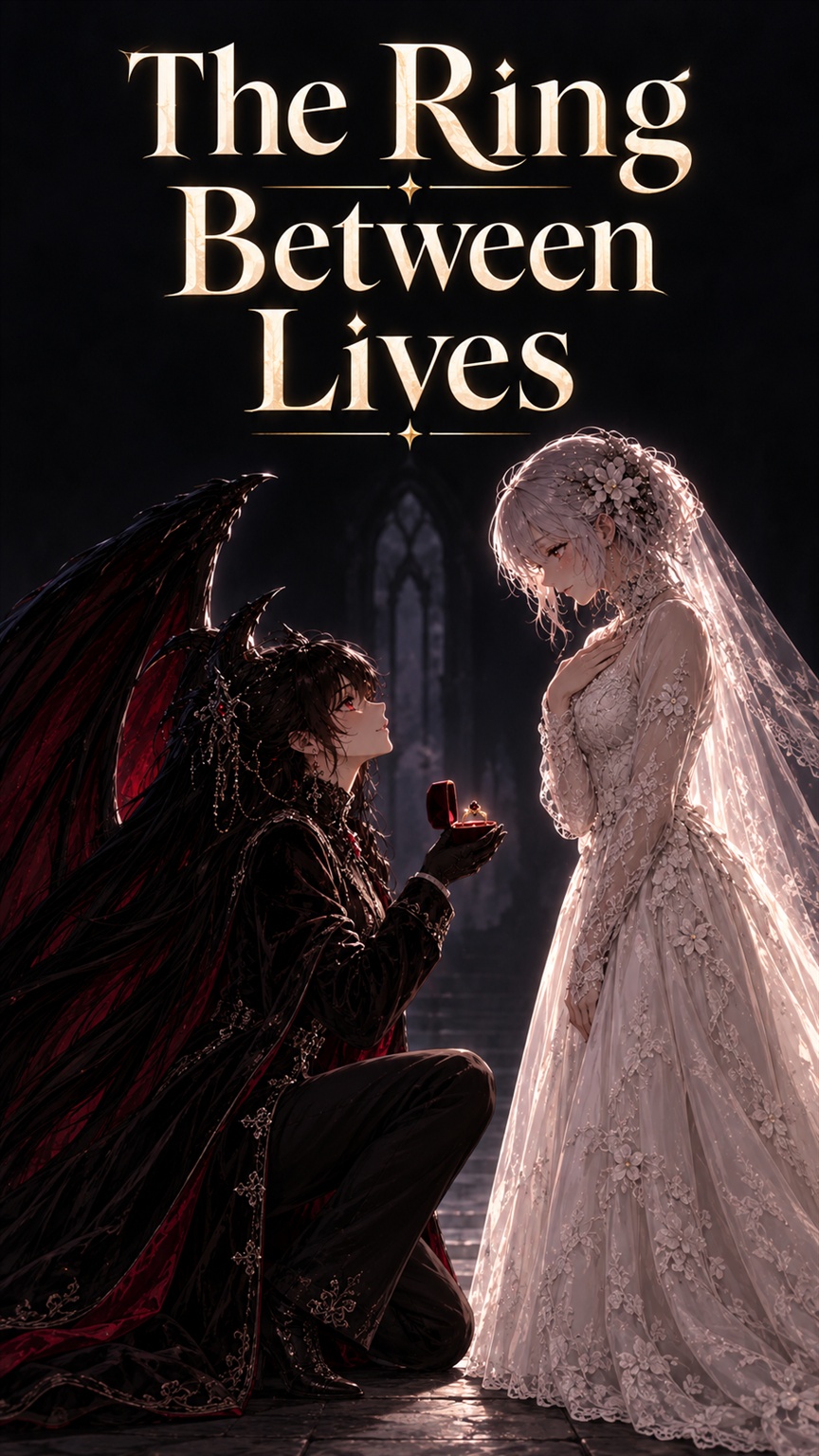
The saint had worn a wedding dress to the enemy’s castle, and Rhazelle had chosen the wrong trousers for kneeling.
That was her first thought. Her second was that the woman beneath the pointed arch had come through two armies, carrying her white skirts clear of the mud, and someone ought to take her cloak. Moonlight caught in Sidonie’s pale hair. Her mouth was set in the grave, unpromising line Rhazelle remembered from their first truce conference, before six weeks of letters had taught her what that mouth could do when amused.
At twenty-nine, Sidonie had been her country’s reigning saint for four years. Rhazelle was immortal and had been Demon Queen long enough to remember when the saint’s country used a different alphabet. Neither fact had prepared her for the dress.
“Your Majesty,” Sidonie began. “I have come to propose—”
Rhazelle knelt. A seam complained beneath her black velvet coat. She spread her wings for balance, their crimson undersides briefly filling the arch, and opened the little box she had kept for three hundred years.
“You always ask first,” the queen whispered. “I wanted to beat you to it this time.”
The ring lay in new silk. All the old linings had worn out around it: three blue, two red, a regrettable green. Gold leaves clasped a dark garnet, no larger than the nail of Sidonie’s smallest finger. Rhazelle had once rejected six stones for being too pale, too red, insufficiently red. The jeweler had died of old age without ever meeting the intended bride.
Sidonie took a step backward.
Oh.
“This time?” she said.
Rhazelle had imagined surprise, laughter, possibly tears. She had not imagined having to explain reincarnation while looking up somebody’s nose.
“We’ve been married twice.”
Sidonie stared at her. Behind Rhazelle, a log collapsed in the drawing-room hearth.
“I have never been married.”
“No. You haven’t.” Rhazelle closed the box halfway, then opened it again. “Your soul has had other lives. I knew you in two of them. We married. You asked both times, before I could give you this.”
Sidonie looked from the ring to Rhazelle’s face. “Is this something you say to visiting saints?”
“The last visiting saint threw a chair at me.”
“My predecessor. Yes. She mentioned that.” Sidonie pulled off one glove, finger by finger. “She didn’t mention you were beautiful. That would have been useful.”
Rhazelle’s wings jerked. Sidonie watched them, and for the first time that evening her solemn mouth betrayed her.
“Could you stand up? I was ready for threats. Or mockery. There is a speech for imprisonment in my cloak pocket. I don’t know what to do with this.”
Rhazelle rose, keeping the box open. Sidonie surrendered her cloak but retained something folded beneath it: four sheets tied with white ribbon.
“I came to ask you to marry me,” she said. “As you seem to have guessed. Both crowns would then hold the border duchy, and neither country would have to yield its claim. My council has approved the terms. Your council’s last letter said they would accept joint possession. I thought we might at least discuss it.”
She worked the knot loose. The papers were densely written, with additions in a smaller, angrier hand.
“You brought a marriage compact.”
“Yes.” Sidonie held it out. “There are two clean copies in my saddlebag. This one’s got my remarks on it.”
Rhazelle looked at the papers and then at the white dress. She had let herself imagine Sidonie choosing it for her: standing before a glass, wondering what would please her, rejecting one ribbon in favor of another.
“Of course,” she said, too late. “Come in.”
The drawing room smelled of beeswax and the oranges Rhazelle had ordered from the southern slopes. A silver bowl of their candied peels stood beside the fire. She set the ring on the table and laid the compact beside it. Her own ministers had spent weeks securing terms they could recommend to their soldiers. A sovereign marriage was the one old provision both countries recognized by which neither party became the conqueror. Rhazelle had approved it. She had merely hoped to arrive at it by a less administrative route.
Her preparations had included fifty-four rehearsals before a curtain, during which she had tried to make her wings look imposing without concealing the ring. On the fifty-fifth—
“We needn’t have that,” Rhazelle said.
Sidonie stopped unpinning her veil. “Which part?”
Rhazelle looked past the fire, toward no point the room contained.
“You there, reading this. I trust the first fifty-four attempts establish that I took some trouble.”
Sidonie slowly put the veil pin down.
“Who are you talking to?”
“The person reading about us.”
“Us.”
“At present.”
Sidonie glanced toward the window. Rhazelle wished she could have postponed this until after the wedding. Or at least after wine.
“I hear the account,” she explained. “As it happens. The description of my extremely private rehearsals, for instance. Sometimes I address whoever is reading it.”
“Can you hear them answer?”
“Never. I can’t see them, either.”
“Then you were telling a stranger about rehearsals I hadn’t heard about.”
“Yes,” Rhazelle said miserably.
Sidonie sat down on the sofa. Her white skirts subsided around her. “Fifty-four?”
Rhazelle sat at the other end. “The coat complicated matters.”
Sidonie looked at the long velvet skirts of it, the slits for the wings, the silver fastenings. “It was worth the trouble.”
The fire clicked and settled. Rhazelle wanted to move closer by approximately the width of one cushion.
“Does this account tell you what’s going to happen?” Sidonie asked.
“No. I can’t hear beyond the present sentence. Or hear your thoughts unless you speak them. Usually it confines itself to mine, in excruciating detail.”
“And it’s only about you?”
“There are other stories in this world. Other centuries, civilizations built over civilizations. I’ve heard enough to know that even the oldest ruins beneath this castle are comparatively young. But I can’t turn to those accounts. I have this one, whenever it troubles to notice me.”
Sidonie lifted the hem of her dress and examined a splash of mud. “Does it do weddings?”
“I have reason to hope.”
“Good. I paid an appalling amount for this.”
She let the skirt fall and studied the ring on the table. At their conference she had studied Rhazelle just as intently, and Rhazelle had hidden her shaking hand beneath her coat.
“How did you know it was me?”
“At the conference. When you stood up to argue.”
“You recognized an argument?”
“Your soul. I can see a little of it, when I’m close. I don’t know why yours is so clear to me.” Under Sidonie’s ribs it moved like a light glimpsed between passing trees, familiar through every interruption. “Your face was new. Your voice. The appalling things you said about my cavalry. But I knew.”
“You never said.”
“We were settling the prisoner exchange. It didn’t seem the moment.”
Sidonie conceded that with a small tilt of her head. “What were they like? The women you married.”
Rhazelle reached for the silver bowl. “Have some of these. You used to—”
Sidonie’s expression changed.
Rhazelle stopped with the bowl between them.
“I hate candied peel,” Sidonie said.
“Oh.” She put it down. “The first life I knew. She liked it.”
“Was she like me?”
“She was a theater carpenter. Brown hair. A dreadful singing voice. She’d eat all the peel out of a cake and leave the naked slice on my plate.” Rhazelle could see the slice: pale crumb, small, picked-over cavities, one bright morsel overlooked. “She proposed while I was helping her shift a stage moon. She was holding the other end. I dropped mine.”
“Did it break?”
“Split right across the mountains. She made me hold it while she mended it. I had to ask whether we were engaged.”
Sidonie leaned back, eyes on Rhazelle. “How long were you married?”
“Forty-three years. She had a crooked finger by the end. Used to tuck it under mine so she could hold a cup.”
Her hand remembered before she could stop it, smallest finger curling to support an absent weight. She left it that way on the velvet of her knee.
“The second time,” she said, “she was an astronomer. Very quiet until she knew you. She proposed in a letter she left inside my boot, because that was the one place she was sure I’d look before flying off to do something tiresome. We had fifty-seven years. She liked the peel less than I did, but she kept buying it because I’d told her it reminded me of someone.”
Sidonie glanced at the bowl again.
“I put on a great deal of weight,” Rhazelle said.
The laugh that escaped Sidonie was brief and startled. Rhazelle was grateful for it. She could have gone on into the last winter: the astronomer’s breath clouding the glass while she tried to see a comet, Rhazelle warming her wool stockings between her palms. She had been dead for over a hundred years and Rhazelle still disliked a clear winter sky.
“Did they remember?” Sidonie asked.
“The astronomer didn’t remember the carpenter. You don’t remember either. Both went into the country of the dead before they were born again. I couldn’t go with them, or bring them back.”
“But you knew I’d return?”
“I hoped.”
Sidonie was silent. She rubbed a crease in her discarded glove with her thumb. Outside, a guard called the hour, and another voice answered from the gate.
“I don’t know how to be jealous of a carpenter,” Sidonie said at last.
Rhazelle turned fully toward her. “Jealous?”
“She’s had forty-three years with you. I’ve had eleven letters.”
“Fourteen.”
“I’m not counting the three about the prisoners.”
“I am. You wrote a postscript on one of them. About my handwriting.”
“You thought that was romantic?”
“You offered to teach me.”
Sidonie covered her mouth, but her laugh came out around her hand. Then she moved across the empty cushion. Her skirts pressed against Rhazelle’s knee.
“I didn’t ask for stories about your gardens in order to study their military value,” she said.
“Your letter said you were interested in the uses of poisonous plants.”
“Yes, well. I couldn’t think how to ask what you did in the afternoons.”
Rhazelle had spent nearly all those afternoons composing replies. In one, she had included a drawing of a moth with its wings folded so Sidonie could distinguish it from the poisonous plant’s flower. Sidonie had sent it back wearing a tiny crown.
“I liked your moth,” Rhazelle said.
“You sent me one letter without any jokes, after the battle in the orchard. I sat with it for a long time.” Sidonie looked down at their knees. “I didn’t want you to think I could only be amusing.”
Rhazelle remembered that reply. Sidonie had named a young captain killed in the orchard; Rhazelle had known him only as the officer who always brought his own teacup to negotiations. Sidonie had written that his mother wanted the cup. Rhazelle had found it among the effects collected by her soldiers and sent it home.
“I never thought that.”
“I know. You wrote again.”
The treaty rustled in the draft from the hearth. Rhazelle reached across and put the bowl on one corner. The peace she had known with her second wife had outlasted her by generations. Then a childless duke had died, and two courts had found competing promises in his papers. Rhazelle had survived every generation involved. She had still failed to prevent the armies marching.
“The compact is good,” she said. “I want it signed tonight. Whatever else happens.”
“So do I.” Sidonie placed her bare hand beside Rhazelle’s on the sofa. “But I’d like you to notice that I came in a wedding dress.”
“I noticed.”
“You looked at those papers as though I’d offered to marry you in exchange for a herd of cattle.”
“I was rather afraid you had. Metaphorically.”
“I could have sent the compact by courier and asked you to negotiate a date. Instead I rode here in this thing. It’s got thirty-seven buttons. I had to stand while two women argued about the back of it.” Her fingers found Rhazelle’s. “And I still didn’t know whether you wanted me.”
Rhazelle took her hand. At the conference Sidonie had drawn a rough map with bread crumbs, pretending outrage when Rhazelle ate a disputed village. In her first letter the saint had confessed to putting the most troublesome settlement within reach. Rhazelle had kept that letter inside her coat for so long that the paper was soft at the folds.
“I’ve wanted you since you accused me of consuming your tax base,” she said. “I wanted to kiss you while you were laughing at me. In front of everyone.”
“Oh.” Sidonie looked up quickly. “You might have said something.”
“I thought the flowers—”
“You sent those to my entire council.”
“To you. With sufficient flowers for it to look diplomatic.”
Sidonie shut her eyes. “My treasurer dried his.”
Rhazelle began to laugh. It hurt a little, coming out of the tightness in her chest; then Sidonie was laughing too, holding her hand against the absurd expanse of white silk between them.
“I’m fond of him,” Sidonie said, when she could breathe. “But I don’t want him included in the next attempt.”
“He won’t be.” Rhazelle picked up the box. “Sidonie. Will you marry me?”
Sidonie looked at the ring, then at Rhazelle’s extended wings. She let go of her hand.
“Wait.”
She stood and turned away. Rhazelle had time to consider six calamities before Sidonie reached beneath her veil and untied the cord at the nape of her neck. A second ring slid into her palm.
“I had to carry it somewhere I wouldn’t lose it. The dressmaker wouldn’t put in pockets.” She held out a silver band set with a small, square emerald. “I don’t know whether it fits. I tried to remember the size of your hands. Then I thought you could wear it on a chain, except you might not like chains, so I bought a ribbon as well.”
Rhazelle set the box down before she dropped it.
“You brought me a ring.”
“I’m having trouble reaching the question.” Sidonie took a breath. “Rhazelle, will you marry me? And come away with me for a little while afterward? Somewhere your gardeners aren’t watching you be impressive. I’d like to find out what you’re like when you haven’t rehearsed.”
“Yes.”
Sidonie blinked. “Both?”
“Both. Where shall we go?”
“I don’t know yet.”
Three hundred years with the box. Three centuries in which she had chosen gardens, balconies, moonrises, the correct hour for dinner, and failed each time to produce the perfect beginning. Rhazelle held out her hand to a woman who had come with a treaty and no honeymoon destination, and the silver ring went easily over her knuckle.
“It fits,” Sidonie said, with such relief that Rhazelle loved her a little more.
She put the garnet on Sidonie’s finger. It was too loose. Sidonie curled her hand to hold it safe, then caught Rhazelle’s face between her palms and kissed her.
There were pins in the veil, and one of them caught on a horn. Neither noticed until Sidonie tried to draw away. She laughed against Rhazelle’s mouth and kissed her again while Rhazelle blindly searched for the pin. The old ring pressed cool against her cheek.
By the time they separated, the veil was hanging from Rhazelle’s left horn.
Sidonie looked at it. “You can keep that.”
“I shall wear it to council.”
Sidonie adjusted the lace around her horn, looking pleased with herself.
They signed the compact before midnight. Both commanders witnessed it, standing at the table where the candied peel had been. Hostilities were to cease on receipt of their joint order; the competing garrisons would withdraw from the duchy together, and prisoners would go home before either army was dismissed. The duchy would answer to both crowns, with the same provision binding their successors. The commanders read, asked questions, and set their seals beneath those of the two women.
Riders left from both gates. By dawn the nearest fronts had sent acknowledgments; farther detachments would receive the order as the couriers reached them. Sidonie read each report in her wedding dress, with a length of thread wound beneath the garnet to keep it on her finger. Rhazelle had been made to promise a jeweler after breakfast.
They married in the castle’s east gallery as the sun reached the long windows. Some of the soldiers attending still wore mourning bands. There was no cheering until the vows were finished, and then one of Sidonie’s escorts began so suddenly that Rhazelle startled and knocked the celebrant’s book shut with a wing.
Sidonie bent to kiss her ringed hand in front of their commanders.
Rhazelle had held two dying wives. This one’s lips were warm on her knuckles. She could feel Sidonie smiling there, taking longer than ceremonial courtesy required, while the soldiers cheered and somebody laughed.
“Well,” Rhazelle said, turning toward the place beyond the room, “I suppose you’ve—”
“Rhazelle.”
Sidonie was still holding her hand. She tugged, once.
Rhazelle turned back to her wife.
“I want that kiss you were going to give me in front of everyone.”
This time Rhazelle folded her wings first, and let them all watch.