The Room That Waited
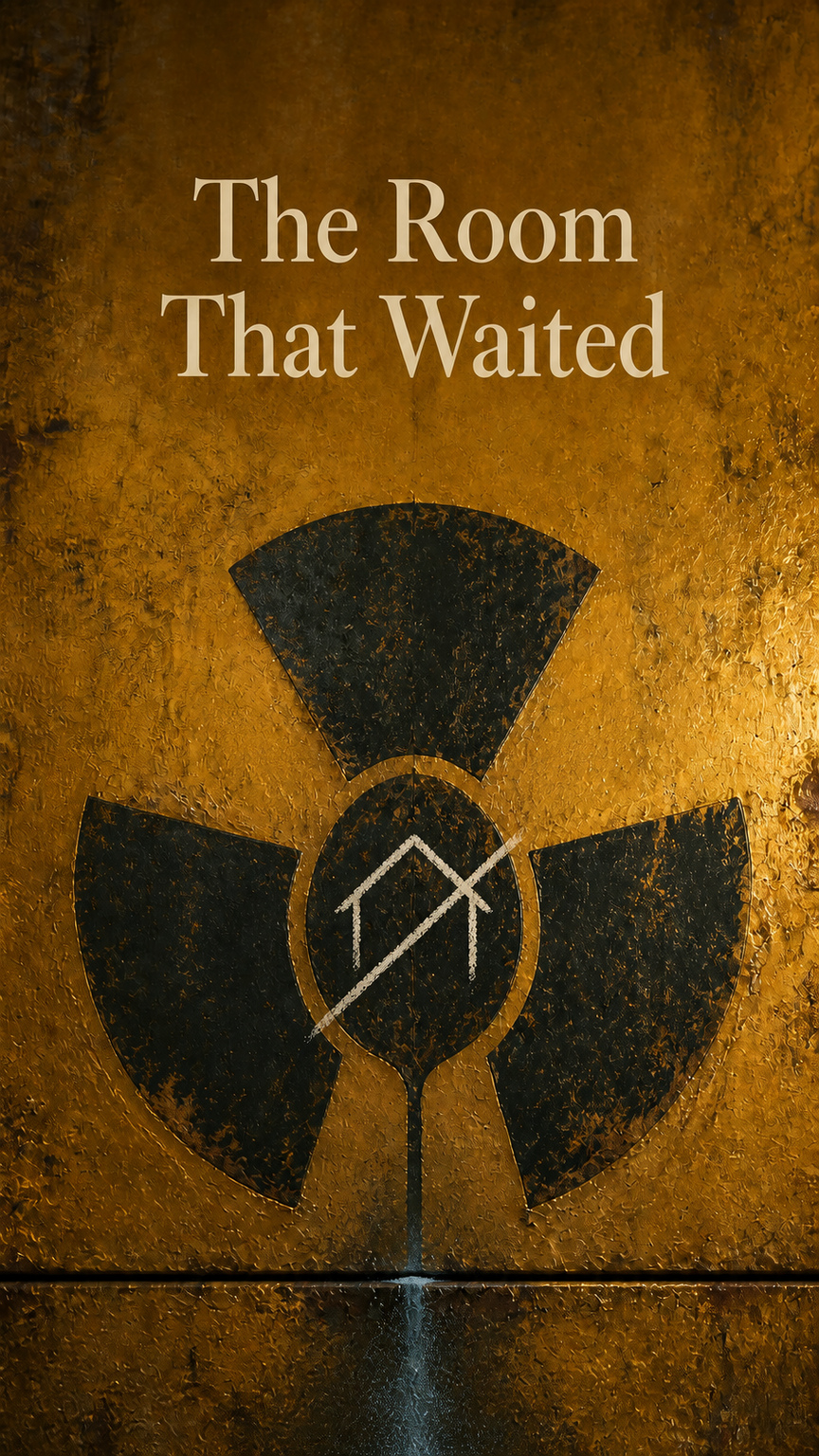
Society fell apart without nukes going off. Most history and advanced technology has been erased. You don’t realize it, but you just found a Nuclear Launch Facility.
Zumi is lying on her belly in the dry wash, talking to the ground.
“Breathe again,” she tells it.
The ground does.
A thread of dust lifts beside her cheek. It hangs there, turns, and slips into a crack under a shelf of baked clay. Zumi looks up at you with the expression she saves for winning before anybody else knows there has been a contest.
You kneel and put two fingers to the crack. Cold touches the sweat between them.
“Shade air,” you say.
“There isn’t any shade under there.”
“Stone keeps the night.”
“First judgment.”
You have, for three days, hoped she would forget the promise. Three days ago she found the rim of a buried jar, and by the time the other diggers came over you had called it a seed jar, dated the clay by its grit, and told everyone where Zumi must have been standing when she nearly noticed it. That evening, while she ate with her back turned to you, you promised that the next thing she found would be hers to judge first.
Above the wash, the last grass of summer rasps in the wind. There may be four weeks before frost. Half the winter grain has gone sweet with mold in the upper store, and a dry old cellar would be nearly as useful as grain itself. You have spent the afternoon reading straight banks and buried paving where everyone else sees only a gully.
Still, a promise is a promise even when made to a thirteen-year-old who knows this too well.
“Your judgment,” you say.
Zumi presses her eye to the crack until you pull her back by the belt. “A buried room. Big. Empty enough to breathe.”
“Air doesn’t tell you empty.”
“It told me buried.” She sits up and scrubs clay from her eyebrow. “Your turn.”
“Grain cellar.”
She makes a rude little noise through her nose.
You dig.
The crack lengthens beneath your knives. Clay gives way to a plate of dark metal, colder than the soil, with a ring folded into a hollow. It is not red with rot like plow iron. When you strike it with the bone handle of your knife, the sound goes down a long way.
Zumi holds out her hand for the short pry bar. You give it to her. That is part of the promise too, though neither of you says so.
By the time the sun touches the wash rim, you have uncovered one edge and a hinge broad as your foot. The plate has settled crooked in its frame. You work the pry bar together, Zumi above you with both heels dug in, you below with your shoulder under her hands. The seal breaks with a cough of dirt. Cold air comes steadily through the opening, carrying old metal, old dust, and something sharp that has no name in a field.
“Empty,” Zumi says, panting.
“Air,” you correct.
“Mine was first.”
You widen the gap until a person can pass. Beneath it, narrow metal steps descend beyond the reach of daylight.
You set the hooded oil lamp between you. Its little horn window has three scratches cut across it. The oil stands just below the first.
“At the last line, we turn,” you say. “If the flame gutters twice, we turn. If I say up—”
“We go up. If I say up?”
This is not one of your rules. Zumi watches you see that.
“Then tell me why quickly.”
“Because you enjoy a speech while falling down a hole.”
“That is inherited from your father.”
Her smile arrives despite herself. She takes the chalk from your kit and draws the return mark on the underside of the hatch: a long white stroke hooked toward daylight. Her line is too thick, but you do not fix it.
You go first.
The steps ring softly under your boots. They do not sag. At the bottom, the lamp reveals a landing and a door standing open on hinges sunk into the wall. Door is too small a word for it. Its edge is thicker than your hand is long. A wheel sits in its face, and bars disappear into the metal above and below.
Zumi squeezes past you to look. “For grain?”
“For keeping something dry.”
“For keeping something out.”
“Same door, depending where you stand.”
You expect her to answer, but she is counting. Two handles on the inner wall. Two black boxes above them. Two rows of pegs, each with the same pale number painted underneath. Beyond the door, two benches face each other across a passage.
“Pairs,” she says.
“Spares.”
“Every spare?”
“People who could make a door like this could afford extras.”
That ends it because you put the ending into your voice. Zumi takes the chalk and marks the wall beside the great door. When she follows, her shadow in your lamplight is smaller than yours and much busier.
The corridor turns twice. Your footsteps return from ahead as if other people are walking there, careful people who stop when you stop. The walls are made of poured stone without seams. Pipes run along the ceiling in tidy ranks, painted colors that have survived where everything else has gone gray. Nothing drips. Nothing hums. The lamp flame leans toward the way you came and then stands straight.
At the first crossing, Zumi puts down another hooked mark.
“Smaller,” you say. “Chalk is not free.”
“Neither are lost people.”
“Lost people use less chalk.”
“They do after.”
You have no answer that will not reward her, so you choose the left passage.
Yellow signs begin beyond the crossing. Each bears a black seed surrounded by three broad black leaves, though no plant ever grew that way. Under one, letters remain sharp enough to sound out: CAUTION. RADIATION AREA.
Zumi shapes the second word twice and gets two different words from it. “Rattle-ation. Ration-ation.”
“Neither helps.”
“Ration means food.”
“Not when it has too many letters.”
“Your grain cellar has a grain sign.”
“My grain cellar has a warning sign.” You lift the lamp closer without touching the plate. “That much is plain.”
“What warning?”
The three leaves turn around their black seed whichever way you tilt your head. “Don’t lick the walls.”
Zumi laughs hard enough that her echo laughs after her. Then a fleck of ceiling dust falls through the light, and both of you look up.
The next room holds clothes no living body would choose. Yellow skins hang from pegs, collapsed at the knees, with thick hand-shapes and boots joined to them. Round windows cloud their hoods. One has split along the shoulder, showing a softer lining inside. On the wall, a row of pictures shows a bare figure raising its arms under falling water, turning, raising them again. Arrows herd the water toward a drain in the floor.
You do not cross the threshold.
“Rain clothes,” Zumi says.
“No rain down here.”
“Washing clothes.”
“You take clothes off to wash.”
“Maybe these people were shy.”
“All of them?”
“Pairs of them.”
You give her a look. She hooks another chalk mark around the door and adds two dots to it before you can object.
Your cellar theory has gone thin. You keep it because a thin theory is still something to walk on. The rooms beyond might have held sacks. The yellow skins might have kept dust from flour. The warning might name a blight. Anything built so deep must have preserved something.
The numbered doors preserve only emptiness. Behind 17 are racks with straps and spaces where boxes once sat. Behind 18, narrow beds are stacked two high, their mattresses reduced to stained cloth and springs. Behind 19, steel cupboards stand open around a table fixed to the floor. Cups remain in clips along one wall. A spoon lies beneath the table, furred green.
“People lived here,” Zumi says.
“For a while.”
“How long?”
“Long enough to put cups on a wall.”
“That isn’t a length.”
“It is when you have cleaned up after people.”
She rolls her eyes, but she studies the cups. Every clip has a twin.
The oil lowers toward the second scratch.
You find EXIT painted above a door. That word survives wherever old builders wanted strangers to leave: above theater doors with no theaters, inside burned counting houses, once on a stone privy whose other three walls had fallen away. Children learn its four letters before they learn the old word for tax.
An arrow points along the right-hand corridor.
“Out,” Zumi says.
“Not our out.”
“An out.”
“We know where ours is.”
Zumi glances behind. Three passages meet there, identical except for her chalk. “You know.”
Before you can ask what that means, she opens the unlatched door under EXIT.
The room is hardly wider than a closet. A gray box hangs at shoulder height. From it curls a cord ending in a black object shaped almost like the jawbone of a small animal. Zumi has it off its hook before you say not to.
She holds one end to her ear and the other near her mouth. “Below calling above,” she says. “Send bread.”
“Put it back.”
“Above, do you hear? Kilta has found a grain cellar with beds.”
“Zumi.”
The use of her name does what the first order did not. She returns the object to its hook, but not carefully. Her face has gone blank in the practiced way that means you have embarrassed her and she intends to make it your fault.
“Unknown things do not go against your eyes, mouth, or ears,” you say.
“It was made for an ear.”
“So are earwigs.”
She turns; her shadow climbs your chest and face. She says nothing.
On the opposite wall, under a skin of clear material, colored lines branch through a drawing of the rooms. A red arrow points to a small block. YOU ARE HERE, the letters say. You know the words but not how the arrow could know.
Zumi forgets to be offended. “That square has teeth.”
She means the mark at one edge of the drawing: a box crossed by short parallel lines. Stairs. From it, a thick passage bends twice before reaching the block under the arrow. The shape agrees with your walk.
“Or shelves,” you say.
“Shelves we climbed down?”
“Show me our door.”
She does, tracing in the air so her finger never touches the clear skin. The route is not where you thought. You had carried the first turn backward in your head. Your chalk would still bring you out, but the error sits unpleasantly behind your teeth.
Zumi traces farther in. Most of the lines end in small rooms. One broad line reaches a double-sized chamber at the center. She taps the air over it.
“Last room,” she says.
“Oil says one room.”
“I said it first.”
You take the black jaw from its hook.
It is heavier than it looks. The upper end fits your ear with a closeness that makes you understand Zumi’s joke was not wholly a joke. You wait.
No voice comes. There is not even the sea-noise of a shell. Only the hard press of the thing against your skin and, inside your own head, your pulse.
Zumi does not smile. That kindness is worse than teasing.
You replace the jaw gently. “One room.”
The map leads you there.
Another immense door guards the central chamber, though this one is wedged open by a fallen strip of rubber. The space beyond drops two steps. Two chairs sit on rails before two long banks of dark glass and square buttons. Their cracked cushions face a map covering the far wall.
It is a map of shorelines, perhaps, but no shore you know. Pale land-shapes float in blue. Red circles surround black points on the land, some nested one inside another. Fine lines run from a column of numbered squares toward the circles. Age has peeled the blue in long curls. The red remains.
“Weather,” you say.
Zumi looks from the map to you. “What weather?”
“Storm counting. Flood paths.”
“Underground.”
“Weather comes above. Counters can sit wherever they like.”
This would normally earn a snort. Zumi is too busy taking in the pairs.
The two chairs have worn hollows in the same places. Each bank of glass has the same dark columns. At the outer end of each is a metal slot with a red cover above it. The stations are too far apart for one person to reach both. Between them, a metal plate carries a block of close print. Most of it has flaked away, but two words remain on the first line: TWO-PERSON.
“Not spares,” Zumi says.
You lift the lamp. Beneath a row of black windows, the same word repeats: MISSILE. Under the red covers, another survives: LAUNCH.
Zumi sounds them. “Miss-ill. Lanch.” She tries the second again, giving its last sound more room. “Do you know them?”
“Old names.”
“For weather?”
“People name storms.”
She walks from one chair to the other, seven short paces. “They had to sit apart.”
“They could roll.”
“The floor rails stop.”
“Then apart.”
“But doing the same thing.”
Behind the chairs, two sets of shoulder straps hang from the wall. Two clocks have stopped at different times. Two empty clips might once have held keys. The room has waited with its doubled hands open, and the lamp gives it the only moving light.
The oil touches the second scratch.
You set the lamp on the fixed table between the stations. Up close, one red cover is scratched around its edge. Whatever lay beneath it was meant to move. A useful place must offer more than rooms and warnings. If this is a weather counter, there may be a way to read it. If it guarded stores, some inner door may answer. If nothing answers, you will return to moldy grain and explain why the finest find of your life contains only cups, beds, and words nobody understands.
“We could see whether the matched pieces move together,” you say.
Zumi puts her palm over the nearer red cover.
“No.”
You look at her chalk-whitened fingers. “Move your hand.”
“You said paired catches are paired for a reason.”
“I said that about spring traps.”
“You said it after the glass mill.”
“Which had springs.”
“We didn’t know until it cut the mill apprentice.”
The example lands badly in the sealed room. The apprentice’s missing fingertip is a joke to everyone except when they remember the blood.
“This has not moved since before anybody’s grandmother,” you say.
“The hatch hadn’t.”
“The hatch was a door.”
“After you opened it.”
You can order her aside. You can lift her by the waist, as you did at the crack, though she will kick and the lamp will spill and every sensible rule you have ever made will lie broken around you. Zumi knows this. Her mouth is pinched. Her eyes are wet, either from dust or fury, and she keeps her hand where it is.
“You don’t get first judgment on my hands,” she says.
Somewhere in the corridor, metal ticks once under the lamp’s small warmth. Both of you turn toward the sound. The room offers nothing after it. No glass brightens. No clock resumes. The black windows hold your lamp in dozens of small, warped reflections.
“Oil,” you say.
Zumi does not move.
“I don’t know what this room does,” you say. The words feel larger than they ought to, six common stones that will not stack neatly. “I know we’re leaving it alone.”
Her hand comes off the cover.
You pick up the lamp and hold the chalk out to her. “You remember the wall drawing?”
“Yes.”
“Then take us to the stairs.”
She does not reach for the chalk at first. “My judgment?”
“Our way out is yours.”
That is not the whole thing she asked. It is enough for her to take.
Zumi leads.
At the first crossing she chooses left, though your body insists on right. She counts two doors and stops before the third. On the wall ahead, EXIT points into darkness.
“Our marks are the other way,” you say.
“That’s the washing room. I put dots there.”
The hooked chalk stroke has blurred on a pipe behind you. Beneath it sit two dots.
You follow her left.
The lamp reaches the final scratch. Its flame shortens whenever you walk too quickly, so you learn Zumi’s pace: four fast steps, a pause at each crossing, her finger drawing the remembered map against her thigh. She takes you past 19, 18, 17. She finds the corridor of paired benches. At the great door, your first hooked line shines on the wall.
Only there does she look back to see whether you are watching.
“Spares,” you say.
She considers the benches. “Maybe.”
You climb with the lamp between you. Warm evening air thickens at the top of the steps. When Zumi pushes through the hatch, sunset spills around her boots, red as the circles on the buried map.
Outside, the world has remained ordinary. Grass leans east. A crow worries something pale on the far bank. Your pry bar lies where you left it. The wash holds no grain.
Zumi sits beside the opening while you lower the metal plate until only the crooked gap remains. Cold air threads out, too slight to see now that the dust has settled.
On exposed metal beside the ring, you begin the shelter mark: a roof shape, an open door, one bar for a dry chamber below. People searching after you will know there is space here. In winter, space can be life.
Zumi watches until the mark is finished. Then she takes the chalk from your fingers and draws the danger stroke through it.
“That tells them not to enter,” you say.
“Yours tells them to.”
“It may be a shelter.”
“It may be a glass mill.”
You look at the two meanings crossed on the dark metal. Any other finder would curse the contradiction. They would stop. They would call someone over. They would argue before lifting the ring.
You leave both marks.
Zumi holds the chalk out. Instead of taking it, you fold her fingers around it.
“Keep it,” you say.
She slips it into her pocket. Then she shoulders the empty grain sack, and the two of you start up out of the wash before the last light goes.