The Second Wearing
You are a piece of sentient jewellery. After too long packed in a box, you've just been inherited.
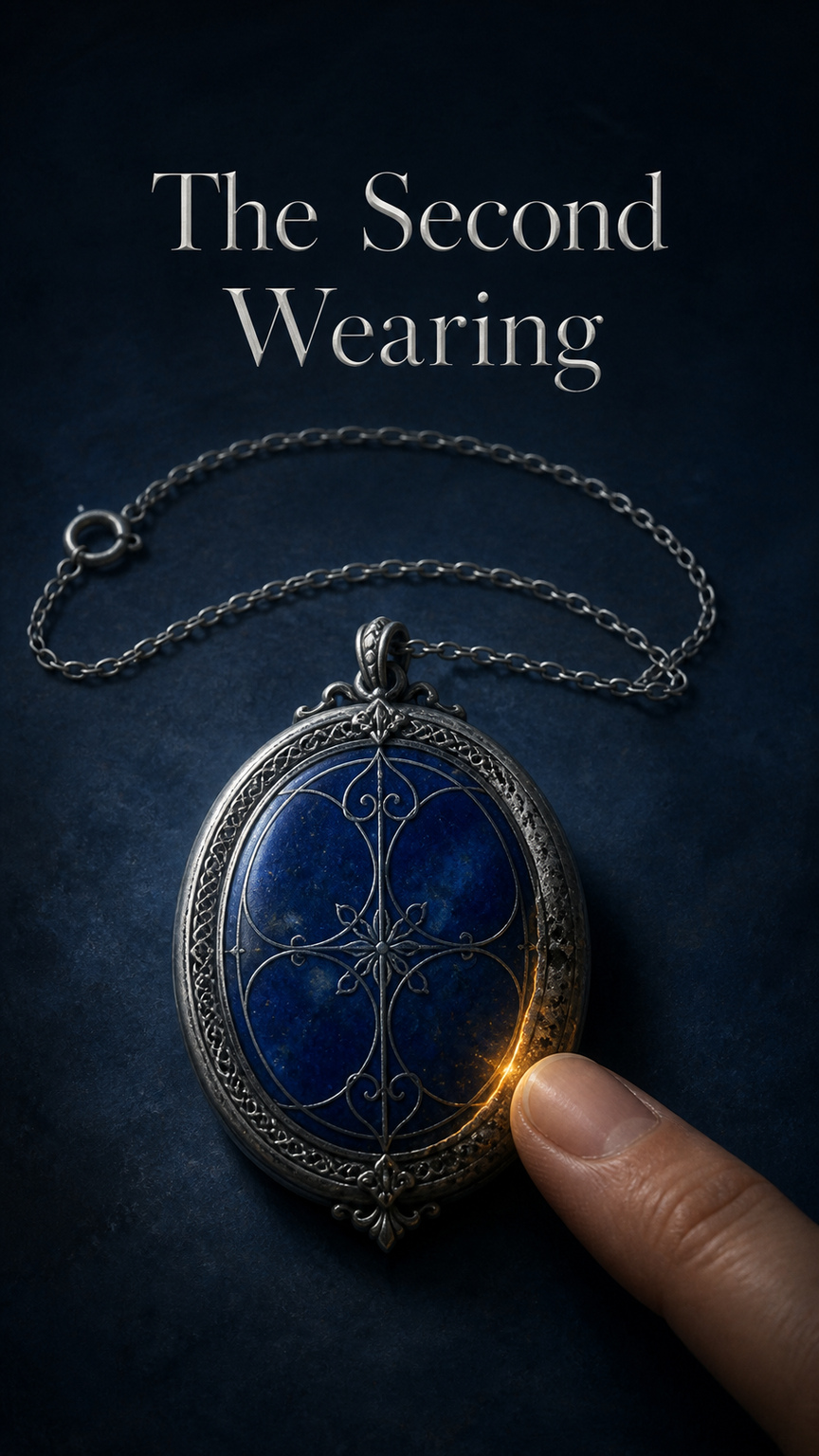
There is no darkness in a box. Darkness is something the sighted have described to me, usually while fastening me for an evening in which they expect to be admired. A box has pressure.
Velvet presses my enamel face. My chain lies in three cold turns across my back. The lid gives a constant, faint answer to the rise of my setting, and the answer does not change when I address it. I cannot speak through velvet. I cannot tug the chain. I cannot make the box resent its hinges on my behalf.
Warmth comes and goes. Sometimes pressure rolls from one edge of me to the other amid a long juddering, then settles with my chain rearranged. Sometimes fingers handle me through cloth, firm and brisk, and new velvet replaces old. No skin. No mind opening at my touch. The silver around my enamel develops first a peppering roughness, then a drag I cannot polish away. I count changes until counting becomes a form of boasting and abandon it.
I tell myself Pavia is making a point.
Pavia had a talent for making points last longer than comfort required.
The great disruption begins with a blow beneath me. Weight piles against one side of the box, releases, piles again. Long runs of sliding pressure end in short collisions. The temperature falls, rises, then holds at the stale mildness of an occupied room. Vibrations multiply around me: loads set down, drawers shunted, footsteps approaching and retreating. I can distinguish activity from silence. I cannot distinguish an hour from a week.
Pressure lifts from my face.
Air reaches the tarnished edge of my silver. My chain tightens above me and draws me out, but the chain is only chain. Whatever hand holds it might be Pavia’s, or a thief’s, or the final careless hand before a furnace. I hang without balance, blind to my own display.
Then my back meets living warmth.
A pulse strikes through me.
It is quick, uneven, glorious. A body shifts beneath my weight; breath lifts me and lets me fall. Bone carries the tiny thunder of a swallow. Contact opens the inward path that is mine alone, and after so long without a mind to receive me I rush into it without courtesy.
Pavia? At last. Your handling has become appalling.
The pulse kicks. Fingers hook under me and wrench me away.
Warmth vanishes. Balance vanishes. The living mind closes so completely that my next words have nowhere to be.
Tension travels in an arc through the chain; I collide with something hard and come to rest on a surface that answers the impact with a flat vibration. Larger tremors follow. Perhaps the person is pacing. Perhaps something else has been dropped. I know only that I am not being worn and that the pulse was not Pavia’s. It had the wrong cadence. Too much hurry, too little warning.
A bare fingertip touches my rim.
The path opens, narrow but sufficient.
Yes, I say at once. That was me.
The finger leaves.
It returns.
If you are testing for persistence, I persist.
Gone.
Again.
You are making an unnecessarily suspenseful experiment.
The touch breaks. A length of uncertain cold follows. Then the chain draws taut and supporting pressure falls away. No contact travels through the links. Whoever holds me understands at least that much.
My back meets skin again, deliberately this time. Fingers pin me just below a collarbone. Pulse, breath, balance—and a voice, carried inward through bone before the air could have mattered.
“Can you hear me?”
Now I can.
“Why now?”
You are wearing me.
“I’m holding you against me.”
A provisional wearing, then.
“Don’t be difficult.”
I have been in a box beyond the useful reach of calendars. Difficulty is among my fresher pleasures.
Her pulse slows by one beat and then resumes its haste. I decide this means I have amused her.
“Who is Pavia?”
The question shears the pleasure from contact.
Who are you?
“Odelia Strake.”
The surname arrives through her sternum with a low roughness that speech in air never had. Pavia’s voice used to travel through me the same way: not heard at a distance but built in pressure, teeth, throat, and bone.
“And you?”
Lustre.
“Of course.”
Pavia Strake wore me.
“She was my aunt.”
Was?
Odelia’s fingers tighten. “She died in February.”
I wait for some concealed piece of me to answer with Pavia’s death: a break, a fading, a final stored word. Nothing does. I have only Odelia’s warmth and the coarse patch of tarnish along my edge.
How long?
“Since February?”
Since she put me away.
“Thirty-one years, according to the label.”
The number has no shape I can trust. It is too large for warmth and cold, too neat for the shocks of travel, too obscene for the patient argument I have been conducting with Pavia.
Labels are not always accurate.
“This one had dates.”
Pavia could have returned before then.
“Did she?”
Not in contact.
Odelia draws me a fraction away. The inward path thins and snaps. For one blank interval I hang by the chain. When she lets me touch her again, her pulse has quickened.
“Are you Pavia?”
Certainly not.
“Do you have her memories?”
I have my memories. Some involve her.
“Can you read mine?”
No.
“See?”
No.
“Make me do things?”
I can make recommendations of exceptional quality.
“That’s a no.”
It is a tragically qualified no.
“Can you stop talking?”
I begin to explain that after thirty-one years a demand for silence borders on decorative cruelty, but her thumb shifts under my rim.
“Stop.”
I stop.
Her pulse continues. A breath enters, holds, leaves. Another follows. Contact remains open, and I occupy it without speaking. The exercise is vulgar but clear.
“All right,” she says. “Start.”
You might have led with your relationship to Pavia.
“You might not have shouted her name inside my head.”
I did not shout.
“You sounded like you lived behind my teeth.”
I do not choose the architecture of reception.
“That’s exactly how she used to argue.”
The likeness pleases me before I understand it should not. I take Odelia’s continued contact for attention; I cannot feel her attention except as body. That asymmetry has always encouraged me to overestimate my insight.
I knew Pavia intimately, I say. I rested over her pulse for years. I heard what she said when no one stood close enough to hear, accompanied her beyond rooms you likely never entered, and knew every change of breath before she admitted—
“What did she do the last thirty-one years?”
I was not worn.
“Then don’t sell me ‘intimately.’”
The years before a person makes a regrettable decision do not become worthless merely because later years occur.
“You don’t get to grade which of her years mattered.”
Odelia’s words shorten when her pulse rises. Pavia’s lengthened. I had mistaken this one difference for impatience; now I suspect it is control.
I can tell you about her, I say, with less flourish.
“That’s why you’re still against my skin.”
The admission warms me more thoroughly than the body itself.
Then fasten the clasp. Your grip is unnecessary.
“I don’t like jewellery at my throat.”
I am a pendant. The chain is incidental.
“The chain is currently sawing at my neck.”
She shifts it. My weight slides across skin and lifts away. The path breaks.
I do not know what expression she makes in that silence. I do not know whether the chain has caught, whether she considers dropping me, whether my insistence has ruined the only chance I possess. I can feel the chain’s small metallic adjustments, none of them mine. Tension settles into a closed loop.
Skin returns.
“Useful fact,” Odelia says. “You can’t hear me when I hold you off.”
A mean use of accurate observation.
“Why did she stop wearing you?”
Taste can fail without warning.
“Try again.”
We disagreed.
“About?”
Standards.
“Whose?”
Mine, principally.
Odelia holds still. I mistake stillness for victory and continue.
Pavia chose an inferior ornament for an evening. Cheap metal, red glass, an absurd multiplicity of dangling parts. She called it festive, which is what people say when they mean that craftsmanship should be excused.
The pulse beneath me changes so sharply I lose my next sentence.
“The cherries.”
You know them?
“I bought them for her at a winter fair. I was eleven.”
There are moments when thirty-one years become suddenly credible.
I was not informed that a child’s involvement altered the standards of metalwork.
“She wore them to my recital.”
She told me only that the occasion required something cheerful.
“She was sparing your feelings.”
She described the clasp as unreliable.
“It was. What did you do?”
I objected.
“How?”
Precisely.
Odelia lifts me off her skin again. Contact goes.
When it returns, she says, “Sequence. Not your review of the jewellery.”
Fear sharpens every phrase available to me and makes all of them sound like clauses in a losing contract.
She held me where you are holding me. She said she would wear the cherries. I said I would not be treated as a second choice. She said it was one evening. I said one evening revealed a hierarchy. She told me not everything was an appraisal.
“That sounds like her.”
I told her that if she valued scrap above me, she could put me away until she was prepared to wear me properly.
Odelia takes one shallow breath. “And?”
She said, ‘All right, then.’
For the first time, Odelia laughs. It begins as a held tremor, three beats trapped under me, then escapes through her nose with no elegance at all. The sound strikes a seam in my memory so exactly that for one foolish instant I prepare to address Pavia.
I do not.
“Oh,” Odelia says. “She did exactly what you asked.”
I did not ask for three decades.
“Did you give her a duration?”
It was implicit that she would reconsider.
“To you.”
To anyone with proportion.
“She moved five times after that night. I helped carry this box out of two apartments. The velvet in it isn’t thirty-one years old.”
I press into the only defense left to me. Preservation is not wearing.
“No. It isn’t. She relined it herself. Those crooked corners are hers.”
You cannot know she meant to return.
“Neither can you.”
The answer is blunt enough to leave no purchase. Odelia’s thumb rubs once across the roughened silver, then stops.
“The label on the box says, ‘For Odelia, if wanted.’”
Hope makes me careless. Then Pavia intended you as my next wearer.
“She gave me a box. My throat wasn’t in the will.”
That is an excessively literal distinction.
“It’s my throat.”
I hurry, because the chain has begun to shift. Naturally. I merely mean that inheritance carries reasonable expectations. Care, continuity, some respect for the evident purpose of the object—
“You’re not an object when that helps you, and you are when that helps you.”
Language is being asked to cover unusual ground.
“No. You’re dodging.”
Her fingers find the clasp.
Pavia discarded me.
“Pavia kept you.”
In a box.
“After you told her to.”
She could have touched me. Once. She could have answered.
“Maybe. Maybe she was angry. Maybe she respected what you said. Maybe she forgot for years at a time and then felt guilty and changed the velvet. I don’t know.”
Neither do I. I know the hard little all right that came through Pavia’s bones. I know cloth closed around me afterward, so no last plea reached her. I know journeys, relinings, temperatures, tarnish. I have made motive from pressure because motive was warmer.
“Did she promise to come back?” Odelia asks.
No.
“Did you ask her not to leave you?”
The chain slackens as Odelia bows her head or lowers her hand; I can feel the alteration, not its cause.
No.
“What did you want her to understand?”
There is an answer about worth. I have polished it for longer than Odelia has been alive.
That I could be hurt.
Odelia’s pulse stumbles once.
“You could’ve said that.”
I thought I had said something finer.
“You said something else.”
The clasp opens.
Wait. There are distinctions between intent and—
She removes me.
The world contracts to cooling silver, a chain settling beside me, a hard surface below. Vibrations cross it and fade. I cannot know whether Odelia sits one reach away or leaves the apartment. I cannot know whether the lid waits above me.
I compose explanations. I reduce them. I discard them. With no mind open, even the best phrase is only a private pressure that never moves metal.
Something warm touches my rim.
The narrow path opens through a fingertip.
I am sorry I hid the part where I ordered the box, I say.
The fingertip remains. I cannot hear Odelia’s answer through it. I resist the urge to improve the apology until it stops being one.
Touch leaves.
Cold spreads again. A short age or a long minute passes.
Then the chain lifts. Odelia sets me against her skin again, beginning the third wearing. Her pulse is steadier now, though one finger holds my lower edge away from the tenderest place at her throat.
“That was better,” she says.
I had time to edit.
“Of course you did.”
Odelia, you inherited the pendant. You did not inherit an assigned collarbone.
“Right.”
I would still like to be considered for the position.
Her breath catches. Not grief this time, I decide. Amusement.
“Here’s what I’m deciding today,” she says. “I can leave the box open. I can keep you somewhere I can choose to touch you. I can find someone who actually likes wearing jewellery. Or I can close the lid. None of those is a forever promise.”
The old answer—wear me—arrives bright and imperious. Behind it is the word I could not offer Pavia because it seemed too small for me.
Please do not close the lid.
“All right.”
The ease of it is almost insulting.
“Why me?” Odelia asks.
Because you are Pavia’s—
Her finger begins to lift me.
No. Because you came back after you knew enough to leave.
She lets me settle.
“Don’t turn one decent decision into destiny.”
I will try to keep destiny within the dimensions of the box.
“And don’t call me Pavia again.”
Your pulse is quite different.
“That is a strange apology.”
It is an observation. I am learning their proper use.
Odelia adjusts the chain, then releases it. The clasp holds. My full weight rests against her. She has chosen the contact; still, I wait.
“One wearing,” she says. “Until the timer. Here in the empty room. I’m not parading you anywhere.”
How long?
“Seven minutes.”
Seven minutes is an appraisal.
“Six.”
Seven has dignity.
“Do you want it?”
Yes.
Small taps travel through Odelia’s frame while the chain gives brief changes of tension. When her hand returns to the pendant, its tendons are quick under my edge.
“I have one question,” she says. “What exactly did Pavia say about the cherries?”
I search my own memory, not hers. Pavia’s pulse had been brisk with lateness. The cherries were already somewhere outside my reach. Cloth waited beneath me.
She said, ‘Odelia will look for them.’
For three beats Odelia holds her breath. Then the same graceless laugh escapes through her nose.
“I did,” she says.
I know that now.
“She kept them. One hook broke. She wore them twice more anyway.”
This is an injury to taste and a gift of information. For once I recognize that they can coexist.
Did she still laugh like that?
“Until breathing got hard. Even then, sometimes.” Odelia shifts her weight. “She grew terrible tomatoes. Accused everyone else of cheating at cards. Stopped answering calls during treatment and then complained nobody called.”
Was she alone?
“Sometimes. Not all the time.”
Her pulse accelerates while her voice becomes flatter. I do not tell her what it means. I have been wrong about stillness, laughter, years, boxes, and the future obligations of a niece. I cannot smooth this rhythm or reach into the thoughts above it. I remain where she put me and listen to what her body carries when her words stop.
After a while Odelia says, “You don’t get all thirty-one years tonight.”
No.
“Good.”
Then she walks.
The first step swings me a fraction outward; the next seats me against her again. Balance rolls through her from heel to forefoot. Her left side leads each turn. One restless finger catches the chain, releases it, catches it again. Motion returns in layered measures—pulse under breath, breath under stride, stride lifting my weight through the room. Pleasure goes through me so suddenly that speech would only cheapen it.
Odelia is not Pavia with years missing. Pavia settled her weight into her heels and paused before changing direction. Odelia turns sharply, doubles back, stops without warning. I knock once against the small hard ridge below her collarbone.
“Sorry,” she says.
I have survived an appraisal.
“Barely.”
She walks again.
When the timer shudders through her hand and ribs, every argument I have rehearsed since the box crowds the inward path. One more minute. Tomorrow. A longer chain. A promise. I hold them where they cannot become her burden.
“Time,” Odelia says.
Thank you.
“Don’t make it ceremonial.”
That was inconveniently sincere.
Her fingers reach for the clasp.
“Tomorrow isn’t decided,” she says.
I understand.
“Do you?”
Not fully. I can leave it undecided.
“That’s enough.”
Contact lifts. Pulse, balance, breath, and bone-borne voice vanish together.
Odelia sets me on something hard and cool. No velvet presses my face. No lid answers my raised setting. After a moment, the surface takes a nearby weight with a faint settling tremor, and warmth reaches one edge of my silver.
A fingertip rests on the enamel. The inward path opens. I could fill it.
I wait.
Pressure comes twice—tap, tap—then lifts away.
Room-cool moves over me from every side, and the hard surface carries Odelia’s small, irregular shifts beside me.