The Seventh Night
An adult elven adventurer has spent years hiding an infuriating curse: if she goes too long without taking a lover, the magic begins stealing her youth and beauty, rapidly aging her until she gives in and the clock resets.
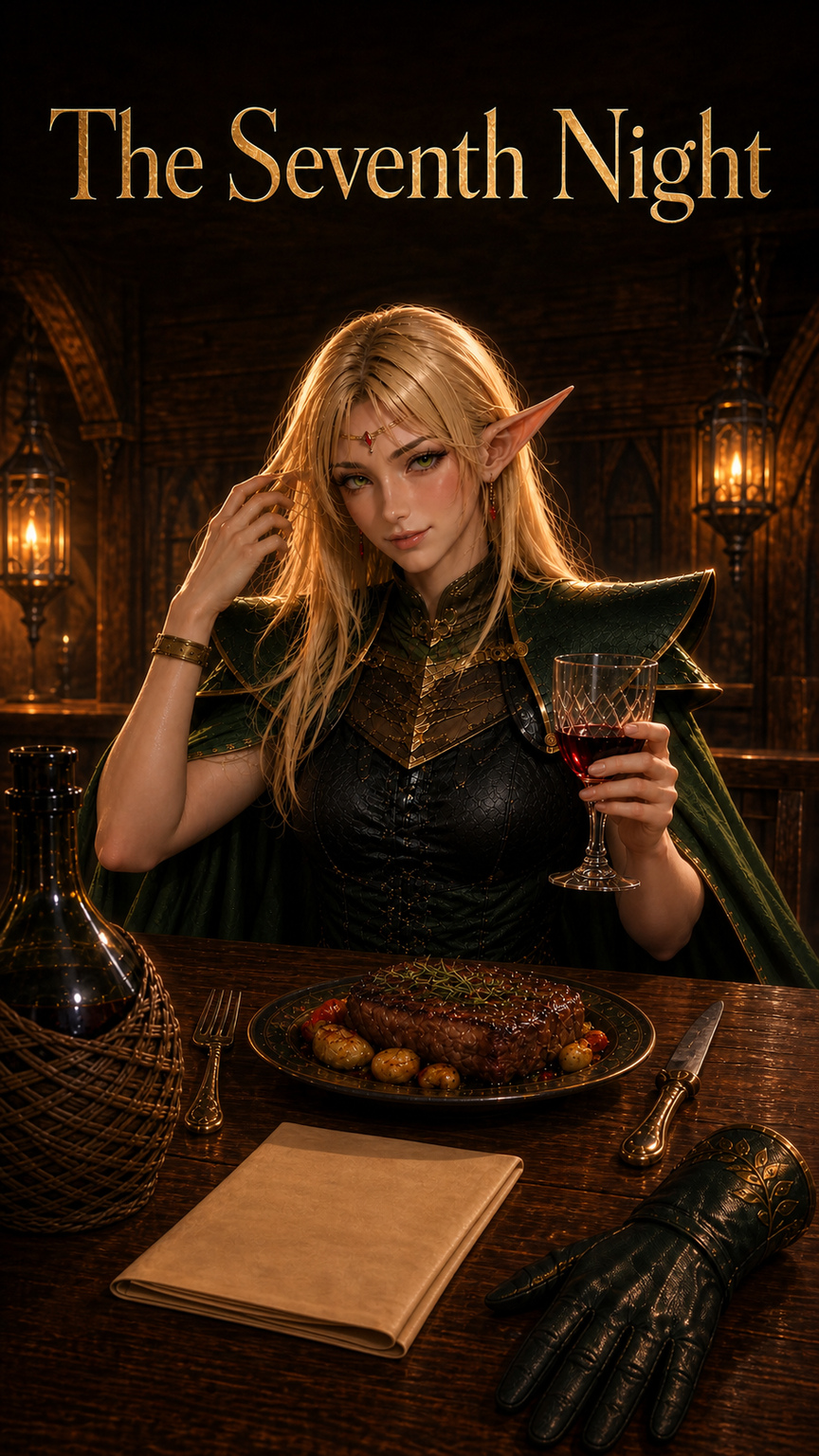
By the time Galten laid the broadside beside the gravy, Thalenna had already dismantled half a roast bird with the precision of a field surgeon and the innocent expression of a woman who had never been naked in a dungeon in her life.
The private dining room had been left to the two of them. Candles warmed the dark timber and the gold fittings of Thalenna’s green-black armor. Her cloak, a deep green better suited to dramatic arrivals than supper, hung from the back of her chair. Long golden-blonde hair fell over one shoulder, carefully freed from every buckle and hinge, and the little red jewel at her brow burned above eyes as green as bottle glass. Poise had required preparation. So had the hair.
Across the table, Galten tapped the broadside with one blunt fingernail.
“You said there were three lies.”
“Three material lies.” Thalenna cut another slice. “Demonic blood. Seductive magic. The phrase helpless thralls. The rest is merely vulgar arrangement.”
“It says the orgy began at midnight.”
“That is not material.”
“It began before midnight.”
“That is not the useful correction.”
“It was useful to me. I was trying to remember whether supper counted.”
She set down her knife. On the broadside, an inked elf with horns, breasts of ambitious geometry, and six yards of hair beckoned three kneeling swordsmen toward a dungeon bed large enough for a duke. The title promised the true account of the Demon-Blooded Delver of the Seventh Night. Below it, smaller type suggested she had drained the youth from her victims and applied it to her own face.
The engraving had given Galten a moustache. He was a grown human man, quite capable of growing one, and had chosen not to. This was its least plausible claim.
“You agreed to discuss what we tell people,” she said.
“I agreed to dinner.”
“The dinner is for discussing what we tell people.”
He looked at the platters: roast bird, buttered roots, onions glazed dark with wine, a loaf still warm beneath its cloth, and a quince tart waiting under a silver cover. “Then you ordered too much food for two sentences.”
“There will be more than two.”
“I was afraid of that.”
Thalenna folded the broadside so the horned caricature vanished. “We returned from an extended expedition in compromised condition. Malicious observers invented a sexual spectacle. We deny the invention, decline particulars, and preserve the dignity of all four adults involved.”
“Four adults who weren’t involved?”
“Four adults whose involvement is no one’s business.”
“You can’t deny the spectacle and preserve the spectators.”
“There were no spectators.”
“That isn’t what I meant.”
She knew. His jokes had been coming half a heartbeat too quickly since he sat down. Galten joked when a wound was small enough to expose and large enough to resent. Thalenna had learned this over two years, several contracts, and a love life whose map required colored pins.
She reached for her wine. “The broadside is wrong where it matters.”
“Then say what happened.”
“You were there.”
“I want to hear which version of me was.”
The bird cooled between them.
Thalenna disliked a battlefield on which stillness counted as an attack. “The seventh day underground, I became ill.”
“You told us it was tomb dust.”
“We were in a tomb. There was dust.”
“Your hair went grey between breakfast and noon.”
“Ash adheres to hair.”
“By noon you looked eighty years older and were pretending not to notice.”
Her pointed ears heated. She hated that he could still see it. “I had hoped to disclose the relevant facts after we escaped.”
“You couldn’t straighten your fingers by supper.”
“Hence the tight gauntlet.”
Galten leaned down, brought up a gauntlet, and placed it beside the folded broadside.
It was hers: dark green-black leather, narrow in the wrist, worked with a gold leaf at the cuff. She had spent two days claiming it had been lost in a flooded gallery.
“Traitor,” she told the gauntlet.
“It was in my pack. Under your left boot.”
“My left boot was also lost.”
“No. I wore it out.”
“I had wondered why you limped.”
“You asked if I’d developed a seductive gait.”
Against her will, the corner of her mouth moved. She hid it in her wine.
Galten tore bread instead of eating it. “Tell it properly.”
Properly was not a condition Thalenna associated with that night. Still, he had brought back her gauntlet. He had also brought the broadside instead of showing it to anyone whose laughter would travel.
“The curse usually gives me six uncomplicated days,” she said. “If I go longer without sex, it begins taking what it considers excess youth. On the seventh day it works quickly. Skin, hair, strength, balance. By the seventh night, I can lose decades in hours.”
“And sex resets it.”
“To my own adult baseline. It doesn’t make me younger than I am. It doesn’t heal a cut, mend a bruise, cure exhaustion, or improve my disposition.”
“Nothing improves your disposition.”
“Several people have tried.”
His bread suffered a second, more thoughtful tearing. “No other way?”
He knew the answer. He had watched her test enough answers to hate them with her: fasting, feasting, potions, prayer, counterspells, solo efforts, and two expensive healers who had disagreed on everything except their fee.
For years she had hidden the result behind short contracts, invented family obligations, and a romantic calendar complicated enough to require colored ink. Ordinary travel could be managed. An extended crawl swallowed dates, privacy, and the comforting fiction that heroes controlled their own schedules. Stone did not care who was expecting her home on the sixth night.
“No cure,” she said. “No substitute. No postponement. No clever interpretation. And before you ask again, no demon. There is no demonic blood in me, no irresistible aura, no power that produces desire. The curse cannot make anyone want me, agree with me, touch me, or remain in a room. It doesn’t make me want anyone, either. It doesn’t care whether anyone else is willing. It only punishes me for going too long without sex.”
Galten’s gaze lifted from the bread. His expression had lost its joke.
“There,” she said. “That is the relevant truth.”
“Most of it.”
She gave the onions a look usually reserved for mutinous scouts. “On the seventh night I told three other adults. You, the archer, and the ward-scribe. The archer is an adult veteran with grown children. The ward-scribe is a widower old enough to have gone grey honestly.”
“You told us while wearing one stocking on your arm.”
“My joints were stiff.”
“You called us to a tactical conference.”
“There was a tactical difficulty.”
“You stood behind a hanging bedroll and announced that the situation required carnal cooperation.”
“I was attempting not to alarm anyone.”
“The bedroll fell down halfway through carnal.”
“The rope slipped.”
“You were wearing the stocking.”
“Galten.”
“Properly,” he reminded her.
She carved a root vegetable into four increasingly small pieces. “I explained badly. You laughed. I considered killing you. Then I asked. Plainly enough, eventually. None of you owed me an answer. All three of you chose yes.”
“Because we already wanted to.”
“I was there for that part.”
“You keep leaving it out.”
The knife stopped. Galten met her eyes, then looked down first and put bread into his mouth as if he could chew the admission back into harmlessness.
Thalenna resumed cutting. “The door was barred. The terms were clear. Four adults made a private choice. What followed is not part of tonight’s account.”
“At last,” he said around the bread, “an accurate sentence.”
“When we were dressed again—”
He coughed.
“What?”
“A generous use of dressed.”
There lay the treacherous heart of the story. The middle, which the broadside had inflated into a perfumed siege, had gone as middles went: intimate, ridiculous in places, and nobody else’s. The aftermath had required leadership. The aftermath had not received it.
“I was dressed,” Thalenna said.
“You had one boot, my shirt, and your cloak fastened backward.”
“A cloak is reversible.”
“Not when the clasp is between your shoulder blades.”
“It remained attached to my body. That is the principal work of a cloak.”
“You told the archer it was a court fashion.”
“She had been staring.”
“Your backside was showing.”
“Then she was rude to stare.”
Galten laughed into his cup. This time the sound came late enough to be real.
Thalenna speared an onion. “My usual appearance returned very suddenly. I had fastened the mail while my body was diminished. When my hair came back in full, half of it threaded itself through three links at the collar.”
“Five.”
“Three links caused difficulty. The other two were decorative.”
“We had to oil you.”
“You oiled the mail.”
“It was attached to you.”
“That distinction is the foundation of civilization.”
They had possessed one cup of clean water, two cloths of uncertain history, and a thumb-sized cake of soap for four recently unclothed adults in a crypt. Galten remembered the arithmetic with vindictive clarity. Thalenna maintained that her hair required half the water because it represented half the cleaning surface. He maintained that dungeon dust could not possibly have reached the back of her knee in the quantity alleged.
“Dungeon dust travels,” she said.
“With purpose.”
“Unlike some people, who spent ten minutes polishing a belt that was not theirs.”
“It looked like mine.”
“Yours does not have silver stars.”
“The light was poor.”
“You put saddle dressing on it.”
“You put massage oil on your scabbard.”
“It slid beautifully afterward.”
Galten choked on wine. Thalenna ate her onion with serene attention until he recovered.
“That,” he said hoarsely, “was deliberate.”
“I don’t know what you mean.”
“Of course not.”
She did. Victory restored her appetite.
“The inventory took nearly an hour,” Thalenna said, returning the conversation to defensible ground. “Four belts became five because someone counted the baldric. We found three left boots before locating a right. Your shirt had acquired a tear shaped like a small country. The adult ward-scribe found my brow jewel pressed into a folded map, and the adult archer recovered a stocking from the ration bag. None of which explains why a spoon was buckled into your sword harness.”
“You blamed structural collapse for the spoon,” Galten said.
“The tomb was unstable.”
“The spoon was secured with two buckles.”
“I did not say it collapsed quickly.”
By the time their account reached the privacy rope, Galten had eaten half his roast without noticing. Before the private choice, the rope had supported two bedrolls as a screen. Afterward, Thalenna explained, four adults who had recently displayed nearly everything to one another discovered an urgent need to change clothes separately. They retied the rope, added a blanket, and produced a knot of such moral seriousness that no blade wished to approach it.
Then they needed the rope to cross the broken stair.
“You cut it,” Thalenna said.
“You ordered me to.”
“I suggested decisive action.”
“You said, ‘Cut the damned thing before I age another year.’”
“An idiom. I had reset.”
“And remained charming.”
“The shortened rope wouldn’t span the gap,” she continued, “so we tied belts to it. Two belonged to the wrong people. One held. One surrendered. The third had never been a belt at all, but the ward-scribe’s instrument strap.”
“His measuring frame rang all the way down the steps,” Galten said.
“For a very long time.”
“You tried to count the bounces.”
“I was estimating the depth.”
“You reached thirty and said the tomb was being theatrical.”
“It was.”
Thalenna buttered bread. “No one was injured.”
“My dignity was injured.”
“Your dignity was wearing my boot.”
“Only because you had mine.”
She glanced beneath the table, where both her present boots sat properly paired. “It was dark.”
“You walked three miles before admitting the heel was loose.”
“The reset does not heal blisters. I have explained this.”
“It also doesn’t heal bites.”
“That mark came from falling masonry.”
“Masonry with excellent teeth.”
She pointed the bread knife at him. “The act remains off the record.”
“The aftermath has tooth marks.”
“Many dungeons do.”
For a moment neither managed to eat. Thalenna pressed her lips together. Galten stared at his plate with both shoulders shaking. When he made the mistake of looking up, her restraint broke. Her laugh came out inelegant and too loud for the small room. It loosened something under her breastbone that armor had nothing to do with.
The broadside lay folded between them. Its hidden ink waited.
Galten wiped his eyes. “You forgot the watch.”
“We did not forget the watch.”
“Then who had it?”
“The archer.”
“She was repairing your cloak.”
“The ward-scribe, then.”
“He was looking for his frame.”
“You.”
“I was getting your hair out of the mail.”
“I was clearly occupied.”
Their laughter thinned as they reconstructed the missing watch over cooling plates. There had been no watch for forty minutes. Nothing had attacked them. Something had eaten the honey from the ration bag with delicate, scraping bites, leaving the spoon and taking the last clean cloth. Four celebrated delvers had then accused one another of licking the jar.
“I still think it was you,” Thalenna said.
“I don’t like honey.”
“You like the archer.”
“What has that got to do with honey?”
“You were very quick to accept her denial.”
There it was: her own jealousy, springing a trap intended for his. Galten’s eyebrows rose.
Thalenna took refuge in the roast. “The point is that by dawn, no one had slept, our equipment was distributed according to chance, and we left looking less like heroes than survivors of a wardrobe explosion. That is the truth behind the rumor.”
“Not all of it.”
“You keep saying that.”
He unfolded the broadside. The horned elf returned, smiling with supernatural confidence. “This says you compelled us. Your version says three companions assisted you with a medical emergency.”
“A magical emergency.”
“That’s not better. In both versions, we don’t get to want anything.”
“You want credit for the orgy?”
“No.”
The answer arrived stripped of humor. Galten put both hands flat on the table, then seemed to dislike the display and picked up his knife. He sawed at meat already cut small enough.
“I don’t want to be another bit of equipment,” he said.
Thalenna looked at the gauntlet between them. Her gauntlet, carried in his pack. Her missing boot, worn out because he had put it on in the dark and kept moving when the dungeon demanded movement. For two years, she had treated gratitude as a dangerous opening through which other words might get in.
“You weren’t,” she said.
“Then why do you keep editing me out?”
“I am editing everyone out.”
“That’s very fair of you.”
“My reputation is not an ornament. It gets us contracts. It gets doors opened before things behind them finish eating people. The songs call me the Golden Thorn, not the Elf Who Requires Scheduled Company.”
“The second one scans badly.”
“And if this version spreads, every victory becomes seduction. Every refusal becomes proof of enchantment. Every person I share a room with becomes a victim, and every person I actually choose becomes a fool.”
Galten stopped cutting. That, at last, had reached him. Not perfectly; he still had to swallow before he answered.
“I don’t want it spread,” he said. “I brought you the sheet. I’m not taking your truth outside this room.”
“You also brought a prosecution.”
“Dinner came with gravy. I misread the invitation.”
She could have ended there. He had agreed on the important thing: no public correction, no public testimony, no feeding the rumor a second course. The curse would remain private. The broadside would have only mismatched gear and tired witnesses to chew on until a fresher scandal arrived.
But the quince tart waited between them, and Galten had not touched it. He loved quince. Thalenna hated it. Ordering it had seemed much less compromising when it was under a lid.
She removed the silver cover.
Galten looked at the tart, then at her. “Bribery?”
“Final course.”
“Same thing in better pastry.”
She cut the tart. The crust resisted, cracked, and sent a fan of crumbs over the folded broadside. One landed precisely on the caricature’s cleavage. Galten brushed it away before Thalenna could decide whether this was jealous.
“You have asked why there were four of us,” she said.
“I have thought it loudly.”
“One would have reset the curse.”
His face did something small and ugly before he could stop it. “The ward-scribe, then. Very efficient.”
“He spent a quarter hour trying to unlace a boot that belonged to the archer. Efficiency was not our governing principle.”
“The archer—”
“Has grown children, sound judgment, and no obligation to soothe you by being undesirable. Leave her out of this.”
Galten shut his mouth. He looked properly ashamed, which improved him.
Thalenna gave him the larger slice. “I asked all three because I wanted all three. The curse made honesty urgent. It did not invent the answer.”
“And me?”
“You were among the three.”
“A stirring distinction.”
She ate a spiteful forkful of quince and regretted it at once. The fruit was perfumed wool. Across from her, Galten waited badly, his shoulders held too square, his fork untouched. He had stopped joking. She had stopped having sequence.
“I asked you first,” she said.
“Because I was nearest.”
“You were across the chamber.”
“Because you knew I’d say yes.”
“No.” Her fork clicked against the plate. “Because you were the one I was afraid would say no.”
Galten’s attention dropped to the table between them, to her bare hand beside the gauntlet. He set down his knife.
Thalenna could feel the ceremony trying to rebuild itself around her. She did not let it.
“It has been two nights since the reset,” she said.
He looked up.
“Tonight is not necessary. Dinner was not necessary. You are here because I wanted you across the table. You, not a useful pair of hands and not the nearest available body.”
“That was nearly a speech.”
“Do not improve it.”
“I wouldn’t dare.”
“You brought the gauntlet as evidence against me.”
“I brought it for dramatic effect.”
“It lacked drama.”
“You called it a traitor.”
“I was being kind.”
He smiled, but did not rescue himself with a joke. Instead he reached across the table and turned her hand palm-up. His fingers rested in hers, warm and ordinary, carrying no magic at all.
“I was jealous of the archer,” he said.
“I know.”
“Not the ward-scribe.”
“That is extremely rude to him.”
“I’ll apologize if he ever finds his belt.”
Thalenna folded her fingers around his. With her other hand she pushed the broadside beneath the empty silver cover. The agenda had ended. The candles had shortened; the tart remained; neither of them moved to leave.
“Eat,” she said. “I ordered the revolting thing for you.”
Galten took his hand back only long enough to pick up his fork. “Properly,” he said, and stayed.