The Shadow That Nested
A moon begins casting two shadows across the world below. An orbital repair crew discovers that the second shadow comes from an ancient sunshade mistaken for a celestial omen—and that an enormous living migration has built its nests across the machinery needed to move it.
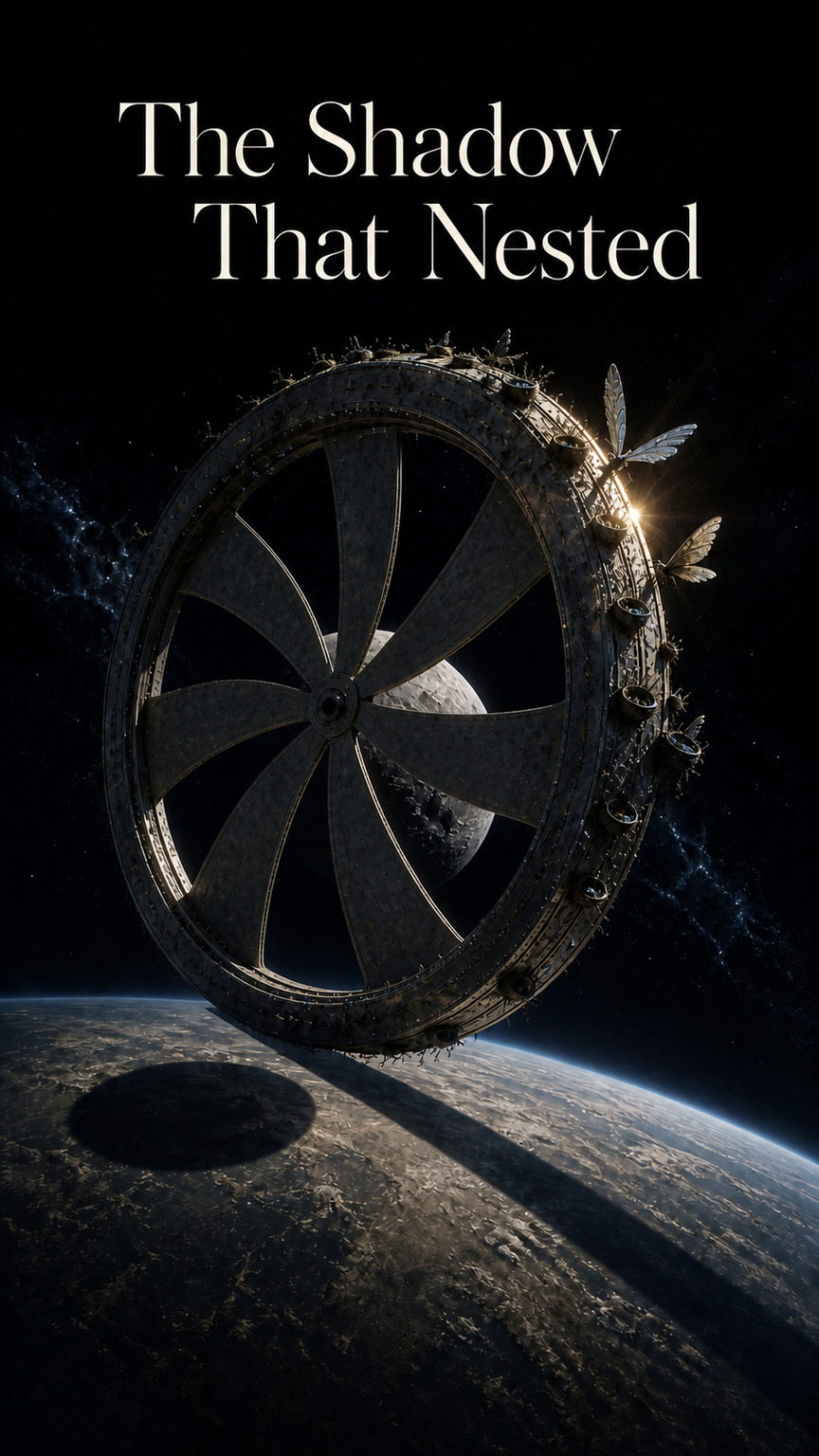
The second shadow crossed the pump fields while Adal still had one boot hooked under the tug’s open equipment rack.
It showed on his visor map as a dark, straight bruise following the moon’s round umbra west. The two were separate on this pass. On the next, the projected shapes slid together over the reservoirs and the long banks of thermal storage that kept the surface grids alive through eclipse.
“Revised track,” Enver said from the ground. His voice arrived thin and late, with control-room speech behind it: numbers, a dropped tool, someone insisting a district name twice. “North charging yards closed when the second edge appeared. South followed. They called it an omen closure, so the queues are empty. Storage can carry one shadow. Not both.”
Bero rolled the tug before Enver’s last word reached them. Stars tipped across Adal’s visor, then steadied. “If the straight track keeps its measured rate, we intercept in eleven minutes. If it accelerates under light, twelve and we miss the near rim.”
“Eleven,” Adal said. “Keep the moon out of the lamps.”
“The raw feed will lose the rim.”
“Capture first. Enhance after.”
The straight shadow had looked, from below, like something added to the sky. From the tug it took a long time to become anything at all. Adal saw a run of stars disappear, reappear, then disappear farther on. Bero killed the cabin display’s enhancement. There it was: a black lattice nearly edge-on to the sun, larger than the tug’s approach radar wanted to admit, hanging off the moon’s apparent limb without touching it.
Pado leaned across the cockpit rail. Her sleeve nudged Adal’s helmet.
“You have a whole window,” he said.
“The window lies about contrast.” She pointed at the raw optical feed. “That rib repeats. There. Again.”
Regular bays emerged as Bero yawed them. A rim curved beyond both sides of the view. Inside it lay eight broad vanes, overlapping like the leaves of a shutter and canted just enough to throw a single hard patch of night. Inspection chevrons, faded to pale scratches, marched along the outer truss. No beacon answered. No registry recognized the shape.
“Sunshade,” Adal said.
“Was,” Bero answered. “The collar’s lost attitude. Solar pressure has been walking it broadside.”
Enver came back over them. “Second edge is visible from the western stations now. Revised overlap begins in fifty-three minutes.”
“Ground, copy fifty-three,” Adal said. “We have eight shutter sectors on one collar. Going outside.”
“I said fifty-two by the time you receive this.”
Adal shut his helmet and checked Pado’s seal. She checked his, one glove pressing each shoulder ring, then slapped the suit status panel when it continued to blink amber.
“Panel’s old,” he said.
“Your neck is older. Hold still.”
The amber cleared. They cycled out with two drive packs, a line reel, and the portable jack Adal expected to use on the collar. Its case bumped his thigh as the airlock opened.
Outside, the sunshade refused to fit inside sight. The nearest ribs were pale beams scored by dust and old thermal cracks; the far rim dissolved into black. Adal crossed by tether, taking the structure through his gloves one handhold at a time. Each contact delivered a faint, irregular tapping. Not loose metal. Too many soft starts and stops.
He reached the collar and turned his lamps inward.
Something folded against the bearing housing.
Its body was no larger than his chest, a dark knot hugged to warm metal. Four translucent surfaces furled around it. As his light moved, those surfaces opened into thin fans stitched with bright veins, then closed again. Behind it, hundreds more shapes layered the stationary housings. Cups woven from silver-black fiber filled the recesses between bolts. Some held pale clusters. Lines ran from cup to cup, and across the narrow gaps where rollers met the shutter ring.
Pado came alongside and stopped so abruptly that her tether bowed past her.
“Don’t touch the fibers,” she said.
“They cross the load path.”
“I see that. Don’t touch them yet.”
Adal put his jack case against a clean-looking panel. Three folded bodies lifted from it. He moved the case to the truss.
Bero asked, “Do I have a seized collar?”
“You have nests on every fixed housing I can see. Fibers bridge the rollers.” Adal pushed his lamp beam deeper. The collar’s drive teeth were buried under interlaced strands. “Normal drive sweeps all of it.”
Pado anchored a sensor puck to bare truss. “Adults on the warm side. Brood cups stationary. Maybe they chose heat.”
“Maybe later. I need the machine.”
“You need to know what tightens when you move it.”
Adal found a manual test socket beneath a flap of mineralized cloth. The service markings were almost gone, but the shape was familiar: insert, quarter-lock, pulse only. He seated the jack’s probe rather than its gearbox.
“One low-force tick,” he said. “Bero, zero tug input. Pado, watch the spans.”
“Zero input if your collar rate stays below point zero two,” Bero said. “Above that I arrest it.”
“Confirmed. One tick.”
Adal squeezed the probe.
The metal answered through both hands. Across the housing, folded bodies flattened hard. Their wings clamped over the brood cups. Every bridging line snapped taut at once, silver threads becoming straight enough to ring against the probe.
“Stop,” Pado said.
He had already released it. “Stopped.”
“Stop, Adal.”
“I am stopped. Look at my hand.”
The delayed command hung between them. Pado looked. Her breathing slowed once, deliberately.
“Vibration makes them brace,” she said. “Or makes them brood-cover. I can’t separate those yet.”
“Either puts the fibers deeper in the teeth.” Adal withdrew the probe. The lines stayed rigid for six seconds, then softened by degrees. “Full drive is out.”
“If full drive is out,” Bero said, faster now, “a tow only rotates the entire lattice. I can move its center line maybe half a degree before eclipse. That doesn’t separate the tracks. More thrust and I fold a rib.”
“Cut it loose from the collar,” Enver said. He must have heard only the first part. “Can you cut the vanes free?”
“No,” Adal and Bero said together.
Bero continued through Adal’s answer. “—because free shutters become eight occulting objects with no attitude reference. Ground, did you hear?”
Adal waited out the overlap. “Severing makes debris and keeps the shadow. Tow can’t turn it. Drive destroys what’s on the bearings.”
“I heard tow,” Enver said. “Overlap now forty-six minutes. Pump row three has gone to reserve early.”
“Correction,” another ground voice cut in. “Row three is coasting. Row four took reserve.”
Pado floated with her helmet near the fibers, following one line without touching it. “Waiting might change the load. These aren’t rooted here.”
“Waiting spends the pass,” Adal said.
“Yes. It may still give us a smaller motion than your tick did.”
There it was, the maintenance answer he disliked most: stand beside a broken system and let something else set the schedule.
He pulled himself along the collar. The shutter had been built to survive drive failure; it had to have local isolation. Under nests and accreted grit, he found a service rail running around the rim. The first mechanism on it looked like a thick metal jaw with a recessed crank and a dog symbol stamped beside it. No power lead. No shared control bus. Honest machinery.
Adal scraped the label clear with his thumbnail. “Maintenance dog. Sector isolation.”
“Individual?” Bero asked.
“Individual. Clamp the collar, release a sector clutch, hand-jack that leaf. Portable gear won’t turn the array, but it can feather one sector.”
“How many?” Enver asked.
Adal could not answer that. “Bero.”
The pilot was silent for several seconds. Adal pictured him spreading the eight leaves across the orbital model, refusing the answer until the shadow existed as numbers.
“Four,” Bero said. “Four sectors, balanced, each opened between two point eight and three point six degrees. That fragments the umbra into bands. If I hold the reaction during each jack. If the dogs still take load. If no leaf springs past four degrees.”
“Ground?” Adal said.
No answer yet. He opened the dog’s crank socket and found it dry but intact. The hand crank seated with a deep, satisfying stop.
“Your bands must stay under ninety seconds at any one surface line,” Enver said when the signal returned. “That leaves thermal reserve at four percent. I need the first separation before thirty-one minutes.”
“Four sectors,” Adal said. “We inspect all dogs, then pick alternating leaves.”
Pado had turned away from him. Beyond her, the sun reached the outer rim as the artifact’s slow drift changed its angle. A blade of light traveled across the housings. The folded animals stirred ahead of it. Wings spread: not flapping, but widening into curved, almost weightless sails. Fine sparks crawled their veins.
One by one, the adults loosened the lines that crossed from fixed housing to moving ring. They did not dismantle the cups. They drew fibers in with hooked forelimbs, shortening the bridges until the shutter gaps lay clear. Then the first body released. Sunlight took its wings. It slid outward along the bright edge, turned without a thrust Adal could see, and joined a stream lifting from the rim.
Pado spoke slowly. “Heat departure. No. I retract that. They’re leaving the warmer housing, not seeking it. Could be surface charge at the light edge. Could be magnetospheric current. The wings are taking solar pressure once they’re clear.”
“The fibers,” Adal said.
“Crossing fibers slacken first. Cups stay. Not evacuation. Only the travel lines come off the moving gaps.”
“How long?”
“I have one edge. I don’t have a cycle.”
Adal moved to the next dog. A nest cup covered half its jaw, but no line crossed the crank. Sector C’s dog was buried three layers deep. At E, adults had begun opening their sails. At G, the fixed housing looked furred with cups all the way to the service rail.
“Mark C and G occupied,” he said. “A clear after edge. E clearing.”
“Your alternating set is A, C, E, G,” Bero said. “That is the cheap balance.”
“C and G are the densest.”
“I said cheap, not available. Give me every clear dog.”
Adal and Pado split around the rim, the line reel between them paying out against the truss. The machine’s scale became dog sockets, tether clips, the shove of a stuck inspection cover. D was clean but its roller gap carried five taut spans. F’s crank moved, then stopped against something soft beneath the jaw; Adal backed it off without testing again. H had cups around the housing and a clear service track.
The overlapping leaves broke the advancing light into separate passages. A second edge passed H. Its adults unhooked the crossing strands, waited with wings open, then launched after those from A. The motion came in bursts separated by stillness. Some bodies failed to catch whatever carried the others and folded back against the rim. None approached the crew. None repeated the tug of a line in response to Pado’s lamp or hand.
“Second edge matches the first,” Pado said. “Launch follows light.”
“Certainty?”
“No. Retraction: it follows a moving boundary that includes light. We changed vibration between observations. I can’t call which cue.”
“I need openings, not motives.”
“A, E, H clear at the gaps for now. D is slackening. F isn’t.”
Enver broke in. “Twenty-eight minutes. Eastern stations have the moon’s leading dim. Your straight edge has widened by six percent.”
“Six?” Bero asked.
“Six percent.”
“If width is six, I need three point three average. Adal, don’t open anything under three.”
“Three minimum. Confirm.”
“Three minimum. Four maximum.”
“Four maximum.”
Adal returned to A and drove the maintenance dog shut. Its crank fought him through the suit. The jaw descended over the collar, metal complaining in a register he felt in his elbows. When its telltale pin rose green, he fixed the portable gearbox over the sector clutch.
“Dog A locked. Clutch coming out. Bero, take reaction.”
“Holding if you stay below two kilonewtons. If the ring gives you more, stop.”
“Pado, spans?”
She was three sectors away, braced over D. “A looked clear at the edge. I can’t see its underside from here.”
“Then come see it.”
“D is opening now. We lose this one if I leave.”
Enver said something about nineteen minutes; the beginning arrived under Pado’s answer and vanished.
Adal craned past the gearbox. One strand hid in the dog’s shadow, loose but still hooked across the roller. He took it with the jack’s insulated guide, lifted it from the tooth, and laid it against the fixed housing. A folded animal there pulled its wings tighter. He froze. The strand remained loose.
“A clear,” he said. “Advancing two tenths.”
He leaned into the jack.
Torque came up through his chest. The sector leaf moved with majestic reluctance, a black plane changing angle against the stars. At the first fraction of a degree, every nearby body clamped down. Loose lines tightened. The strand Adal had moved whipped against his guide.
“Stop,” Pado said.
“Stopped. A at point two. Bero?”
“Reaction held. You have a tension rise at the collar.”
“Confirmed stopped. Pado?”
She took a breath before answering. “My light-edge forecast was wrong about continued slack. First motion resets the clamp. Wait for release. Smaller pulses after.”
“How long?”
“The test released in six seconds. This is more vibration. I don’t know.”
Enver’s missed update returned through a ground relay. “Nineteen minutes to combined penumbra. Repeat, nineteen.”
Adal held the jack still. Designed state sat three degrees away. The machine invited force: a clean drive through the clutch, a predictable number on the ring, everything back where its builders had meant it to be. Instead he watched one silver line tremble against his tool while his suit clock removed seconds.
It softened after twelve.
“A spans releasing,” Pado said from D. “Try one tenth. Pause on tension.”
“One tenth. Pause.”
The work became offensively small. Press the jack until the scale moved. Stop before the fibers sang. Wait through Bero’s torque number, through Pado’s slower clear or hold, through Enver’s surface clock arriving from a world already farther along. At one degree, A’s crossing adults launched into the light stream. At three point one, Adal dogged the sector itself and left the brood housing untouched.
E went faster because they knew what not to do. Pado watched the spans from the underside while Adal jacked. She called “hold” twice before he saw any change, and once after his hands had already stopped.
“You’re repeating me,” he said.
“Your suit isn’t showing receipt.”
“My hand is the receipt.”
“I can’t see your hand through a shutter. Hold.”
“Holding. E at three point four.”
“Now I see it.”
Adal seated E’s sector pin before they moved on.
At D, the launch wave had cleared the roller but left two adults wrapped around the dog jaw. Pado had been right not to abandon it; when the leaf’s shadow shifted, they lifted off together, leaving the crank bare.
“D clear,” she said. “Clear at the dog and gap. That is observation, not a prediction.”
“We take it.”
Bero cut in. “If D, then H. A-D-E-H balances within my hold limit. Unequal band spacing. Ground must accept one hundred eight seconds on the southern line.”
“Ground, can you carry one-oh-eight?” Adal asked.
Silence. He clamped D’s dog while he waited.
“No answer isn’t yes,” Pado said.
“I know what no answer is. Seat the clutch tool.”
Enver arrived as Pado locked it. “Southern thermal can take one hundred twelve. Not one more. West pumping has stopped to preserve head. You have nine minutes until the tracks touch.”
“D and H,” Adal said. “Three point two each.”
“If H stays clear,” Bero said. “If H closes, your remaining set needs G.”
“G stays locked.”
“Then H must work. I am giving you the branch, not arguing it.”
At D’s second pulse, Pado’s voice lost its careful spacing. “Hold hold, line under the jaw, your side, Adal, your side.”
He stopped, but the jack took another fraction through gearbox windup. A fiber drew tight beneath the clamp. The animal at its other end did not release; its wings wrapped the nearest cup.
“Back one tooth,” Adal said. “No farther.”
“Back risks clutch seating,” Bero said.
“One tooth. Hold reaction.”
He reversed the crank until the line bowed. Pado guided it out from under the jaw without pulling it toward herself. They waited. When it slackened, she laid it with the other fixed-side strands.
“Clear,” she said, slower. “I withdraw ‘under the jaw.’ It was under the clamp plate. Jaw is clear.”
“D advancing one tenth. Confirm.”
“One tenth,” Bero said.
“Clear,” Pado said.
“Six minutes,” Enver said over both of them.
They pinned D at three point two. The tug’s attitude jets fired in brief, hard taps that came through the lattice and woke a thousand moving wings. Bero swore once, not at anyone, then said, “Reaction reserve twelve percent. H gets three degrees, not three point two. If you overshoot, I let the shade rotate or I spend return propellant.”
“Three exactly,” Adal said. “Pado, go H.”
They hauled themselves along the line. The sun had reduced to a white blade at the moon’s edge. Beneath them, broad panels cast darkness onto a world Adal could not see. H’s service track was open, as Pado had reported. Beyond it, G remained thick with woven cups and folded bodies. Its perfect place in the alternating set was no reason to put a tool through it.
At H, three strands still crossed the roller.
“Not clear,” Adal said.
“They were,” Pado answered. “New crossings, or ones I missed. I can’t tell.”
“Time?”
“Three minutes to contact,” Enver said. No preamble now. “Charging yards remain closed. Reservoir pumps are coasting.”
Bero said, “If you begin H in thirty seconds, I can hold three degrees. If not, leave all four where they are and we take the overlap. Three sectors make bands too wide.”
Pado watched the folded animals along H. “The boundary is coming. Maybe twenty seconds. That is a range, not a call.”
Adal set the jack case against the truss, not the housing. “Dog ready. Clutch ready. We wait for the spans.”
“Adal,” Enver said.
“Call contact only.”
The light reached H. Wings opened. One strand unhooked and drew back. The second followed. The third stayed across the gap, tied into a cup cluster on the fixed housing.
Pado did not offer a meaning. “One remains.”
Ten seconds. The animal beside the cluster spread its sail, gathered the line twice around a forelimb, and pulled it clear before launching along the light edge.
“Clear now,” Pado said.
“Dog down. Bero, reaction. Enver, contact.”
Adal cranked. The telltale rose. He released the clutch and took the gearbox in both hands.
“Reaction held if under two,” Bero said quickly. “One point six. One point nine. Hold.”
“Holding. Confirm hold.”
“Held.”
“Spans soft,” Pado said. “Pulse.”
“Contact in eighty seconds,” Enver said.
Adal advanced H by tenths. Clamp, wait, release. Clamp, wait, release. At two degrees his forearms shook inside the suit. Pado took the crank without asking and moved the next tooth while he kept pressure on the gearbox body.
“Two point six,” Bero said. “Two point eight. Stop at three.”
“Stopping at three,” Adal repeated.
The last pulse turned the leaf. The scale settled on 3.02.
“H locked,” Pado said.
“Verify dog,” Adal said.
“Dog green. Sector pin green.”
“Verify again.”
Her glove struck each pin. “Dog green. Sector green.”
Bero’s jets fired, then went quiet. “Four sectors holding. Net rate point zero one.”
Enver did not answer. The moon’s shadow had reached the first ground relay, and for several seconds the channel carried only hiss.
Adal clipped the jack to the service rail. Around the rim, the migration streamed along the narrowing line of sun, bodies opening into sails and vanishing into black beyond his lamps. On C, F, and G, the deepest cups remained exactly where they had been. The collar stayed isolated. Four leaves stood a few degrees wrong.
The hiss broke.
“Moon umbra passed the west reservoirs,” Enver said. His plain voice was nearly buried under ground-room traffic. “First shade band now. Forty-one seconds. Light. Second band, fifty-three. Light. Southern line entering.”
No one filled the intervals. Adal kept one glove on H’s dog and felt for movement.
“Southern line clear,” Enver said at last. “One hundred nine seconds total. Storage low point four point three. Pumps restarting in sequence. The two shadows did not overlap.”
Bero exhaled into the channel. “Return reserve is eight percent. I need you off the rim.”
“One minute to secure tools.”
“You have forty seconds before I come collect you badly.”
Adal reeled in the guide line. Pado covered the jack sockets and marked the four active dogs on their suit record. At G, a row of wings opened in the returning light. The adults loosened their own crossing fibers and lifted from the housing, one after another, while the brood cups stayed warm against the old machine.
“A, D, E, H locked,” Adal said. “All other sectors untouched. Collar drive remains isolated.”
“Recorded,” Enver replied. Then, after the lag: “West charging yard reopened one gate.”
Adal took the tether Pado passed him and pushed away from the rim. Behind them, four narrow seams of sunlight opened through the shutter. The rest of the ancient shade remained broadside, inhabited, and broken.