The Sister Behind Her Smile
Your sister was an emotional, spoiled, conniving noble lady, yet deep down you still loved her. However, one day she suddenly changes, becoming much kinder. While the thought of her improving herself makes you happy, you can't help but feel there's something...off about her.
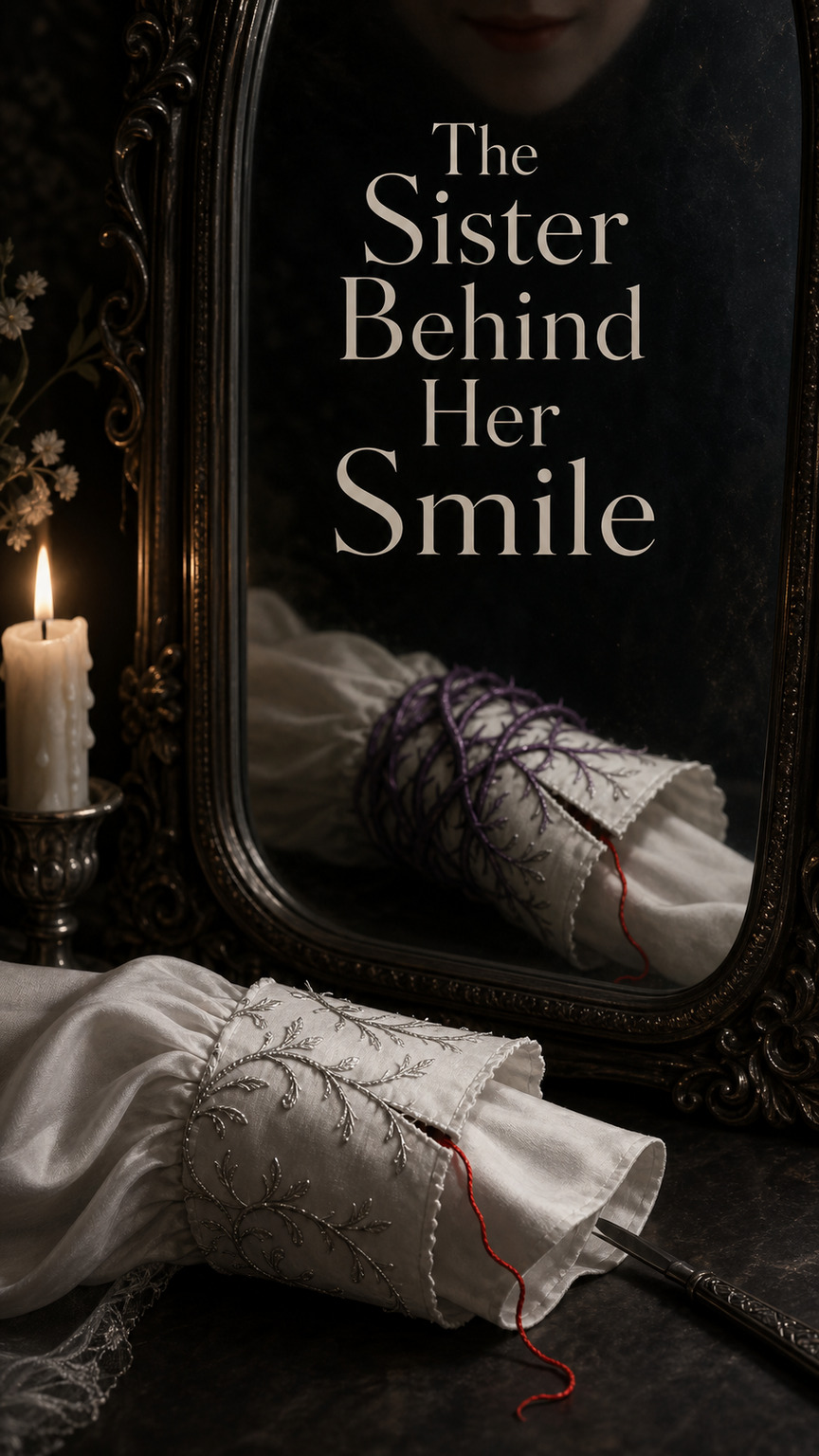
My sister smiled at supper, and every spoon at the table went still.
Lady Odrienne Auvray had many smiles. One meant she had forgiven you and would collect payment after you relaxed. One meant she had arranged a surprise at someone else’s expense. The smallest, which showed no teeth, meant a servant had better remember every word spoken in the room.
This smile was warm. That was new enough to be alarming.
Felisane stood at Odrienne’s shoulder with the sauceboat. She had been on her feet since before sunrise, and the skin beneath her left eye jumped each time the musicians in the western gallery reached the same four-note courtesy phrase.
“My lady,” she said, “the laundress has taken sick. May I leave after the second setting? They need another pair of hands downstairs.”
Ordinarily, Odrienne would have asked whether the laundress had chosen illness specifically to inconvenience her. Once, when a stable boy had requested an afternoon to bury his father, she had sent a wreath large enough for a duke and charged its cost against the boy’s wages. She had wept when I objected, because I had made generosity sound ugly. By the end of that argument I had apologized, the boy had thanked her for the wreath, and no one had mentioned his wages again.
Now Odrienne set down her spoon. The gallery violins rose through the first three notes.
“Of course,” she said on the fourth. “Go now, if you are needed.”
Felisane did not move. “The second setting will do. This sauce curdles if it sits.”
“As you prefer.”
The phrase began again. Four notes; Odrienne’s smile returned exactly on the last.
I had wanted this. Every person under Odrienne’s roof had wanted some version of it. No tears summoned at inconvenient facts. No silk ordered for cousins who had admired hers and then billed to accounts they could not question. No rivalries coaxed between servants so that each hurried to be the first to report what another had broken. During the past six days, bells had stopped ringing after midnight. Kitchen trays no longer came back because the pears leaned the wrong way. Doors had quit closing softly ahead of her.
It should have felt like a house released from weather.
At my first court address, I had forgotten every sentence I meant to say. Odrienne knocked an inkpot over her own gold skirt and gave the room something better to stare at. She charged me for the silk the next morning. I loved her. This did not make her easier.
“The violas are muddy,” Odrienne said.
The nearest player stiffened behind the gallery rail.
Then my sister added, “Not you. The room is swallowing your lower notes. Move the screen two feet left and try again.”
The player blinked. “Yes, my lady. Two feet.”
Precision instead of humiliation. I almost laughed from relief.
Odrienne turned to me. “Camet, our aunt admired Mother’s lap harp last winter, didn’t she? Please have it sent with her trunks tomorrow.”
My hand tightened around my glass. When we were children, Odrienne had bitten me hard enough to bleed because I touched one of the harp’s ivory pegs. She did not play it. She kept it under a dust sheet and checked the lock herself.
“You won’t lend me the blue guest room for three nights,” I said.
“Certainly.”
“You haven’t heard why.”
“I’m sure your reason is good.”
The four notes ended. Her answer landed with them, neat as a place card.
I leaned across the table. “I’m housing six petitioners from the canal quarter. Two have children. They will bring their boots, their papers, and possibly fleas.”
Odrienne’s fingers pressed the white cloth. Her smile never shifted.
“Certainly,” she said again.
In the tall mirror behind her, the silver embroidery on her right cuff darkened from pearl to bruised violet. On her wrist itself, the thread remained white.
I looked from cuff to reflection. The color vanished.
“Camet?” she asked.
“Nothing.”
Her eyes held mine a fraction too long. Then she tapped one fingernail twice against her water glass, paused, and tapped once more.
It was the rhythm we had used as children when our tutor planted himself between us in the schoolroom: two quick, one slow. Follow when you can.
The musicians began their courtesy phrase again.
Odrienne smiled.
Felisane found me beside the warming closet, where I had been pretending to inspect plate covers for nearly a quarter of an hour.
“The small ones go on the pudding dishes,” she said. “If you are going to hide in service corridors, learn the cupboards.”
“I wasn’t hiding.”
“Then you were putting fish covers on pudding, which is worse.”
She balanced a stack of napkins against one hip. Felisane did not sound like Odrienne, even now. My sister’s old barbs came wrapped in lace; Felisane used the edge she needed and then returned to work.
“Has she threatened anyone this week?” I asked.
“No.”
“Bought anyone’s loyalty?”
“No.”
“Had you followed?”
“Not that I caught. Hold those.”
She loaded the napkins into my arms and checked the warming closet with two fingers. “Too hot. Tell the footman to open the vent.”
“You tell him.”
“I’m leaving after second setting. Remember?”
“Right.”
She shut the door. I followed her down the narrow passage, still carrying the napkins.
“So she has improved.”
Felisane stopped. “She didn’t say the collar pin scratched her this morning. I found blood on the lining. She hasn’t chosen tea since last Thursday. She agrees to every tray before the lid comes off. Yesterday I asked whether to open the north shutters, and she said yes. Then I asked whether to keep them closed, and she said yes to that too.”
The kitchen door swung open. A scullion backed through with a bucket, and Felisane pulled me aside before I became part of the washing-up.
“Fewer people are frightened,” she said when the door had shut. “That matters. It doesn’t make this right.”
“You think she’s planning something.”
“I think she has stopped warning me when I stick her with pins. Planning would be familiar.”
Six days earlier Odrienne had dismissed a chambermaid for stealing a ribbon. The ribbon had never been stolen. My sister had hidden it in a cousin’s sleeve to make another cousin jealous, then let the maid take the blame when the game turned clumsy. Odrienne had confessed only after the carriage carried the girl beyond the gates. She spent that evening snapping at everyone who called the act cruel, then tore up six attempts at an apology and called each one cowardly.
The next morning, kindness had arrived like a new uniform.
“Where is she now?” I asked.
Felisane took the napkins back. “Dressing room. And if you mean to accuse her of anything, wait until I have taken the good pins out.”
Odrienne stood before three mirrors while another gown lay open across the couch. She had changed out of supper silk into a white morning dress, though dawn was hours away. Silver vines climbed the cuffs and crossed above her heart in a loop so fine it looked painted on.
Felisane reached for a sleeve button. Odrienne stepped away.
“Leave us,” my sister said.
The gallery music drifted through two walls. Four soft notes.
“No,” Felisane said. “That shoulder seam is open.”
“It can wait.”
“It cannot. You tore it reaching behind the mirror.”
Odrienne went still.
I placed myself where I could see both her sleeve and its reflection. “Is supper over?”
“Yes.”
Nothing changed.
“Is the west gallery beyond this wall?”
“Approximately.”
The reflected vine stayed pearl-white.
“Do you want Mother’s harp sent away?”
“It would please our aunt.”
The reflection tightened. Violet gathered at the silver leaves, one knot after another, while the thread on her real sleeve did not move.
Odrienne looked at me in the mirror. Her face was calm. Her breathing was not.
“Would you rather keep it?” I asked.
“Whatever is most generous.”
The knots pulled higher.
“Do you dislike the canal petitioners? Do you want the blue room? Did you mean to dismiss that girl? Are you angry with me?”
Violet crowded into black. Odrienne’s mouth opened, but the gallery reached its fourth note and her jaw closed around a smile.
Felisane caught my sleeve. “Stop making requests.”
“I’m asking questions.”
“To someone who agrees with them. Stop.”
Odrienne knocked twice on the dressing table, then once. Follow.
She turned toward the couch. The reflected vines flashed a thin, hard blue toward the fallen gown; because of my questions, or because of Felisane’s hand on me, or because the music had changed key, I could not know. Color was evidence of pressure, not a vocabulary.
But the rhythm was ours.
Under the gown lay a workbasket. Its contents had been torn apart: ordinary thread, silver skeins, three blunt needles, a card folded into eighths, and a cuff half-unpicked from its sleeve. Felisane lifted it carefully.
“This is gracework,” she said. “Court seamstresses use a few stitches to delay an angry word through a ceremony. Not a whole gown.”
“I improved it,” Odrienne said.
No one had asked her.
The card named impulses a wearer might choose to pause: interruption, appetite, envy, discourtesy. Odrienne had added her own cramped list in the margin. Refusal. Complaint. Preference. Suspicion. Anger. Ungenerous motion. Disappointing speech. The marks filled both sides and continued along the fold.
Below them, the printed directions ended with a warning. A pattern repeated through seven dawn cadences would set around its living anchor. Before binding, the wearer could revoke it by cutting that stitch. The instruction sounded simple until the last line: any impulse already suspended might also delay revocation.
I set the card down. “You did this to yourself.”
The mirrored thread went colorless. A fact, then.
“After the chambermaid,” Felisane said.
Odrienne nodded once.
“You could have brought her back,” I said. “You could have paid what she’s owed. You could have told the house you lied.”
“I will do all of that.”
Perfectly timed. Perfectly reasonable. I hated that part of me loosened at the sound.
“When?”
“Tomorrow.”
Violet flooded the mirror.
“You were trying to take the gown apart,” Felisane said.
Odrienne’s fingers twitched toward the open shoulder seam. Her hand stopped halfway.
“Would you like me to tear it off?” I asked.
She looked relieved before I finished. “If you think it best.”
I seized the silver crossing at her shoulder.
Odrienne struck my wrist away.
The blow surprised all three of us. Then the grace caught up. She folded both hands at her waist, white-faced and smiling.
Felisane put herself between us. “She said no plainly enough.”
“She didn’t say anything.”
“She hit you.”
I rubbed my wrist. My wish to rescue Odrienne had been only another question with the answer supplied.
My sister tapped the table: two quick, one slow. Then four even beats. She pointed toward the gallery wall. Two quick, one slow. Four even beats.
“Follow after the music,” I said.
Her reflection flashed blue.
“That’s not a yes,” Felisane said.
“No. It’s a guess.”
Odrienne picked up the instruction card, turned it over, and pressed one nail beneath a line drawn there in her own ink: mirror chamber, seventh cadence, dawn. Then she left the room.
We followed.
Valsor Palace had been built by people who believed music improved when forced through stone. Copper throats in the walls carried the gallery’s sound into the state rooms, the chapel, and the old mirror chamber at the eastern end. Odrienne had ordered the dawn courtesy played through all of them for a week. At the time, I thought she was punishing the musicians for laughing during rehearsal.
Now the silver leaves on her cuffs leaned toward every grille we passed.
At the last turn, I reached for her again. She pulled away before I touched her. The black knot that appeared in the mirror opposite us might have meant fear, refusal, or only the effort of moving quickly. I kept my hands to myself.
The gallery held nine musicians among music stands and moved screens. The first violin had a bit of chalk tucked behind one ear. A reed player was tightening a frayed binding with his teeth. Three singers bent over a marked score.
“Stop playing,” I said.
The first violin lowered her bow. “We stop at the end of a measure.”
“Stop now.”
The reed player let the binding fall from his mouth. “He means now.”
Silence rushed into the copper grilles.
Odrienne stumbled. Her hand flew to the silver loop above her heart. Then she straightened and pointed at the score.
“Continue,” she said. “The dawn service must be ready.”
“Does she want you to play?” I asked.
The youngest singer looked from me to Odrienne. “She just told us to.”
“That doesn’t answer him,” Felisane said.
“I don’t know what answers him.”
The first violin tapped the score with her bow. “My lady, the fourth entry is still late. Do you want it corrected or not?”
“Yes.”
“That was a poor question,” the reed player muttered.
Odrienne tapped the music stand: two quick, one slow. Follow. Then four even beats, broke the last with her knuckle, and did it again.
“She wants the count broken,” I said.
“Or wants a different tempo,” said the violinist.
“We don’t know,” Felisane said. “But she brought us here and marked the broken beat. Can you make the sound miss itself?”
The musicians looked offended in several different ways.
“I can enter late,” said the young singer.
“You always enter late,” said the violinist. “Tonight it must be on purpose.”
“I can split the reed note,” the player said. “Don’t ask me to hold pitch while she drags the strings under it.”
“I wasn’t going to.”
“You were looking at me.”
Odrienne had already gone.
We found her in the mirror chamber. Moonlight stood in six tall mirrors, each one facing another across a floor inlaid with silver. At the center waited a low chair, a dressing stool, and the seam knife from Odrienne’s workbasket.
She had planned this much. The knife lay an arm’s length from the chair. She sat, placed both hands on her knees, and watched herself on every side.
The first gray of morning touched the windows.
From the walls came the courtesy cadence. One singer entered early, another late. The reed note cracked like ice under a boot. A violin held stubbornly to the written pulse, then lost it when the others pulled away.
Odrienne’s right hand lifted.
The silver vines tightened. Her hand returned to her knee.
“Take the knife,” I said.
Violet stormed through all six reflections.
I had done it again. Turned her action into my command, her struggle into an answer I wanted.
Felisane crouched beside the chair and studied the gown. “The anchor isn’t at the heart. That’s a crossing.”
“The card said a living anchor.”
“Cloth isn’t living. Hold the lamp lower.”
I did. Near Odrienne’s inner wrist, beneath the cuff edge, one silver stitch disappeared through a narrow ribbon laid against her skin. It did not pierce her. It moved with her pulse.
“There,” I said.
Odrienne’s eyes found the stitch in the nearest mirror. She tapped twice with her left hand, once with her thumb. Follow.
Not permission. Not proof. A direction she had chosen before I understood it.
I moved the stool closer without putting the knife in her hand. Felisane caught the gown’s heavy skirt and eased its weight off Odrienne’s arm.
“Not that seam,” she said when I reached down. “You’ll bind her elbow. Lift from the hem.”
“I am lifting.”
“You’re bunching. Give it here.”
The music stumbled. Someone swore through the copper throat. The first violin called, “No, from three. If we lose all the bars, it becomes noise.”
“Noise is useful,” the reed player shouted back.
“Not if no one knows where to break it. From three.”
They began again. Three clean counts. The fourth arrived in pieces.
Odrienne reached. Her fingers stopped above the knife. Her smile appeared in every mirror, gentle and unbearable.
I did not encourage her. Felisane did not ask what she wanted. We held cloth and lamp and waited while the broken cadence came through the walls again.
On the third attempt, Odrienne’s fingers closed around the knife.
She missed the stitch. The blade scraped a bright line across the cuff embroidery. She made a sound low in her throat and tried again.
The sun put a thin red edge along the window frame.
The musicians reached three.
On four, the singer went silent, the reed jumped sharp, and every violin chose a different fraction of the beat.
Odrienne hooked the knife beneath the anchor and pulled.
The silver thread snapped.
All six reflections flared violet, blue, and furious red. Then the colors fell out of them. The embroidered leaves sagged into ordinary thread. Somewhere in the wall, a reed squealed and stopped.
Odrienne’s smile vanished.
“My wrist hurts,” she said.
Felisane let out one breath. “Because you’ve had a ribbon rubbing it raw for six days.”
“Why did no one tell me?”
“I did. Twice. You thanked me and put the cuff back on.”
Odrienne looked at the red skin, then at me. Anger arrived openly, uneven and alive.
“You were pleased,” she said.
I could have denied it. Instead I put the seam knife on the floor where none of us had to hold it.
“At first.”
“At first,” she repeated, uglier.
“I should have asked sooner.”
“You asked constantly. That was the trouble.”
There was too much truth in that for a graceful answer. I sat on the floor beside the stool. Odrienne did not forgive me. Felisane began unfastening the ruined cuff.
Before breakfast, Odrienne dictated three letters.
The first admitted that the chambermaid had not stolen the ribbon. The second ordered her wages paid through the end of the season whether she returned or not. In the third, Odrienne requested that all dismissals from the past year be brought to the household comptroller for review.
“Two years,” Felisane said, sorting the gown’s silver thread into a bowl so no strand touched Odrienne again.
Odrienne’s pen stopped. “One.”
“The pastry cook lost his place fourteen months ago because your sugared violets were damp.”
“They were damp.”
“He didn’t make them.”
Odrienne blotted a furious dot onto the page. “Two years.”
She offered Felisane a sapphire clasp as thanks. Felisane refused it.
“It is worth more than a year’s wages,” Odrienne said.
“That is why I’m refusing. Pay the people you owe. And someone besides you should hear complaints.”
“You?”
“No. I have a laundress to help and would like to remain a maid instead of becoming your conscience.”
Odrienne winced. Not magically. She pushed the clasp back into its box.
The plain cuff Felisane made for her had one loose red stitch where the anchor had been. No silver, no mirror-thread, no force in it at all. Odrienne could have thrown the dress away. She chose to wear the damaged sleeve to breakfast.
The servants brought pears, bread, and three kinds of preserve. Odrienne looked at each dish before speaking.
“Tea, please,” she told the footman. “Not the spiced one.”
He poured. She tasted it, frowned, and passed the pear preserve to me.
“I hate this,” she said. Then, after no music and no measured pause, she added, “Thank you.”
The footman carried on with the tray. Felisane left for the laundry. Odrienne reached across me for the blackberry jar without asking, knocked my spoon into my lap, and told me the blue guest room could have three petitioners but not six unless I found another chamber pot.
I wiped tea from my knee while she buttered her bread.
The red stitch at her wrist held because it was only thread.