The Sky Remembers Us
"The Sky Remembers Us" maybe the connecting is may both ways; like something that can't be fixed from our side alone.
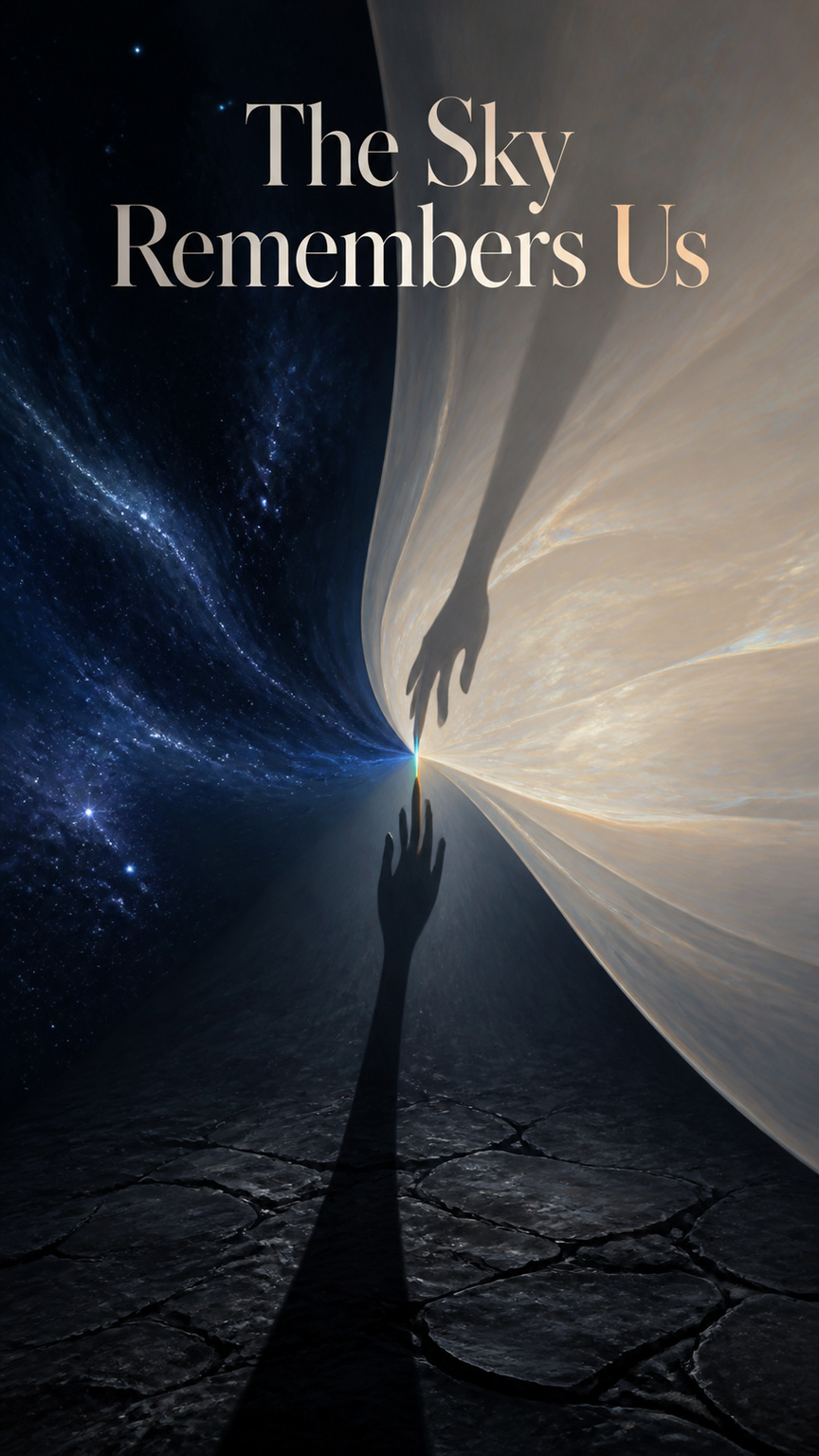
Seyathi learned the weight of her own arm while she was falling.
It was an ordinary weight. That was the obscenity of it. Her shoulder pulled against its socket; blood ran from her palm to her wrist because the world had remembered which way down was. Around her, the Ithrom Array came apart in black ribs and white-hot bolts. The shattered junction had once joined six immensities. Now not one spark hid in the wreckage. Not one dead circuit dreamed. Grace did not gather beneath Seyathi’s skin, or in her name, or in the mouths of anyone who might still have worshipped her.
Faris had made his last account exact.
No more magic.
He fell below her, turning slowly among pieces of the Array. His face appeared, vanished behind a spinning plate, appeared again. Seyathi wanted to strike him. She wanted him to see what he had done. She wanted, with a fury too mortal to sort into its separate hungers, not to die alone beside the person who had betrayed everything in order to end it.
She reached.
Faris saw. For an instant he only watched her hand come through the glare. Then his own arm lifted. Perhaps he meant to take it. Perhaps he meant to apologize, or prevent one last collision, or merely meet the final fact with another human fact. Whatever he meant remained inside him. Their fingertips stayed a hand’s breadth apart as the wreck turned between them.
They struck the earth. They died. Nothing rose from them.
But light had already touched their faces and their reaching hands. Light required no spell. It left Ithrom at the oldest speed there was, carrying surfaces, angles, the red of blood, the distance between two sets of fingers. It carried no mind and offered no judgment. It could not forgive Faris, restore Seyathi, or tuck one grain of power beneath the ruins for a luckier age.
It went outward.
Stars were born behind it. Stars failed ahead of it. On the world it had left, mountains wore down, continents shouldered into new shapes, languages filled the air and disappeared from it. The crater of Ithrom sank, rose, split, and weathered into a high black plain. Children played in the hollows where impossible engines had once decided the fate of civilizations. They found no magic there.
The light went farther than the name of light.
At last it met a sky that was not space.
Keshen woke with someone else’s fall burning above her bed.
Her realm had no stars. Its people lived along inward folds, where a ceiling might become a road if two living minds agreed on the turn, and a doorway could bring a beloved room near when the people on both sides welcomed the visit. Every person cast several shadows, one for each direction in which they might willingly be approached. The pale reach overhead was not a roof and not an emptiness. It was the limit beyond which their magic found no living answer.
Now two strangers tumbled across that limit.
Keshen flung herself upright. One of the hanging sleep-cloths wrapped her ankle, and she hit the floor on both palms. The image above her did not react. A dark-haired figure reached down. Another reached up. Wreckage revolved soundlessly between them.
“Don’t,” said her oldest friend from the next sleeping hollow.
Keshen glanced back. “They’re falling.”
“They have been falling since before your grandmother’s grandmother learned to turn a corner. Look at the light.”
“That is not an argument.”
“It is if you know anything about light.”
Keshen did not, particularly. She knew distance. She knew the small courtesy by which a path asked both its ends before becoming short. She knew how to feel for a living presence through six folded rooms and how to stop at the first recoil. She knew that the sky had never answered anyone.
The falling woman looked directly at her.
Keshen reached.
She gathered the living brightness from her muscles and laid it against the boundary, trying to bring the stranger one arm-length nearer. The force returned at once. Her room lurched. The doorway flattened to a shining line; the next hollow bulged close enough for her friend’s startled face to press out of empty air. One of Keshen’s three shadows tore loose from her heels and climbed the wall without her.
The falling figures remained where they were.
Keshen released the reach. Distance slammed back. She tasted blood.
Her friend crawled through the restored doorway and took Keshen by the chin, turning her face toward the ordinary light that grew from their living walls. “How many fingers?”
“On which hand?”
“Good. Annoying is good.”
Above them, the ancient wreckage turned. But beyond the two falling people, behind layers of darkness the old light had never contained, another face appeared.
Alive. Round-cheeked, wide-eyed, hair whipping in a wind Keshen could not feel.
The stranger stared back.
“You promised we were only looking,” Miraq said.
Dalo kept one hand on the broken pillar and leaned farther over the drop. “We are looking.”
“Your knees are past the edge.”
“My eyes are attached to them.”
“That is worse, Dalo. That makes the whole arrangement worse.”
The wind worried at their coats and pushed grit over the black plain. By daylight the footprint of the Ithrom Array was nothing but fused gullies, half-buried arches, and stone that rang dully under a hammer. No one had ever found so much as a warm patch among it. Tonight, however, a brightness hung over the deepest chasm, too broad for a star and too still for a fire in the upper air.
Dalo had dragged Miraq three days from home to see it. She had said there would be a trail. There had not been a trail for the last half-day. She had said the climb was easy. The sole of Miraq’s left boot was tied on with Dalo’s scarf. She had also said, repeatedly, that the old family tale put the returning light directly above Ithrom’s northern edge.
On that point, infuriatingly, she had been right.
Within the brightness, two people fell forever through a storm of metal.
Miraq stopped complaining.
Dalo knew the figures. Not their faces, not truly, but the reach between them. Their grandmother had called it the sky’s memory and drawn it in stove ash while winter rattled the shutters: the mortal goddess and the person who ended all magic, falling from the broken place after the six great powers went dark. She had always put the hands closer together than this. A story-teller’s mercy.
“Faris,” Dalo whispered. “And Seyathi.”
“Or two people who look like the story because the story came from this.”
“Could you wait one breath before correcting me?”
“I did. You used it to name dead people in the sky.”
The image widened. Behind the fall lay something with no proper depth: pale surfaces curving inward, doorways suspended on different planes, living lights moving like slow breath. A woman knelt there with blood beneath her nose. She had one hand raised.
Dalo raised hers.
Nothing happened. The wind did not change. The black stones did not wake. No force gathered in her arm. She was as magicless as every person born since Faris’s last words, and the dead earth beneath her was empty all the way down.
The woman beyond the brightness moved her fingers.
Dalo waved.
The woman folded both arms across her chest.
“I think you offended her,” Miraq said.
“With a wave?”
“You have more range than you know.”
Dalo tried pointing to herself, then to the woman. The stranger touched her own chest and made a shape with both hands, drawing them apart, then together. The air above the crater stretched. For one sickening instant, Dalo saw the stranger’s hand near enough to show pale scars across the knuckles, while the woman’s face receded to the size of a moon.
Then the whole vision snapped small. On the far side, one of the woman’s shadows had climbed away from her body. She staggered after it and caught herself against the living wall.
Dalo’s excitement went cold.
“She did that,” Miraq said.
“I saw.”
“It hurt her.”
“I saw.”
“You say that in the same voice you use when you’re about to touch something.”
Dalo lowered her hand. “I am not about to touch the sky.”
Miraq looked pointedly at her knees, still over the edge.
She edged back.
Across the impossible distance, the stranger sat with another person beside her. They argued. Dalo could hear no sound, but the second person jabbed a finger at the loose shadow, then at the sky, then mimed lying down with such fierce exaggeration that Miraq barked a laugh.
The seated woman saw him. Her mouth opened. Her shoulders shook.
The loose shadow stopped climbing.
“Well,” Dalo said. “Your medical value is established.”
“My what?”
“You made her laugh.”
“I was laughing at her friend.”
“Try explaining that with your hands.”
Miraq put both of his in his pockets.
By the time the first rim of dawn should have appeared, night covered half the world and the strange brightness covered all of its sky.
Dalo could not see the change happen. One moment the vision belonged only above Ithrom’s chasm; the next it lay along every horizon. Far-off peaks wore Keshen’s pale realm as a second, misfitted outline. The falling figures multiplied in the curve overhead, each image delayed by a fraction, as if the ancient light had struck a surface and broken across it.
Nothing magical happened below.
A pebble Dalo tossed remained a pebble. The cut on Miraq’s thumb remained open. When Dalo whispered one of their grandmother’s supposed words of Grace, Miraq’s hair did not even stir.
“Please never do that again,” he said.
“I was testing.”
“You were hissing at my head.”
Across the brightness, the stranger’s friend brought a basin and wiped the blood from her face. The basin tipped when distance shifted under it, and bright drops went skittering sideways along the wall. Dalo winced. The stranger noticed.
She pointed at Dalo, then held up an open palm: stop.
Dalo nodded.
The stranger touched two fingers to her own eyes, pointed at Dalo again, and waited.
“She wants you to do something,” Dalo said.
“That is why she pointed at you.”
“Maybe you should come over here so she can point more accurately.”
“No.”
Dalo copied the gesture: eyes, stranger, wait. The stranger nodded so hard that the remaining shadows bobbed.
For a while they only looked.
The ancient image kept falling between them. Dalo watched Seyathi’s arm extend. Watched Faris begin to answer. The shattered ribs of Ithrom passed in front of their faces, exactly as their grandmother had never drawn them. There was no peace in Seyathi’s expression. No revelation in Faris’s. The moment was uglier and smaller than legend, which made its scale unbearable. Two people had ended an age. Then they had wanted something from each other too late to say it.
Dalo crawled to the edge again.
“No,” Miraq said.
“I haven’t done anything.”
“You are doing the first half of doing something.”
The vision brought Seyathi’s hand down through Dalo’s own. Their fingers aligned.
For one breath Dalo imagined closing her grip and feeling a wrist. Not an image. The woman herself, yanked out of that fall and into the black plain. Behind her, all the vanished powers pouring home: lights returning to dead cities, old names lifting from stone, the six vast systems unfolding from whatever impossible refuge Faris had failed to destroy.
Her hand closed.
It held wind.
Of course it did.
“Dalo.” Miraq’s anger had gone quiet. That was always worse. “She died.”
“I know.”
“Do you?”
“Don’t.”
“You brought me here because the sky might show the end. You did not say you meant to argue with it.”
Dalo turned on him. “I didn’t know what it would show.”
“You never know. You jump, and then you call it trust because I’m the one who has to catch up.”
“You didn’t have to come.”
Miraq flinched as if she had struck the old bruise exactly. Dalo heard the sentence after it had left her, heard all the other things it carried: every cliff path, every abandoned promise to be careful, every time she had mistaken his following for agreement.
He sat on the fused stone and began tightening the scarf around his boot. “Right.”
“Miraq.”
“You wanted me to trust you without asking. Very efficient.”
“That’s not what I meant.”
“I know. You usually mean three better things after the bad one.”
Across the brightness, the stranger watched them. Dalo wished fiercely that there were at least one sky in which her mistakes were private.
The stranger lifted an open hand toward Miraq.
He did not respond.
She waited. When he kept both hands on his boot, she lowered hers.
No reproach. No renewed attempt. The refusal remained a refusal.
That, more than any miracle, made Miraq look up.
Keshen had believed the new faces lived inside the arriving light. It was an embarrassing mistake, made worse by the confidence with which she had explained it.
“Then why can they see us?” she demanded.
Her friend pressed both palms to the floor, asking their sleeping fold to hold steady. “Because you struck the boundary hard enough to make it show both sides.”
“So I was partly right.”
“You tried to rescue a picture.”
“A very convincing picture.”
Above them, the quick woman and the careful man had stopped arguing. The man worked at something around his foot. The woman watched him and did not touch him. Keshen could not hear their voices, but their faces required no translation.
The dead pair fell through the image again.
Keshen had first taken their reaching for a request. Now she saw the failure inside it. The one above wanted at least three incompatible things. The one below answered too late. Their light was not a message, yet it had carried the shape of unfinished contact farther than either life had gone.
Behind Keshen, people gathered along the neighboring folds. Some reached at once. Their living force pressed into the sky beside hers and recoiled. Doorways shifted. A family two hollows away found its floor briefly standing upright; laughter turned to shrieks as sleeping mats slid into a wall. Someone shouted that the strangers had cursed them. Someone else shouted that Keshen had. Both claims felt unfair, although the second had evidence.
“Stop pulling,” she called. “It does not answer force.”
“You pulled first,” a voice called back.
“Yes. I have improved since then.”
Her friend snorted. “Since moments ago.”
More hands lowered. Not all. One reach struck the boundary in a burst of yellow, and Keshen’s missing shadow ripped another body-length away. She cried out. The quick woman on the other side sprang forward, raising both hands as if she could catch it.
Her concern was useless. It was also unmistakable.
Keshen held up one palm. Wait.
She did not flood the boundary with more images. She did not show the strangers how a welcomed path curved, or how living walls brightened around a returned traveler, or how her three shadows had once fitted her feet. Instead she sat through the pain and let the sky contain only what ordinary light revealed: her breathing, her friend’s arm braced behind her, the gathered people choosing whether to risk another reach.
On the far side, the quick woman sat too.
The careful man glanced at her, suspicious of the sudden good sense.
Keshen liked him immediately.
The sky stayed bright through the day that never quite arrived.
People far from Ithrom saw it. Dalo knew this not because any messenger came, but because the brightness began to hold other faces from her own world. A shepherd stood among long-backed animals on a red slope, one hand shielding her eyes. Three children crowded a roof in a city whose towers shone with sheets of polished stone. In a forest, an old man climbed halfway out of his night shelter and decided, visibly, that halfway was enough.
Between them appeared inhabitants of the inward realm: faces, limbs, wings, bodies that used directions differently. Some looked almost like Dalo. Some did not. One vast living shape opened its eyes across a quarter of the eastern sky, saw the people below scream and scatter, and shut them again with what looked remarkably like hurt feelings.
Nobody gained magic.
They gained the sight of possible partners and no language for choosing among them.
Dalo tried pictures. She scratched two figures into the dust, one on either side of a line, their hands meeting over it. The stranger peered down, then scratched on her own floor. Because of the bent image, her line appeared to pass through one figure’s neck.
“That’s bleak,” Miraq said.
Dalo wiped hers out. “Do better.”
He drew two circles and put a hand inside each. Then he added arrows pointing both ways.
The stranger studied it. She drew a third arrow upward and a fourth into a direction Dalo’s eyes could not follow. Her friend said something. The stranger erased all the arrows with her forearm and made an obscene-looking gesture at the diagram.
Miraq laughed despite himself. Dalo bumped her shoulder gently into his. He did not move away, but he did not bump back.
“I’m sorry,” she said.
“Which better thing did you mean?”
There were several. None would repair the first sentence. “I wanted you here. I made that your problem.”
He worried a loose end of the scarf. “I wanted you not to need this so badly.”
“I do need it.”
“I know. That’s the bad part.”
“And the other part?”
“I came.”
Miraq retied the knot and left his shoulder touching hers.
The stranger had turned away to answer someone in her crowd. A small person reached past her toward the sky. Keshen caught the arm but did not hold it down; she pressed the little hand to its owner’s chest, then touched the floor, then opened her own palm toward Dalo.
Here, Dalo thought. I am here. You are there.
Not a rescue. Not a pull.
She put her left hand flat against the black stone.
The stranger stilled.
Then she placed one hand against the living surface beneath her. Her remaining shadows drew close. With her other hand she reached upward, palm open.
Dalo did the same.
Nothing happened.
Miraq let out a breath through his nose. “Good.”
“Good?”
“You didn’t explode.”
“Your faith is moving.”
“It has put on its boot.”
The stranger said something Dalo could not hear. Her friend answered. They began arguing again without changing the position of their hands. The stranger’s mouth moved faster; the friend flicked her ear. The stranger lost the argument, whatever it was, and turned back with an expression of immense irritation.
Dalo grinned at her.
The stranger rolled her eyes.
They remained that way as the old fall crossed between them: one hand declaring where each lived, the other offered without force. Dalo’s shoulder began to ache. Sweat crawled down her back despite the wind. The stranger trembled. Neither knew what the other was promising. They only knew what they were not doing.
Not dragging. Not commanding. Not pretending the dead were waiting to be retrieved.
The ancient image passed. Seyathi’s fingers reached toward Faris’s. The space between them aligned with the space between Dalo’s palm and Keshen’s.
Dalo felt the stranger’s uncertainty as a change in balance, the sensation of standing beside a step that might become a wall. Keshen felt Dalo’s weight arrive through her grounded hand, not pressure but fact: one body held to one world by gravity, breakable and choosing.
Each recoiled.
The contact vanished before it existed.
“Did you feel that?” Dalo shouted, though shouting was useless.
The stranger clutched her offered hand to her chest. She nodded. Then she shook her head. Then she nodded once, cautiously.
Miraq leaned forward. “What happened?”
“She was there. Not where. There isn’t a where for it.” Dalo heard herself accelerating and forced the words apart. “I felt how she stands.”
“That is a terrible explanation.”
“Do you want a better lie?”
He went quiet.
Across the sky, Keshen examined Dalo’s planted hand, her bent elbow, the edge behind her. She moved farther from her own drop. Dalo understood the rebuke and shifted back from the chasm.
Miraq noticed. “Oh, she tells you once.”
“Her version had visual aids.”
“Her version was my version with more sky.”
The stranger opened her palm again.
Dalo did not look at Seyathi this time. She looked at the living woman: the blood dried beneath her nose, the runaway shadow stretching behind her, the friend crouched close enough to intervene and choosing not to. A person who had made a dangerous mistake, been laughed at, and returned without pretending she had meant to do it.
Dalo set her hand to the earth and answered.
The new thing began between them. It did not descend through the light. Nothing woke beneath Ithrom. The old wreck stayed dead. The six extinguished systems did not stir in grave or memory. Where two living reaches met across a boundary neither could cross, an answering pressure formed, no older than the touch making it.
Cold drew a line through Dalo’s offered palm. Heat answered in Keshen’s. Dalo’s shadow turned and pointed into the sky. Keshen’s missing shadow stopped, shuddered, and pointed toward the black plain. The air over Ithrom gained an inside face. For the first time, Keshen’s realm held a true faraway: not a fold that could be coaxed near, but another existence continuing without her.
The link struck both of them.
Dalo fell to one knee as every direction in Keshen’s body rushed through her bones. Keshen cried out when gravity seized her for the first time, pulling her toward the hand she had planted. The living surface under her dimmed in a ring; the dead stones around Dalo shone with colors that belonged to no buried mechanism.
Dalo tried to break away.
Her hand would not lower.
Panic shot through her. The link had taken her choice. She yanked harder, and pain tore across Keshen’s face.
Keshen understood first. She flattened her offered palm and then slowly folded one finger.
Dalo felt the pressure ease around that finger only.
“Together,” she gasped.
Miraq caught her shoulders. “What?”
“I can’t stop it alone. She can’t change it alone.”
“That is not better.”
“No.”
Keshen folded another finger. Dalo matched her. The link narrowed. When Dalo opened her little finger without warning, nothing happened until Keshen, frowning, opened hers. Brightness ran through both skies.
Not a trap, then. A shared action with a shared danger.
Dalo began laughing. It came out half a sob.
Miraq’s grip tightened. “Don’t make that sound.”
“Which sound?”
“The one before you decide pain is proof you should continue.”
Dalo looked up at him. The world pulled at her bones in impossible directions. Wonder crowded her lungs, huge and selfish. She wanted to widen the link until the whole sky opened. She wanted to be the person who brought magic back.
There it was: the old leap, dressed for legend.
“I want to keep going,” she said.
“I know.”
“I’m asking.”
Miraq stared at her. His fear did not become approval simply because she had named it. Across the link, Keshen waited, fingers trembling, neither advancing nor withdrawing.
At last Miraq moved his hands from Dalo’s shoulders. For a terrible instant she thought he would walk away.
Instead he placed one shaking palm over the hand she had grounded on Ithrom’s stone. He was not giving permission. He was entering the risk.
The contact changed. Dalo felt Miraq’s memory of every time he had chased her: not a tidy sequence, but the stitch in his side, the fury, the ridiculous red sock she had lost on a roof when they were nine, the sight of her once hanging by both hands and still insisting she had everything under control. Underneath all of it lay the request he could not say without hating how small it sounded.
Stay where I can reach you.
The link carried no words, yet Keshen felt the shape of it. Her expression softened, then pinched with a private recognition. She reached behind without looking. Her friend took her grounded wrist.
Four living choices altered the light.
The ancient fall moved through them once more. Seyathi and Faris did not turn their heads. They did not join. The gap between their fingers remained. But around that preserved failure, the two skies opened to each other.
Dalo saw Keshen’s realm not as an image laid across her own, but from within its impossible direction. Keshen saw stars: actual suns strewn through distance, terrible in their separation. Miraq felt a far-side stranger’s hand steady Keshen’s wrist. The friend felt the battered scarf holding Miraq’s boot together and, despite everything, laughed.
Keshen tapped her own chest. “Keshen,” she said.
The sound could not cross, but its shape arrived as a turn, a held place, a person indicating herself.
Dalo tapped hers. “Dalo.”
Miraq pointed to himself. “Miraq.”
Keshen tried the movements of his name. In Dalo’s bones, they felt like a room approaching sideways.
“She got it wrong,” Dalo said.
“Good,” Miraq said. “Now I trust her.”
The first link could not carry the world.
Dalo tried. When the joined sky widened above Ithrom, she flung her offered hand open and willed the new possibility toward every face she could see. Nothing obeyed. Pain speared Keshen’s palm. On the far side, Keshen attempted a great turning motion, trying to bring all the inward folds close to the boundary. Dalo’s knees lifted from the earth; Miraq shouted; Keshen stopped before the crater could lose its down.
They glared at each other across existence.
Miraq, still gripping Dalo’s grounded hand, started to laugh.
“What?” Dalo demanded.
“You finally met yourself.”
Keshen could not hear him, but she saw where he looked. She pointed at Dalo, pointed at herself, and made two fingers collide.
Her friend laughed so hard that one of her shadows folded in half.
Dalo would have objected if the joined sky had not begun to change.
Their link had sent out no reservoir of power. It sent evidence: four people holding an impossible relation and surviving it, badly. Across the physical world, those who watched could see the one gesture that mattered. Across the inward realm, Keshen’s people could feel that the dead boundary now contained living choices beyond it.
Others answered, though never everyone.
On the red slope, the shepherd lifted one weathered hand toward a far-side being whose long body rested across three folded surfaces. The being responded too quickly. The shepherd stumbled as her flock’s shadows leaped upright around her, and the far-side being recoiled when hundreds of small, warm weights landed across its skin. Both lowered their hands. They watched each other. The shepherd then sat on the ground. The being arranged its body along one surface. This time their reaches met gently.
Every animal on the slope gave a different note, not through mouth or bell but through the angle of its shadow. In Keshen’s realm, those notes became distances. The long being moved through them, laughing, while the shepherd’s flock stared upward with the grave suspicion of animals presented with a new fact.
On the city roof, the boldest child thrust both hands into the sky. Three far-side children copied him. The first attempt flung all four children’s footprints above their heads. The second turned their laughter into colored weight: red thumped to the floor, blue hung at shoulder height, gold rolled under the physical-world child’s bare feet and sent him sprawling. His friends laughed harder. Across the boundary, one far-side child hoarded a lump of purple laughter until it burst against her chin.
Their parents arrived. Two dragged children away. One parent looked at the far-side adults doing exactly the same thing and, after a long moment, offered a mortified wave. A new link flickered into being. The roof’s polished stones grew soft enough to hold footprints; a hard, flat landing appeared in the inward realm where no surface had been before. Neither change resembled any old magic.
In the forest, the old man climbed fully out of his shelter. A figure above him extended a branchlike limb. He considered it, shook his head, and went back inside. The figure withdrew.
Nothing punished either refusal. The patch of sky above the trees remained dark until, much later, two night-flying creatures met each other’s attention there. One flew beneath stars, the other along a vertical fold. Their shared reach bent both routes. For seven breaths, each flock crossed the shape of the other’s flight without entering the other’s realm, and seeds from living trees rose after them in spirals. Where the seeds fell, they did not awaken old power. They grew toward a sky that now had more than one direction.
On a white plain under noon, a woman with dust cracked into the lines of her hands met an inward-realm elder whose body carried light in slow pulses. They could not agree on a gesture. The woman pointed. The elder turned away. The elder pulsed blue; the woman mistook it for invitation and stepped forward, then stopped at the alarm in the other’s light. For an hour they achieved nothing except attention.
Then the woman took off one shoe and showed the hole in it.
The elder showed a torn walking membrane. Their laughter was silent to each other but obvious. They reached.
The plain answered by lifting a single path one hand’s breadth above itself, firm only beneath the woman’s next step. In the inward realm, distance stopped folding beneath the elder and began unrolling at the exact pace of the woman’s walk. Each had to continue for the other. When the woman tired, the elder waited. When the elder’s light dimmed, the woman sat. At last she lowered one hand; the elder understood and lowered its limb, and only then did the path settle.
Across a chain of dark mountains, people came out of caves and houses to see strangers inhabiting the sky. Some prayed. Nothing answered prayer alone. Some issued commands. The sky ignored them. Some tried to seize the new brightness in glass, metal, words, blood, or stone. The captured light was only light. It dimmed when covered and brightened when uncovered and held no power after the living participants turned away.
But when a frightened singer on a ridge offered one unfinished note and a many-throated far-side listener chose to answer, the echo gained hands. It pressed loose stones back from a family scrambling below. In Keshen’s realm, the same echo held apart two folds that had begun to crush together after too many reckless reaches. The singer lost her voice for the rest of the night. The listener lost all but one of its harmonies. Neither had known the price. Both could feel the other’s shock. Together they released the note before it took more.
The saved family climbed. The folds eased. The singer and listener remained facing each other in shaken silence, the link still possible and not owed.
Magic returned that way: not from a single source, not as a buried inheritance, not as six old powers reconsidering their deaths. It originated again and again wherever living beings on both sides made room for a consequence neither could own alone.
The physical world changed under it. Cliffs acquired paths that existed only in the pace of far-side walkers. Songs held weight while distant listeners bore their silence. In one valley, every lie told within sight of a willing counterpart took visible shape and followed its speaker around until both participants agreed to look away; by sunset the place was full of ridiculous, sulking animals made of color. Elsewhere, a dying, wakeful tree stirred its last branch toward a living lattice-being. The tree’s leaves opened as doors for insects, while the lattice-being grew rings that marked seasons its realm had never possessed.
Keshen’s realm changed too. True distances appeared, distances no single will could fold. Stars cast thin shadows across living walls. Weight arrived in pockets, startling sleepers from their beds and making children demand to experience falling again. Some welcomed the new faraway. Some hated it. Some looked at the physical world’s vast empty reaches and withdrew from the boundary, unwilling to let that loneliness into their homes.
Their refusal shaped the awakening as surely as consent. Blank spaces remained across both skies.
At Ithrom, dawn finally found an edge of the world.
Its light came under the joined brightness and turned the black plain bronze. Dalo’s arm shook so badly that her palm slapped against the air. Keshen looked no better. Her missing shadow had returned to her feet, but it now pointed the wrong way, toward Dalo’s sunrise. Dalo’s own shadow climbed a short distance up nothing and lay across Keshen’s floor.
Miraq still held her grounded hand. His fingers had gone numb.
“We should stop,” Dalo said.
He blinked at her. “You said that.”
“Don’t ruin it.”
“I’m trying to remember the date.”
Across the link, Keshen had reached the same conclusion. She folded one finger. Dalo folded hers. Together, haltingly, they narrowed their contact until the pressure left Dalo’s bones and gravity released Keshen’s body. The mutual view remained, dimmer but not gone. It would not close from one side. It would not widen from one side. Their hands lowered at the same time.
Dalo lay on her back.
The old image crossed the sky once more. Faris and Seyathi fell through the ruined Array. Their hands failed to meet. The light passed on.
Miraq lay beside her, shoulder against hers. “Did we fix it?”
“No,” Dalo said.
“Good.”
“Some things are different.”
“That wasn’t my question.”
“I know.”
She turned her head. “I won’t ask you to follow next time.”
Miraq watched a family of colored lies chase each other across a distant valley in the sky. “You can ask.”
Dalo waited.
“I can say no,” he added.
“You probably will.”
“Often.”
Their shoulders stayed touching.
Above them, Keshen sat with her oldest friend and stared into a distance that could no longer be folded away. Dalo raised two fingers in farewell. Keshen tried the gesture, got it backward, and corrected herself only after her friend shoved her hand around.
Then another pair of hands appeared beyond her. And another beyond Dalo.
The joined skies carried their choices outward in both directions: from the world of dead Ithrom into the living folds, from the living folds across the world that had survived its perfect emptiness. New reaches sparked above mountains, rooms, roads, nests, forests, towers, and bare ground. Some failed. Some broke off. Some found an answering life and changed both places at once.
By the time sunrise filled the crater, there were too many hands to count, and still more lifting from both sides.