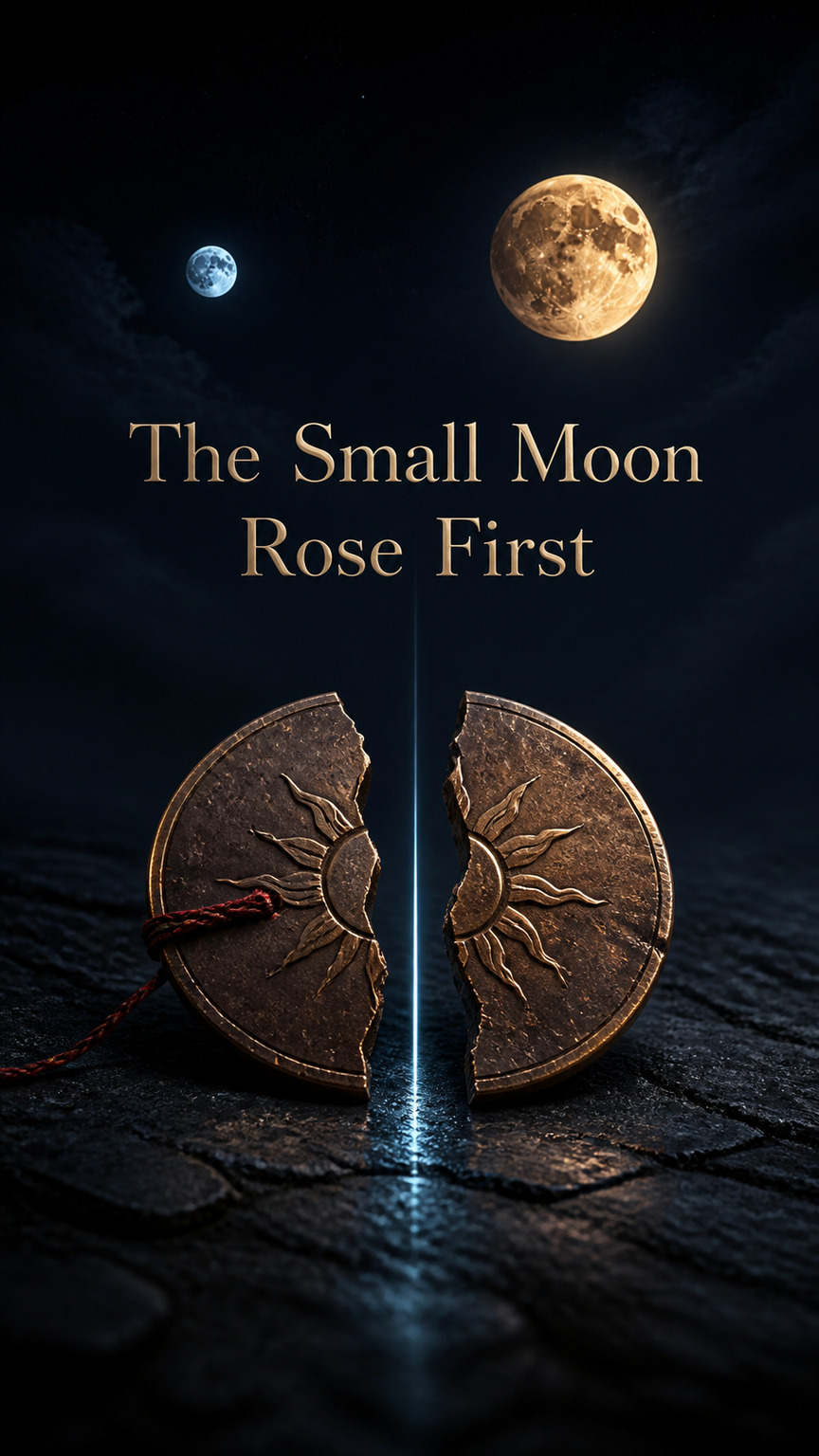
The Small Moon Rose First
You and your best friend survived 617 days in another realm before you severed the portal home. You return to discover that, on Earth, your friend will not disappear for another four months—and when nobody believes he was ever real, one shared memory becomes your only chance to find each other again: the small moon rose first.
Day 617
Nell cut the six hundred seventeenth notch into her belt while the Glass Gate cracked above her.
The knife skipped. A new white line opened across the old leather, crooked but countable. Behind her, the last living resistance fighters kept their palms against the copper rails. Their breath came in ragged chorus. The rails carried the magic they gave into the panes, and the glass shaped it into a doorway full of winter stars.
It was not enough. A black thread ran from the shattered ledger room, through the arch, and around Bash’s left shoulder. Words crawled inside it: fragments of given names, family names, homes spoken by frightened mouths. Somewhere beyond the fallen stone, the Hollow Regent was still alive and pulling.
“Five seconds,” Bash said. He had one hand in the light and the other locked around Nell’s wrist. “I can hold the return path.”
“You said that five seconds ago.”
“Those were experimental seconds.”
Even now, he could make annoyance elbow past terror. He was the brother Ravel had assigned her without paperwork, younger by a year and older by several disasters.
At the foot of the hill, Saint screamed and tried to bite the blue sparks off his own bridle. Tavra dragged the gray mule toward the trees. Her free hand was lifted in farewell.
Trenn should have been there to shout at them. One word, then stop, the road guide had taught them. Give the Regent’s people one piece of yourself and make them spend blood finding the rest. But Trenn lay behind the broken primary ledger, and the copper gaming token he had left them was split into two rough crescents. One cut Nell’s palm. The other shone between Bash’s fingers.
The black thread tightened. Bash’s shoulder jerked toward the arch.
“It’s using you as a road,” Nell said.
“I know.”
“Then let go.”
“Absolutely not.”
The small blue moon cleared the ridge. Eleven minutes before the large gold one, exactly as Bash had once made her stay awake all night to prove.
That blue light touched the Gate. Nell felt her own remembered departure sharpen inside the charged glass: freezer air, a red hoodie, her mother’s hand slipping from hers. Bash’s living memory burned beside it, private and different. They had never told each other the dates. In Ravel, dates could become handles too.
The Regent’s thread reached the skin below Bash’s ear.
Nell had rehearsed the severance line until the Gate Cant lived under her tongue. It could cut a path. It could not aim a traveler, choose a time, or put a broken road back together.
She made the choice anyway.
“Living road, release the held path!”
Her breath supplied the final living push. The Cant shaped it through the resistance’s stored charge. The bright path between their hands snapped.
Bash’s fingers slid from her wrist. Nell caught skin, then his half-token, then nothing.
“I’m right behind you,” he shouted.
The glass-light folded around her before she could decide whether to believe him.
February 18
Nell hit a freezer door hard enough to make every pizza behind it jump.
Someone screamed. A shopping basket overturned. Frost smoked around Nell’s red sleeves, and an untied sneaker skidded in a crushed bag of peas.
Her body was thirteen again. The Gate had returned the narrow shoulders and too-short jeans of her departure, but it had kept the pale ash-hound tracks around her calf and the shiny ridge across her palm. Her tally belt hung twice around her waist. The copper crescent was still clenched in her fist.
Celia seized both her arms.
“Nell? Nell, where did you go?”
Her mother was wearing the same worried expression, holding the same carton of eggs. The freezer clock had advanced eleven seconds.
At the hospital, staff photographed scars that had healed months before they appeared. They found old fractures, calluses, and a body half-starved by a place no scan could locate. They found no trace of Bash.
The calendar still said February 18.
The supermarket cameras made the eleven seconds worse. Nell watched herself stand beside Celia in one frame, reaching for a freezer handle. In the next, the aisle was empty except for her falling basket. Eleven seconds later she struck the glass from the wrong direction, wearing the same clothes around a body that had learned too many new ways to flinch.
There was no flare, no second silhouette, no shadow shaped like a Gate. The footage proved that something had happened and refused to prove the part that mattered.
That first week, Nell slept beneath the kitchen table because it had three solid sides. She woke with her hand curled around a knife that was no longer on her belt. Celia started announcing herself before entering rooms. Neither of them called this improvement.
Celia believed that Nell had vanished. She believed the injuries and the panic when a metal cart squealed like a Drosswall arrow. Believing in Sebastian was harder.
They searched anyway. Sebastian, twelve years old. Boston, perhaps Cambridge. Cello lessons. Latin good enough to insult a customs priest in two dead declensions. No surname. No exact home. No date on which he had disappeared.
Celia phoned missing-child lines while Nell searched recital programs, school newsletters, and photographs of youth orchestras. Every dark-haired boy holding a cello stopped her breath. Every wrong face started it again. She found three Sebastians in Cambridge and nine around Boston. One played violin. One was six. One had moved away before Nell ever touched the freezer door.
There was no matching missing-child report. There was no boy with the right crooked little finger. There were only thousands of Sebastians and an increasingly gentle series of questions about whether Bash might have been someone Nell invented to survive.
On the fourth night, Nell laid her copper crescent beside the belt with its 617 cuts.
Dead was possible. Invented was not.
Missing, she decided, and opened Celia’s laptop.
She made the post anonymous. She gave it no photograph and no real location. For the title she used a sentence that would mean nothing to a search engine and everything to one infuriating boy.
The Small Moon Rose First.
The Facts Strangers Can Steal
For three weeks, nobody answered. In the fourth, everybody did.
Nell had posted too much at first: two moons, a place called Ravel, the Glass Gate, a gray mule, the glass arrows at Drosswall, Marn’s Bridge. She mentioned a boy called Bash who played cello, knew Latin, and had survived 617 days beside her. The details felt useless until strangers copied them back with confidence.
One claimant sent a picture of a copper crescent filed from a plumbing washer. He knew the small moon was blue because Nell had written it. He knew about the arrows because a local reporter had repeated the story under a headline with the word delusion in it.
“What was under Marn’s Bridge?” Nell asked on their video call.
“Treasure,” he said immediately. “The Regent’s treasure. We were going to split it.”
Nell closed the call.
Under Marn’s Bridge there had been thousands of stoppered jars. The glass itself had done nothing. Living clerks serving the Regent had pressed stolen identity-lines into it, and living victims had whispered from the stored magic when Bash and Nell carried the jars into daylight. Treasure did not beg you to remember its children.
The claimant sent six more messages, then a threat.
Trenn’s rule returned with the steadiness of his thumb tapping once against his cup. One word, then stop.
He had taught them to be Nell and Bash on the roads. In the Regent’s bounded system, a given name was one line, a family name another, a recognized home a third. One line let a searcher narrow the hunt. All three let a skilled living user reach deeper.
Nell had watched that reach happen at Willa Corst’s house. A Regent officer laid a living palm on the copper plate beside the door. His magic traveled through the fittings, and the beams recited the record they had been made to store.
“Willa Corst,” the house said in Willa’s own exhausted voice. “The red-doored home above the eastern salt cuts.”
Willa had covered her ears. She had still been Willa after the words were stolen, furious and frightened and entirely herself, but the officer had possessed a road into her life.
Later, Indexer Prax offered Nell a bargain beneath three shelves of silent ledgers.
“His family line and his home,” Prax said. “Give me those, and I will put you through the Gate.”
Prax had living hands, living magic, and the patient smile of someone asking a child to price her brother. The ledgers merely held what people like him fed them.
Nell had refused because she did not know Bash’s missing lines. She would have refused if she had known.
Now she had built a smaller ledger for the entire internet.
Celia found her at two in the morning sorting facts into columns.
PUBLIC: the night Bash insisted they watch the moonrise and won by eleven minutes; the broken roofs at Drosswall; the existence of Trenn’s token.
PRIVATE: the silver button sewn inside Trenn’s collar; the ash-hound scar that bent Bash’s little finger; three taps, a pause, and two for Still alive?; one tap for For now.
PRIVATE: Saint bit the customs priest because Nell fed the mule the tasseled end of Bash’s red scarf to keep him quiet. Saint objected when the priest tried to take it back.
Celia set a mug beside the laptop. “Someone emailed me a picture of our front steps.”
Nell’s fingers stopped.
“I believe something happened to you,” Celia said. “I believe you lost people. I don’t know how to believe every part of it, but I know these strangers are hurting you. Please close the post.”
At the hospital, a doctor had called Bash an organizing figure in an extended trauma narrative. The phrase offered Nell a terrible kind of rest. If Bash was a symptom, she could stop waiting without abandoning him. She would only be getting well.
Then she remembered him in the dark between Drosswall walls, tapping three-pause-two through the stone until her shaking slowed.
Nell deleted every searchable clue from the post. She left the title and a contact form. Anyone who answered would receive a question in private, and the answer would not be something they could steal from her page.
It was less proof. It was also the first protection she had ever built that left Bash a choice about entering it.
June 7
The message arrived at 8:16 in the morning.
Saint bit the customs priest because you fed him my red scarf. Also, the small moon rose first because you were wrong, not because it liked you better.
Nell read it six times. Then she carried the laptop to Celia without taking her eyes off the screen.
Hope was not warm. It was a trapdoor opening under her ribs. Anyone could have watched her old interviews before she deleted them. Anyone could have guessed that a mule bit someone. But no public version mentioned the scarf, or Nell’s part in sacrificing it, or Bash’s three-day sulk over losing it.
They answered through the relay.
Which hand?
Left. Little finger. You set it crooked and blamed the ash-hound.
What did Trenn hide inside his collar?
A silver button he claimed was lucky after it failed to be valuable.
Three. Pause. Two.
One. For now.
Nell’s hands shook so badly Celia had to steady the laptop.
Bash wrote that he had left a cello lesson that morning and vanished for twelve seconds. He returned in the same red scarf, carrying 617 days of scars and one half of a copper token. When he searched the only phrase he thought Nell might have used, he found a post four months old.
He sent a photograph of that morning’s date beside the copper crescent, then appeared live on camera so Celia could see that the bent finger moved when he moved it. He looked younger than Nell remembered and older than any twelve-year-old had permission to look. Behind him, two adults hovered with the rigid helplessness Nell recognized from Celia.
“We never told each other our dates,” Nell typed.
We gave the Gate separate memories. The resistance built the charge around each traveler’s remembered departure. It must have returned each of us to our own anchor.
Not the Regent’s identity lines. Not a rule for every crossing. This one Gate had shaped what their living memories supplied, and their memories had never matched.
Nell had spent four months treating absence as evidence of death. Instead, she had been waiting for a departure that had not happened yet. The thought was so unreasonable it fitted the facts better than anything reasonable had.
They did not exchange surnames. They did not type exact homes into a channel that had already attracted thieves. Celia joined a video call with the frightened adults behind Bash, and the adults arranged the rest.
The children agreed to meet at 30th Street Station.
30th Street Station
Nell recognized Bash by the way he distrusted the building.
He stood beneath the departure board with his back against a stone column. His eyes counted exits before faces. His left shoulder stayed angled away from the crowd, guarding an injury that no longer needed guarding.
He looked twelve.
That was almost worse than seeing a stranger. Ravel had lengthened him, sharpened his cheeks, and put gray in the expression around his eyes. The Gate had restored his departure body and his whole red scarf. It had not restored ignorance.
The scarf’s tasseled end was perfect again. Nell remembered Saint chewing it to wet red threads, and grief rose for the ridiculous missing damage. Bash had been given back the cloth. Neither of them had been given back the person who wore it before Ravel.
Celia stopped several steps behind Nell. Two adults waited on Bash’s side of the concourse. None of them called the children forward.
Bash took out a copper crescent.
Nell held up hers.
The broken edges met. Trenn’s scratched sun became one badly proportioned circle.
Bash raised his left hand. The little finger leaned toward the next one. A pale line crossed his wrist where a Drosswall arrow had glanced from glass and found skin. Nell showed him the matching white hook in her palm.
Still he did not smile.
He tapped three times against the token, waited, then tapped twice.
Nell answered once.
For now.
The distance between them disappeared. Bash hit her like an undersized landslide, arms locked around her shoulders, face jammed against her hoodie. Nell held on until the station stopped tilting.
He smelled of train dust and laundry soap instead of woodsmoke. His shoulder blades were too small beneath her hands. Nell had wanted proof that the boy from Ravel existed; holding him made her understand that both versions did, layered together, and neither canceled the other.
Then he pulled back and said, “Did the path break, or did you cut it?”
She could have lied. He had earned more than evidence.
“I used the severance line.”
His hands dropped. “You let me think the crack took it.”
“I did. I should have corrected you the first time you said it. I was afraid you’d hate me—and that you’d make the Gate our next mission. That was wrong.”
“I needed the truth from you.”
“I know.”
“And I told you I could stabilize it.”
“The Regent was at your neck.”
“I needed five seconds.”
“You had none.”
People rolled suitcases around them. The departure board clicked through ordinary delays. No adult stepped into the space where Ravel stood between the children.
Bash looked toward his family and then away. “Tavra is still there. Saint. Everyone whose jar we opened. If the Gate can be reached again—”
“No.” The word came out in Trenn’s road voice: one piece, then stop.
“You don’t get to make that choice alone too.”
“If I hadn’t cut it, the Regent could have followed your memory straight here.”
“I know what the risk was.”
“Then why are we arguing?”
“Because you decided my risk belonged to you.”
The too found its mark. Nell heard Indexer Prax asking her to make Bash useful. She heard resistance leaders praising children because children could remember a departure with painful clarity. She heard Bash turning survival into the next mission before either of them had learned how to sleep in beds again.
She stepped toward the nearest exit.
Celia’s face tightened, but she stayed where she was. For months Nell had complained that adults never trusted her account. Now her mother trusted her enough not to rescue her from an argument only she could finish.
“Nell.” Bash did not grab her. “I can’t promise I won’t look for a route.”
She stopped.
“I can’t promise I’ll help you,” she said.
“I know.” His voice roughened. “But if one appears, neither of us opens it, enters it, or cuts it without the other knowing. No emergency rule unless there is actually an emergency.”
“There was actually an emergency.”
“Then your decision was right and still hurt me.”
Nell hated that sentence because it left no clean side to stand on.
She came back to the matched token. All her months of searching had been built from what she refused to give. The refusal had kept them safe. It did not have to be the only thing keeping them together.
“Nell Mercado,” she said. “Philadelphia. A narrow brick rowhouse in Frankford, with a blue drainpipe and trains that shake the spoons at night.”
Bash let out a breath.
“Mercado,” he repeated, not taking it, only receiving it.
Then he said, “Sebastian Wren. Cambridge. Second-floor apartment over a violin repair shop, back room, radiator knocks in threes.” His mouth twitched. The fuller version—Sebastian “Bash” Wren—had the stiff absurdity of a school form, but Nell held every part of it.
“Wren,” Nell said.
Nothing flashed. No copper warmed. No hidden system tightened around them. The names rested in ordinary station air because two people had chosen to put them there.
Bash separated the token halves and returned hers.
“No unilateral choices,” Nell said.
“Shared bad decisions only.”
“That is not what I said.”
This time, he smiled.
One Year After Nell Returned
Reunion had not taught either of them to sleep normally.
Bash still chose the floor when a room had only one door. Nell still hid crackers in coat pockets. Their families argued about missed school, train fares, and whether the Gate pack under Bash’s bed counted as preparation or obsession. Joint therapy gave the children better words for some things and no agreement at all about Ravel.
They learned to ask before checking each other’s scars. They learned that a slammed cupboard could ruin an afternoon and that ruining an afternoon did not ruin a week. Bash visited Philadelphia; Nell visited Cambridge. Sometimes they fought about the Gate until one of them missed a train. Sometimes they watched terrible movies and spoke of Ravel only to complain that no modern pizza used enough root pepper.
The two copper halves stayed separate. That was not distrust. It was the shape of the promise.
On the anniversary, they went back to the supermarket.
The automatic doors opened. Nell stopped on the rubber mat.
Freezer air reached her from aisle nine. For an instant she had glass-light in her eyes and Bash’s fingers leaving her wrist. She counted the front doors, the staff door, the fire exit beyond produce, the loading corridor—fast, alone, breath thinning.
The store smelled of floor wax and oranges. A cart wheel knocked in an uneven rhythm. Nobody else noticed that the threshold could become a cliff, which meant nobody else could cross it for her.
Bash waited outside the threshold. He did not touch her.
“Want company?” he asked.
Nell looked at the store map. “You take the back two.”
He counted them. Then he tapped three-pause-two against the cart handle, a question offered instead of demanded.
She answered once.
They went to aisle nine. Bash chose pepperoni. Nell said Ravel root rounds had tasted better, which was untrue and made him accuse her of rewriting history. They argued until Celia told them to put one pizza in the cart or eat crackers for dinner.
Nell chose one. Bash shared the exit count.
They walked out together through ordinary doors.