The Spider's Hunger
In a world where live spiders are worn in neck pouches as the ultimate defense against witchcraft, yours suddenly starts acting strange.
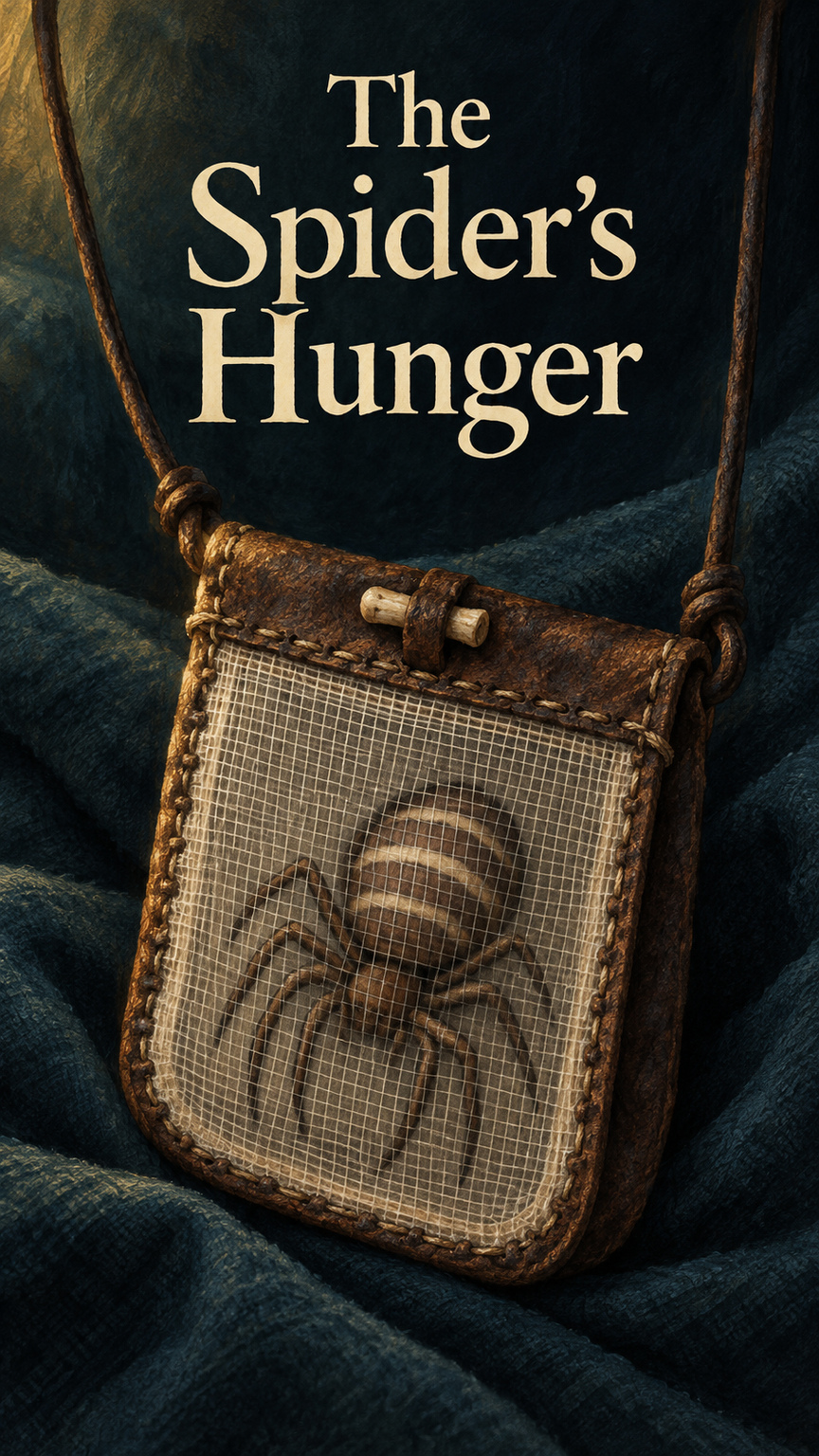
The fly walked over the spider’s back and came out through the feeding hole.
Ivrine caught it under her cup. She had fetched this one from the privy window, where the flies were large and stupid, and she wasn’t fetching another. Through the gauze front of the pouch she could see her spider resting against the leather, legs tucked beneath an abdomen so swollen that its pale stripes had spread apart. Yesterday it had at least turned toward the scratching.
“Still no?” Pelset asked.
She tilted the pouch. One leg unfolded, slowly, then folded again.
“Perhaps it wants butter on them.”
He put a slice of bread beside her elbow. He had buttered it to the edges, which he always accused the inn’s guests of doing, and scraped the black part off the crust. During these three weeks at home he had remembered that she hated burnt bread. She had forgotten he remembered.
“Leave it alone,” he said. “You’ll have it out on the table.”
Ivrine closed the feeding hole with its little bone peg and let the pouch down inside her neckline. The skin beneath it was sore. Usually she shifted it from side to side during the day, following the spider’s irregular pulls on the cord; lately it hung in one place like a stone. She had raised this spider from something scarcely larger than a bread crumb. It had traveled eight years with her, lived through a winter in a damp attic, and once escaped inside a lady’s sleeve while she was fitting the lady for mourning. It couldn’t die the day before her cart came.
“I’ll take it to the poucher.”
“That woman will sell you another.”
“I’ll make her look at mine first.” She lifted the cup and looked at the fly. “This one can go back.”
Pelset opened the kitchen window for her. Cold air carried in the smell of wet harness from the yard. Her trunk stood by the loading door; he had brought it downstairs before she woke. There was a new strap around its middle where the old one had split.
“You needn’t go tomorrow,” he said.
“The cart’s paid for.”
“He could take you next week.”
She let the fly go. It settled immediately on the windowsill.
“I’ve told the woman at the sewing shop I’ll be there tomorrow afternoon. She can’t keep turning other people away.”
Pelset reached past her to shut the window. His arm stayed across it a moment before he went back to the stove.
Their mother’s slippers were still underneath, warming on the bricks. Ivrine had meant to move them every morning since the funeral. Instead she ate her bread while Pelset fried her an egg.
The poucher laid the spider on a piece of dark felt. It tried to climb onto her finger, failed, and crouched where she had put it. Ivrine leaned across the counter.
“Move back a little.” The woman moved the felt out of Ivrine’s shadow. “When did it last eat?”
“A fly? Four days. I’ve tried small ones, too.”
“When did it last eat a working?”
“I don’t know.”
That was what the animal was for. Ivrine bought flies in winter and rubbed the pouch cord with wax where it chafed her neck; in return, she didn’t have to know when somebody in a crowd breathed a working to turn her ankle or make her set down her purse. Schoolchildren wore low collars so their teachers could see whether the pouch gauze was clear. Even the men who went about selling wards wore spiders behind their ward medals.
The poucher touched a fine brush to the animal’s rear foot. It shifted just enough to let the bristles pass.
“Any warming lately? Somebody working on a tooth? A charm for sleep?”
“Not that I know of. I have felt warm here.” Ivrine touched the hollow below her collarbone. “I thought it was the spider.”
“When?”
“At night. Twice. Perhaps more.”
“Put it back on. Against your skin.”
Ivrine held the pouch while the woman coaxed the spider inside with the brush. She settled it beneath her dress.
“May I warm your wrist?”
“If that will tell you.”
The woman took her hand, keeping the wrist bare, and bent close enough for Ivrine to smell the mint she was chewing. Her lips narrowed. She breathed out slowly, paused to draw air through her nose, then breathed again.
Warmth spread beneath Ivrine’s skin. It didn’t feel like a hot cloth. It began inside the wrist and worked outward, an unpleasantly private sensation to have at a shop counter.
The woman straightened. “There.”
“It’s stopped defending me?”
“It’s full.”
She brought another pouch from a drawer. Its thin occupant ran twice around the gauze while she adjusted the cord. There was nothing beautiful about it: one foreleg was crooked, and its abdomen had none of the creamy marks Ivrine knew. The poucher had her lift the old pouch over her dress and put this one against her skin, lower down, then held her wrist again.
The same slow breath. A sharp scramble under Ivrine’s collar. No warmth.
“You felt it feeding?” the woman asked.
Ivrine nodded. The strange spider was still moving.
“Yours has had too much. Not flies. You couldn’t do this with flies.”
“Will it recover?”
“Keep it off your skin, let it rest. By tomorrow it ought to be hunting. Bring it back if it isn’t.”
Ivrine looked down at the familiar pouch lying on her bodice. “Can one person do that to it?”
“One patient person.” The poucher retrieved the felt. “Or a roomful of well-wishers. Have you been ill?”
“My mother died.”
The woman’s brush stopped. “Ah. People do meddle.”
There had been people. They had kissed Ivrine beside the grave and warmed her hands between their own; they had stood close to tell her about their mothers. But that was nine days ago. The spider had been catching flies afterward.
“You can’t say who?” she asked.
“No.”
The woman named the bond for the loan spider. Ivrine paid, then stood aside while a boy brought in a torn pouch and an empty matchbox. He said he had slept with his spider loose because it scratched. His father, waiting at the door, looked exhausted.
Ivrine tucked the loan pouch out of sight. She left her old one over her dress, where it could rest.
At the inn, Pelset was trying to serve dinner and scrub a bedpan. He had set the pan in the yard and a covered dish of turnips on the windowsill above it. As Ivrine came through the gate, a guest was calling for mustard from inside.
“There isn’t any,” Pelset shouted.
“There is,” Ivrine told him. “By the flour.”
“That’s horse-radish.”
She took off her coat and carried the dish through to the dining room. By the time she had found the mustard, fetched bread, and exchanged a spotted knife for a clean one, Pelset was back at the kitchen table. He had put their own plates out beside a pile of bills.
“I need to ask you about her money.”
Ivrine sat down. Their mother had divided her savings into two blue purses while she could still count without losing her place. Pelset had received the inn as well, with its leaking roof and three paying guests. Ivrine’s purse was upstairs under her pillow. She had slept with it there ever since the burial, though the silver made an uncomfortable ridge.
“I thought we had settled that.”
“You told me what you were doing with it.”
She broke a potato with her fork. She knew what the bills were before he touched them.
“Leave me enough for the roof. Just the back slope. I can manage the rest.”
“I need all of it for the shop.”
“You haven’t paid her yet.”
“I’ve agreed.”
He pushed a plate aside to give himself room. It was her mother’s plate, the deep one with the chipped rose. He had put it out with theirs.
“You could agree to come a month later.”
“And where does the money come from in a month?”
He didn’t answer. Water dripped off the dish rack onto the corner of a bill. He moved the bill with two fingers.
“You could sell this place,” she said, although she knew before she finished that she ought not to have said it while eating the dinner he had cooked.
“With her hardly cold?”
“I don’t mean tomorrow.”
He pushed the bills toward her. “There were nights I was up three times with her. I’d put my hand down the bed and find she was wet again, and she’d cry because she couldn’t help me turn her over.”
From the dining room came the scrape of a chair. Pelset stopped and listened until the guest went upstairs.
“You wrote that she was comfortable,” Ivrine said.
“She was. I kept her comfortable.”
Ivrine put down her fork. She had sent money, bought better blankets, written to ask if she should come. None of that gave her anything useful to say about his hand in the bed. Her mother had been clean and warm when she arrived. Pelset had made that appear easy, and Ivrine had let him.
“I should have come sooner.”
He rubbed a patch of dried food on the table with his thumbnail.
“Stay till the end of the week, then. Help me get those two upstairs rooms done.”
She almost agreed. A few days’ work wasn’t half a shop. And he looked so tired; the side of his nose had begun to peel where he kept rubbing it.
“I can finish the curtains this afternoon,” she said. “Before I go.”
Pelset pulled the bills back into a pile.
“What did she say about your spider?”
Ivrine glanced down at the visible pouch. Behind her collar, the borrowed spider climbed the gauze.
“It needs rest.”
“That’s all?”
“She said to leave it alone.”
“Did it eat for her?”
“No.”
He reached to lift the pouch from her chest. He had done it when she was little, checking whether she had cleaned out the husks. This time she caught the cord first.
“You’ll shake it about.”
His fingers remained open for a moment. Then he took his plate to the sink.
She had wanted to tell him what the poucher had done, how the warmth had begun inside her wrist. She watched him washing a plate that still had most of his dinner on it, and kept the visit to herself.
Ivrine worked on the guest-room curtains in her old bedroom. The fabric was faded along the fold where her mother had pinned up the hem, and the stitches came apart as soon as she pulled them. Beneath her collar the strange spider worried at the gauze. She had kept putting a finger to it all afternoon, an unfamiliar habit. Her own spider had usually rested until dusk.
Pelset brought her tea. He set it on the windowsill, leaned over her chair to draw the shutters against the low sun, and asked if she needed the lamp.
“Not yet.”
For a moment his face was close to her neck. She heard air pass between his lips; the hidden pouch jerked. He straightened with a little cough.
She kept sewing. Perhaps he had blown dust off the shutter latch. Perhaps that was all the sound had been.
When he left, she opened the shutters again. Across the yard the carter was finishing a harness repair. She called down to ask when he was leaving.
“First light. You want your trunk on tonight?”
“Yes, please.”
“I’ll fetch it after the wheelwright’s. Might be late.”
She thanked him and pulled the curtains across the open window. There was still an hour of daylight. She could have gone downstairs, put her purse on the table, and asked Pelset to tell her what he wanted so badly that he had begun breathing it against her skin.
She folded the finished curtain over the chair instead.
Her bed stood along the wall beside the door. Ivrine lay down facing the window, her cheek pressed into the pillow, and loosened her hands against the bedspread. The blue purse was beneath her ear. She could feel the edges of the coins through the stuffing.
Downstairs, a pan struck the stove. A guest asked something; Pelset answered. There were footsteps on the stairs and then none. She waited long enough for her shoulder to begin hurting.
The latch lifted.
“Ivrine?”
She let her jaw slacken against the pillow. He came into the room. Through her lashes she saw his knees beside the bed. He lifted the old pouch by its cord and lowered it beneath her neckline, his knuckle brushing her skin. She waited for his fingers to find the other cord, but it lay farther back, hidden beneath her hair.
He bent down. His first breath stirred the little hairs behind her ear. He drew in another through his nose and let it out more slowly. The borrowed spider scrambled toward the leather against her breastbone. No warmth came.
Pelset paused. The bed creaked as he put one hand down beside her head. Again he gathered his breath, holding it so long that she waited for the exhalation with him. When it came, the gauze dragged sharply against her skin.
She wanted to sit up. She wanted to hit his mouth with the back of her hand. Her shoulder had begun to tremble with the effort of leaving that hand on the bedspread.
He made a small dissatisfied noise and stood up, breathing openly now. Ivrine felt the mattress rise as he took his weight off it. The door closed.
She stayed on her side until she heard him in the kitchen. Then she got up and moved the chair beneath the latch.
All those evenings beside the fire: Pelset pulling her shawl straight, Pelset reaching around her for the bellows, Pelset telling her to sit still while he put a cushion behind her head. She couldn’t sort the things he had done for her from the things he had been doing to her. The tea was on the windowsill. She had already drunk half of it.
She held the loan pouch away from her skin by the cord. Its occupant was moving, abdomen still narrow. When she touched the feeding peg, a leg struck the gauze. The poucher’s creature remained hungry.
Ivrine put it back against her breast. She laid her old pouch in an empty sewing basket, propped so air could pass through the front, and knotted the basket shut.
At supper she took her plate into the dining room and ate with the guests. Pelset said nothing, but later he came to her door with the warming pan.
“I’m in bed,” she called.
“Lift the latch.”
“I’m warm enough.”
He tried the door. The chair leg grated on the boards, loud in the small room.
“What’s against it?”
“The chair.”
A long silence. Then he said, “You always did fuss about sleeping here.”
He took the pan downstairs. She sat fully dressed on the bed and listened to the ordinary work of closing the inn. Twice she heard him cough. When the carter came for her trunk, she leaned from the window to make certain it left with him.
Before dawn, the spider in the sewing basket climbed onto the gauze and began picking at a bit of thread. Its abdomen was smaller. Ivrine cried a little at the sight, soundlessly and with great annoyance. She had other things to do with her face before she went downstairs.
She washed, tied her hair over the thin cord of the loan pouch, and put her familiar spider, still in its own pouch, back in the basket. The blue purse went inside her coat. She carried the basket in her left hand.
Pelset was waiting in the kitchen. There was breakfast on the table, bread beside a covered dish. The loading door stood open onto the yard.
“Your driver isn’t ready.”
“I’ll wait outside.”
“Sit down. Eat something.”
She set the basket on the sill beside the door. Her right hand stayed inside her coat, closed around the blue purse. Pelset stepped between her and the yard.
“Leave her money here.”
“I’ve given you my answer.”
“I’ll send it when the roof’s paid for.”
“Move, please.”
His eyes went to her throat. There was no pouch visible now. He caught the opening of her coat. She backed against the table, pulling away from him, and her hand came out with the blue purse clutched in it.
“Put it on the table.”
He drew a breath. She tried to back away, but the table was behind her and his arm was beside her shoulder. His mouth shaped the words again as he let the air out, slowly, toward her face.
Her smallest finger lifted from the purse.
It wasn’t the trembling she had felt upstairs. The finger was being drawn straight. The next began to follow, peeling her grip apart while the rest of her hand strained to close. She caught the purse against her belly with her other hand.
Under her collar something struck, a hard little rush of feet. The drag on her fingers slackened. Pelset inhaled through his nose and leaned closer, cheeks hollowing with the long breath. The spider pulled the pouch sideways. Ivrine’s fingers closed so abruptly that her nails hurt her palm.
She shoved him. He stumbled against the doorpost and caught her sleeve.
“What have you got under there?”
She struck at his hand. Cloth tore at her elbow, but he held on. His face had gone dark and wet around the lips. He was trying to take another breath.
“Trunk’s tied,” the carter called from the yard. “Want a hand with that basket?”
Pelset turned his head. Through the doorway Ivrine saw the carter coming around the wheel, holding out an arm. She seized the basket and thrust it toward him. To keep hold of her, Pelset would have had to follow her out while she was handing another man her luggage.
His fingers opened.
“She’s taking everything with her,” he said to the carter, in the voice he used when a guest broke something and hadn’t yet offered to pay.
“Room enough,” the man said, and put the basket beside the trunk.
Ivrine followed him to the cart. Her knees were shaking so badly that she missed the step. The carter gave her his forearm; she climbed without looking back until she was seated behind him.
Pelset stood in the doorway, his hand on the splintered post. She could still see the cloth laid over her breakfast.
“I’ll need an address,” he called. “For the rest of your things.”
There were no things she needed badly enough.
“I don’t have one yet.”
“You said it was all arranged.”
The carter shook the reins. Ivrine turned to face the road and let the wheels carry her out of the yard before Pelset could make her answer.
Beyond the last houses, she worked the torn sleeve free of her elbow. She could open and close her hand. She did it several times with the blue purse deep in her pocket, feeling each finger move because she wanted it to.
The carter offered her a corner of his blanket. She took it and shifted the basket onto her knees. Inside, her spider was busy with a fly husk caught in the seam. It dropped the husk, climbed the gauze, and waited with its front legs lifted.
Against her skin, the other spider moved. Ivrine turned at once to see who was close enough to breathe on her. There was only the carter, facing forward, and the empty road behind them.