The Star That Followed the Bells
A shepherd finds an injured living starship grazing on an aurora above the summer pastures. It cannot remember its destination, has lost the small satellites it calls its flock, and assumes the shepherd’s bells are an offer to guide it home.
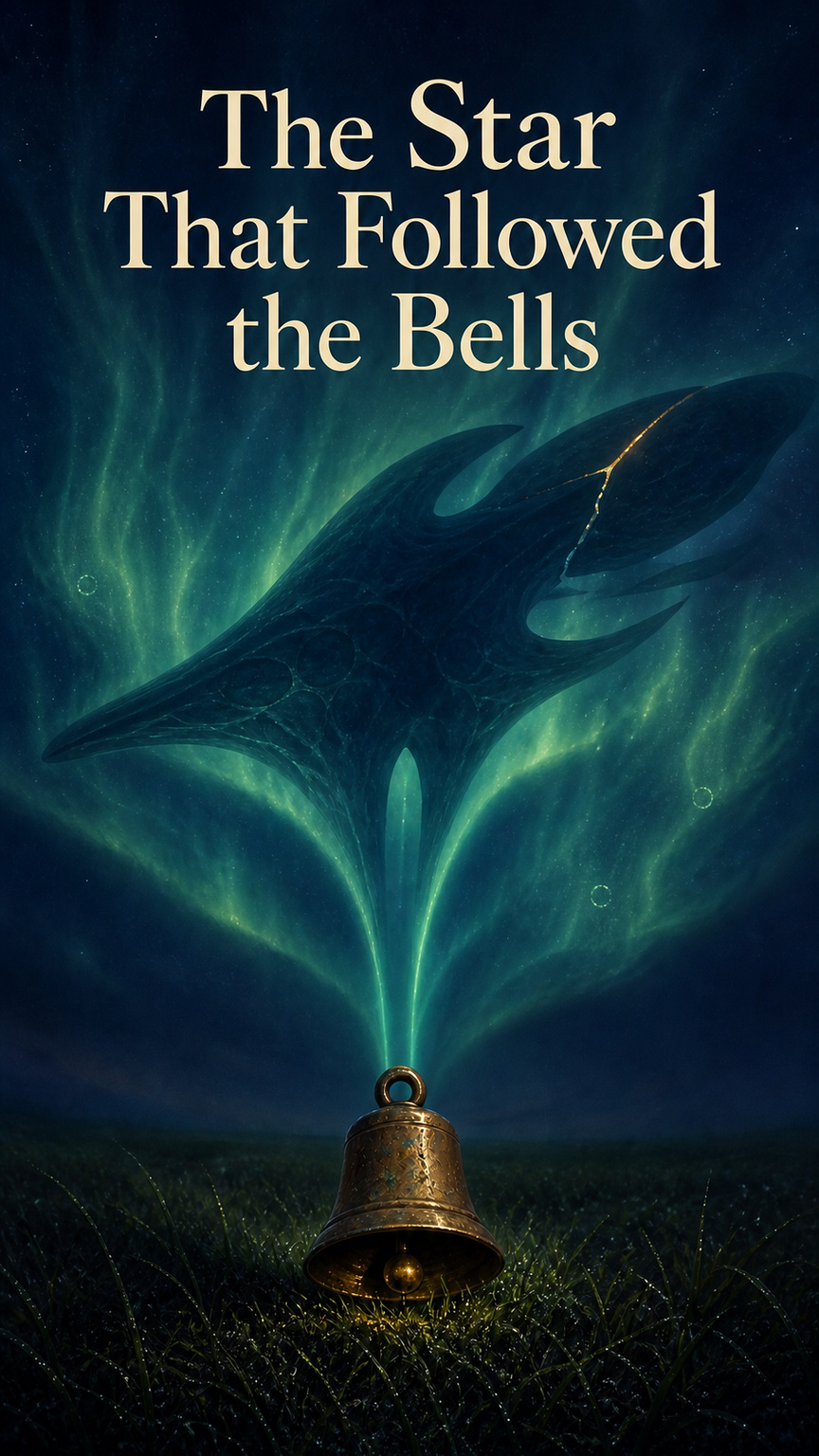
Nali Sern found the lame ewe because its bell kept answering from the wrong side of the count.
Nali had counted eighty-two sheep between the leaning stones above the night pen. The sound should have gone with them: a loose, uneven wash of brass moving downhill through dusk. Instead the eighty-third bell knocked twice from the sedge beyond the upper spring, waited, then knocked again.
Nali closed the tally slate and climbed back for it.
The ewe stood with her left forefoot lifted, chewing as if this were no one’s emergency. Nali felt down the warm leg, found a pebble wedged beside the hoof wall, and worked it free with the point of her knife. No swelling. No blood. She would lead the ewe slowly, check it again at the pen, and still have the flock under stone before the weather came over the north shoulder.
Then all the bells below her stopped.
The sheep had raised their heads toward the sky.
The aurora had sagged low across Ruskala that evening, a green filament combed thin above the summer range. Something vast moved along it. At first Nali mistook the shape for cloud because it had no hard edge. Then the cloud flexed.
Long field vanes opened from a dark central body and gathered the auroral strand between them. Green light flowed along branching channels beneath a translucent hide. The vanes drew together, released, drew together again. Grazing, Nali thought, because she had no better word for the patient taking-in of something that grew no grass and left no bite marks.
One lobe near the body’s rear did not open with the others. Its membrane hung split. Each time the ship rolled, the tear leaked a thread of amber charge that crawled across the air and vanished.
Living. Hurt.
The ewe tugged at Nali’s grip. Her bell struck once.
The ship stopped feeding.
A low pulse crossed the pasture. Metal answered it: Nali’s knife, her belt buckle, every gate pin and bell below. The single bell note came back from the sky stretched into three close harmonics.
Nali lifted her radio. “Mavek. Upper spring. Look north and up.”
Static pressed against her ear. Then Mavek Tural said, “I see light. Is that what you mean?”
“The thing inside it.”
A pause. Mavek was good at not filling a pause merely because it existed.
“I see it,” she said. “Your sheep are at the west wall. Gate’s still open.”
“Close it. Don’t ring the hand bell.”
“Confirm no bell. Closing west.”
The ship pulsed again. This time cold light spread over the grass in front of Nali, a flat projection no wider than a shearing tarp. A dark oval appeared at its center. Three smaller marks circled it, then moved outward until the image could no longer contain them. A line unreeled from the oval into a scatter of white points. Halfway across, the line frayed into blocks and began again from the wrong point.
The ewe’s bell knocked. The projection changed. Tiny points gathered along a second line, copying the bells below as the penned sheep shifted toward the west wall.
The ship’s route line brightened.
“Mavek,” Nali said, “get them off that gate. Slow.”
“They’re already leaning. I’ll bring them south.”
Nali took the ewe’s halter short and started downhill. The other sheep heard her boots in the turf and Mavek’s working call from the pen. They turned. Their bells spread, then drew into a moving corridor toward the south corner.
Above them, the starship turned too.
Its good vanes folded. The wounded lobe lagged, shuddering. The enormous body slid down out of the aurora after the bells.
“Stop moving them,” Nali said.
“They’ll pack the corner.”
“Stop anyway. It’s following.”
Mavek gave the long low call that meant stand. Some sheep obeyed. Others shouldered on, frightened by the green shadow passing over the ground. Their bells kept moving.
The ship descended.
Nali’s radio display, built to show storm height when the range vanished into cloud, caught an echo and printed a wavering number. Eight point one. Seven point eight. Seven point three.
The torn lobe sucked inward.
Amber charge snapped from its edge to the ridge posts. Every bell on the range rang at once.
The flock broke.
Sheep poured through the lower gate before Mavek could reach it. Once outside, they turned uphill, away from the charge striking the west wall, and the track narrowed above the broken slope.
Nali let go of the lame ewe. “Mavek, lower gate. Now.”
“Lower gate, confirm. Where are you?”
“Cutting above them.”
She ran across the slope rather than down it, boots tearing wet roots from the soil. The ship’s pulse filled her belt buckle with a hard insect vibration. Her radio flashed six point nine and lost the echo.
The lead sheep reached the narrow track. Nali flung herself past them, planted her crook against a stone, and spread her coat wide. They checked, crowding. The first animal tried right, saw the drop, and lurched back into the others. Nali gave the sharp turning call once, not loudly, and shoved with her shoulder against a woolly chest.
Below, a gate clanged. Mavek’s voice came breathless through the static. “Lower is shut. Bring them left. Left is clear.”
Nali turned the loose animals one by one until they began to bend. A slow bend became a stream. They passed her downhill, seven bells battering without pattern.
The ship followed the bend.
Its wounded side dipped toward the broken slope. The split ran one bright rib farther. Beneath the translucent surface, branching light contracted unevenly around the opening, the whole side tightening as living hide would around pain.
“No,” she said, though no one could hear the word at that distance. She pulled the spare felt from her pack and caught the lame ewe’s bell. Then she ran downhill, grabbing every lead bell she could reach and stuffing wool or felt around the clappers.
“Muffle them,” she told Mavek. “All you can get.”
“That’s thirty bells.”
“Start with the leaders.”
Mavek did not repeat the number. She climbed onto the wall, caught the first ewe by the neck, and wrapped its bell in her scarf.
Sound went out of the flock in patches. Brass became dull knocks, then small thuds inside cloth. As the last clear bell stopped, the magnetic pressure over the pasture broke off.
The ship held where it was.
Not rose. Not turned. Held.
Nali kept both hands on a restless ewe until the animal’s feet settled. “Leave them muffled. Count from south.”
“I have seventy-six inside.”
“Seven out, including mine.”
“Confirm seven. Weather’s on the shoulder now.”
Nali looked north. Cloud had covered half the aurora. The ship hovered below the remaining green, one side working far harder than the other. Its route projection trembled over the grass, now mixed with the shape of the moving sheep. The central oval and three absent points appeared again. One point flashed nearby, one high, one beyond a curved horizon. All three went dark when the broken route line reached for them.
It had not merely lost a direction. It was calling others with the wrong one.
Nali could not tell it that. She could barely tell Mavek where the loose sheep had gone.
They recovered the seven from the sedge and shut them in the stone pen. Mavek checked the lame ewe while Nali fetched two removable bells from the tack box. The bells were nearly twins, though one had a chipped lip and spoke lower. She carried the low one to the spring and handed the other to Mavek.
“Stand by the north cairn.”
Mavek weighed the bell in her palm. “That puts the flock between us.”
“They’re quiet now. Keep outside the wall.”
“And if it comes lower?”
Nali glanced at the ship’s pinched wound. “Drop the bell. Don’t run with it.”
“Confirm drop, don’t run. That’s poor general advice.”
“For tonight.”
Mavek went.
Nali waited until the pale blur of her coat reached the cairn. She struck the low bell twice, leaving the same space between notes that she used when counting beyond fog. The ship answered in color: two bands of blue crossed its underside, separated by a dark band of equal width. Its magnetic return shook the low bell against Nali’s fingers.
At the cairn, Mavek repeated the two notes.
The ship’s body tilted north.
Nali struck again from the spring. It tilted back toward her.
“It’s choosing the sound’s place,” Mavek said over the radio.
“Maybe. Change the call. Stay where you are.”
“To what?”
“Anything we use.”
Mavek rang the brisk uneven pattern for salt. The penned sheep surged toward the north wall, then stopped in confusion because no trough had appeared. Nali swore under her breath. Ordinary work still applied, even under a wounded piece of sky.
The ship did not turn away from Mavek. Instead the broken route blazed across its projection again. The three absent points lit at its end.
Place mattered. Their meanings did not.
“It thinks every bell says go there,” Nali said.
“Or it can’t hear the calls are different.”
“It copied the difference.”
“Then stop changing calls. One thing at a time.”
Nali almost argued. A gust pushed cold rain across the spring. In the pen the salt-called sheep were crowding Mavek’s side, and the lame ewe had been forced off her careful foot.
“Move them south,” Nali said. “No bells. I’ll watch the ship.”
Mavek gave a quiet working call and went to undo the confusion they had made.
Nali set the bell on the ground. The ship sent a fresh sequence before Mavek reached the wall: central oval, three points, route line; three blue bands; a spill of blocks across every radio channel. Nali’s handset squealed with overlapping tones. The old bells inside their wrappings twitched. It wanted an answer so badly that it left no room for one.
Nali waited.
The projection repeated faster.
She waited longer.
At last the ship’s good vanes opened to catch what remained of the aurora. The signals ceased.
Only then did Nali strike twice. She let the notes die completely. She waited five breaths and struck the same pair again. Then she put both hands flat on the bell and did nothing.
The ship began to answer over her second strike. Nali slapped the bell’s rim once, a cracked interruption, and stopped.
It flooded the radio again.
“Too much,” Mavek said. “I’m losing you.”
“Don’t transmit.”
“Confirm silence.”
“Mavek.”
“Right.”
They gave the ship no signal at all.
Rain stippled the projection. The route blocks ran and broke. A blue band formed, faded, formed again. Then the field went dark and stayed dark for five breaths.
Nali rang twice. Waited. Rang twice. Waited.
The ship returned two blue bands. A full pause. The same two bands again. Another pause.
She did not know whether it had understood a rule, copied restraint, or merely exhausted itself. She answered the completed sequence once more.
They repeated the exchange from the cairn. Then from the spring. On the third trial a muffling slipped from one of the sheep and a bell sounded inside the pen. Nali cut off halfway through. Above, a blue band began, faltered, and vanished. The ship held its position.
“It waited,” Mavek said.
“Again. Same interruption.”
“We can’t make that sheep ring on order.”
The bell sounded again as the ewe scratched its neck against the wall.
“Apparently we can.”
Nali completed nothing. The ship did nothing.
That was the first answer she trusted.
The storm set recovered its echo. Seven point two. The wounded lobe had stopped collapsing, but the ship could not remain there. The cloud was swallowing the last feedable light, and each gust rolled the good side farther than before.
Nali took the low bell uphill to the clear ridge while Mavek remained at the lower cairn. They sent completed pairs only when the ship’s projection showed the local slope. At the cairn, Mavek rang and waited while Nali watched the torn lobe draw inward. On the ridge Nali rang the same sequence; the ship rose a little, the tear easing open rather than pinching shut.
They did it twice more. Lower, the wound darkened. Higher, it held. When Nali offered an incomplete pair toward the clouded north shoulder, the ship waited. When she repeated the full pair from the clear ridge, it laid a green line above that ground and left the deeper white route blank.
Not home. Not destination. Only this way was clear as far as Nali could see.
The ship changed its projection.
The three small points separated around the central oval. The corrupted route line faded. In its place appeared a narrow ring above the world-curve, high enough that the ship’s own image tipped sideways when it entered alone. Three empty places waited along the ring.
The starship sent a low radio harmonic, paused, and repeated it. The call was nothing like the sheep bells now. It had kept their spacing and discarded their sound.
For a long time, nothing answered.
Mavek’s voice came through quietly. “Sheep count is eighty-three. Lame one is bearing weight.”
Nali watched the blank points. “Confirm eighty-three.”
“You coming down?”
“Not yet.”
“Rain will make that ridge slick.”
“I know.”
This time Mavek let the radio rest.
A thin tone touched the lowest edge of the channel. It wavered, stopped before matching the ship, and began again from a different bearing. On the projection, the nearest small point lit. It moved toward the ring but did not take its place.
A second answer arrived high and split cleanly into two frequencies. The high point lit and held well above the first.
The ship brightened too quickly. It sent its ring request over both replies. The nearer tone withdrew. The higher one remained but would not synchronize.
“It talked over them,” Nali said.
“I saw the first leave.”
The starship’s vanes tightened. Its magnetic pulse rattled stones against the low bell.
Nali did not ring back. Neither satellite did either.
The ship went still. Then it sent the low harmonic once, allowed the whole channel to empty, and repeated. It left another full pause.
The near answer returned. The high answer descended by one measured interval. Far to the east, beyond the ridge and below the world-curve on the projection, the third point flickered without sound.
“Three,” Mavek said.
“Not joined yet.”
“Confirm three located. Not joined.”
The ship repeated its request, pause intact. The third answer came as a cluster of delayed clicks that Nali felt first through the bell’s handle. It did not move on the first request. On the second, after the ship preserved every silence, the far point rose toward the ring.
They came in by choice and they did not dock. The nearest satellite showed itself first, a black disk crossing the aurora’s last uncovered seam. The high one descended as a pair of silver surfaces hinged around darkness. The far-side member remained invisible, but its clicks arrived steadily enough to hold its place in the projection.
One by one they took staggered positions around the living ship. Their harmonics met without merging. A field line tightened from the nearest disk to the torn lobe; another braced the good vanes; the delayed third steadied the whole body against the wind. The starship’s wounded side rose.
It projected the green line above Nali’s clear ridge and waited.
Nali rang the completed pair. She paused. She repeated it, confirming only what she had tested: open sky above the ridge, cloud lower to the north, no promise beyond sight.
The ship answered with the same spacing. It did not restore the lost white route.
Supported by its flock, it climbed.
At eight kilometres the torn lobe relaxed. At ten, the amber leakage shortened to a faint seam. Higher, the satellites widened their formation, each holding a different distance. The starship reached the narrow ring it had proposed and turned with them toward the clear eastern sky, not onward to any forgotten star.
Before the aurora closed behind the cloud, four separate harmonics crossed Nali’s radio. They were not bells. They asked her for nothing she could hear.
She listened until the channel emptied.
Then she went down.
At dawn, Mavek had the lame ewe outside the pen and was checking its stride on level ground. Nali counted from the south stones. Eighty-three noses, eighty-three backs, eighty-three sets of feet, with one front left still placed cautiously but placed.
“Weather’s clearing east,” Mavek said.
“It cleared early.”
“For them. Not for us. We’re moving off this strip.”
An amber discharge had scorched a crooked line through the upper grass. Nali marked its ends with stones so no animal would crop there before the next rain had worked through it. They shifted the pen gate, packed the wet felt, and restored each clapper to its bell.
The flock sounded wrong at first. Too loud after a night of waiting. Then the separate notes spread across the slope as the sheep found grass, water, one another, and their ordinary distances.
Nali listened through the first full count. None of the bells came from the sky.